
October 20, 2026
Explore: Style
How Should a Men’s Tank Top Fit? Armholes, Neckline and Length
Armholes pinch, the hem's too long, or it's see-through? Work out if your tank is the wrong size, the wrong cut, or built for a different job.
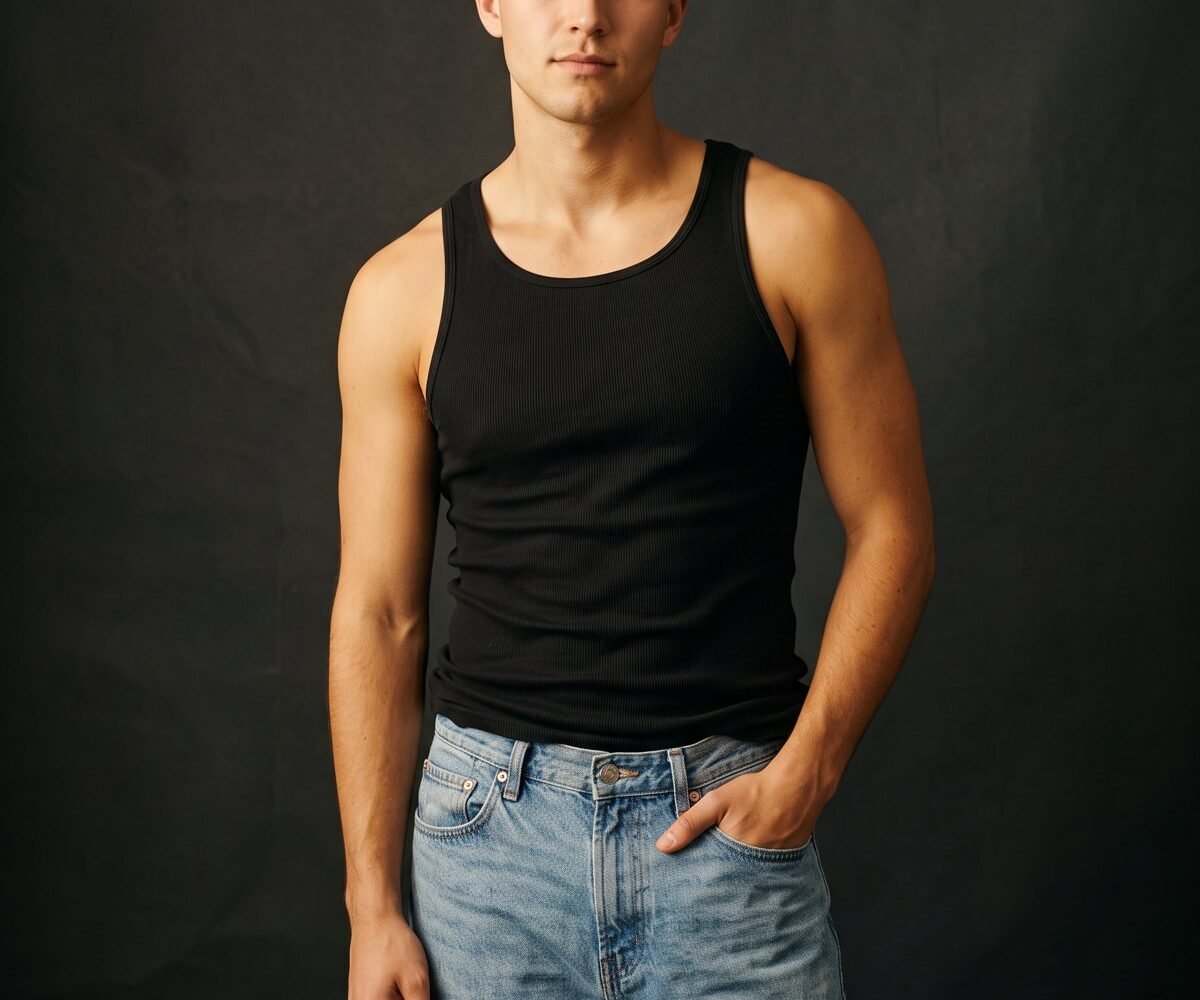
The tank looks fine on the hanger. Then you put it on and the armholes ride up into your arms every time you move. You try the next size, and the armholes calm down, but now the hem is somewhere around your thighs and the whole thing hangs like a sack. Or you finally find one with the right length, and it turns out to be so thin you can read the label through it.
None of that is a verdict on your body. A tank top has fewer parts than a T-shirt, so each part does more of the work: two armholes, a neckline, two straps and a hem decide almost everything. When one of them is wrong, the usual reflex is to change the size, which moves all of them at once. This guide helps you work out whether you have the wrong size, the wrong cut, or a tank built for a different job.
The short answer: a tank top fits when you can move through a normal day without the armholes digging in, the neckline and straps stay where you put them, and the coverage at the sides and chest is the coverage you actually want. How close the body sits and where the hem lands depend on whether the tank is worn on its own or under something else. If one area works and another doesn’t, look for a different cut before reaching for a different size.
Tip: tap any diagram to open it full size.
First, what’s the tank for?
Plenty of tank frustration comes from judging a garment against a job it was never designed for. Before you look at a single seam, decide which of these it’s meant to be.
- Worn on its own. This tank is the outfit. It needs fabric thick enough that you’re happy with what shows through, a hem that works untucked, and armholes and neckline that give you the coverage you’re comfortable with in public.
- Under a shirt. This tank is meant to disappear. It should lie flat, stay tucked if you tuck it, and keep its neckline below the opening of whatever goes on top.
- Visible under an open shirt. A half-way case. The neckline, color and texture become part of the look, so they matter more than they would on a hidden layer.
- Under overalls. The bib, straps and side openings of the overalls interact with the tank. Here you judge the finished outfit, not the tank alone. There’s a short section on this further down.
One shopper on Reddit described the mismatch exactly. He wanted tanks he could wear on their own for summer, but kept finding ones that were “basically undershirts”: very thin, and too long to wear without tucking or covering them. Those tanks weren’t badly made. They were made for something else.
Manufacturers often tell you which job they had in mind. Hanes, for example, describes its ribbed cotton tank undershirt as having a long length “ensuring the hem stays tucked in”. If that’s what you bought, a hem that reaches your thighs untucked is the design working.
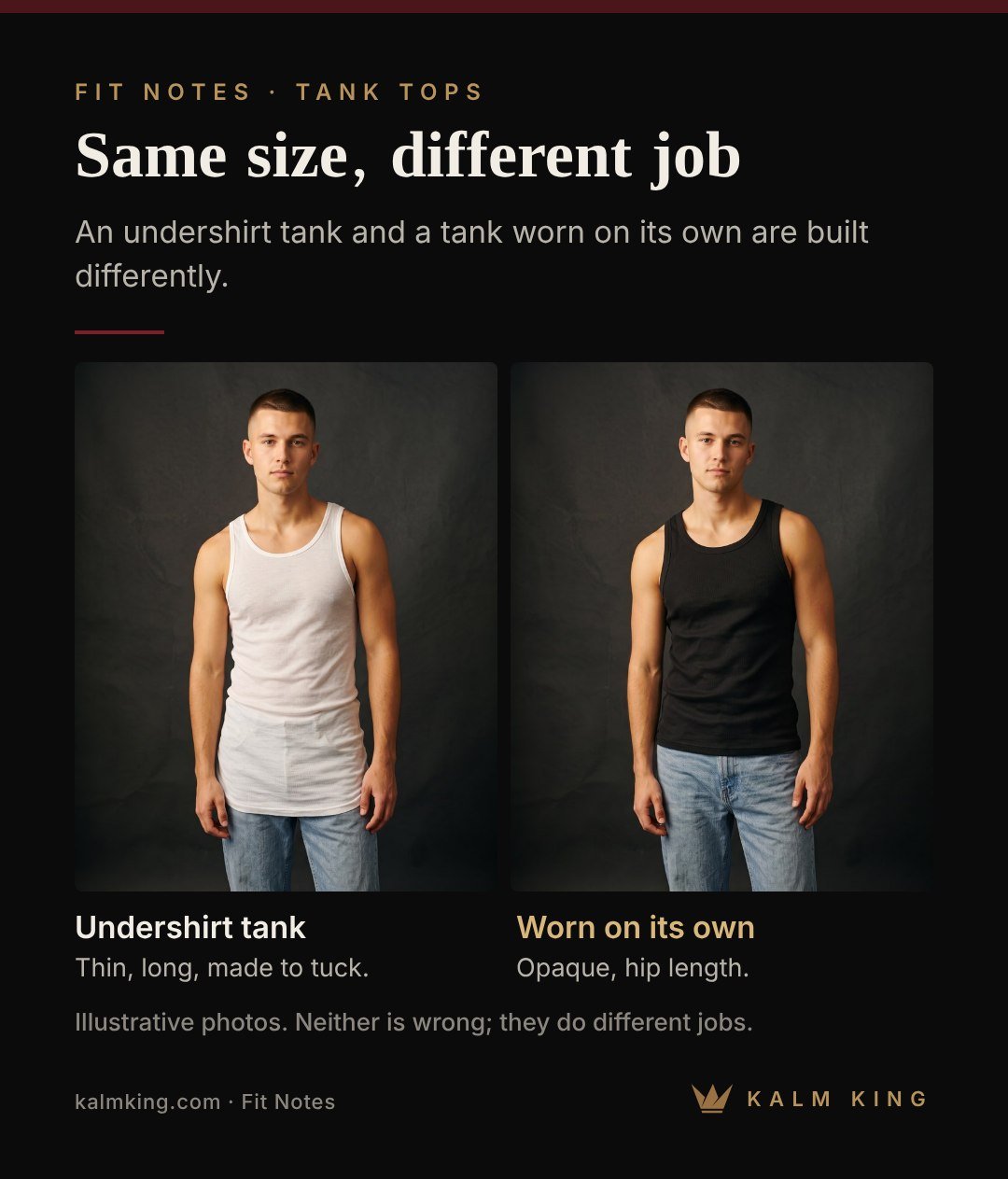
Tank or tee under your shirt?
If you’re choosing an undershirt, know what a tank can and can’t do. It can’t cover an area its fabric doesn’t reach, so it won’t sit between your underarm and your shirt the way a sleeved tee does. Some men like the lighter feel anyway. Others rule tanks out under thinner tops altogether, because the shoulder strap bumps show through. That’s a fair test. Put the top layer on and check the shoulders and the edge of the armhole in a mirror, in daylight.
If underarm coverage is what you’re after, our guide on how a men’s T-shirt should fit covers sleeves and armholes on tees.
The five places a tank fits, or doesn’t
Every tank, whatever its cut, comes down to five zones. Check them in this order, wearing the trousers you’d normally wear with it, from the front and the side.
- Neckline: where the opening sits on your chest and back.
- Straps: how wide they are and where they sit on your shoulders.
- Armholes: how deep they’re cut and whether they rub.
- Torso: how closely the body follows you.
- Hem: where the tank ends, and whether that suits tucked or untucked wear.

Armholes: often the first thing to check
On a T-shirt, the sleeve hides a lot. On a tank, the armhole edge sits right against your body, so a few centimeters of difference in its shape changes both comfort and coverage.
Check three things:
- No digging. Swing your arms, reach forward and lift them overhead. The edge shouldn’t cut into your underarm or ride up onto your arm.
- Side coverage you’re happy with. Look from the side, arms relaxed, then arms raised. How much of your side and chest shows is a choice, and the armhole decides it.
- The edge lies flat. A banded or bound edge should sit against you without flipping outwards or rolling.
The classic problem is armholes that pinch even though the rest of the tank fits. One man with a wide back and broad shoulders described exactly this: on every everyday tank he owned, the arm holes rode up into his arms and felt close to tearing. Sizing up fixed that, but made the tanks too long, boxy and clunky. A commenter asked whether he’d been buying muscle shirts rather than tank tops, since the tanks he owned had wider arm holes and fit comfortably.
That’s the useful lesson. When the chest already has the room you want and only the armholes fail, the next size up adds length and width you didn’t need. Look instead for a different armhole shape: a wider or lower opening, or a cut described as relaxed rather than fitted. A sleeveless tee (often sold as a muscle shirt) usually has a smaller, higher armhole than a tank, which is a fix for some people and the cause of the problem for others.
At the other end, a very deep armhole that opens down the side of your ribs isn’t automatically a size mistake. Stringers and some gym tanks are cut that way deliberately. Decide whether that’s the coverage you want, then buy the cut that gives it to you.

Neckline and straps
The neckline should stay where you want it without being tugged back into place every few minutes. Lean forward as if tying a shoe and check whether it gapes more than you’re comfortable with.
How low is too low is your call. One UNIQLO customer tried a popular ribbed tank and felt the opening sat lower on his chest than he was used to, showing more collarbone and chest than his other tanks. Neither he nor the tank was wrong. Neckline depth varies between patterns, and your build and your other tanks set your expectations.
Under a shirt, the need often reverses. A man who wears tanks as undershirts found the neckline came up so high that the tank showed whenever he undid more than the top button of his shirt. One reply was simply: wear V-neck tanks. If a tank is meant to stay hidden, test it under the shirt you actually wear, buttoned the way you actually wear it.
Straps decide shoulder coverage and how the tank sits:
- Wider straps cover more of the shoulder and often read more casual and less athletic.
- Narrower straps show more shoulder and move the look toward gym or beach wear.
- Either should stay put. If a strap keeps sliding off the edge of your shoulder, or slowly drifts toward your neck, the spacing doesn’t suit your frame.
You’ll see fixed rules about strap width in some style guides. There isn’t one correct width, and none of them requires a particular physique. Pick the coverage you’re comfortable with.
Torso: close, relaxed or oversized
How closely a tank follows your body is a design choice, not a quality grade. Three broad shapes exist:
- Close or fitted. Follows your shape, often in a stretchy rib knit. UNIQLO lists its DRY Color Ribbed Tank as “Fitted”, and Nike describes its N.A.C. ribbed tank as a “tight fit: snug and form-fitting”. On those garments, a close fit is the intended result.
- Relaxed. A little room through the body, so the fabric skims rather than follows. Often the easiest everyday choice.
- Oversized. Deliberately wide, often with deeper armholes and a boxier hang.
What you’re checking for is whether the result looks and feels intended. A close tank that leaves pull lines across your chest or rides up your stomach when you breathe is too small. A relaxed tank that bunches into folds under a shirt may be fine on its own and wrong for layering. And skip blanket advice like “always size down, tanks stretch”. Read the fit description and the garment measurements for the tank in front of you.
How long should a tank top be?
For a tank worn untucked with ordinary trousers or jeans, a hem somewhere around the upper hip is a reasonable place to start. That puts it past your waistband without hanging over your seat. Treat it as a starting point, not a rule: the right length shifts with your torso, the rise of your trousers, and how much shows when you reach up.
Length complaints come from both sides. One man asked for ribbed tanks that aren’t super long, wanting one that ends at the waist where his trousers start, because every tank he found stretched much further down. Meanwhile, undershirt tanks are often made long on purpose so they stay tucked when you sit.
So check length for the way you’ll wear it:
- Untucked: stand naturally, then raise your arms. Some skin showing when you reach is normal. Decide whether the amount bothers you.
- Tucked: sit down, lean forward and reach. If the tank pulls out of your waistband, it’s too short for tucking, whatever the label says.
- Cropped or longline: both exist on purpose. Judge them against the look they’re designed for, not against an everyday tank.
If a tank fits everywhere except length, a tailor can often shorten a plain hem. Lengthening one isn’t really possible, so for a short hem, look for a tall or long-length option in the same width.
The stand, reach and sit check
A mirror shows you a tank at rest. The problems show up when you move. Try this in the fitting room, or at home before you remove the tags.
- Stand and let the tank settle without straightening it. Note where the neckline, straps and hem sit.
- Reach forward and across your body, as if grabbing something from a car seat. Watch the armholes and the side coverage.
- Raise both arms overhead. Do the arm holes dig in? How far does the hem lift?
- Sit and lean forward. Does the neckline gape? Does a tucked hem stay tucked?
- Stand up and see whether everything falls back into place on its own.
You’re not looking for a tank that never moves. You’re looking for one that doesn’t restrict you, doesn’t show more than you intend, and doesn’t need resetting after every movement.

Measure a tank that already works
The easiest way to buy a better tank is to copy one you already like. Lay it flat on a table, smooth it out without stretching, and take three numbers:
- Chest width: straight across, just below the armholes.
- Body length: from the highest point of the shoulder strap, straight down to the hem.
- Armhole depth: measure vertically from the top-of-strap level to the bottom of the armhole, with the tank laid flat. Follow the retailer’s method when comparing. Few brands list this, but it explains a lot when you compare two tanks side by side.
Then compare those numbers with a retailer’s garment measurements, if they publish them. Check how they measure, because some take chest width at a set distance below the armpit. And don’t compare a flat chest width with the circumference of your own chest: one describes the shirt, the other describes you.

Record your numbers on the Fit Card in our Size & Fit Reference.
Fabric changes the fit you see
Two tanks with identical measurements can look completely different on you, because the fabric decides how they hang.
- Ribbed knits stretch and recover, so they tend to follow your body closely. The ridges also add visible texture.
- Smooth jersey usually drapes more softly and looks closer to a sleeveless T-shirt.
- Weight and density decide how much shows through, and whether the fabric holds a shape or clings.
“Ribbed” on its own doesn’t make a tank underwear or outerwear. UNIQLO’s ribbed tank, for instance, is pitched for wearing on its own in hot weather or layering under shirts and jackets when it’s cooler. It also flags that the white color is “slightly sheer depending on lighting and layers”, while its other colors aren’t listed as sheer. That’s a useful habit to borrow: judge opacity color by color. A white tank that’s fine indoors may be see-through in bright sun. Hold it up to a window, or look at it in daylight with a light behind you, before deciding it works on its own.
For care, follow the label. If a tank’s armholes or neckline loosen over time, that’s a change in the garment’s condition rather than proof you bought the wrong size, and no home trick reliably reverses it.

Feeling self-conscious in a tank?
This one comes up a lot, from slim men and bigger men alike: the worry that a tank looks “try-hard” or like you just came from the gym. The useful answer is about the garment, not your body. Thicker straps, smaller armholes and a plain solid color read more like everyday clothing than a deep-cut gym tank with a graphic on it
That matches what fit can actually do. You don’t need to earn a tank with a particular chest or arms. If you want it to feel less like you’ve just come from the gym, change the tank, not yourself:
- Choose more coverage: wider straps, a higher armhole and a higher neckline.
- Choose a little room: a relaxed body that skims rather than clings often feels easier to wear.
- Choose a substantial fabric in a color that isn’t see-through.
- Add a layer: an open shirt or an overshirt turns the tank into part of an outfit, and you can take it off if you get warm.
And if you’d just rather wear a T-shirt, that’s a perfectly good answer too.

A tank under overalls: the quick check
Overalls and a tank can work well together in warm weather, but the overalls change how the tank sits, so test the finished outfit rather than each piece on its own.
- Set the overalls’ straps first, at the length you normally wear them.
- Look at the neckline against the bib. Whether the tank shows above it or not is a styling choice; just make it the one you meant.
- Check the shoulders and back for straps and hardware sitting on bare skin or on the tank’s edge where they could rub.
- Check the side openings, where the tank’s armholes and the overalls’ sides meet.
- Sit and reach. Watch for the tank bunching inside the bib or pulling out at the back.
For choosing the layer itself by season and neckline, see what to wear under overalls. If the overalls’ straps or bib are the part that feels wrong, start with how men’s overalls should fit.

A quick note on names
The same garment goes by several names. In the US and Canada it’s a tank top. A close-fitting, often ribbed version is also called an A-shirt, short for athletic shirt. In the UK, particularly when worn as an undershirt, it’s a vest. In Australia and New Zealand, it’s a singlet. You’ll also still hear an older, uglier nickname. We don’t use it, and you don’t need it to find a good tank.
Quick troubleshooting
| What you notice | Try next | Avoid |
|---|---|---|
| Chest fits, armholes pinch or ride up | A cut with wider or lower armholes, or a relaxed fit in your usual size | Sizing up and gaining length you didn’t want |
| Armholes show more side than you’d like | A higher-cut armhole or a sleeveless tee | Assuming a deep cut means the tank is too big |
| Fits everywhere, hem too long untucked | A tank made for wearing on its own, or a hem alteration | Sizing down and losing room in the armholes |
| Comes untucked when you sit | A longer undershirt-style tank | Pulling it lower and hoping it stays |
| Neckline shows under an open shirt | A lower or V-neck tank | Buttoning up further than you want to |
| Strap bumps show under a tee | A thicker top layer, or a tee as the undershirt | Expecting a tank to vanish under thin fabric |
| Straps slide off your shoulders | A different strap spacing or width | Tightening the fit everywhere else to compensate |
| White version looks see-through | A darker color or denser fabric, checked in daylight | Judging opacity under fitting-room lights |
Quick answers
Is a muscle shirt the same as a tank top?
Not quite. A muscle shirt is usually a T-shirt cut without sleeves, so it usually covers more of the shoulder and has a smaller armhole than a tank with straps. If tank armholes feel too exposed, it’s worth trying one.
Will a tank keep me cooler than a T-shirt?
It might feel airier because more skin is exposed, but there’s no guarantee. Fabric, fit, sun and how much you sweat all play a part, and a tank won’t absorb anything at your underarms because there’s no fabric there.
Can I wear a gym tank as an everyday tank?
Yes, if you’re comfortable with its coverage. Gym tanks are often cut with deeper armholes and a closer fit, so check side coverage and opacity before deciding it’s your everyday tank.
Should I buy a tank one size up so it lasts after washing?
No. You can’t predict how much a particular tank will change, and a bigger size changes the armholes, neckline and length all at once. Buy the size that fits now, follow the care label, and measure again after a few washes if it’s borderline.
I’ve found a cut I like. Should I buy several?
Buy one first. Wear it for a normal day, wash and dry it as the label says, then run the reach and sit checks again. If it still works, you’ve got a reference tank worth measuring, and buying more is a much safer bet.
For more practical fit and style guides, join Kalm King Field Notes. Interested in overalls too? You’ll also get the free Overalls Fit Kit.
FIELD NOTES
Get the Overalls Fit Kit, free.
Your measurement card, the six fit checkpoints and a checklist to take shopping. Join Field Notes for new guides and a say in what Kalm King makes.
THE KALM KING JOURNAL
Continue reading
How Should Men’s Dress Pants Fit? Waist, Rise, Seat and Break
How should dress pants fit? Check the waist, rise, seat, thighs and hem with practical sitting tests, break options and realistic tailoring advice.
How Should a Dress Shirt Fit? A Men’s Guide to Collar, Chest and Sleeves
Check dress shirt fit at the collar, shoulders, chest, sleeves and hem. Learn what to measure, how to test movement and when to try another cut.
Men’s Capsule Wardrobe: How to Build One That Actually Works
A men’s capsule wardrobe is a small set of clothes that all work together. How to choose the pieces, colors and fit, and build one at your own pace.