
November 1, 2026
Explore: Style
How to Keep Your T-Shirt Collar From Stretching (and What to Try When It Has)
How to keep a t-shirt collar from stretching: what makes necks sag, gentler wash and dry habits, a store test for collars, and fixes worth trying.

A tee can have a great fabric, a clean shoulder and the right length, and still look tired the moment the neck starts to wave. That wavy, stretched look is often called a “bacon collar” or “bacon neck,” because the band ripples like a strip of bacon. If you’ve been searching how to keep a t-shirt collar from stretching, the good news is that most of the answer is in your hands: how the collar is built, how you wash and dry it, how you store it and how you pull it over your head. This guide walks through each one, shows you a simple test to run before you buy, and covers what you can try when a collar has already gone.
Short answer: Buy tees with a firm rib collar that snaps back flat when you stretch it a little, and look for binding or tape around the neck. Follow the care label and avoid unnecessary tumbling, and let tees finish drying flat or hung from the body, not the neck. Fold tees or use a padded hanger slid in from the hem, and pull shirts on and off by the body instead of the collar. If the care label permits steam, a gentle reshape may help temporary distortion, but no fix is guaranteed and worn-out rib won’t be restored.
What Is a Bacon Collar?
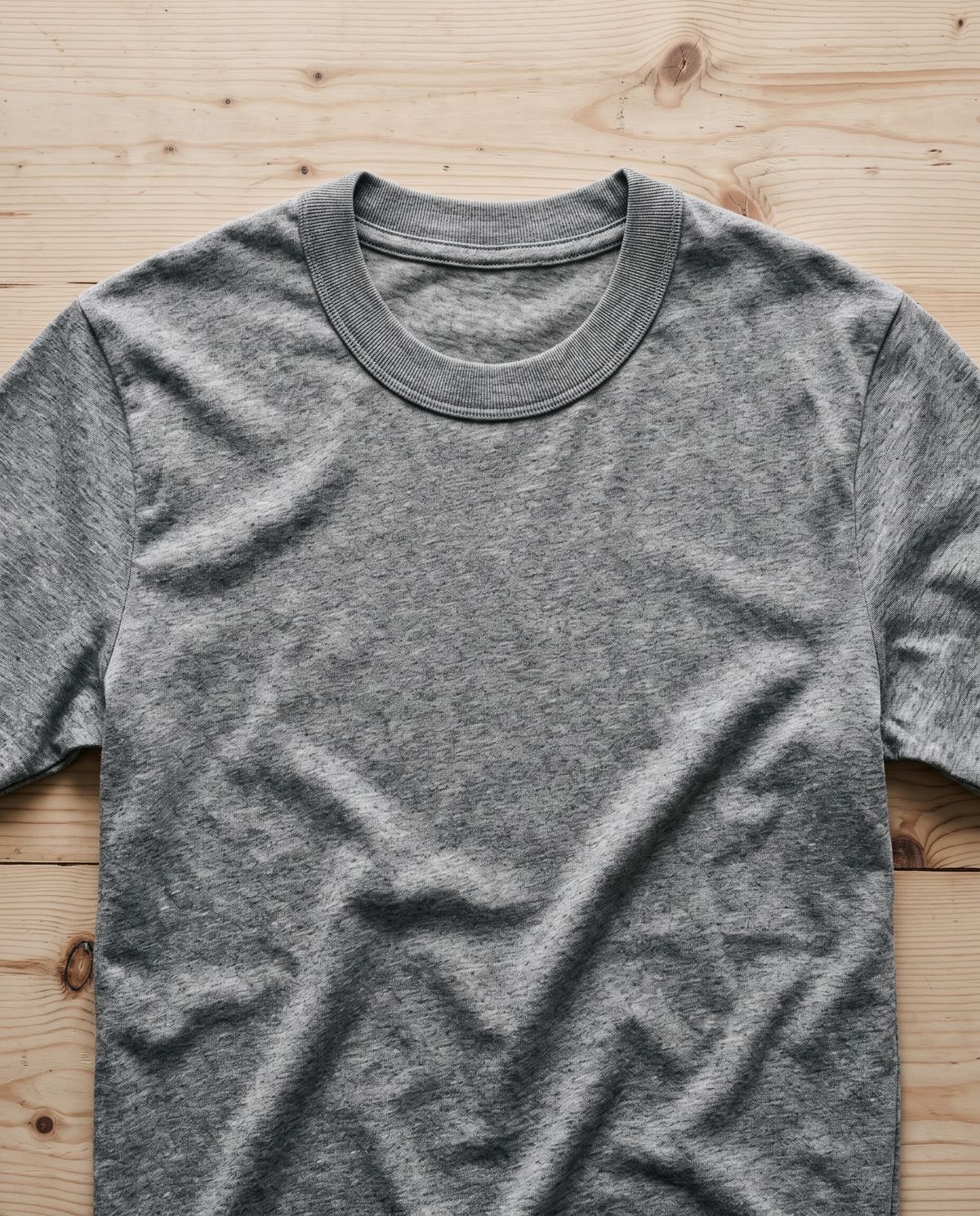
A bacon collar is a tee neckline that has gone wavy and loose, so the band ripples instead of lying flat and round against your neck. The name comes from the look: a rippled edge, like a strip of cooked bacon.
It helps to separate two different problems. The first is temporary. A collar can come out of the wash wrinkled, curled or slightly out of shape, and that often relaxes with a little steam, a reshape while damp or the next wash. A University of Idaho Extension bulletin says washing and drying or steaming can return stretched knits to shape, but it was written about stretch terry and velour and was not a tee repair trial.
The second is lasting deformation. Here the rib itself has lost its recovery, so it no longer snaps back after it stretches. Steam will not restore worn-out rib, and no restoration trick is guaranteed to bring that collar back.
Why Tee Collars Sag, Wave and Roll
A collar has to open wide enough to get over your head, then close back up and sit flat all day. Whether it keeps doing that depends on a few things.
Rib knit and its stretch recovery
Most crew neck collars are made from rib knit. The reference site How Products Are Made describes neckbands as generally made from “one-by-one” rib knits, with heavier fabrics or higher quality shirts sometimes using “two-by-two” rib. The sewing pattern company Seamwork describes rib knit as “specifically engineered for high stretch and reliable recovery.”
Recovery is the key word. Stretch is easy. Coming back to the original size is the hard part. Seamwork’s neckband guide says the band has to “fully recover back to its original size” after it goes over the head. When a rib loses that snap, the collar stops hugging your neck and starts to open up.
How the band is cut and attached
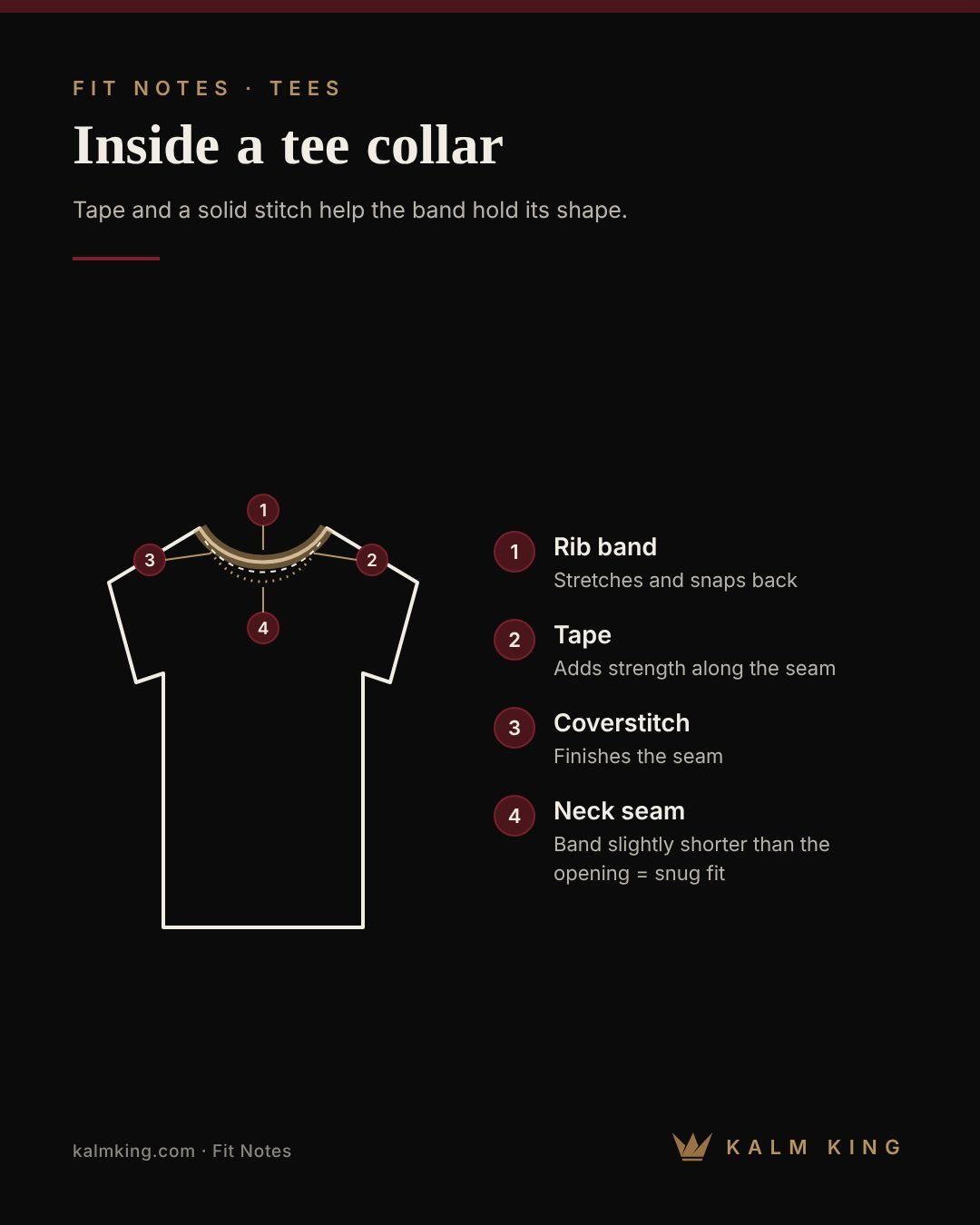
A collar isn’t just a strip of rib sewn on. How Products Are Made explains that on a crew neck, the band has to be stretched “just the right amount to prevent bulging” as it’s sewn to the neck edge. Seamwork makes the same point from the home sewing side: the band should be shorter than the neckline opening, so that when it relaxes it pulls the neckline snug. A band cut the same length as the opening “has nothing to pull against” and stands away from the body.
Seamwork also names one cause of a wavy collar: stretching the band unevenly as it runs through the machine. Pulling while sewing can do the same thing. So a collar can wave from day one because of how it was made, not because of anything you did.
Binding, taping and coverstitch
Look inside the neck of a few tees and you’ll see different finishes. How Products Are Made notes that necklines may be taped “for strength and comfort,” with the tape sometimes running over the shoulder seams, and that the seam is then cover stitched or top stitched. Bound necklines are finished with a cover stitch.
The independent tester at FashionBeans paid close attention to this. In that review, the writer said he prefers bound collars and called them “tough, durable.” On one shirt that wasn’t bound but had binding tape applied, he wrote that the tape “allows it not stretch a lot over time, so it holds its shape a little bit better.” On another, with a collar that was “not a bound collar, no ribbing or anything like that,” he noted “the collar does sag.”
FashionBeans doesn’t describe a formal sag test, so treat these as one tester’s hands-on notes. They do line up with how manufacturing references describe tape: it’s there for strength.
Spandex in the rib
Some rib collars include spandex. Seamwork’s guide says that “even a 5% spandex content in a cotton blend usually means at least 50% stretch,” and it treats spandex content as a clue to stretch when you can’t test fabric in person. That’s about stretch, not a promise of lifetime recovery, so read it as one helpful signal rather than a guarantee. If the label or product page lists spandex or elastane in the collar, it’s worth noting. Then still do the hands-on test below.
Fabric weight and collar style
Heavier tees get a lot of attention, and for good reason. The NBC Select team, which tested more than 50 tees, noted that some of its editors prefer “a structured, heavyweight tee.” But weight alone doesn’t decide how a collar ages. In the FashionBeans review, an 8 oz shirt with diagonal ribbing at the neck “passes the sag test,” while a 6 oz shirt with an unbound collar was still described as having a “nice tight neckline.” Weight is one input. Construction matters too.
Collar style also changes the feel. FashionBeans noted that one shirt’s collar was made from the shirt fabric itself rather than ribbing, so it “doesn’t stretch over your head as easily.” That’s a tradeoff: less give going on, and a different look.
How you pull it on and off
The last factor is you. A collar is built to stretch over your head and come back. Each time you grab it by the neck and yank, you ask it to stretch further and more unevenly than it needs to. Do that every morning and every night, and you’re putting the band through its hardest test twice a day.
Wash and Dry Without Pulling the Collar
Laundry is where a lot of collars lose the fight. Two things to watch: what the care label allows, and how the tee dries.
What the research says about the dryer
Cotton Incorporated, the research and marketing body for US upland cotton, looked at what actually shrinks cotton in the dryer. As reported in Textile World, a load of 100% cotton interlock knit was washed and tumbled in a dryer with no heat. It shrank more than 20% after 45 minutes. Loads dried at 150°F and 200°F shrank by the same amount, just faster. Their conclusion was that the tumbling, not the heat, was doing the shrinking.
For knitted cotton, Don Bailey of Cotton Incorporated gave this as the “preferred method”: “tumble for no more than five minutes to remove wrinkles, then hang them to dry.” That research is from 2005. This study concerns overall cotton-knit shrinkage. It did not test collar sagging, stretch recovery or a collar repair. Use the tee’s care label first; the finding does not establish that a dryer stretches the neckline. More on that in why T-shirts shrink.
Practical wash and dry habits
- Follow the care label first. It’s the maker’s instruction for that specific tee. If it says tumble dry low or hang dry, start there.
- Wash with similar weights. Heavy jeans and towels tumbling with a light tee give the collar a rough ride.
- Turn tees inside out. This is a common habit that keeps the outside face and neck finish from rubbing against everything else in the drum.
- Avoid unnecessary tumbling. Follow the care label and avoid unnecessary tumbling.
- Reshape the collar while damp. Before the tee dries, smooth the band flat and round with your hands. This takes five seconds.
- Dry from the body, not the neck. If you hang a tee to dry, hang it from the hem or over a rod at the middle so the weight of wet fabric isn’t pulling down on the collar. Or dry it flat.

Hangers, Hooks and Drawers: Storing Tees Without Stretching the Neck
A University of Idaho Extension bulletin on stretch knits gives a simple rule. It says, “Padded hangers will prevent knits from stretching out of shape if the stretch is horizontal,” and that “vertical stretch garments should be stored on a shelf or in a drawer.” That bulletin covers stretch terry and velour, not jersey tees, so take it as general knit guidance. But the logic carries over: knits stretch under their own weight, and how you support them matters.
Here’s how to put that to work.
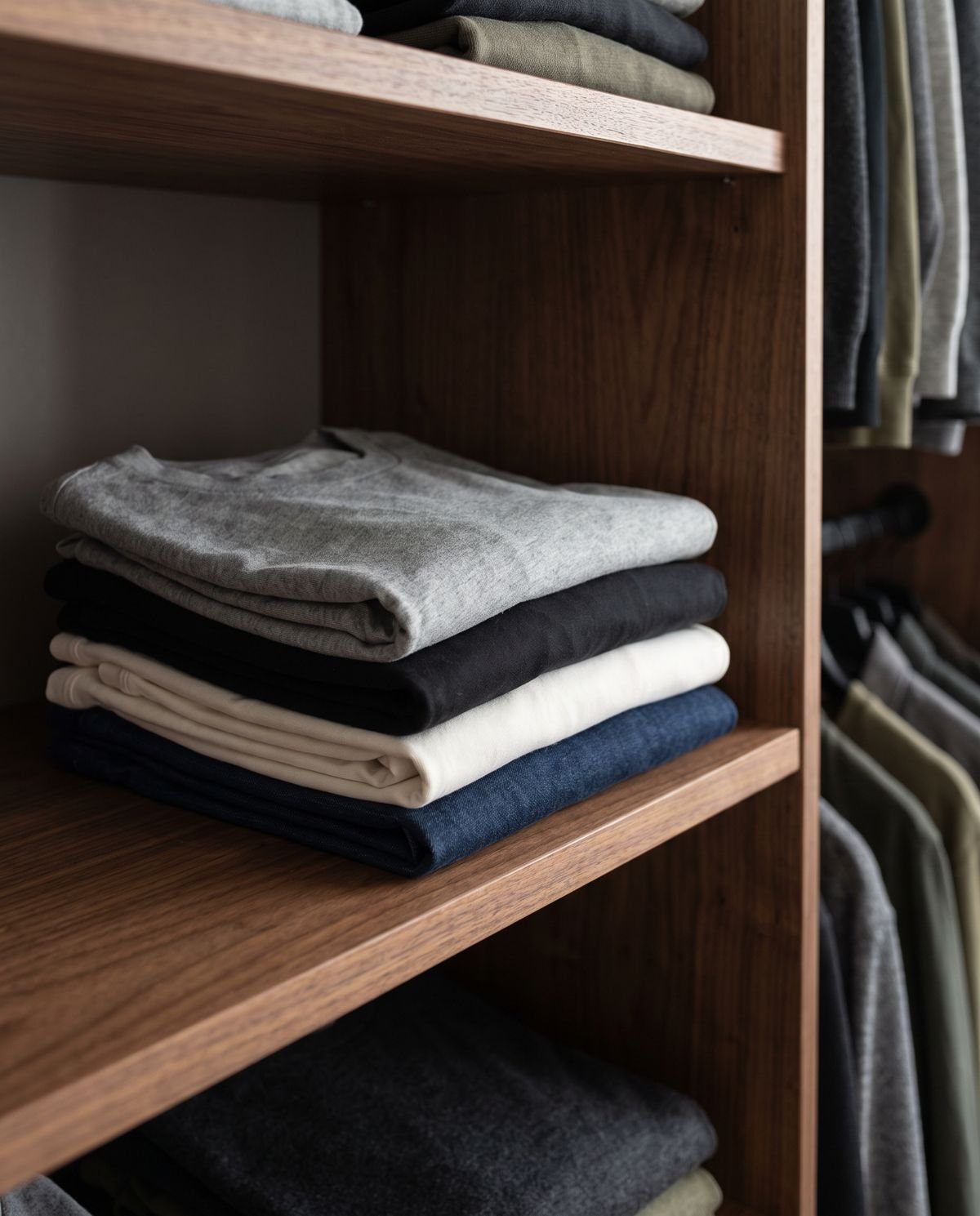
- Fold your everyday tees. A folded tee in a drawer or on a shelf has nothing pulling on the neck.
- If you hang, use a padded or wide-shouldered hanger. Thin wire hangers concentrate the weight in two small points near the collar.
- Slide the hanger in from the hem. Forcing a hanger through the neck opening stretches the band every single time. Going up through the body avoids that entirely.
- Skip the wall hook by the collar. Hanging a tee from a hook at the back of the neck stretches one spot of the band into a point.
How to Keep T Shirt Necks From Stretching When You Get Dressed
This one costs nothing and might be the biggest daily habit change.
Putting it on: Gather the body of the tee in your hands, slip your head through, then put your arms in. Don’t hold the collar open with your fingers and stretch it wide.
Taking it off: The classic move is reaching over your shoulder, grabbing the back of the collar and pulling. It’s fast. It also stretches the back of the band. Instead, cross your arms, grab the hem at your sides and lift the shirt up and over. Your head comes out last, with the collar only stretching as much as it needs to.

Check the Collar Before You Buy
The cheapest fix is a better collar from the start. You can learn a lot in about thirty seconds in a store.
The stretch and release test
How Products Are Made lists a quality control standard for tees: the neckline should “recover properly after being slightly stretched.” You can run your own version.
- Hold the collar at the front with both hands, about a fist width apart.
- Gently stretch it a little. Don’t haul on it. You’re testing, not wearing it out.
- Let go and watch. A good band snaps back flat and round. A tired one comes back slowly, stays slightly open or ripples.
- Look at the collar lying flat on the table or hanger. It should sit flat against the body of the shirt, not stand away or wave.
What else to look for
- Rib or self fabric. Most collars are rib knit. A self fabric collar can look clean but behaves differently.
- Tape inside the neck. A strip of tape along the back neck seam, sometimes running over the shoulders, is there for strength.
- Stitching. Look for a neat, even stitch line around the band with no puckers or waves.
- Band width. A band that looks floppy or loose before you’ve even worn it won’t get tighter on its own.
- The care label. If a tee says hang dry or tumble low, factor that into whether it’ll fit your laundry routine.
For a broader look at fit beyond the collar, it helps to know why the shoulder changes everything. A tee with a collar that holds but a shoulder seam halfway down your arm still won’t look right.
| What you see | What it usually means | What to do |
|---|---|---|
| Band snaps back flat after a gentle stretch | Good recovery | A useful recovery signal, not a durability guarantee. |
| Band comes back slowly or stays slightly open | Weak recovery | Expect sagging sooner |
| Collar waves on the hanger in store | Uneven attachment | Pass if it still waves after gentle smoothing; this test does not predict its whole lifespan. |
| Tape inside back neck | Added strength | A plus |
| Collar made from shirt fabric, not rib | Less give | Try it on; check it goes over your head easily |
| Spandex or elastane listed in the collar | Added stretch | A helpful clue, still test it |

How to Keep Tee Collars From Curling and Stop a Tee From Rolling Up
Sagging isn’t the only collar complaint. Sometimes the band flips, curls or rolls, and sometimes the whole tee seems to ride up.
When the collar curls or flips
Seamwork’s guide names one cause of a band that bubbles or pulls away over time: seam allowances that aren’t secured can flip inside the shirt. Topstitching around the band holds them in place. So when you’re shopping, a collar with a clean line of stitching that holds the seam down is a good sign.
At home, reshaping the collar while it’s damp and drying the tee flat both help it settle in the right position. A quick press with steam can also coax a curled edge back down. Use a press cloth and light pressure. The University of Idaho bulletin warns that heavy pressing stretches knit fabric, so don’t lean on the iron.
When the tee rolls up
If you’re searching how to stop t shirt from rolling up, look at how a T-shirt should fit before anything else. A tee that’s too short in the body will ride up as you move, and no amount of careful washing changes that. Long tumbling can also shrink cotton knits, according to the Cotton Incorporated research above, so a tee that used to sit right can end up shorter after a few hot, long dryer cycles.
NBC Select’s testers pointed out that one brand they reviewed comes in short, regular and long lengths so you can match your torso. That kind of option is worth looking for if you have a long torso. Then follow the care label and avoid unnecessary tumbling.
How to Fix a Stretched Tee Collar
Already got a bacon collar? Here’s what’s worth trying. Be realistic: these methods can help, but none will make an old collar new, and results depend a lot on the fabric.
Steam and reshape
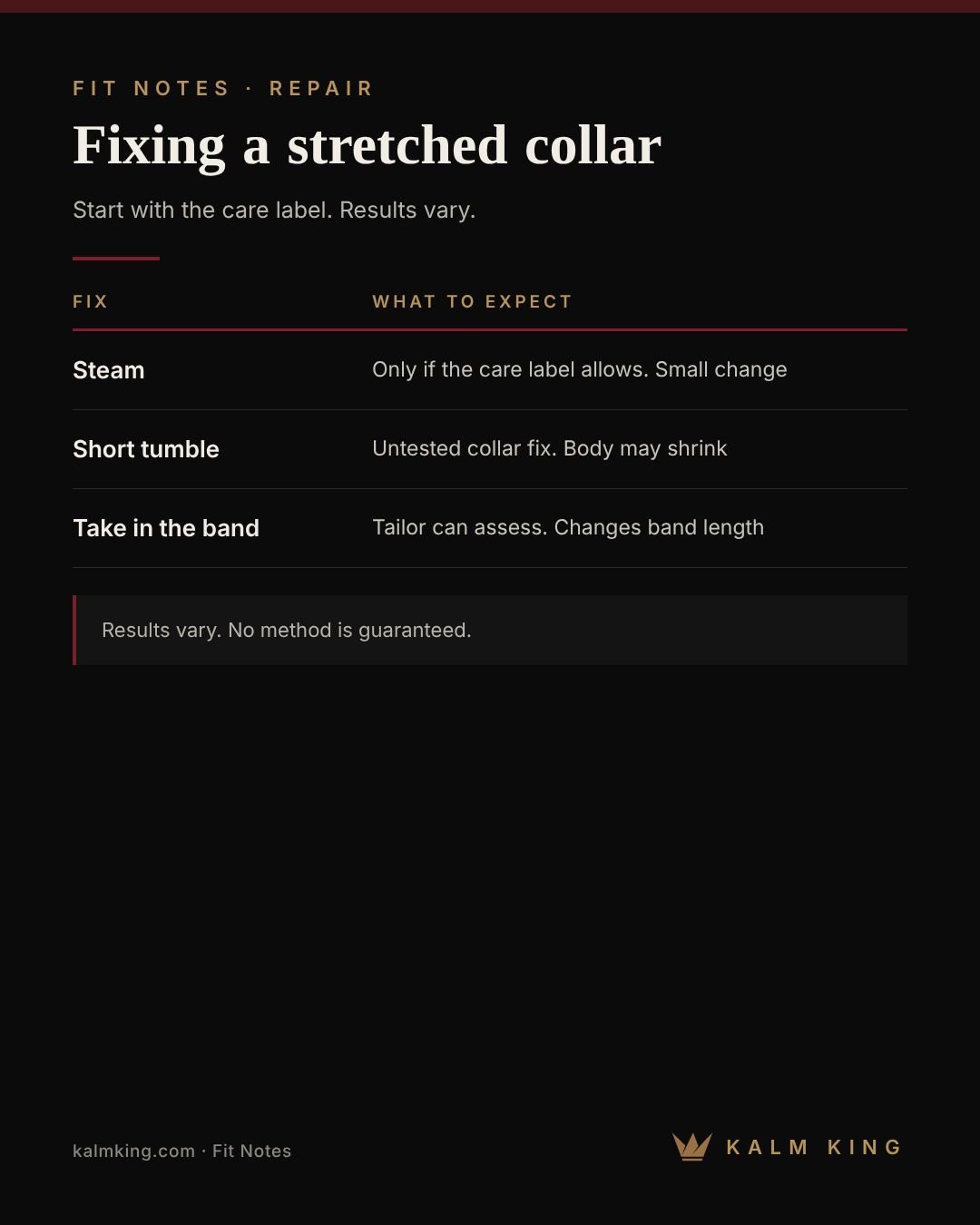
The University of Idaho Extension bulletin says that with stretched knit fabric, “washing and drying or steaming will return the original shape.” It was written about stretch terry and velour and was not a tee repair trial, so it’s not a promise for any tee. If the care label permits steam, a gentle reshape may help temporary distortion; it will not restore worn-out elastic.
How to try it: Lay the tee flat. Use a garment steamer or the steam setting on an iron, held just above the fabric. Work around the collar, then gently push the band back into a round shape with your hands. Let it dry flat. If you press, use a press cloth and light pressure.
A short warm tumble
Untested collar fix; body may shrink. Since tumbling is what shrinks cotton knits, according to Cotton Incorporated’s research, a damp all cotton tee given a short tumble may tighten a little at the collar. The catch is that the whole shirt goes in, not just the neck. Anything that tightens the collar can also shorten the body and sleeves. Check after a few minutes rather than running a full cycle, and only try this on 100% cotton tees whose care label allows machine drying.
Take in or replace the band
If the collar is badly stretched, a tailor may be able to shorten or replace the band, depending on the fabric and construction. Seamwork’s guide explains that a neckband needs to be shorter than the opening so it pulls the neckline snug. A band that’s grown too long has lost that pull.
A tailor or a confident home sewer may be able to remove the band, shorten it and reattach it, or replace it with new rib. It’s real work, so it makes most sense for a tee you love: a great color, a perfect fit or one that’s sentimental. For a cheap everyday tee, it often isn’t worth it.
Methods we left out
You’ll see other tricks online, such as boiling the collar or running elastic thread through the band. We couldn’t find a source we’d stand behind showing how well these work on tees, so we’re not recommending them here. If you try something, test it on a tee you don’t mind losing.
Tees Under Overalls: Why the Collar Matters More
Here’s where a collar goes from minor detail to center stage. When you wear overalls, the bib covers most of your chest and the straps frame your shoulders. What’s left showing? The sleeves and the neck of whatever you’ve got on underneath.
That makes the collar one of the few visible parts of the tee. A crisp, flat band reads intentional. A wavy, sagging one stands out more than it would on its own, because there’s less else to look at. If you’re building outfits around overalls, our guide on what to wear under overalls walks through tees, henleys and layers, and every option there benefits from a collar that holds its shape.
The fit of the overalls matters too. Straps set too short can pull at the shoulders of your tee, and a bib that sits too low shows more of the neck. Our guide to how men’s overalls should fit covers strap length and bib height so the whole look sits right.
A practical tip: save your flattest, firmest collars for overalls days.
Join Field Notes and get the free Overalls Fit Kit.

When to Retire a Tee
Every tee has a lifespan. NBC Select’s testers listed “warping collars” among the signs of wear they looked for when they washed shirts repeatedly. Here are some signs it’s time to retire one from rotation.
- The collar stays open after steaming. If gentle fixes don’t bring it back, the rib has likely lost its recovery.
- The band waves even when the shirt is lying flat. That ripple usually shows through, even under overalls or a jacket.
- The neck seam is coming apart or thread is loose. That’s a repair job or the end of the line.
- The fabric has thinned near the collar. Thin, see-through patches around the neck won’t come back.
- It’s shrunk short in the body. A tee that now rides up won’t look right, no matter how good the collar is.
Retiring doesn’t have to mean the trash. A tired tee can still be a sleep shirt or a gym layer.
Your Collar Care Checklist
Save this, screenshot it or stick it inside the closet door.
When you buy
– Stretch the collar gently and let go. It should snap back flat and round.
– Look for tape inside the back neck.
– Check that the collar lies flat with no ripples.
– Read the care label and make sure it fits your routine.
When you wash and dry
– Follow the care label.
– Turn tees inside out.
– Wash with similar weights.
– Follow the care label and avoid unnecessary tumbling, then finish drying flat or hung from the body.
– Reshape the collar while damp.
When you store
– Fold everyday tees.
– If you hang, use a padded hanger and slide it in from the hem.
– Don’t hang tees from hooks by the neck.
When you wear
– Put tees on by the body, not by stretching the collar.
– Take them off by the hem with crossed arms.
When a collar stretches
– If the care label permits steam, try a gentle reshape first.
– A short tumble is an untested collar fix; the body may shrink.
– For tees worth saving, ask a tailor whether the band can be shortened or replaced.
The Bottom Line on Tee Collars
A sagging collar isn’t bad luck. It’s the result of how the band was built, how often it’s been stretched and how it’s been washed, dried and stored. Start with a collar that passes the stretch and release test. Follow the care label and avoid unnecessary tumbling, fold your tees and take them off by the hem. When one does start to go, try a gentle steam reshape before anything drastic, knowing no fix is guaranteed.
Frequently asked questions
How do you keep a t-shirt collar from stretching?
Buy tees with a firm rib collar that snaps back after a gentle stretch, ideally with tape inside the neck. Follow the care label and avoid unnecessary tumbling, reshape the collar while damp, fold tees instead of hanging them by the neck, and take shirts off by the hem rather than the collar.
Does the dryer stretch out t-shirt collars?
A dryer can change the dimensions of a cotton-knit tee, but the cited shrinkage research did not measure collar stretching. Collar shape also depends on the neckband, stitching and handling. Follow the care label; if allowed, support and reshape the damp neckline without pulling it.
How do you fix a bacon collar?
If the care label permits steam, a gentle reshape may help temporary distortion; it will not restore worn-out elastic. A short tumble is an untested collar fix, and the body may shrink. A tailor may be able to shorten or replace the band, depending on the fabric and construction. No restoration trick is guaranteed.
Should you hang or fold t-shirts?
Folding is the safest choice for the collar, since nothing pulls on the neck. If you hang tees, a University of Idaho Extension bulletin recommends padded hangers for knits, and sliding the hanger in from the hem avoids stretching the collar.
Sources
- The Best T-Shirts For Men (FashionBeans) — independent tester
- Best White T-Shirts, Tested and Reviewed (NBC Select) — independent tester
- Researchers Find That Tumbling, Not Heat, Shrinks Cotton (Textile World, reporting Cotton Incorporated research) — research / industry body
- Stretch Terry and Velour, Current Information Series No. 581 (University of Idaho Cooperative Extension) — standards or government (university extension)
- T-Shirt (How Products Are Made) — research (reference encyclopedia on manufacturing)
- How to Sew a Perfect Neckband (Seamwork) — brand guide
FIELD NOTES
Get the Overalls Fit Kit, free.
Your measurement card, the six fit checkpoints and a checklist to take shopping. Join Field Notes for new guides and a say in what Kalm King makes.
THE KALM KING JOURNAL
Continue reading
How Should Men’s Dress Pants Fit? Waist, Rise, Seat and Break
How should dress pants fit? Check the waist, rise, seat, thighs and hem with practical sitting tests, break options and realistic tailoring advice.
How Should a Dress Shirt Fit? A Men’s Guide to Collar, Chest and Sleeves
Check dress shirt fit at the collar, shoulders, chest, sleeves and hem. Learn what to measure, how to test movement and when to try another cut.
Men’s Capsule Wardrobe: How to Build One That Actually Works
A men’s capsule wardrobe is a small set of clothes that all work together. How to choose the pieces, colors and fit, and build one at your own pace.