
November 1, 2026
Explore: Style
Why T-Shirts Shrink and How to Help Prevent It
Why cotton tees shrink, how to prevent a t-shirt from shrinking in the wash and dryer, how to read care labels, and how to buy length with shrinkage in mind.
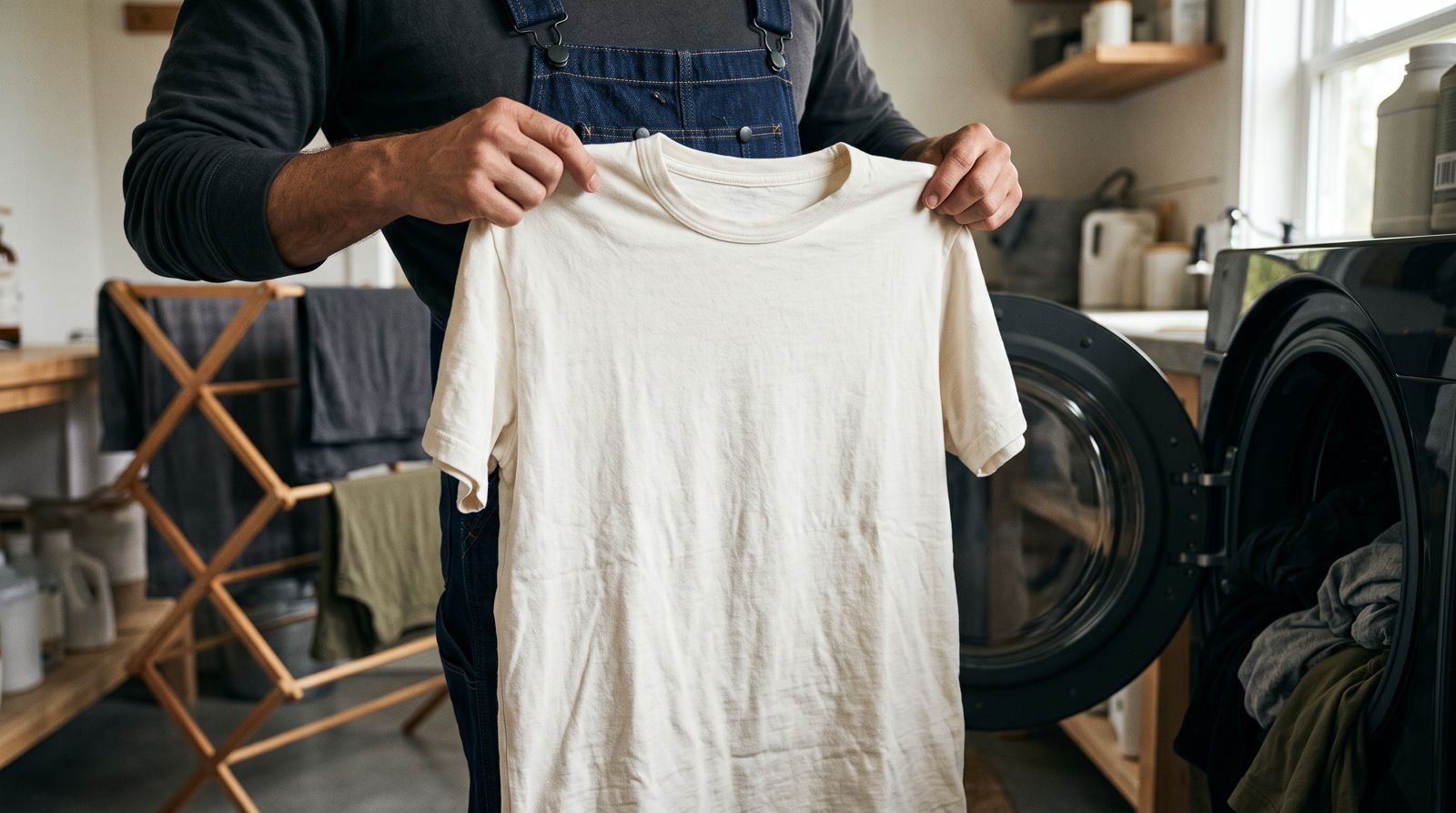
You bought a tee that fit right. Three washes later it rides up when you reach for something, and the sleeves grip your arms. If you’ve ever searched how to prevent a t-shirt from shrinking, you already know the frustration. The good news is that shrinkage isn’t random. It follows rules, and once you know them you can wash, dry and shop around them.
Below: why cotton knits shrink, what “preshrunk” and “garment dyed” really mean, how to wash and dry, how to read a care label, and how to buy enough length. There’s a checklist at the end.
Short answer: Cotton-knit tees can shrink as tension left from manufacturing relaxes during washing and drying. For the fabrics discussed here, limiting tumble drying is a useful way to reduce further change. Buy tees with a little extra body length, wash cold, and dry flat or on a line if you want the fit to hold.

Why Do My Shirts Shrink in the First Place?
Start with how a tee is made. Most tees are cut from cotton jersey, a knit fabric made of rows of interlocking yarn loops. During knitting, dyeing and finishing, that fabric is pulled, wound, squeezed and stretched by machines. Cotton Incorporated, the research and marketing body for US cotton, describes one stage of wet processing, water extraction, as “the single greatest area of concern for length distortion,” and says length stretch of 10% and higher is commonplace there.
That stretch doesn’t stay. Cotton Incorporated calls the result relaxation shrinkage: the fabric’s ability “to freely relax from tensions experienced during construction.” In plain terms, the fabric was held longer than it wants to be. Give it water and movement, and it pulls back toward its natural shape.
So when you ask “why do my shirts shrink,” the honest answer is that a lot of the shrinkage was built in at the factory. Your laundry routine decides how much of it you see, and how fast.
What water does to cotton
Cotton is absorbent. When a cotton knit gets wet without tension, Cotton Incorporated explains that the fibers, yarns and fabric swell. The stitch loops try to round out, and that shortens them. Then, as the shirt dries, the fibers deswell. Swelling and deswelling together drive the shrinkage.
The detail that may surprise you is when it happens. According to the same bulletin, shrinkage stays low while surface water evaporates. The biggest relaxation happens late in drying, at moisture levels below about 20%. That’s the stretch of time when a tee is nearly dry and still tumbling.
What movement does
Agitation matters too. Cotton Incorporated notes that absorbed water acts like a lubricant inside the fabric, and that mechanical action on a wet fabric produces “even higher levels of shrinkage.” Tumbling with nothing to hold the fabric in place works like compression. Every drop and turn in the drum nudges those loops tighter.
What about heat?
Heat gets most of the blame, and it’s worth being careful here. In one Cotton Incorporated test, interlock cotton knit was tumbled at 100°F, 150°F and 200°F, and the shrinkage curves and totals were identical. The bulletin says this contradicts the common belief that heat increases shrinkage.
That was one fabric in one lab test, so it’s not a license to blast everything on high. Other fibers and finishes can behave differently. But it shifts the focus: for a cotton tee, moisture and tumbling look like the real engine of shrinkage.

Why Do My Shirts Keep Shrinking After Every Wash?
You washed a tee once, it shrank a bit, and you assumed that was the end of it. Then it shrank again.
Cotton Incorporated’s bulletin explains why. One tumble drying cycle “may remove around 90% of the total shrinkage available,” but it says several cycles of wetting and drying may be needed to reach fully relaxed dimensions. For lab testing, it recommends at least five wash and dry cycles to get a reliable read.
So a tee doesn’t give up all its shrinkage at once. Most of it can go in the first dryer cycle, then the rest creeps out over the next few. If you air dry for the first few washes and then toss a tee in the dryer once, you can still lose length you thought you’d protected.
There’s also the question of how you dry. The bulletin draws a clear line between drying methods. With line or flat drying, it says “mostly elastic shrinkage will affect performance.” With tumble drying, “all available residual shrinkage will be realized.” That one sentence is the core of how to prevent t shirt from shrinking: the dryer cashes in all the shrinkage your tee has left.
A recurring complaint in shopper reviews matches this pattern. A Kimola analysis of Amazon reviews for one budget men’s tee summarized reports of shrinkage after washing, with sleeves and total length shrinking by “at least 2 inches,” alongside other reviewers who were happy with the fit. That’s one product and a small review sample, not a measure of tees in general. It does show what shrinkage looks like from the wearer’s side: it’s the length and the sleeves you notice.
Preshrunk, Garment Dyed and Compacted: What the Labels Mean
Shopping tags throw around a handful of terms. Here’s what they can and can’t tell you.
Preshrunk
“Preshrunk” means the maker did something to reduce shrinkage before you bought the tee. It doesn’t tell you how much is left. The FTC’s guide to the Care Labeling Rule doesn’t define the term, so treat it as a promise of effort rather than a number.
Cotton Incorporated describes the tools makers use. Relaxed drying lets fabric settle without tension. Compaction uses compressive force to shorten the fabric and reduce length shrinkage before it’s cut. In one of its trials, compaction removed another 4% of relaxation from a fabric. In another, compacted single jersey still had residual shrinkage of 4.5% in length and 6% in width. In other words, these steps help, but they don’t always get a knit to zero.
Prewashed
Some makers wash the finished tee before selling it. In FashionBeans’ testing of men’s tees, the two shirts described as pre-washed, from Asket and Dehen 1920, both measured 0% shrinkage. That’s a small sample from one tester, and FashionBeans doesn’t publish its wash and dry method. Still, it lines up with what Cotton Incorporated says about relaxation: if the shrinkage has already happened before the tee reaches you, there’s less left to happen at home.
Garment dyed
Garment dyeing means the tee is sewn first, then dyed as a finished piece. That puts the whole shirt through a wet process. Cotton Incorporated’s bulletin on garment dyeing says knitted fabrics are pre-relaxed to minimize shrinkage during garment dyeing and drying, and that garments can be cut oversized to compensate for shrinkage, though seam appearance may suffer.
What the bulletin doesn’t say is that a garment-dyed tee won’t shrink at home. It depends on how much relaxation happened before and during dyeing. If a brand tells you its garment-dyed tees are washed and dried as part of the process, that’s useful. If it just says “garment dyed,” don’t assume it’s shrink-proof.
Blends
Cotton’s swelling and deswelling is a big part of why it shrinks. Cotton Incorporated notes that synthetic fibers don’t go through that same cycle, and that cotton can’t be heat set the way thermoplastic synthetics can. That’s one reason a cotton and polyester blend may behave differently in the wash. How differently depends on the blend, the knit and the finishing, and the sources I read don’t give a rule of thumb. FashionBeans did test one hemp blend tee from Buck Mason, which measured 2.5% shrinkage in width and 1% in length.

What FashionBeans Measured: Real Shrinkage From Real Tees
Numbers help, because “it shrank a bit” means different things to different people. FashionBeans, a hands-on review site that is affiliate-funded, tested a range of men’s tees and listed a shrink figure for each one it measured. A few of them:
| Tee (as tested by FashionBeans) | Width shrinkage | Length shrinkage |
|---|---|---|
| Asket (pre-washed) | 0% | 0% |
| Dehen 1920 (pre-washed) | 0% | 0% |
| Velva Sheen | 2.3% | 0% |
| Uniqlo Heavyweight Crewneck | 2.3% | 2% |
| Kirkland | 4% | 2% |
| Merz b. Schwanen | 5% | 3% |
| Whitesville | 5.4% | 3% |
| Wonder Looper Fox Fiber | 7.69% | 6% |
Two things stand out. The range is wide, from nothing to nearly 8% across the chest. And in these tests, width shrinkage was often bigger than length shrinkage, so a tee can feel tighter across the chest even if the hem barely moves.
Keep the limits in mind. This is one tester’s results, FashionBeans doesn’t describe the wash and dry method, and a figure for one shirt says nothing certain about another batch. Use the table as a sense of scale, not as a guarantee.
Wash and Dry to Reduce Shrinkage
Now the practical part. Your goal is to give the fabric as little reason as possible to relax further, while still getting it clean.
Washing settings that help
- Follow the label first. The FTC requires the maker to have a reasonable basis, meaning reliable evidence, for the care instructions. That label is your safest starting point.
- Go cold or warm, not hot, unless the label says otherwise. The Cotton Incorporated test above suggests temperature may matter less than you think for cotton shrinkage. But there’s little reason to wash an everyday tee hot, and cold water helps with color, which we’ll get to below.
- Use a gentler cycle when you can. Agitation on wet fabric adds to shrinkage, according to Cotton Incorporated. A shorter, gentler cycle means less of it.
- Wash less often. Every wet and dry cycle gives the fabric another chance to relax.
The dryer decision
This is where you win or lose. Cotton Incorporated says plainly that tumble drying realizes all the residual shrinkage a fabric has left, while line or flat drying mostly limits it to elastic shrinkage. And it notes that the heaviest relaxation happens when the fabric is nearly dry, which is exactly when a dryer keeps tumbling it. The collar has its own care quirks; see how to keep your T-shirt collar from stretching. For synthetic blends, see whether polyester shrinks.
Your options. Dry flat and hang dry are both air drying choices; the sources don’t rank one above the other.
- Dry flat. Lay the tee on a rack or towel, smooth the body and sleeves to the length you want, and leave it.
- Hang dry. Hang from the body on a wide hanger or line, not from the neck. It’s quick and easy, and it keeps the fabric off the tumble.
- Tumble briefly, then finish on a rack. If you need speed, a short tumble to knock out wrinkles and then air drying limits how long the tee spends tumbling while nearly dry.
- Tumble dry fully. Expect the tee to give up whatever shrinkage it has left.

Reading the Care Label Without Guessing
Care labels look like a row of hieroglyphs, but there’s a federal rule behind them. Here’s what the FTC’s Care Labeling Rule requires in the US, based on the FTC’s own business guide.
What the label must cover
- Washing: whether to wash by hand or machine, with a water temperature only if hot water would harm the product.
- Drying: whether to machine dry or use another method, with a temperature only if high heat would harm it.
- Ironing: instructions if the item needs repeated ironing.
- Bleach: if only non-chlorine bleach is safe, the label must say so. If no bleach is safe, it must say “No bleach” or “Do not bleach.”
- Warnings: if there’s a reasonable chance you’d use a harmful method, the label must warn against it with wording like “Do not,” “No” or “Only.”
The FTC also says that if you follow the label, the instructions should cause no substantial harm to the product. And labels must be attached permanently and stay legible for the useful life of the product.
What that means for shrinkage
Under the Rule, a temperature only has to appear if a higher one would cause harm. So the cited FTC guide interprets a minimal “Machine wash. Tumble dry.” label as allowing any temperature; additional label restrictions still govern. The FTC guide doesn’t mention shrinkage directly, and it doesn’t define how much change counts as harm.
The other thing to know is that warnings aren’t required for alternative methods. A tee that says “Dry flat” doesn’t also need to say “Do not tumble dry.” If the label asks for flat or line drying, take that as a strong hint that the dryer isn’t the maker’s safe method.
Symbols
The FTC guide allows the approved ASTM care-symbol system in place of written instructions. Symbols are optional; when words are present, read them alongside the symbols.

Keeping a Black Tee From Fading
Shrinkage and fading tend to come up together, because the habits that protect one often protect the other. If you’re wondering how to keep black t shirt from fading, Consumer Reports offers a short list:
- Wash cold. Consumer Reports says cold water helps keep the fibers in black fabrics from losing their color.
- Turn it inside out. That protects the outer surface.
- Skip detergents with bleach alternatives.
- Measure your detergent. Too much detergent, or very cold water, can leave streaks. Consumer Reports notes detergent enzymes need at least 60°F to work well.
- Air dry indoors, inside out. Tumbling with other clothes roughs up the surface and creates fuzz that makes black look faded. Don’t dry outside, because the sun fades dark clothes.
- Wash less. The more you wash, the more dye washes away.
Notice the overlap. Cold water, less washing and no dryer are good for your fit and your black. If black is a big part of your wardrobe, our piece on three ways to make black feel considered covers how to wear it so it looks deliberate.
Can You Unshrink a Shirt?
Maybe a little, and maybe not for long. Be realistic before you try.
Home tips usually involve soaking the shrunken tee in lukewarm water, sometimes with hair conditioner, then gently stretching it and drying it flat. I couldn’t find independent testing of these methods, so I can’t tell you how well they work or how much length you’d get back.
What the research does suggest is a caution. Cotton Incorporated describes shrinkage as the fabric relaxing from tension. Stretching a damp tee puts tension back into it. That stretch may hold while it dries flat, but the next time the tee gets wet and tumbles, the fabric has every reason to relax again. So if you do try it:
- Work gently, especially at the neckline and seams.
- Stretch along the length and width evenly, not just one spot.
- Dry it flat, and keep it out of the dryer from then on.
- Expect a partial, possibly temporary result.
The more reliable fix is to stop the shrinkage before it happens, and to buy with it in mind.
How Long Should a T Shirt Be on a Man?
This is where shrinkage and fit meet. Our rule of thumb: an untucked tee should reach roughly the middle of your fly, covering your waistband when you stand, without passing the bottom of your seat. When you raise your arms, a little skin at the hem is fine. A full strip of stomach isn’t.
That’s easy to hit on day one. The trick is still hitting it after ten washes. If a tee loses even a couple of percent in length, it can move from “right” to “a touch short.” Here’s a rough illustration with simple math, not a measured result: a tee with a 29-inch body length that loses 2% ends up about 0.6 inch shorter. At 6%, the top length loss FashionBeans recorded, it’s closer to 1.7 inches. That much length loss can noticeably change where the hem lands.
Longer without wider
One thing we hear from guys who are tall or long in the torso is that they want tees that are longer without being wider. If the shoulder fits and the length doesn’t, the fix usually isn’t a bigger size (more on that below). Our piece on why the shoulder changes everything explains why the seam placement matters so much.

Buying a Tee With Shrinkage in Mind
You can do most of the work at checkout.
Measure the tee you already like
Take a tee that fits you well after it’s been washed and dried your usual way. Lay it flat and measure:
- Body length: from the highest point of the shoulder, next to the collar, straight down to the hem.
- Chest: across the tee, one inch below the armpits, side seam to side seam.
- Sleeve: from the shoulder seam to the sleeve hem.
These numbers are your target after shrinkage, not before.
Compare to the size chart
Most brands publish garment measurements. Compare them to your target. If a brand says its tees are pre-washed or that measurements are taken after washing, you can match your numbers closely. If not, look for a tee a little longer than your target, and decide how much chest room you’re willing to give up if it shrinks in width too. The FashionBeans figures are a reminder that width loss can be real. Not sure which numbers matter? Our T-shirt fit guide walks through chest, shoulder, length and sleeve, and the Fit Card in our Size & Fit Reference keeps them in one place.
Read reviews for shrinkage, not just fit
A review that says “still fits after a month” beats one that says “fits great” on day one. Search reviews for “shrink” and “length,” and look for patterns, not one loud voice.
Why Sizing Up for Shrinkage Can Backfire
A recurring complaint from wearers goes like this: they buy a tee one size up to allow for shrinkage, and after a few washes the body has crept shorter while the chest, width and sleeves still feel too big. The result is a tee that’s short and baggy at the same time.
The reason is simple. A bigger size doesn’t just add body length. It adds chest width, shoulder width and sleeve length too. And as the FashionBeans figures show, a tee can lose width as well as length, so there’s no telling which extra room will shrink away and which will stay. You end up trading one fit problem for another, with the shoulder seam sliding down your arm.
The better path uses the steps above. Compare the body length and chest of your best fitting tee, measured after washing, against the brand’s size chart, and pick the size that matches your chest. If the length falls short, look for tall or long sizing rather than the next size up. Then read reviews that mention length after washing, not just fit out of the bag.
If you’re buying for someone else
Ask whether he uses the dryer, and lean toward pre-washed tees. Our guide on how to buy clothes for him without guessing covers the rest.

Tees Under Overalls: Why Length Matters Even More
If you wear overalls, your tee is doing a different job. It shows at the chest and arms, sits under the bib and straps, and gets tucked or bunched at the waist. A tee that has shrunk can pull out of the sides when you bend or reach, which looks sloppy and feels worse.
A few things help:
- Pick enough length to stay put. A tee that shrank short can ride up under the bib. Buy with a little extra length so it stays in place.
- Watch the sleeves. Overalls frame your arms. Sleeves that shrank tight or high change the whole look.
- Keep the width honest. A tee that loses width can cling under a structured bib. Air drying helps it keep its drape.
For more on pairing, see what to wear under overalls. And since the tee and the overalls work as one outfit, our guide on how men’s overalls should fit covers bib height, strap length and the rest.

Your Shrinkage Checklist
Use this before you buy and every time you do laundry.
When you buy
- [ ] Measure a tee you like after washing, and shop to those numbers.
- [ ] Check the size chart for body length, chest and sleeve.
- [ ] Prefer tees described as pre-washed when fit matters most.
- [ ] Don’t treat “preshrunk” or “garment dyed” as shrink-proof.
- [ ] Choose a little extra length if you plan to use a dryer.
- [ ] If you’re tall, look for tall sizing before sizing up.
- [ ] Search reviews for “shrink” and “length.”
When you wash
- [ ] Read the care label and follow it.
- [ ] Wash cold or warm, on a gentle or normal cycle.
- [ ] Turn dark tees inside out.
- [ ] Wash less often. Air tees out between light wears.
When you dry
- [ ] Dry flat or hang dry whenever you can.
- [ ] If you tumble, keep it short and finish on a rack.
- [ ] Smooth the length and side seams while damp.
- [ ] Remember that shrinkage can keep coming over several dryer cycles.
Bringing It Together
Tees shrink because their fabric was stretched while it was made, and water plus tumbling let it relax back. Wash gently, skip the dryer when you can, read the label, and buy enough length to absorb a little loss. The tee that fits on day one can still fit on day fifty.
If you want fit notes like this in your inbox, join Field Notes. You’ll get the free Overalls Fit Kit when you sign up.
For jeans, hoodies, chinos and overalls, see our guide on whether cotton shrinks.
Frequently asked questions
Why do my shirts shrink in the dryer more than in the wash?
Cotton Incorporated’s research found that cotton knit relaxes most when it’s nearly dry, at moisture levels below about 20%, and that tumble drying realizes all the residual shrinkage left in the fabric. Line or flat drying mostly limits it to elastic shrinkage. That’s why, for the fabrics discussed here, limiting tumble drying is a useful way to reduce further shrinkage.
Does high dryer heat explain all cotton-knit shrinkage?
No. In the cited cotton-interlock test, different dryer temperatures produced similar total relaxation shrinkage. That result concerns the tested fabric and drying process; it does not establish a safe wash-water temperature for every tee. Moisture, movement, finishing and garment construction also matter, so follow the care label.
Are preshrunk shirts guaranteed not to shrink?
No. “Preshrunk” tells you the maker took steps to reduce shrinkage, not how much is left, and the FTC’s care labeling guide doesn’t define the term. Cotton Incorporated’s trials show that even compacted fabric can keep some residual shrinkage.
Can you unshrink a cotton t shirt?
You may get some size back by soaking a tee and gently stretching it while you dry it flat, but I couldn’t find independent testing of these methods. Cotton Incorporated describes shrinkage as fabric relaxing from tension, so any stretch you add may not last through the next wash and tumble dry.
Sources
- Clothes Captioning: Complying with the Care Labeling Rule (Federal Trade Commission) (standards or government)
- Technical Bulletin ISP-1009: Guide to Improved Shrinkage Performance of Cotton Fabrics (Cotton Incorporated) (industry body)
- Technical Bulletin TRI-3003: Garment Dyeing of Cotton Apparel (Cotton Incorporated) (industry body)
- The Best T-Shirts for Men (FashionBeans) (hands-on review, affiliate-funded)
- How to Keep Your Black Clothes Looking Their Best (Consumer Reports) (independent tester)
- Kliegou Men’s T-Shirt Feedback Report, Amazon (Kimola) (review analysis)
FIELD NOTES
Get the Overalls Fit Kit, free.
Your measurement card, the six fit checkpoints and a checklist to take shopping. Join Field Notes for new guides and a say in what Kalm King makes.
THE KALM KING JOURNAL
Continue reading
How Should Men’s Dress Pants Fit? Waist, Rise, Seat and Break
How should dress pants fit? Check the waist, rise, seat, thighs and hem with practical sitting tests, break options and realistic tailoring advice.
How Should a Dress Shirt Fit? A Men’s Guide to Collar, Chest and Sleeves
Check dress shirt fit at the collar, shoulders, chest, sleeves and hem. Learn what to measure, how to test movement and when to try another cut.
Men’s Capsule Wardrobe: How to Build One That Actually Works
A men’s capsule wardrobe is a small set of clothes that all work together. How to choose the pieces, colors and fit, and build one at your own pace.