
November 9, 2026
Explore: Fabric & Care
Does Polyester Shrink? Pure Polyester, Blends and Heat
Does polyester shrink? Why pure polyester resists shrinking, why blends can still shrink, what heat damage looks like, and how to wash and buy with less risk.
You grab a polyester gym tee, a blended everyday tee, or a dress shirt with a “wrinkle-free” promise, and you want to know one thing before it goes in the wash: does polyester shrink? It’s a fair question, because clothes labeled “polyester” behave very differently depending on what else is in the fabric and how much heat they meet. The short version is reassuring for pure polyester and more conditional for everything else.
Below: what kind of fiber polyester is, what that means for shrinkage, why blends behave differently, why construction matters as much as fiber, whether you can shrink polyester on purpose, how to care for it, and how to buy it so the size you choose is the size you keep. There’s a checklist at the end.
Short answer: Pure polyester is generally resistant to shrinking. The American Fiber Manufacturers Association lists it as “resistant to stretching and shrinking,” and University of Georgia Extension credits it with “superior wash-wear performance.” Blends are different: the cotton or rayon in a blend can still shrink. Heat is the bigger risk: too much of it can distort or damage polyester, and UGA Extension lists “melts, if too hot” among its limitations. Follow the care label and keep the dryer and iron low. When a polyester piece does change, the sources cited here point to blends, construction and excess heat rather than the polyester fiber itself.
What Polyester Actually Is
Polyester is a manufactured fiber. The American Fiber Manufacturers Association (AFMA), the trade group for US fiber makers, quotes the Federal Trade Commission’s definition: a manufactured fiber made from “any long-chain synthetic polymer,” built largely from a specific type of ester. The most common type is PET. AFMA notes that PET is “melt spun,” meaning it is melted and pushed out as fiber, and that recycled PET fiber is made by “remelting the PET and extruding it as fiber.”
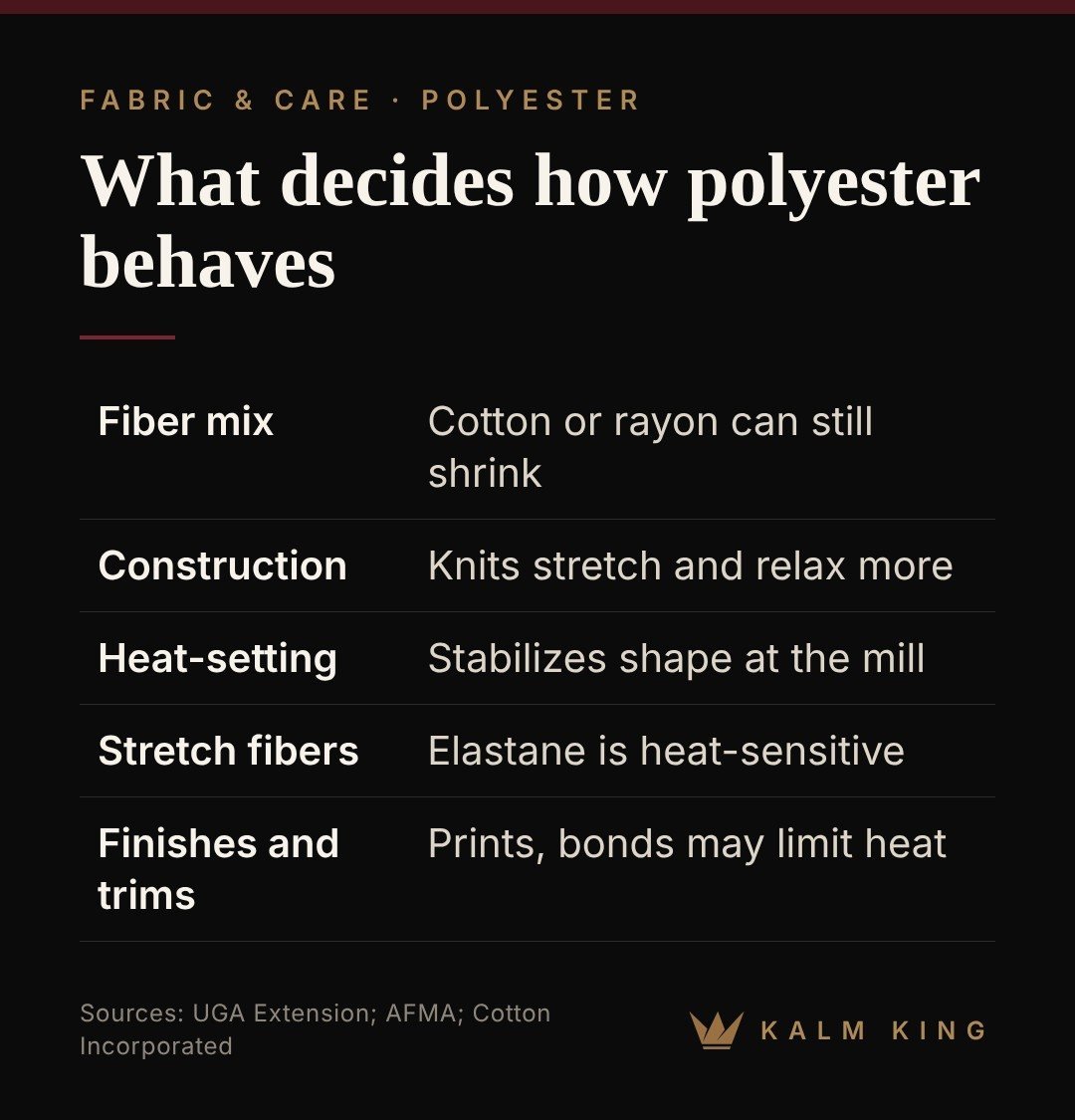
That melt-and-form origin matters for this question. Polyester is what’s called a thermoplastic fiber: it softens with enough heat and, pushed too far, can melt. Cotton Incorporated, the research and marketing body for US cotton, puts it in a useful comparison. In its technical bulletin on cotton shrinkage, it says cellulosic fibers like cotton “are not as easily stabilized as are thermoplastic synthetics,” because cellulosics “cannot be heatset to attain stability.”
What heat-setting means
Heat-setting is a manufacturing step, not something that happens in your laundry room. Mills use controlled heat to lock a thermoplastic fabric or yarn into a stable shape. Once it has been set, the fabric tends to hold that shape through ordinary use. That is why both AFMA and UGA Extension describe polyester as able to retain “heat-set pleats and creases.” The same property that keeps a pleat sharp also helps a polyester knit keep its dimensions.
The catch is that heat-setting is a deliberate, controlled process done at the factory. A heat-set fabric is stable under the conditions it was designed for. Push it far past those conditions and the fabric can distort, pucker or take on set-in wrinkles, and direct high heat such as a too-hot iron can glaze or melt it.
Why water doesn’t shrink it the way it shrinks cotton
Cotton shrinks largely because it absorbs water. Our guide to why cotton t-shirts shrink and how to help prevent it explains that process in detail, including the swelling and drying cycle and why the dryer matters so much for cotton knits.
Polyester doesn’t play by those rules. Cotton Incorporated states it directly: “synthetic fibers do not exhibit the swelling/deswelling scenario that cotton exhibits.” Polyester doesn’t soak up water and swell the way cotton does, which is a big part of why it’s also “quick drying,” another characteristic AFMA lists. No swelling means far less of the push and pull that drives cotton shrinkage in the wash.
Does 100% Polyester Shrink in Normal Washing?
For everyday laundry, the authoritative answer is: not much, if at all. AFMA lists polyester as “resistant to stretching and shrinking,” “easily washed” and “wrinkle resistant.” UGA Extension says fabrics containing polyester “are easy to care for and are wrinkle resistant in wear.” AFMA also says “most items made from polyester can be machine washed and dried.”
None of those sources gives a percentage for home shrinkage, and none of them promises zero change for every garment. “Resistant” is not the same as “immune.” A garment is more than its fiber. How it was knit or woven, how it was finished, whether it was heat-set well, and what else is sewn into it all play a part. So the honest reading is this: if a 100% polyester garment changes size noticeably in normal, label-following laundry, the sources point you to look beyond the fiber name. Look at the construction, the finishing, or the heat it was exposed to.
Shrinkage is not the same as heat damage
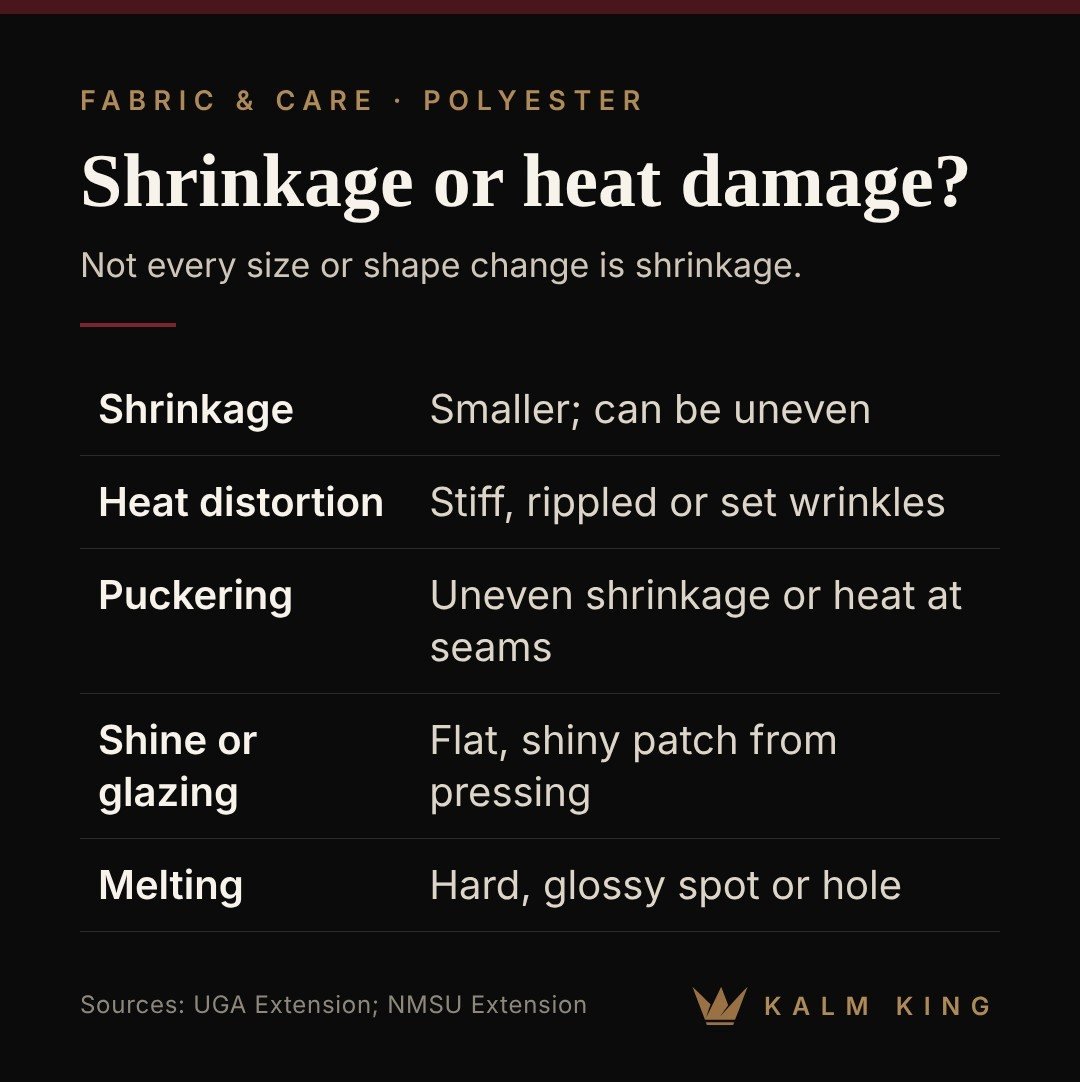
When people say their polyester “shrank,” they sometimes mean something else happened. It helps to separate the possibilities:
- Shrinkage means the garment got smaller. It isn’t always even: a garment can lose more in length than in width, or the other way around, and different components (the body, a lining, a rib collar, a trim) can shrink by different amounts. With pure polyester in normal care, noticeable shrinkage of the polyester itself is the least likely outcome.
- Heat distortion means the fabric changed shape because it got too hot: it may feel stiffer, look rippled, or hold a wrinkle you can’t get out. Polyester takes and keeps a set shape with heat, which is exactly what the pleat-holding property describes. In the wrong place, that same property works against you.
- Puckering shows up along seams or around trims. If a garment combines materials that respond differently to heat and water, such as a stretch band, a different thread, a lining or a cotton pocket, one part can shrink or change while the part sewn to it doesn’t. That uneven shrinkage, or uneven heat damage, pulls the seam into gathers even when the garment as a whole hasn’t gotten noticeably smaller.
- Shine or glazing is a flattened, shiny patch, often from ironing. New Mexico State University Extension’s pressing guide warns that pressing incorrectly can give fabric “a shiny ‘ironed’ look,” and that “too much heat, steam, or pressure may dull or flatten the fabric surface.”
- Melting is the extreme end: a hard, glossy or sticky spot, sometimes with a hole. UGA Extension lists “Melts, if too hot” as one of polyester’s limitations.
Shrinkage you can sometimes plan around. Heat damage is usually permanent. That’s why care for polyester is mostly about managing heat, not water.
Why Polyester Blends Can Still Shrink
Plenty of polyester clothing isn’t pure. UGA Extension notes that “the polyester fiber is often blended with fibers such as cotton, wool, rayon, acetate and linen.” That’s where the answer to “does polyester shrink” gets more complicated, because the other fibers keep their own habits.
Poly-cotton blends
In a cotton and polyester blend, the polyester portion still resists shrinking, but the cotton portion can still relax and shrink the way cotton does. How much the finished garment changes depends on the proportion of each fiber, how the yarn and fabric were made, and how the fabric was finished. The sources cited here don’t give a rule that ties a specific blend ratio to a specific shrinkage figure, so be wary of anyone who does without showing their test.
What you can say safely: the more cotton in the blend, the more the cotton’s behavior matters. Cotton Incorporated’s point that synthetics don’t swell and deswell like cotton is one reason a blend may behave differently from a pure cotton tee, but it doesn’t mean a blend is shrink-proof. For how cotton shrinkage works and how to dry around it, see the cotton shrinkage guide rather than assuming a blend gets you out of it.
Poly-rayon blends
Rayon is a regenerated cellulose fiber, and it has a different set of habits from polyester. UGA Extension lists rayon as “Weaker when wet” and says it “may shrink or stretch, unless treated.” It also notes that finishes have been developed “to reduce shrinking and stretching.” So a polyester and rayon blend can be soft and drapey, but the rayon part needs gentler handling. UGA’s care advice for rayon includes “Machine launder on a short cycle,” and it notes that rayon fabrics “need careful handling during laundering.”
Tri-blends
Tri-blend tees typically combine polyester, cotton and rayon, though the exact mix varies by maker, so always read the fiber content. A tri-blend carries a little of each fiber’s behavior: polyester’s stability, cotton’s tendency to relax, and rayon’s sensitivity when wet. In practice, that means you care for a tri-blend according to its most delicate parts, not according to the polyester. That’s also the logic NMSU Extension gives for pressing blends: “Set the iron according to the fiber requiring the lowest temperature.”
Knit vs Woven, Stretch and Finishing
Fiber is only part of the story. The same polyester can end up in very different fabrics, and the structure decides a lot about how a garment behaves.
Knits
Most tees, polos and performance tops are knits. Jersey and interlock are both knit fabrics, made from rows of interlocking loops rather than threads crossed over and under. Knits stretch and recover, which is why they’re comfortable, but that loop structure also means a knit can be pulled out of shape during manufacturing and relax later. With cotton knits, Cotton Incorporated describes that relaxation in detail. With a well heat-set polyester knit, the fabric is stabilized at the mill, which is the point of heat-setting. If a polyester knit was not well stabilized, or the garment was made from a blend, you may still see some settling after the first washes.
Wovens
Dress shirts, many trousers and outerwear shells are usually woven. Woven fabrics are generally more stable in length and width than knits because the yarns are locked into a grid. Polyester is common in wovens for wrinkle resistance and easy care, and it’s often blended with cotton or wool. Here, the blend partner and the finishing usually matter more than the polyester.
Elastane and stretch fibers
A lot of polyester clothing includes elastane, also called spandex, for stretch. Elastane has a different relationship with heat. UGA Extension says spandex is “damaged by chlorine bleach and heat” and “melts at relatively low heat,” and its care advice is to “drip-dry or dryer-dry at low temperature for ten minutes.” So a polyester and elastane gym shirt or pair of performance boxers may be more heat-sensitive than the polyester alone would suggest. Heat that the polyester tolerates can still wear out the stretch.
Finishes and trims
Finishes can change how a fabric behaves, and trims can behave differently from the main fabric. A printed graphic, a bonded seam, a heat-applied label or a reflective strip may each have its own heat limits. If a garment has any of these, the care label will usually be more cautious than the fiber alone would require, and that caution is there for a reason.
Can You Shrink Polyester on Purpose?
This is where honesty matters more than a neat trick. If a pure polyester garment is too big, there’s no reliable home method to shrink it to a specific size, and the sources I read don’t describe one.
Extra heat is not a reliable sizing tool. A hotter wash or dryer can distort the fabric or damage elastane, prints or trims without producing a predictable smaller fit. Keep following the care label, including its washing temperature and drying method, and don’t exceed those limits hoping to shrink the garment.
The more predictable fixes are the ordinary ones:
- Alter it. For wovens such as trousers, shirts and jackets, a tailor can often take in the waist, seat, side seams or sleeves, depending on the construction and how much fabric there is to work with.
- Exchange or buy another size. For tees, polos and performance tops, getting the right size is usually simpler and more reliable than trying to change the wrong one.
- Restyle it. A slightly roomy piece may work as a layer or a relaxed-fit option rather than something you wear close to the body.
For a blend, any change in size will mostly come from the cotton or rayon, not the polyester, and it may not be even across the garment, which is another reason to fix fit through alterations or sizing rather than heat. Our guide on how a men’s t-shirt should fit covers what to look for when you choose the next one.
How to Care for Polyester Without Worrying About Size
Polyester is easy to care for, which is a big part of its appeal. The rules are short, and nearly all of them are about heat.
Start with the care label
Your garment’s sewn-in care label comes first, every time. AFMA itself says that for specific instructions you should “refer to garment’s sewn-in care label.” The label reflects the whole garment, including blend fibers, stretch, prints and trims, not just the polyester. If the label is more cautious than the general advice below, follow the label.
Washing
- Use the water temperature the label gives. AFMA’s general tip for polyester is to “use warm water.” Blends with rayon, or garments with prints or elastane, may call for cooler water, so let the label decide.
- Choose the cycle with the most delicate fiber in mind. For a polyester and rayon blend, UGA Extension’s rayon advice of a short cycle is the better guide.
- Wash whites with whites. UGA Extension advises that white polyester garments “should be washed only with other white ones.” It also notes polyester can absorb body oils and perspiration odor, so oily stains need spot treatment before laundering.
- Bleach carefully. UGA Extension’s advice for polyester is “use a dry oxygen bleach.” Remember that elastane is “damaged by chlorine bleach,” so check the label for any stretch garment.
Drying
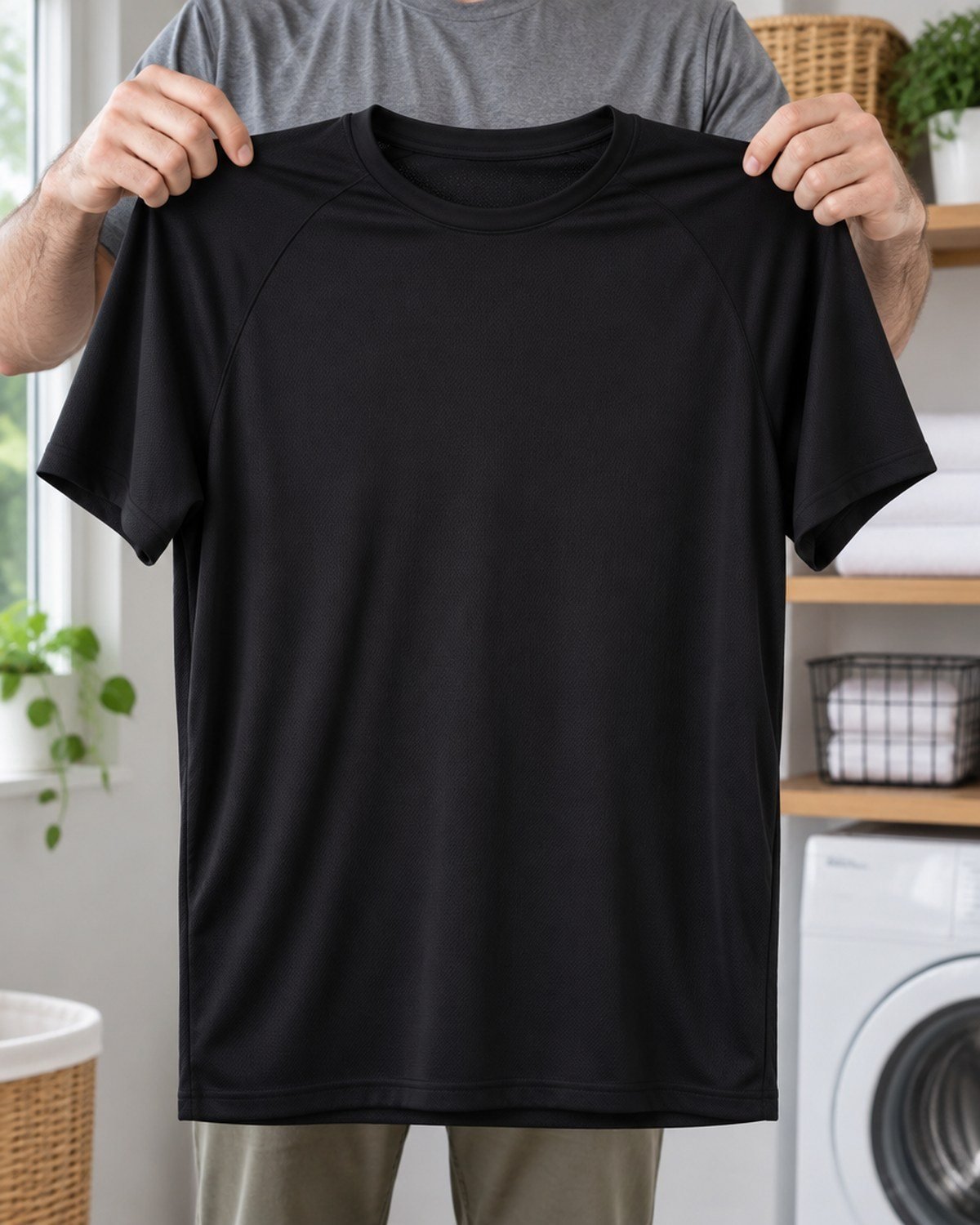
Excess dryer heat can distort fabric, set unwanted wrinkles, or damage stretch fibers, prints and trims. Follow the garment’s care label, including whether tumble drying is allowed.
- Dry low. AFMA advises: “Machine dry at a low temperature and remove articles as soon as the tumbling cycle is completed.”
- Don’t let it sit in a hot drum. Pulling items out promptly is part of the same AFMA advice. A warm, crumpled heap can set wrinkles.
- Hang or lay flat when you can. Polyester is quick drying, so air drying is often fast and takes heat out of the equation entirely.
- Treat stretch pieces gently. For garments with elastane, UGA Extension’s spandex advice is drip-drying or a low-temperature dryer for about ten minutes.
Ironing and pressing
Many polyester garments don’t need ironing at all, since AFMA calls the fiber wrinkle resistant. If you do press:
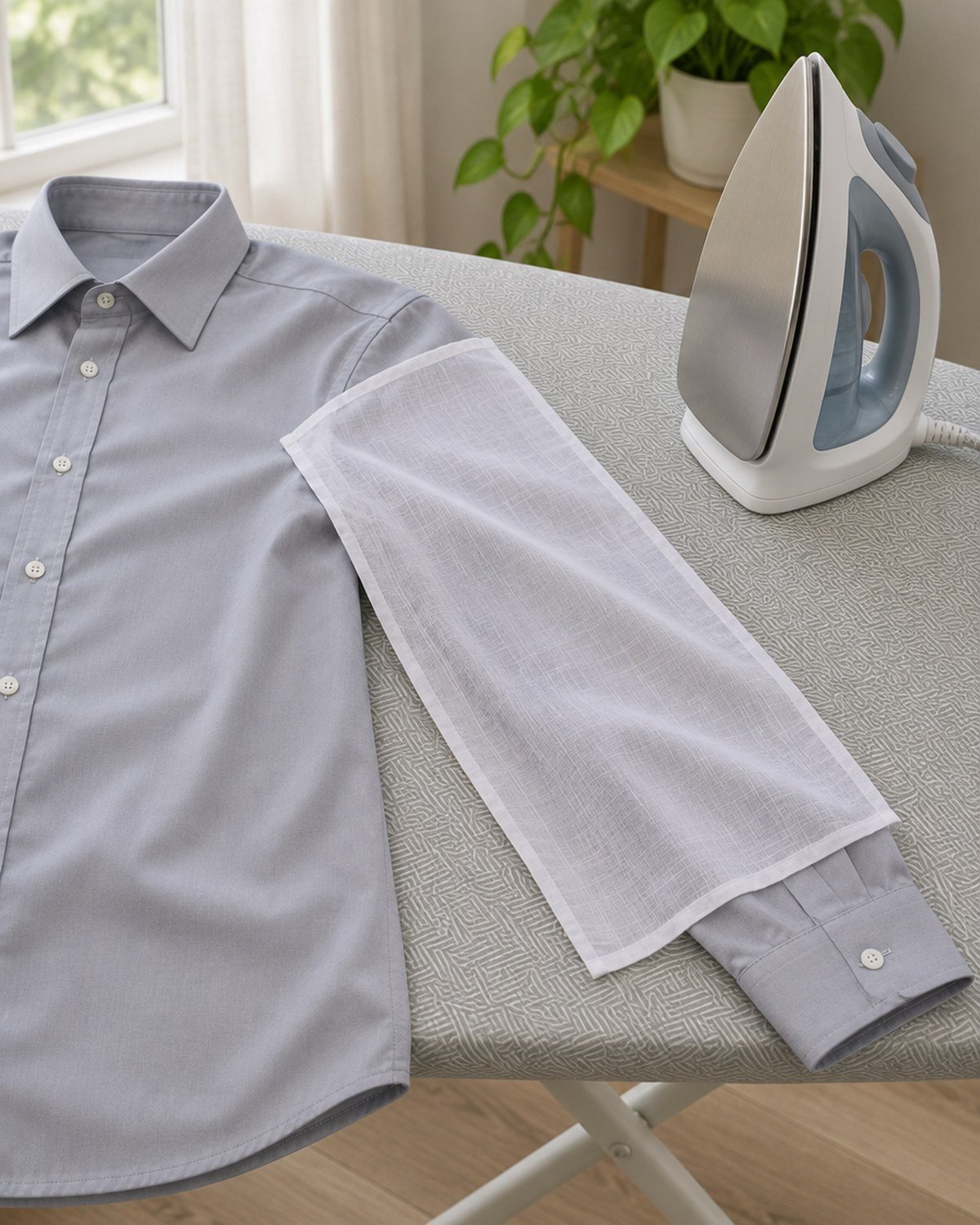
- Keep the iron low. AFMA says “use a moderately warm iron,” and UGA Extension says to “set iron on a low temperature and use steam.”
- Use a press cloth or the wrong side. NMSU Extension’s guide for polyester says to “press on wrong side or with press cloth.”
- For blends, follow the most sensitive fiber. As NMSU puts it, set the iron for “the fiber requiring the lowest temperature.”
How to Buy Polyester With Minimal Size Change
You can avoid most surprises before the garment ever reaches the wash.
Read the fiber content, not just the word “polyester”
“Polyester” on a hang tag might mean 100% polyester, a poly-cotton tee, a tri-blend or a performance fabric with elastane. Find the exact percentages on the label or product page. If size stability is your priority, a high polyester content in a well-made fabric is the most predictable option according to how the fiber is described by AFMA and UGA Extension. If cotton or rayon makes up a large share, plan as if the garment can shrink somewhat.
Read the care label before you buy
If the label says to tumble dry low or line dry, take that seriously, especially on blends. A garment labeled for cool washing and low or no tumble drying is telling you the maker thinks heat is a risk. If you know you’ll put everything through a hot dryer, choose pieces whose labels allow it.
Check the size chart against a garment you like
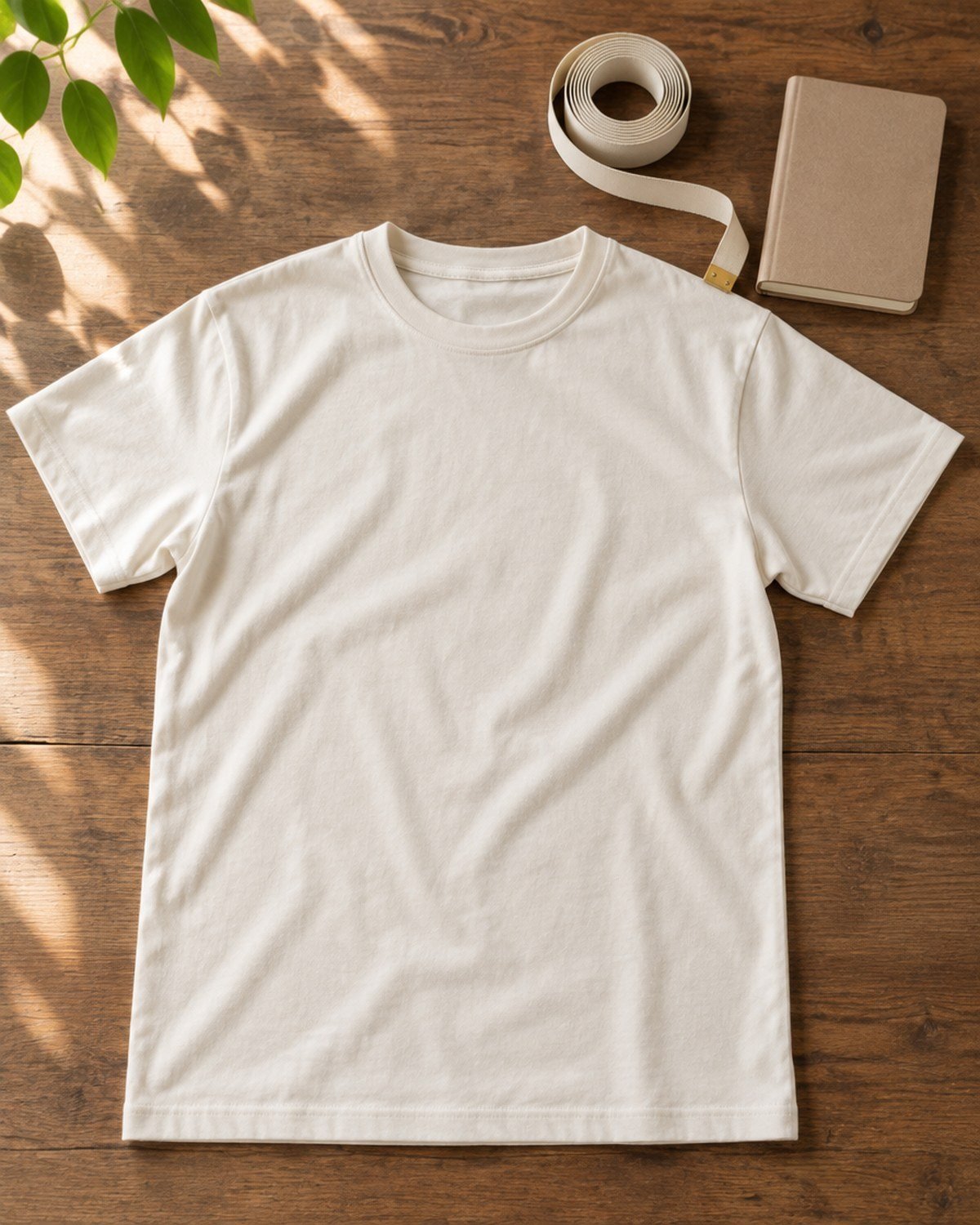
Measure a polyester or blended piece that already fits you well after it has been washed your usual way. Compare body length, chest and sleeve to the brand’s size chart. Our Size & Fit Reference explains how to measure a garment flat and what each number means. With a stable polyester piece, you can generally shop close to your numbers. With a cotton-heavy blend, a little extra length gives you room for change.
Look at construction and extras
Check whether the garment has prints, bonded seams, reflective trims or heat-applied labels, and how much elastane it contains. Each of these is a reason to keep heat low. If you’re buying a polyester piece for someone else and don’t know how they do laundry, a garment whose label allows machine washing and low tumble drying is the more forgiving choice. Our guide on how to buy clothes for him without guessing covers the rest of the sizing questions.
Read reviews for change after washing
Reviews that mention fit after several washes are more useful than first impressions. Look for comments about length, width, pilling or stiffness after drying, and look for patterns rather than one strong opinion. UGA Extension notes polyester “may pill and attract lint” and “accumulates static electricity,” so those are worth watching for too, even if the size holds.
Common Mistakes With Polyester
These habits can increase the risk of size changes or damage.
- Assuming “polyester” means “won’t shrink.” A blend can still shrink through its cotton or rayon.
- Running the dryer hot because “it’s synthetic.” Heat is the main risk for polyester, not water. AFMA’s advice is low heat and prompt removal.
- Leaving items in a warm dryer. Crumpled, warm polyester can hold wrinkles you didn’t want.
- Ironing on high, right side up. That’s how you get shine or worse. Use a low setting and a press cloth.
- Ignoring the elastane. Stretch fibers are more heat-sensitive than polyester, so they can wear out first.
- Using chlorine bleach on stretch garments. UGA Extension notes spandex is damaged by chlorine bleach.
- Using heat to fix a garment that’s too big. The likely result is damage, not a neat size change. Alterations or another size are more predictable.
- Sizing up “for shrinkage” on pure polyester. If the fabric is stable, the extra room may never shrink away. Buy the size that fits.
Your Polyester Checklist
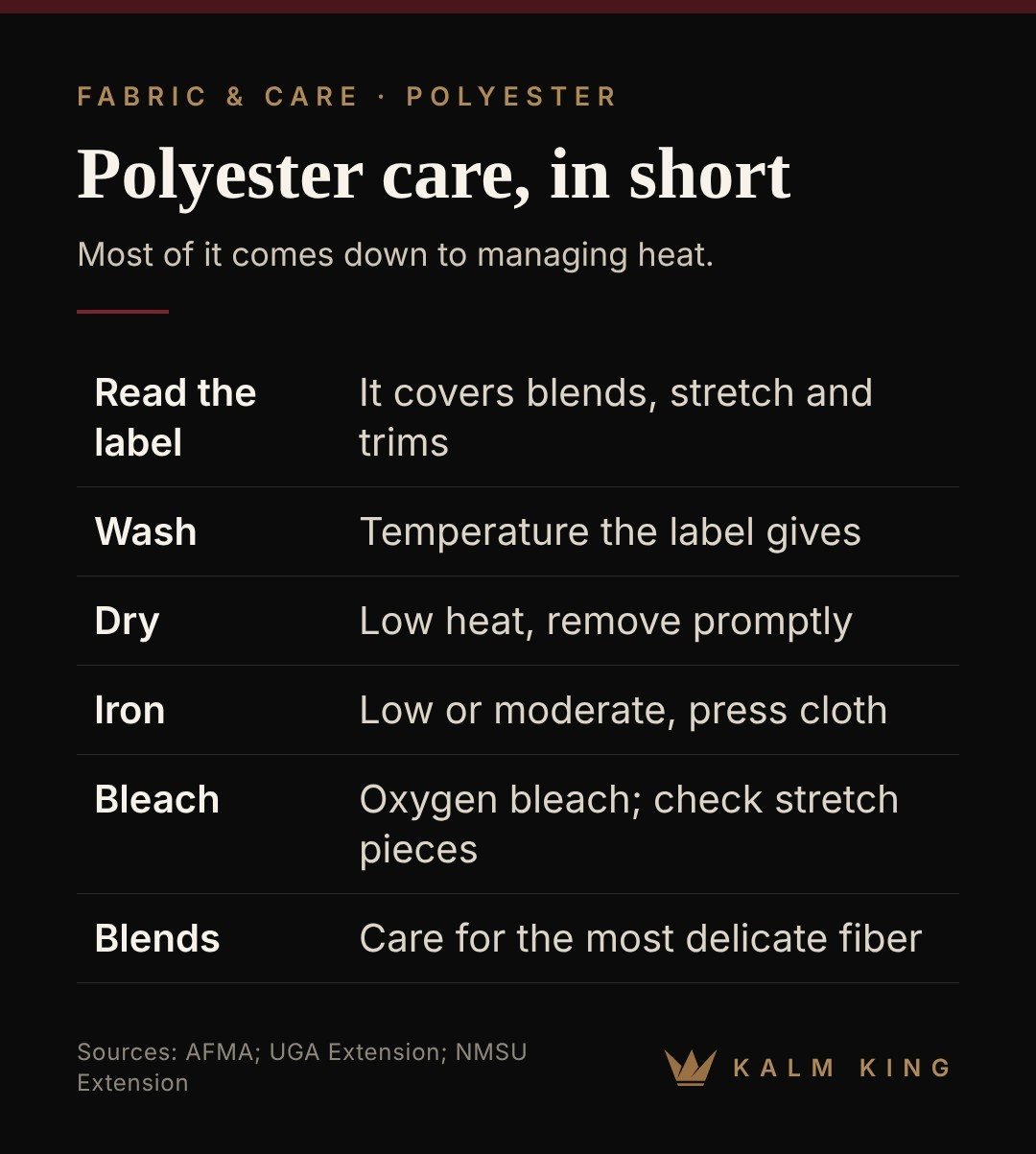
Use this when you buy and when you do laundry.
When you buy
- [ ] Check the exact fiber percentages, not just the word “polyester.”
- [ ] Note any cotton, rayon or elastane in the mix.
- [ ] Read the care label for drying and ironing limits.
- [ ] Compare the size chart to a garment that fits after washing.
- [ ] Look for prints, bonded seams and trims that may limit heat.
- [ ] Buy the size that fits instead of sizing up for shrinkage on pure polyester.
When you wash
- [ ] Follow the care label first.
- [ ] Use the water temperature the label gives.
- [ ] Wash whites with whites, and pre-treat oily stains.
- [ ] Use oxygen bleach if needed, and avoid chlorine on stretch pieces.
When you dry and press
- [ ] Tumble dry low and remove promptly, or hang to dry.
- [ ] Keep elastane pieces on low heat and short cycles.
- [ ] Iron low, on the wrong side or with a press cloth.
- [ ] Set the iron for the most sensitive fiber in a blend.
Bringing It Together
So, does polyester shrink? Pure polyester is built to resist it: it doesn’t swell with water like cotton, and it holds the shape it was heat-set into at the mill. Blends are a different story, because the cotton or rayon still behaves like cotton or rayon. And polyester’s weak point isn’t water at all. It’s heat. Read the label, keep the dryer and iron low, and the size you buy is likely to be the size you keep.
Keep going in Fabric & Care: what viscose is, what modal fabric is, and what a heavyweight t-shirt is.
Frequently asked questions
Does 100% polyester shrink in the wash?
Pure polyester is generally resistant to shrinking in normal home laundering; the American Fiber Manufacturers Association lists it as “resistant to stretching and shrinking.” That isn’t a guarantee for every garment, because construction, finishing and trims also matter, so follow the care label.
Do polyester blends shrink?
They can. In a blend, the polyester resists shrinking, but cotton or rayon in the mix can still shrink, and University of Georgia Extension notes rayon “may shrink or stretch, unless treated.” Care for a blend according to its most delicate fiber.
Can you shrink polyester in the dryer on purpose?
There’s no reliable home method to shrink pure polyester to a specific size. Exceeding the care label’s heat limits can distort fabric or damage stretch fibers, prints and trims. Follow the label’s washing and drying instructions; alterations or buying another size are more predictable fixes.
What temperature should I dry polyester on?
Follow the care label first. As general advice, the American Fiber Manufacturers Association says to machine dry polyester at a low temperature and remove it as soon as the tumbling cycle is completed.
Sources
- Polyester (American Fiber Manufacturers Association) (trade association)
- Understand Your Fibers (University of Georgia Cooperative Extension) (university extension)
- Technical Bulletin ISP-1009: Guide to Improved Shrinkage Performance of Cotton Fabrics (Cotton Incorporated) (industry body)
- Pressing Pointers, Guide C-309 (New Mexico State University Extension) (university extension)
FIELD NOTES
Get the Overalls Fit Kit, free.
Your measurement card, the six fit checkpoints and a checklist to take shopping. Join Field Notes for new guides and a say in what Kalm King makes.
THE KALM KING JOURNAL
Continue reading

How Should Men’s Dress Pants Fit? Waist, Rise, Seat and Break
How should dress pants fit? Check the waist, rise, seat, thighs and hem with practical sitting tests, break options and realistic tailoring advice.
How Should a Dress Shirt Fit? A Men’s Guide to Collar, Chest and Sleeves
Check dress shirt fit at the collar, shoulders, chest, sleeves and hem. Learn what to measure, how to test movement and when to try another cut.
Men’s Capsule Wardrobe: How to Build One That Actually Works
A men’s capsule wardrobe is a small set of clothes that all work together. How to choose the pieces, colors and fit, and build one at your own pace.