
September 19, 2026
How to buy clothes for him without guessing
His closet already contains the best clues. Read the labels, notice the repeats and buy for his actual life.
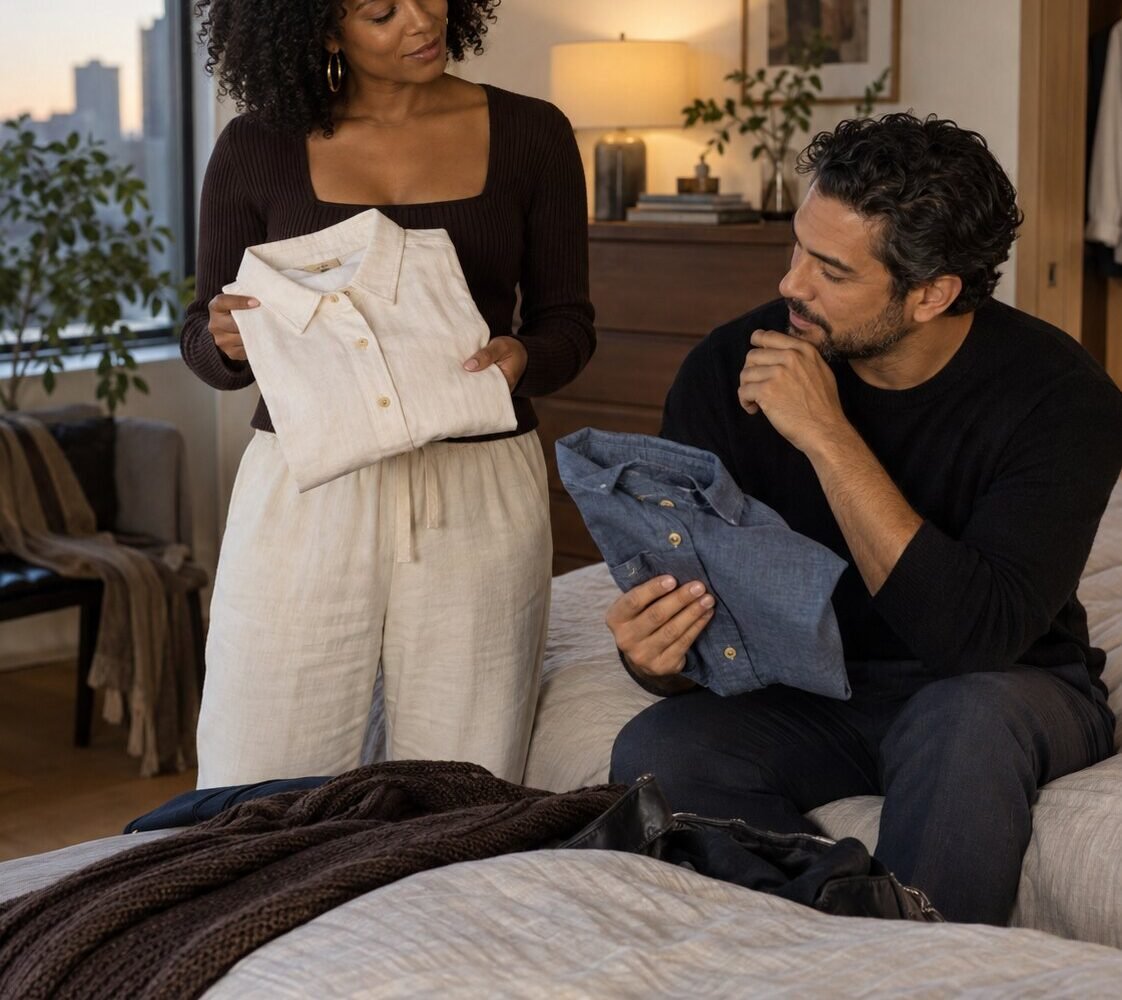
Buying clothes for someone can feel personal right up until the size menu opens. A good gift needs to suit his taste, fit his body and belong in his actual week. Guessing at all three is unnecessary. His closet already contains most of the evidence.
Begin with what he repeats, not what you wish he wore. The shirt that appears every weekend, the jacket hanging near the door and the shoes worn down at the heel tell you more than a trend report. Read those clues, decide how much fit risk you are willing to take and keep the exchange easy.
Use his repeats as the brief
Look for patterns across several garments. One black shirt proves very little. Five dark shirts in cotton, knit and denim suggest a real preference. The same applies to collars, trouser rises, jacket lengths and shoe shapes.
Notice what he wears in specific parts of his life. Work clothing may follow a dress code he would never choose for dinner. Gym clothes may prioritize performance over personal style. The most useful gift usually suits a setting he enters often and a type of garment he already chooses without being reminded.
- Which colors appear most often?
- Are the fabrics crisp, soft, washed, technical or heavy?
- Does he wear clothes close to the body, straight, or deliberately relaxed?
- Which brands and sizes recur?
- What stays unworn even though it is new?
An unworn item may be too formal, uncomfortable, difficult to clean or unlike him. Do not treat its presence as approval.
Research favors usefulness over the reveal
Gift givers often focus on the exchange itself. Recipients live with the gift afterward. That difference helps explain why an impressive surprise can be less welcome than a useful object the recipient will reach for repeatedly.
In four experiments, researchers found that givers leaned toward smaller, more exclusive gifts, while receivers showed more interest in useful options. Later research found that feasible gifts, meaning gifts that are convenient to use, can make recipients feel closer to the giver than more desirable but less practical alternatives. Consumer researchers have also documented how close givers sometimes ignore explicit requests because choosing something unrequested seems more thoughtful. Recipients do not reliably interpret that detour as greater care.
A request is information, not a creativity test. If he names a specific jacket, size or brand, believe him. Add the personal signal through the note, timing or presentation instead of replacing what he asked for.
Copy the label, then measure the garment
A size is useful only inside its brand and cut. A medium in one shirt can resemble a large in another. Photograph the label of a garment he wears often, including brand, size, fabric composition and care instructions. Then compare the new item’s size chart with the garment itself.
Lay the trusted garment flat without stretching it. For a shirt or jacket, record shoulder width, chest, sleeve and back length. For trousers, record waist, front rise, thigh, inseam and leg opening. Use the retailer’s method when provided. A half-chest measurement taken flat is not the same number as a full chest circumference.
The shoulder deserves extra attention because it affects the collar, chest, armhole and sleeve. Why the shoulder changes everything shows where a conventional seam should sit and how to measure a shirt that already fits.
Compare like with like. A relaxed overshirt should not size a tailored dress shirt. A pleated trouser will not share the same thigh measurement as a slim five-pocket pant. The goal is to understand the amount of ease he accepts in that kind of garment.
Choose the right level of fit risk
Some clothing gifts tolerate uncertainty. Others punish it. When the evidence is thin, move toward pieces with flexible sizing and easy returns.
Low-risk gifts include scarves, caps, socks and bags, provided the style matches what he uses. Knitwear, sweatshirts, overshirts and robes sit in the middle because their construction allows ease. Fitted shirts, trousers, tailored jackets and shoes need stronger evidence. Shoes are personal because two people with the same numerical size may need different widths or lasts.
Color does not erase fit risk. Black may be common in his wardrobe, but texture and silhouette still need to belong there. If black is one of his repeats, Three ways to make black feel considered can help you choose a fabric and proportion that work with what he owns.
Buy for his actual maintenance habits
Read the care labels in his closet. If almost everything is machine washable, a dry-clean-only gift creates a chore he did not request. If he travels often, a delicate fabric that wrinkles in a suitcase may stay home. If he runs warm, a heavy synthetic layer can be wrong even when the color and size are right.
Protect the exchange
A gift receipt does not make the choice less thoughtful. It acknowledges that clothing has to pass a test no object can pass in a box. Confirm the return window, whether sale items are final, whether exchanges can be made online and whether the recipient needs the original payment method.
Leave tags attached and make trying it on feel normal. If the size is wrong, treat the exchange as part of completing the gift, not a verdict on your taste.
The five-minute decision check
- Have I seen him wear this garment type more than once?
- Do I know the brand, size and intended fit of a comparable piece?
- Does the fabric suit his climate, comfort and care habits?
- Is the garment for a real part of his life?
- Can I explain what works with it in his closet?
- Is the return or exchange easy?
Good clothing can change how someone carries himself, but only if it feels like his. That connection is explored in Can clothes change how you feel? What the research actually says.
Sources
- Teigen, K. H., Olsen, M. V. G. and Solås, O. E. “Giver-receiver asymmetries in gift preferences.”
- Liu, P. J., Dallas, S. K. and Fitzsimons, G. J. “A Framework for Understanding Consumer Choices for Others.”
- Rim, S., et al. “The Gift of Psychological Closeness.”
- Proper Cloth. “How to Measure a Dress Shirt.”
Frequently asked questions
How can I find his clothing size without asking?
Photograph the label and measure a comparable garment he wears often. Compare those garment measurements with the retailer’s chart instead of relying on the size letter alone.
What clothing gifts are safest when the size is uncertain?
Accessories and relaxed garments carry less fit risk. Caps, scarves, bags, knitwear and overshirts are usually safer than fitted shirts, trousers, tailored jackets or shoes.
Is a gift receipt impersonal?
No. A gift receipt protects the recipient from a brand or fit mismatch and makes the exchange part of completing the gift.
THE KALM KING JOURNAL
Continue reading

Can clothes change how you feel? What the research actually says
Can clothes affect confidence and first impressions? A research-backed look at fit, context, bias and getting dressed with intention.
Why the shoulder changes everything
Learn where a shirt or jacket shoulder seam should sit, how to spot pulling or overhang, and how to measure a garment that already fits.

Three ways to make black feel considered
Black works hardest when the outfit has texture, proportion and one small point of contrast.