
September 22, 2026
Can clothes change how you feel? What the research actually says
Can clothes affect confidence and first impressions? A research-backed look at fit, context, bias and getting dressed with intention.

Most advice about clothing and confidence skips straight to a promise: put on the right outfit and become a different man. The research is more interesting than that. Clothes can influence first impressions, change the way a situation feels and sometimes affect the wearer’s thinking. They cannot manufacture ability, erase nerves or turn an expensive jacket into proof of character.
The useful question is smaller: can getting dressed with intention help you enter a room with less friction and a clearer sense of how you want to move through it?
What “enclothed cognition” actually means
Psychologists Hajo Adam and Adam Galinsky introduced the term “enclothed cognition” in 2012. Their experiments used white laboratory coats and proposed that clothing can affect the wearer when two conditions meet: the garment carries a symbolic meaning and the person physically wears it. Participants who believed they were wearing a doctor’s coat showed improved attention on one task.
That finding became a tidy headline, but later evidence complicated it. A 2019 preregistered direct replication used roughly ten times as much data and did not reproduce the original selective-attention effect. That matters. The honest conclusion is not that clothing secretly rewires the brain. It is that clothes can act as contextual cues, while the size and reliability of specific cognitive effects remain unsettled.
Clothes may change the frame of mind
A separate 2015 paper tested formal clothing across five studies. The researchers found associations between formal dress and more abstract, big-picture processing. In one experiment, participants were randomly assigned to change into formal or casual clothing before completing a visual-processing task. The authors also found that a greater sense of power helped explain part of the relationship.
These were controlled studies, many with student samples, so they should not be treated as a rule that suits make people smarter. They do support a familiar experience: an outfit can help mark a transition. Work clothes, training clothes and evening clothes tell the body that the context has changed. A useful garment can become part of the routine that moves you from one role into another.
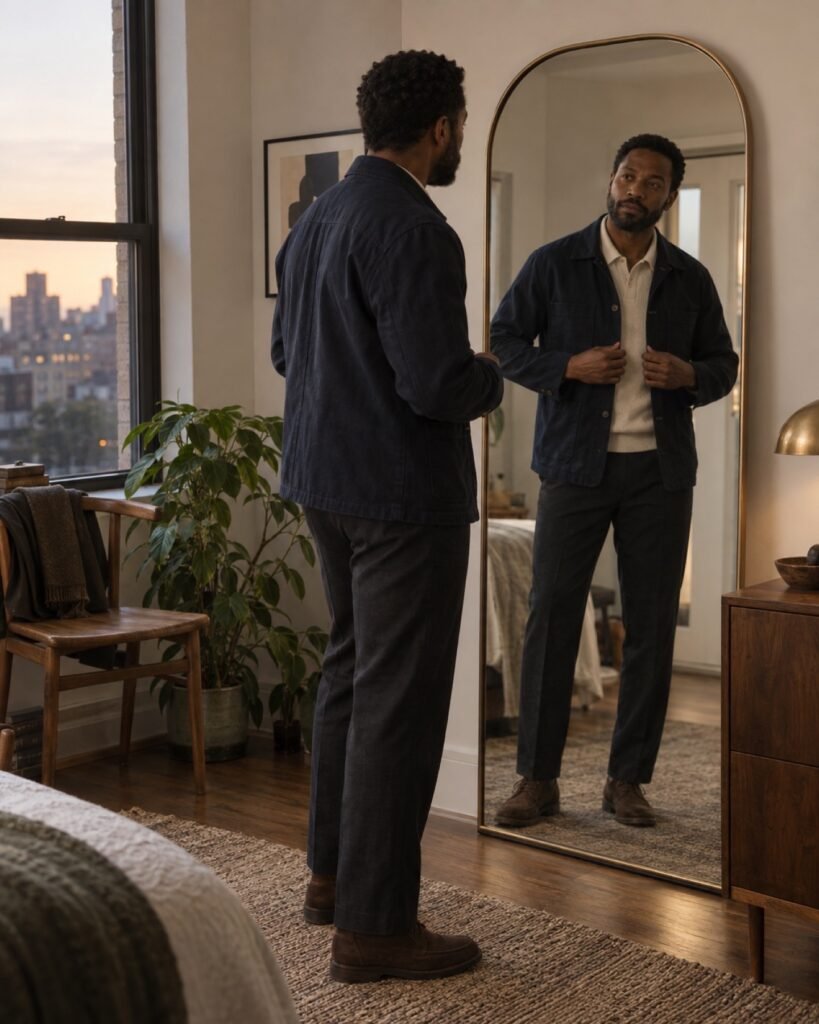
Other people notice smaller differences than we think
Clothing affects the observer as well as the wearer. In a 2013 study, 274 participants saw a faceless man for no more than five seconds. He wore either a made-to-measure suit or a standard off-the-rack version with only minor visual differences. The made-to-measure version produced higher ratings for confidence, success, salary and flexibility, though not trustworthiness.
A 2020 paper in Nature Human Behaviour went further. Across nine studies, the same faces were judged as more competent when paired with clothing that independent raters read as richer. The effect remained when images flashed for only 129 milliseconds and when participants were told to ignore the clothes. The researchers were documenting bias, not discovering a fair way to measure competence. What we wear can influence a judgment even when the judgment is wrong.
That distinction protects us from bad style advice. Looking expensive is not the same as being capable. A garment’s price cannot supply skill, generosity or good judgment. The evidence shows how quickly observers use clothes as shorthand, which is a reason to dress deliberately and a reason to question our assumptions about other people.
A practical way to dress with more confidence
Start with the situation. Name what the day asks from you before opening the closet: ease, authority, approachability, movement or some combination of them. A dinner, presentation and long travel day need different kinds of composure.
Then remove physical distractions. A collar that shifts, a waistband that pinches or a jacket that blocks your reach will keep asking for attention. Good fit is partly visual, but its greater value is that you can stop managing the garment and return your attention to the room.
For shirts and jackets, begin with the upper body: a clean shoulder line helps the collar stay put and lets the sleeve move without making you manage the garment all day.
Build a repeatable formula from clothes you already trust. It might be a knit polo, straight trouser and overshirt; a white shirt with dark trousers; or a clean T-shirt under a relaxed jacket. Repetition is useful when it reduces decisions without making you feel anonymous. Change the fabric, color or shoe while keeping the dependable structure.
Finally, choose one detail that feels intentional at conversational distance. That could be the texture of a jacket, the break of the trouser, a watch you actually wear or a collar that sits cleanly beneath a coat. You do not need a room to notice every choice. You need the outfit to feel resolved when you leave the mirror.
Confidence still has to belong to you
Clothing works best as support. It can reduce distraction, signal that a moment matters and remind you of the role you are ready to occupy. The research also shows that observers bring their own biases to what they see, so no outfit can guarantee the response you deserve.
Wear the clothes, check that you can move and then let your attention leave them. The goal is not to spend the evening thinking about a jacket. The goal is to have chosen well enough that you can think about everything else.
Research notes
- Adam and Galinsky (2012), “Enclothed cognition”, Journal of Experimental Social Psychology.
- Burns et al. (2019), preregistered direct replication, Journal of Experimental Social Psychology.
- Slepian et al. (2015), “The Cognitive Consequences of Formal Clothing”, Social Psychological and Personality Science.
- Howlett et al. (2013), rapid first impressions from minor changes in male attire, Journal of Fashion Marketing and Management.
- Oh, Shafir and Todorov (2020), clothing-status cues and perceived competence, Nature Human Behaviour.
Continue reading
Put the research into practice with three ways to make black feel considered, or use the evidence-first system in how to buy clothes for him without guessing.
Frequently asked questions
Can clothes make you more confident?
They can influence self-perception, comfort and behavior, but no garment guarantees confidence. Fit, context and how closely the clothing matches your sense of self all matter.
Do first impressions depend only on clothing?
No. Clothing is one signal among posture, expression, grooming, speech and the setting. The strongest impression usually comes from those signals working together.
Is expensive clothing more effective?
No. Price is not a reliable substitute for fit, appropriateness or comfort. A well-fitting garment that suits the situation can communicate more clearly than an expensive piece that feels wrong.
THE KALM KING JOURNAL
Continue reading
Why the shoulder changes everything
Learn where a shirt or jacket shoulder seam should sit, how to spot pulling or overhang, and how to measure a garment that already fits.
Three ways to make black feel considered
Black works hardest when the outfit has texture, proportion and one small point of contrast.

How to buy clothes for him without guessing
His closet already contains the best clues. Read the labels, notice the repeats and buy for his actual life.