
November 23, 2026
Explore: Fabric & Care
How to Remove Pilling From Clothes (and Stop It Coming Back)
How to remove pilling from clothes with a fabric shaver, comb or razor without damage, which fabrics pill most, and how to wash so pills don't come back.

You pull out the sweater you wore all last winter and the elbows look like they’ve grown a beard. Little balls of fuzz sit along the sleeves, under the arms and down the sides. The colour’s fine. The fit’s fine. It just looks tired, and tired is the one thing a good sweater shouldn’t look.
Those balls are called pills, and almost every soft fabric gets them eventually. The good news is that pilling is a surface problem. The yarn underneath is usually still intact, which means most pilled clothes can look close to new again in ten minutes, if you remove the pills the right way and change the habits that caused them.
This guide covers what pilling actually is, which fabrics are most prone to it, how to remove pills without damaging the garment, and how to wash and wear your clothes so the pills don’t come straight back.
Short answer: Lay the garment flat on a hard surface, pull the fabric taut and go over the pilled areas with a fabric shaver (also called a de-piller) using light pressure, testing on a hidden spot first. For delicate or loose knits, use a sweater comb gently instead. To slow pilling down, wash clothes inside out on a cold, gentle cycle with zips and buttons closed, don’t overload the machine, and air dry or tumble on low. Pilling is caused by rubbing, so cutting down on friction during wear matters as much as how you wash.
What Is Pilling?
A pill is a small ball of tangled fibres stuck to the surface of a fabric. Cotton Incorporated’s textile team defines pills exactly that way: small balls of entangled fibres attached to the surface of a material. The Woolmark Company, the wool industry body, calls the same thing “bobbling” and puts it simply: pilling is caused by rubbing during wear.
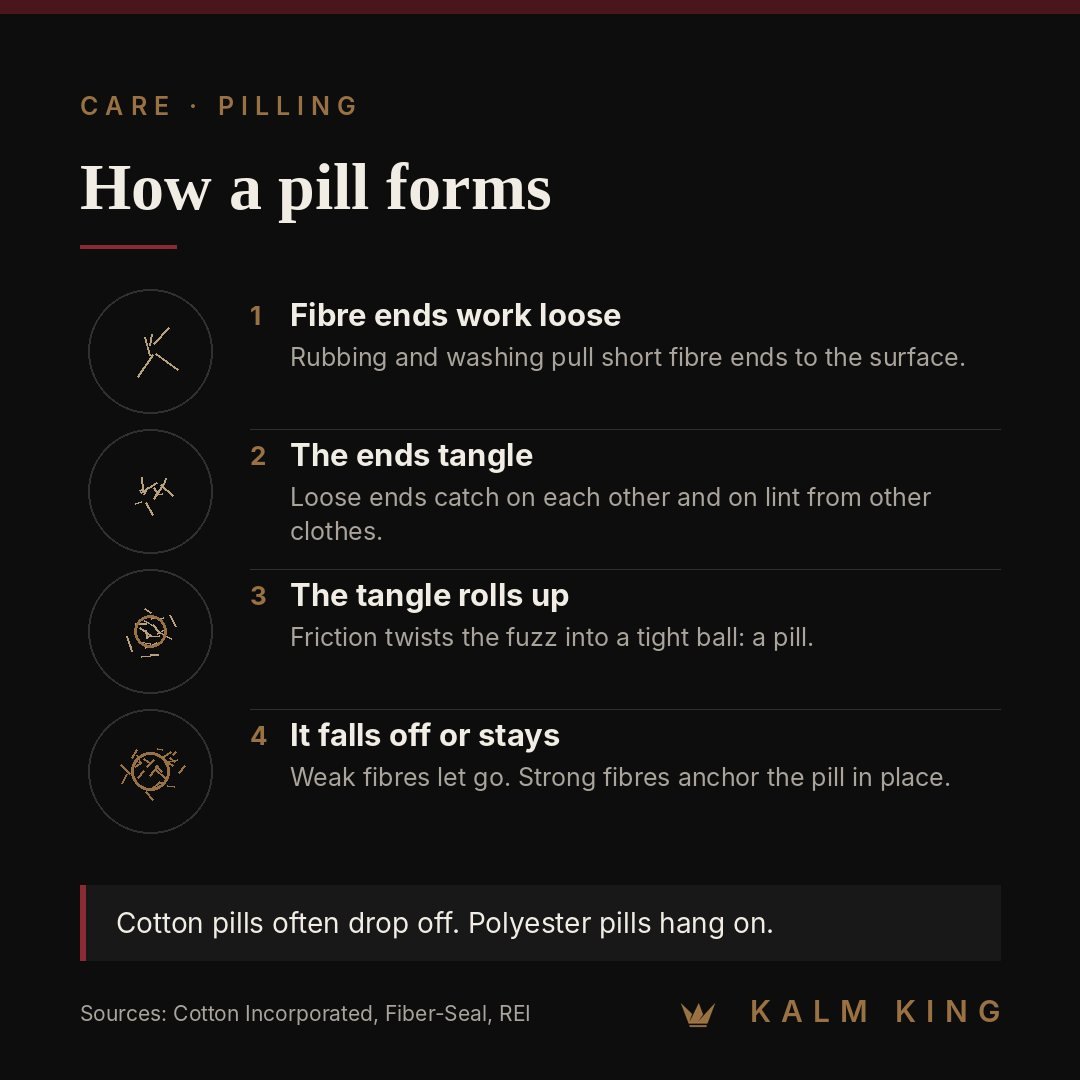
Here is how a pill forms:
- Fibre ends work loose. Every spun yarn is made of many short fibres twisted together. Abrasion, from wear or from tumbling in a washer and dryer, pulls some of their ends out to the surface.
- The ends tangle. Those loose ends catch on each other, and on stray lint from other clothes in the same load.
- The tangle rolls up. Continued friction rolls the fuzz into a tight little ball.
- The pill falls off or stays. This is where the fibre matters. Fiber-Seal’s textile notes explain that with some fabrics, such as cotton, pills can fall off on their own, sometimes so soon after they form that you hardly notice them. Other fabrics have strong “anchor” fibres that hold the pill in place.
Cotton Incorporated adds a useful distinction between two kinds of pill. Laundry pills (or lint pills) form in the wash, where wet and dry tumbling creates plenty of loose fibres. Wear pills form while you’re wearing the garment: under the arms of shirts, around the collar, and in the crotch of trousers. Most pills, according to its materials, form during laundering. That’s why how you wash is one of the biggest levers you control.
Why Some Clothes Pill and Others Don’t
REI’s lab test analyst puts the cause bluntly: abrasion is almost always the culprit. Fabric rubbing on itself, such as the inside of a sleeve against the body of a jacket, or rubbing on something else, such as a backpack hip belt or a hook-and-loop strap, loosens fibres until they tangle into pills.
But two sweaters worn the same way can age very differently. Cotton Incorporated lists the factors that decide how much a fabric pills:
- Fibre type, or the blend of fibres
- Fibre fineness
- Yarn and fabric construction: loose, low-twist yarns and open knits release more fibre ends
- Finishing treatments applied at the mill
- End use: a sock or a base layer sees more friction than a jacket
The Woolmark Company’s advice to designers points the same way. To reduce pilling, it recommends longer fibres, the highest twist the yarn can handle, and fabrics with a higher cover factor, meaning a tighter, denser surface.
Which fabrics pill most
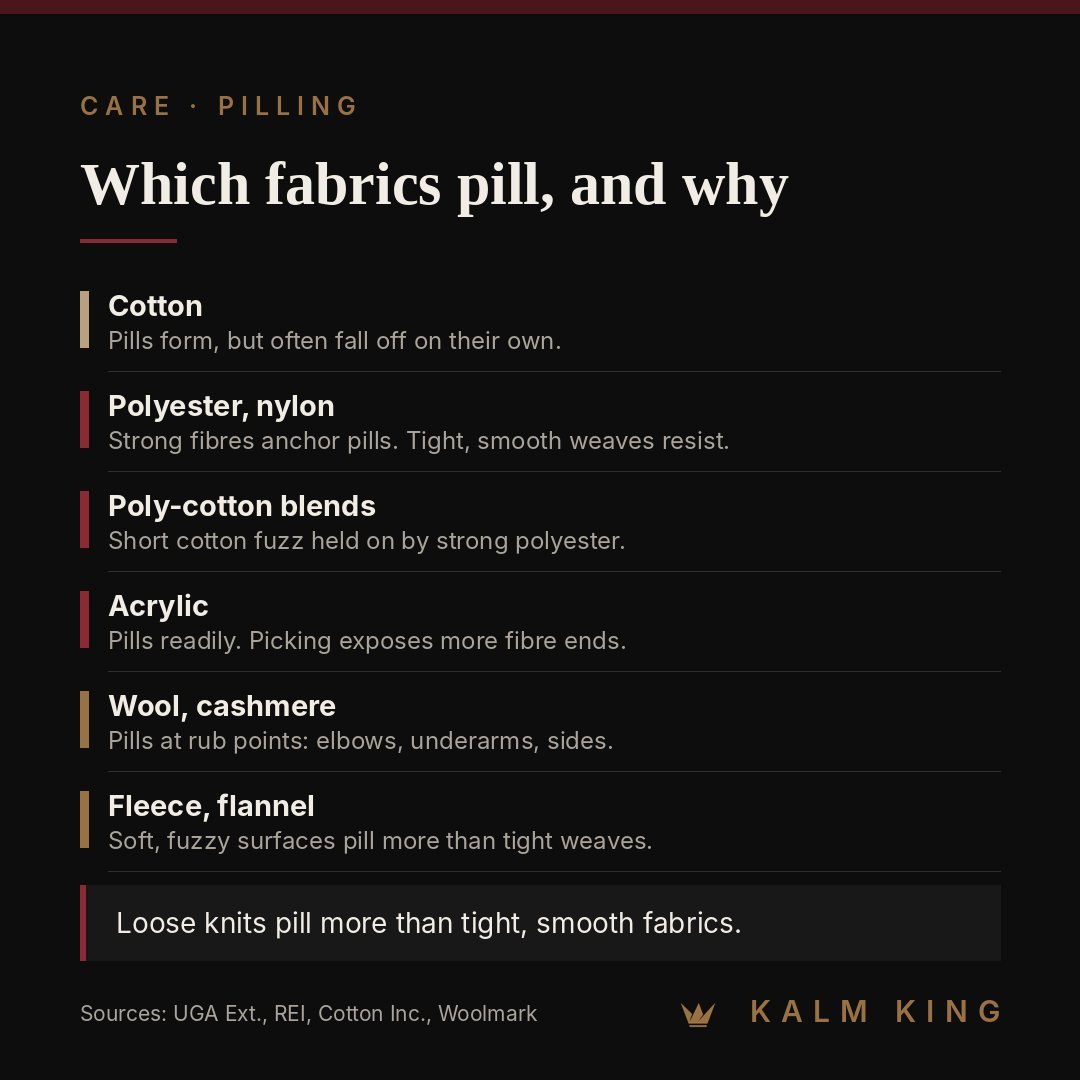
| Fabric | How it pills | What to expect |
|---|---|---|
| Cotton | Pills form, but weak cotton fibres often let them fall off | Surface fuzz and dullness more than stubborn balls |
| Polyester and nylon | Strong fibres act as anchors that hold pills on | Fewer loose fibres, but the pills that form stick around. Tightly woven nylon resists pilling well |
| Poly-cotton blends | Short cotton fuzz gets held in place by strong polyester | Often the most visible, longest-lasting pills |
| Acrylic | Pills readily; static helps fuzz gather | Pills can appear early, especially on cheap knits |
| Wool and cashmere | Pills at points of rubbing | Elbows, underarms and sides first. Usually removable |
| Fleece and flannel | Soft, raised, fuzzy surfaces | More prone than smooth, tightly woven fabrics |
Sources: Fiber-Seal, Cotton Incorporated, UGA Extension, Woolmark, REI.
The blend row deserves a closer look, because poly-cotton is everywhere in hoodies, sweatshirts and cheap tees. In a laboratory study of knitted fabrics from Universiti Teknologi MARA, polyester knits rated better than cotton for pilling, while the polyester-cotton rib knit rated worst. The authors put it down to the combination: short cotton fibres come loose, and high-strength polyester holds the resulting pills in place. Cotton Incorporated’s guidance to mills reflects the same problem: in polyester and cotton blends, it recommends keeping polyester to 20% or less.
Construction matters as much as fibre. The same study found plain jersey resisted pilling better than a looser 1×1 rib. AAA’s laundry guidance makes the general point that knits pill worse than woven fabrics because their threads are looser.
Finishing you can’t see
Two hoodies with identical labels can still pill very differently, because so much depends on finishing at the mill. A study on poly-cotton fleece published in PMC found that singeing (burning off surface fibres) followed by heat setting raised the fabric’s pilling resistance to grade 4, which the authors rate as excellent, while the same fleece without those treatments scored very low. A separate open-access study found that biopolishing cotton knit with cellulase enzymes improved pilling resistance in every treatment tested, though higher enzyme doses also cost the fabric strength.
None of this shows up on a care label. It does explain why price and brand reputation often line up with how a garment ages. REI’s view is that higher-quality items generally pill less than lower-quality ones, and that brands which test their fabrics are more likely to meet a pilling standard.
Where Pills Show Up First
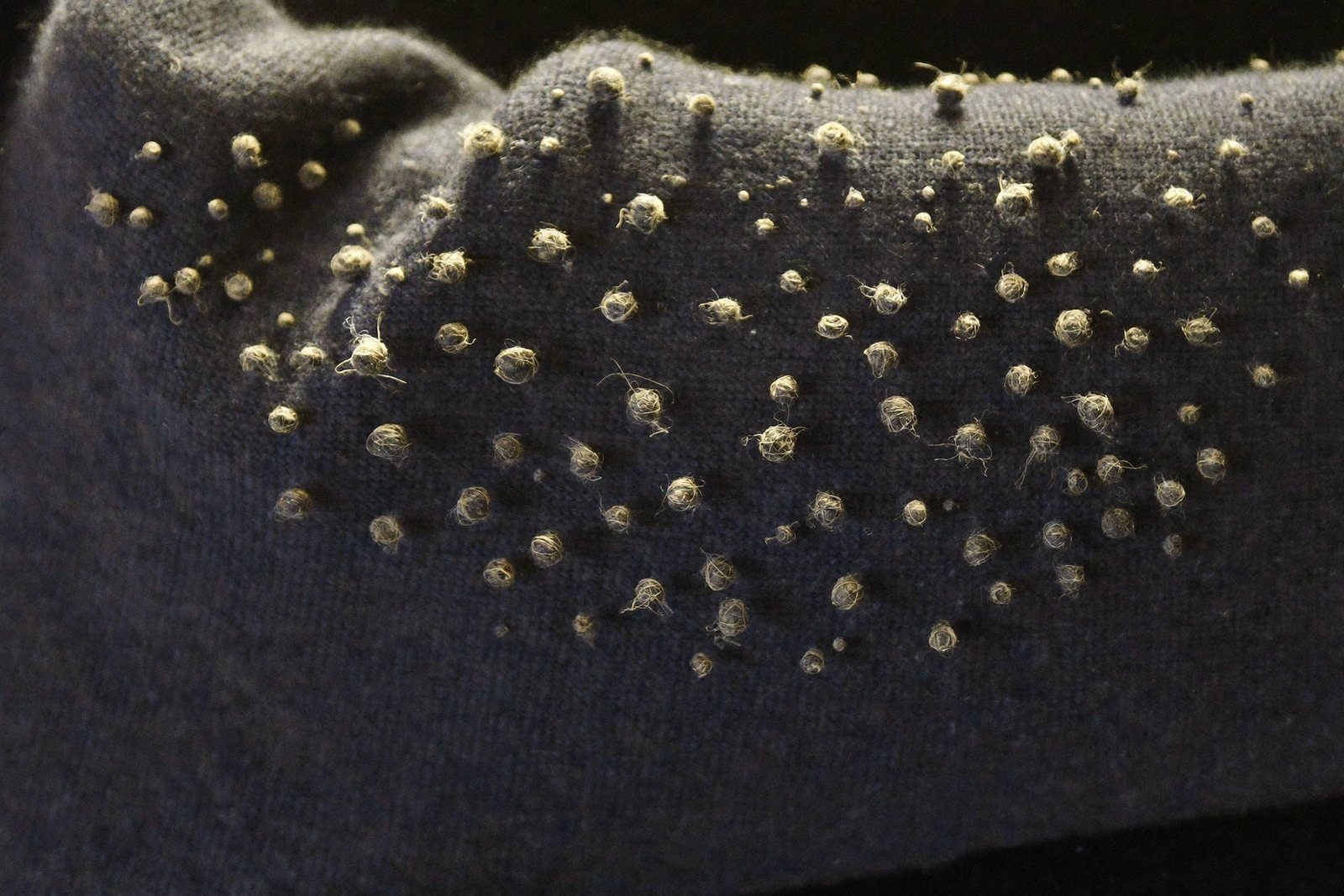
Pills follow friction. The Woolmark Company names the elbows, armpits, sleeves, belly and the sides of a sweater as the most common areas, because the arms of the garment keep brushing against the body. Cotton Incorporated adds the collar and the crotch of trousers for wear pills. REI points to anything that rubs from outside: bag straps, hip belts and hook-and-loop fasteners.
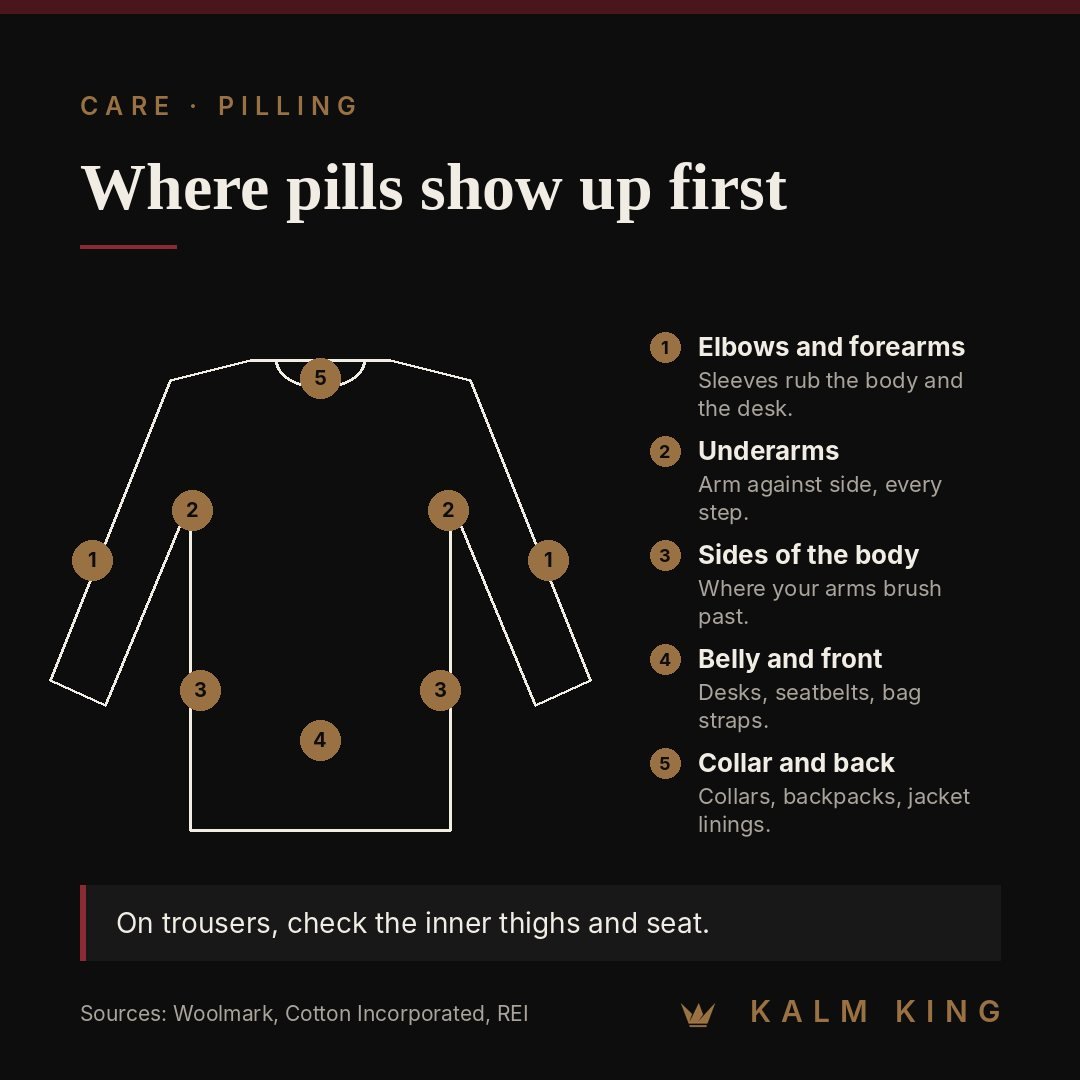
That map is useful twice. First, it tells you where to focus when you’re removing pills. Second, it tells you what in your day is doing the damage. If one side of your favourite knit always pills first, check which shoulder your bag sits on.
Woolmark also notes that how active you are, and what the garment rubs against, changes how quickly pills form. Long hours at a desk with your forearms on the surface count.
How to Remove Pilling From Clothes
There’s no way to un-pill a fabric chemically once the balls have formed. As Fiber-Seal puts it, the only way to deal with pills that have formed is to remove them. The goal is to cut or lift the pill away from the surface without cutting the yarn it’s attached to.
Before you start, whatever method you choose:
- Check the care label and fibre content. Delicate knits need the gentlest option.
- Work on a flat, hard surface such as a table or an ironing board, not on your lap or the bed.
- Pull the fabric taut but not stretched. A loose surface can fold into the blade.
- Test first on an inside seam or the inside hem.
- Go easy. You’re trimming the surface, not shaving it down to the knit.
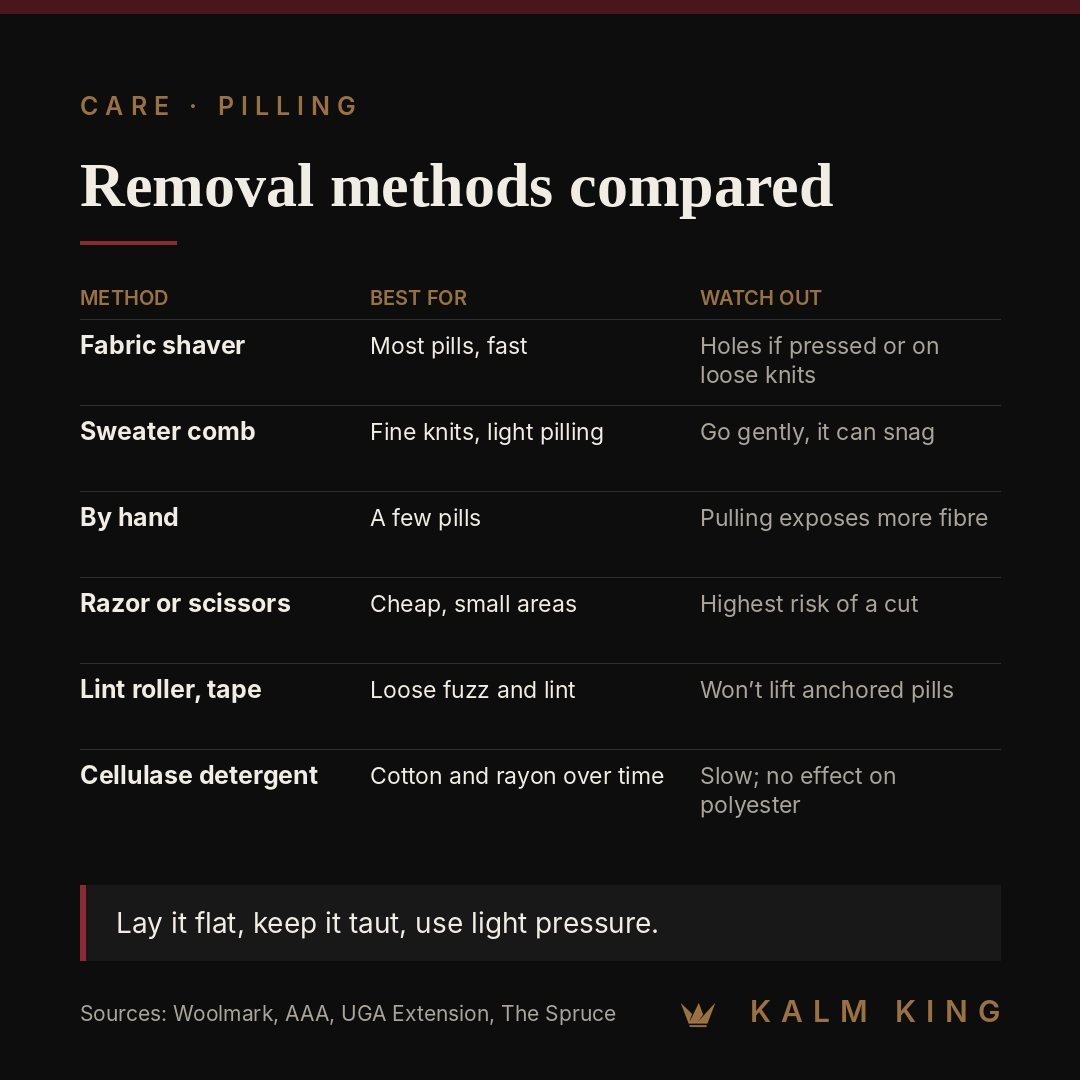
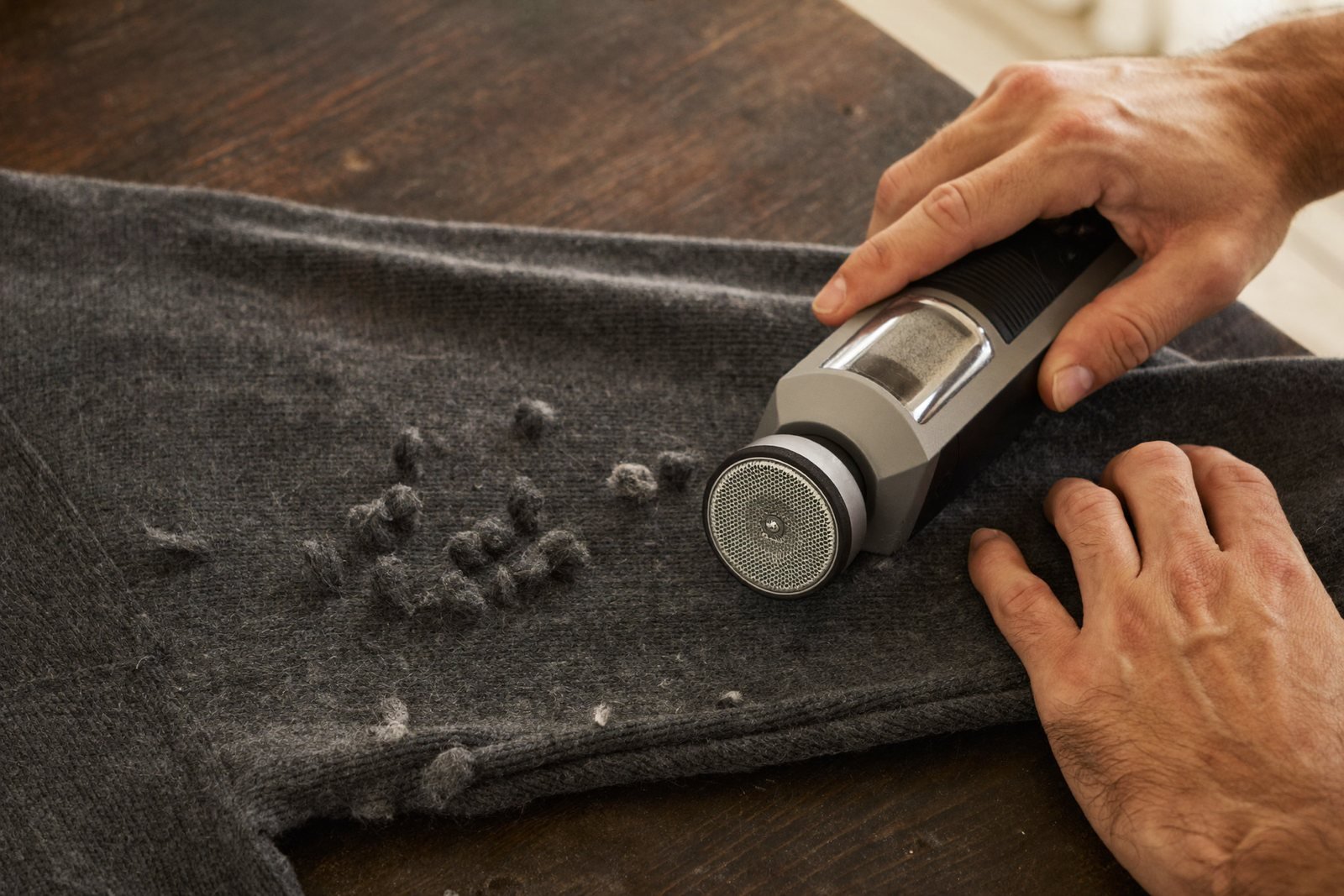
Method 1: Fabric shaver (best for most clothes)
A fabric shaver, also sold as a de-piller or defuzzer, has small rotating blades behind a perforated guard. Pills poke through the holes, the blades cut them off, and the fuzz is collected in a small chamber. The Woolmark Company describes these battery-operated devices as low cost and very effective, and The Spruce recommends them for all but the most delicate fabrics.
How to use one:
- Lay the garment flat and smooth it out. Turn sleeves so you can reach the pilled side without folds.
- Hold the shaver flat against the fabric. Don’t tilt it onto the edge of the guard.
- Move in light, short passes over the pilled area. Let the blades do the work instead of pressing down.
- Empty the lint chamber often. A full chamber stops the shaver cutting cleanly.
- Stop when the surface looks even. Chasing every last fibre thins the fabric.
- Finish with a lint roller to lift the loose fuzz.
Keep the shaver off open or loose knits, lace stitches and anything with raised texture you want to keep, because those structures can lift into the guard. If your shaver has an adjustable height guard, start on the highest setting.
Method 2: Sweater comb (best for fine knits)
A sweater comb is a small, fine-toothed comb made for knitwear that catches pills as you draw it across the fabric. It’s slower than a shaver and gentler, which makes it a better match for cashmere, fine merino and anything you’re nervous about. Woolmark lists the comb as a valid method but adds that it “should be done very gently and carefully.”
Lay the garment flat, hold the fabric just above the area you’re working on so you’re not dragging the knit, and draw the comb across in short strokes in one direction.
Method 3: By hand (for a few pills)
If a garment has only a handful of pills, you can remove them by hand. Woolmark suggests doing this routinely after drying or just before ironing, before the pills have a chance to multiply.
Pinch the pill and snip it off with small scissors rather than pulling it. Pulling can drag more fibre out of the yarn. UGA Extension warns about this specifically for acrylic: picking balls of fuzz off the surface “only exposes additional fiber ends which can multiply the problem.”
Method 4: Razor or scissors (careful, small areas)
A disposable safety razor or small, sharp scissors will remove pills if you have nothing else. AAA’s advice is to pull the fabric tight over a curved surface, such as a rolled towel or the edge of a bowl, and carefully shave or snip the pills away, taking care not to cut the fabric. Use a fresh blade, short strokes and almost no pressure. This is the method most likely to leave a hole, so keep it for sturdy fabrics and small areas.
Method 5: Lint roller or tape (for loose fuzz)
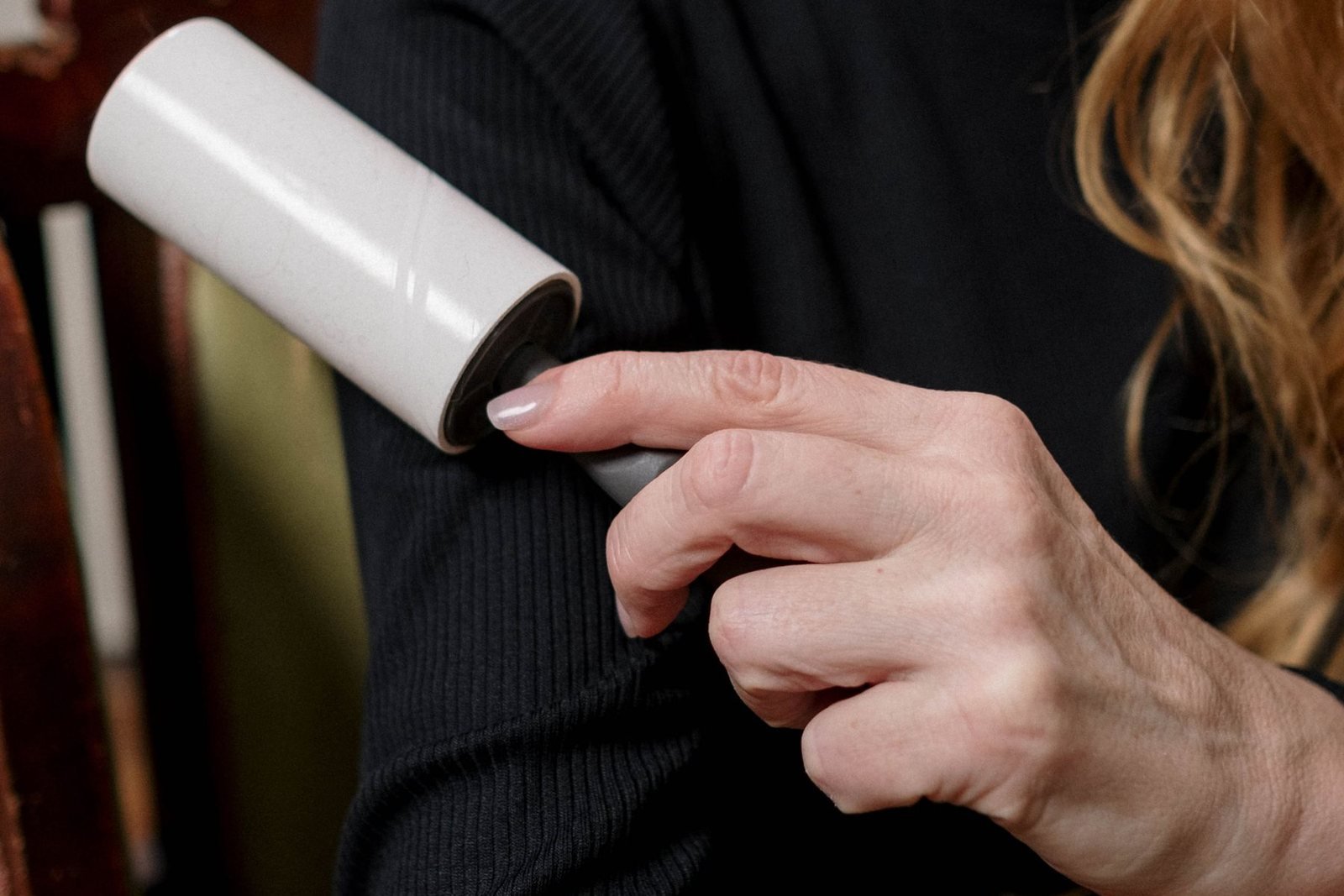
The Spruce notes that lint rollers and sticky tape work for small areas or light pilling. In practice, they’re best at lifting lint and loose fuzz rather than pills that are firmly anchored. Keep one by the door for dark clothes, and use it as the last step after shaving or combing.
What about enzyme detergents?
AAA suggests switching to a detergent that contains cellulase, an enzyme that breaks down cellulose fibres, and says it may help reduce or even prevent pilling. That lines up with mill practice, where cellulase “biopolishing” is used to remove fuzz from cotton fabric. Two limits apply. Cellulase only works on cellulose fibres such as cotton, linen, viscose and modal, so it won’t touch polyester or acrylic pills. And it works by removing loose surface fibre, so expect a gradual improvement over several washes, not a quick fix.
How to Prevent Pilling
You can’t make a soft fabric pill-proof. Woolmark says plainly that nobody can guarantee pilling won’t occur, and REI accepts that very soft, next-to-skin clothes will pill a little. What you can do is slow it down a lot.
In the wash
| Step | Why it helps | Source |
|---|---|---|
| Turn clothes inside out | Only the inside rubs against other garments | Woolmark, Whirlpool, AAA |
| Close zips, buttons and hooks | Hard fastenings abrade fabric in the drum | Whirlpool, AAA |
| Sort by fabric weight | Heavy items like jeans and towels scuff lighter knits | Whirlpool, AAA |
| Sort by colour | Fibres from one colour show up as pills on another | Whirlpool, REI |
| Cold water, gentle cycle or hand wash | Hot water wears fibres faster and makes them more likely to tangle | Whirlpool, AAA |
| Don’t overload the machine | Crowded clothes can’t move freely, so they rub harder | Whirlpool, AAA |
| Use the right amount of detergent | More detergent isn’t more protection | Whirlpool |
| Air dry or tumble on low | Long hot tumbling adds abrasion and stress | Whirlpool, AAA |
If you’re washing small, high-friction items like underwear and socks, our guide to how to wash men’s underwear covers temperature, loads and drying in more detail.
The fabric softener question
Sources disagree here, and the disagreement is worth understanding. Woolmark says to avoid fabric softener on wool. Whirlpool and AAA, writing about laundry in general, suggest softener can help by coating fibres and reducing abrasion. UGA Extension says softener can help with acrylic, because static is part of why acrylic gathers fuzz.
The practical reading: skip softener on wool and cashmere and follow the care label. On acrylic and other synthetics that build static, a modest amount of softener may help.
In wear
- Watch the rub points. A messenger bag, backpack strap or seatbelt rubbing the same spot every day will pill it. Swap shoulders or wear a smoother layer under the strap.
- Keep hook-and-loop fasteners away from knits. REI singles them out. Close the fasteners on jackets and bags before they touch a sweater, and before they go in the wash.
- Rotate your knits. Wearing two or three sweaters in turn spreads the same friction across more garments.
- Lint-roll before washing. Whirlpool suggests removing lint and fuzz before a garment goes in, so loose fibres don’t become laundry pills.
Fuzz is half the reason black looks grey. See how to keep black clothes from fading.
How to Buy Clothes That Pill Less
Removing pills is a fix. Buying well is the cure. When you’re choosing a sweater, hoodie or tee, look for:
- A tight, smooth surface. Squeeze and rub the fabric between your fingers. If it already looks fuzzy in the shop, it will pill. Woolmark’s design advice favours a higher cover factor, meaning a tighter knit.
- Longer, smoother fibres. Woolmark recommends longer fibres and higher-twist yarns for pill resistance. Combed and long-staple cotton are better bets than short, fluffy cotton.
- Plain knits over loose ribs. In the UiTM study, plain jersey resisted pilling best and a loose rib worst.
- Careful blends. A small amount of polyester can add strength, but higher polyester content in a cotton blend tends to anchor pills. Cotton Incorporated’s guidance to mills is 20% polyester or less.
- “Pill-resistant” labels. REI suggests looking for fabrics labelled this way, especially in fleece and synthetics.
If you’re building a small wardrobe of pieces you’ll wear often, those choices matter more than a lower price tag. Our men’s capsule wardrobe guide is built on the same idea: fewer, better pieces, worn often and cared for well. For tees specifically, see what a heavyweight T-shirt is, and for fibre-by-fibre detail on pilling and comfort, our guides to modal and polyester go deeper.
Troubleshooting Pilling
| Problem | Likely cause | What to do |
|---|---|---|
| Pills came back after one wash | Strong anchor fibres plus a rough wash | Shave again, then wash inside out, cold and gentle, in a lighter load |
| New sweater pilling in the first weeks | Loose surface fibres and early friction | Remove pills by hand or comb after drying, as Woolmark suggests, and keep checking rub points |
| Pills on one side only | A bag strap or seatbelt rubbing that spot | Move the bag to the other shoulder or change what you wear under it |
| Light pills on a dark garment | Mixed colours in the wash | Sort by colour, as Whirlpool and REI advise, and lint-roll before washing |
| Pills on trousers between the thighs | Fabric rubbing on itself as you walk | Shave carefully, and consider a tighter weave next time |
| Shaver left a thin patch or hole | Too much pressure, a tilted shaver or a loose knit | Stop on that area. Switch to a comb for loose knits and hold the shaver flat |
| Cotton tee looks fuzzy and dull, not bobbly | Cotton pills falling off, leaving worn fibre | A cellulase detergent may help over time. Wash cold, inside out |
| Fleece covered in pills after a season | Soft raised surface and repeated friction | Shave, wash inside out with similar fabrics, and look for anti-pill fleece next time |
Is Pilling a Defect?
Usually not, in the narrow sense. Fiber-Seal notes that manufacturers tend to describe pilling as a natural phenomenon rather than a defect, and in most cases that’s true: pilling is a normal part of wear for soft fabrics. REI says much the same about soft base layers and socks, which need to feel good next to skin and take a lot of friction. Our guide to choosing men’s socks covers what to look for there.
But “normal” has limits. A garment that pills heavily after a few gentle washes, washed exactly as its label says, is telling you something about its fibre, yarn or finishing. Take a photo, keep the receipt and contact the retailer. Some brands test for pilling. REI, for example, says its analysts test fabrics used in its own-brand items against pilling standards. Others don’t, and you’ll learn which ones from experience.
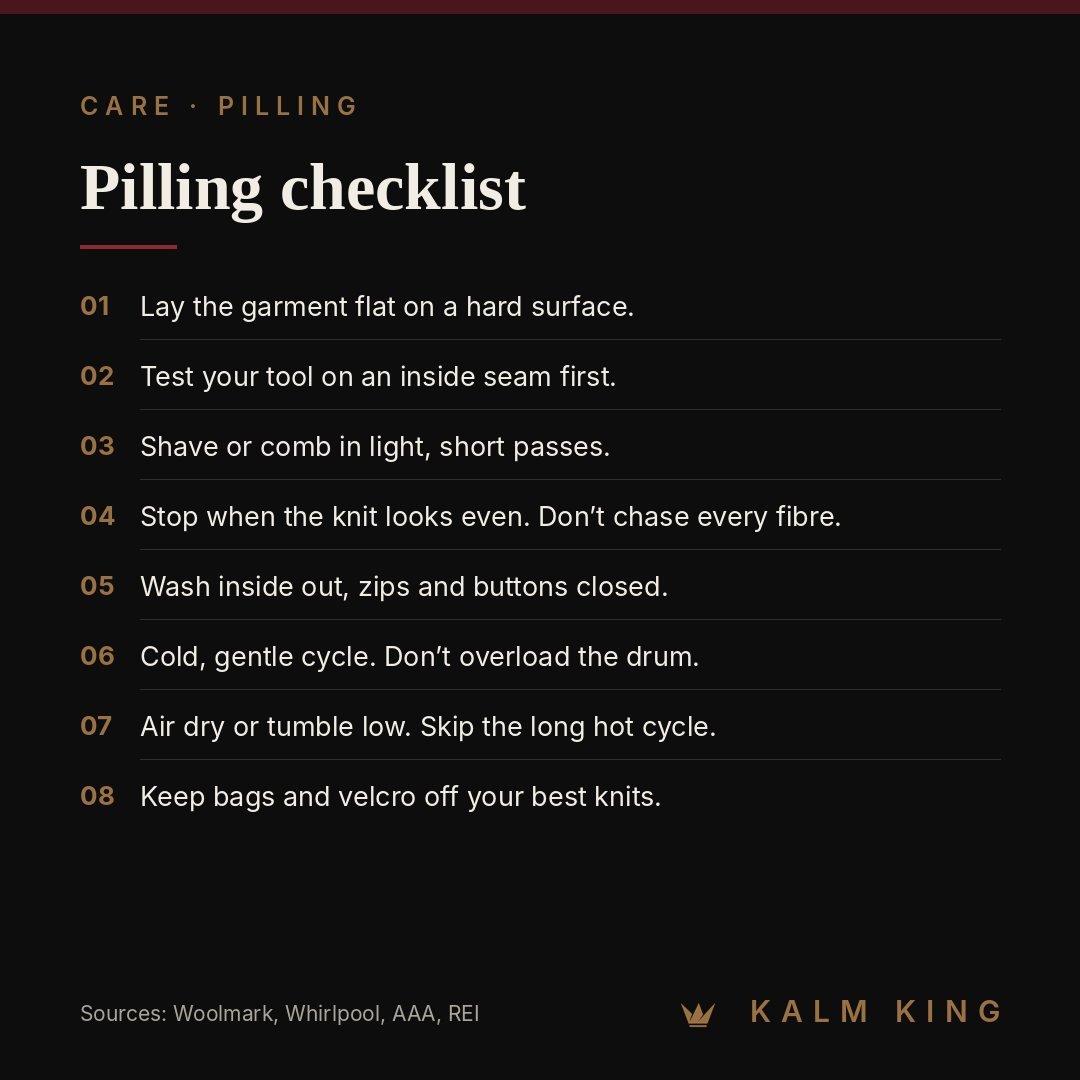
Your Pilling Checklist
Removing pills
– Lay the garment flat on a hard surface and pull it taut.
– Test your tool on an inside seam first.
– Use a fabric shaver in light, short passes, held flat.
– Use a sweater comb on fine or loose knits.
– Snip, don’t pull, individual pills.
– Stop when the surface looks even.
Preventing pills
– Wash inside out with zips and buttons closed.
– Cold, gentle cycle, sorted by weight and colour, with room in the drum.
– Air dry or tumble on low.
– Skip fabric softener on wool. Follow the label for everything else.
– Keep bags, straps and hook-and-loop fasteners off your best knits.
The Kalm King Take
Pilling isn’t a verdict on you or your clothes. It’s friction, written on the fabric. A fabric shaver and five minutes will bring most sweaters back, and a few laundry habits will keep them there for far longer.
The bigger lesson is in the buying. A tight, smooth knit with long fibres will outlast a fuzzy one that feels softer in the shop, and it will look considered for years instead of months. Buy fewer pieces, choose them for how they’ll age, and look after them.
We’re building our own essentials with that in mind. If you want to hear about them first, along with more practical care and fit notes, join Field Notes.
Frequently asked questions
What is the best way to remove pilling from clothes?
For most fabrics, a fabric shaver (de-piller) used flat with light pressure on a hard surface is the fastest and most even method. The Woolmark Company describes these devices as low cost and very effective. For fine or delicate knits such as cashmere, a sweater comb used gently is the safer choice.
Can you stop clothes from pilling permanently?
No. Pilling is caused by rubbing, and soft fabrics will always pill to some degree. You can slow it down a lot by washing clothes inside out on a cold, gentle cycle, not overloading the machine, air drying or tumbling on low, and reducing friction from bags and straps during wear.
Is it bad to pick pills off a sweater?
Pulling pills off can drag more fibre out of the yarn. UGA Extension warns that picking fuzz balls off acrylic only exposes additional fibre ends, which can make the problem worse. Snip individual pills with small scissors or use a shaver or comb instead.
Do fabric shavers damage clothes?
Used correctly, a fabric shaver removes pills without harming the fabric. Damage usually comes from pressing too hard, tilting the shaver onto its edge, or using it on loose or open knits that can lift into the guard. Test on an inside seam first and use light, short passes.
Why does polyester pill so badly?
Polyester fibres are strong, so when a pill forms, the fibres anchor it to the fabric instead of letting it break off. Cotton Incorporated describes these as anchor fibres. Polyester-cotton blends are especially prone, because loose cotton fuzz gets held in place by the strong polyester.
Does washing clothes inside out prevent pilling?
It helps. The Woolmark Company, Whirlpool and AAA all recommend turning clothes inside out before washing, so the outer face rubs less against other garments, zips and the drum. Combine it with a cold, gentle cycle and a lighter load for the best effect.
Sources
- The Woolmark Company: What is pilling? (industry body)
- Cotton Incorporated (CottonWorks): Fabric Defects 101, Understanding and Overcoming Pilling (industry research body, PDF)
- Fiber-Seal Systems: Textile Tips, Pilling (textile care, PDF)
- REI Expert Advice: How to Prevent and Fix Pilling (retailer lab test analyst)
- Whirlpool: What Is Fabric Pilling and How to Prevent It (appliance manufacturer)
- AAA Club Alliance: Pilling on Your Clothes (consumer advice)
- University of Georgia Extension: Understand Your Fibers (university extension)
- The Spruce: How to Get Rid of Pilling From Your Clothes (publication)
- Mohd Azis et al., Effect of Launderings on the Pilling Properties of Cotton and Polyester Weft Knitted Fabrics, Journal of Academia UiTM (peer-reviewed study)
- An approach to improve the pilling resistance properties of three thread polyester cotton blended fleece fabric (PMC8102427) (peer-reviewed study)
- Uddin, Effects of biopolishing on the quality of cotton fabrics using acid and neutral cellulases, Textiles and Clothing Sustainability (peer-reviewed study, open access)
FIELD NOTES
Get the Overalls Fit Kit, free.
Your measurement card, the six fit checkpoints and a checklist to take shopping. Join Field Notes for new guides and a say in what Kalm King makes.
THE KALM KING JOURNAL
Continue reading
What Is Pouch Underwear? Benefits, Designs and Fit
Pouch underwear gives everything its own shaped space. Here’s how the main designs work, what they can and can’t do, and how a pouch should fit.
How to Prevent Thigh Chafing for Men
Stop thigh chafing before it starts: the layers, fabrics, balms and habits that keep your inner thighs comfortable, plus how to treat a rub that’s already sore.
How to Keep Black Clothes From Fading
Black clothes fade from dye loss, friction, heat and sun. Here’s how to wash, dry and store black so it stays black, and what to do when it’s already gone grey.