
November 12, 2026
Explore: Style
Overalls vs Coveralls vs Jumpsuits: What’s the Difference?
Overalls vs coveralls vs jumpsuits: how each is built, why "overalls" means different things in the US and UK, and how each one is sized.

Search overalls vs coveralls and you’ll find workwear shops, safety suppliers and fashion sites all using the same three words in slightly different ways. Part of the reason is simple: “overalls” doesn’t mean the same garment on both sides of the Atlantic. Part of it is that “jumpsuit” covers everything from a parachutist’s flight suit to a tailored one-piece on a fashion rack. The good news is that you don’t need to settle the vocabulary to tell the garments apart. You just need to look at how each one is built.
This guide sorts the three by construction first, then by name, then by how each one fits and how each one is sized. It’s written for everyday wear, not for job-site safety gear. If you already own a pair of bib overalls, our guides on how men’s overalls should fit and how to style overalls go deeper on those.
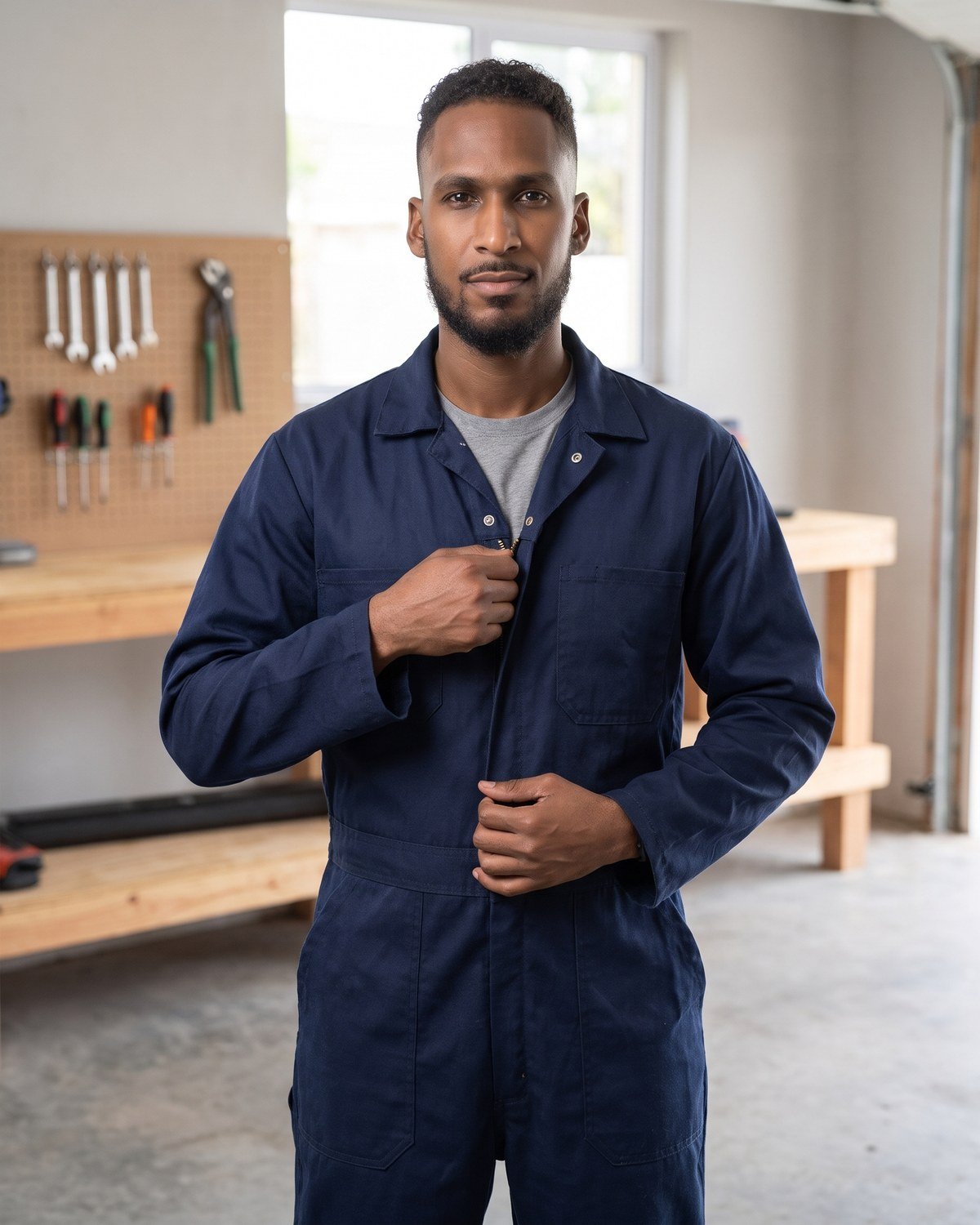
Short answer: Bib overalls are trousers with a bib on the chest and straps over the shoulders. Your arms and most of your upper body are free, so a shirt usually goes underneath. Coveralls, which British English commonly calls a boiler suit, are a one-piece with sleeves and legs, usually opening down the front, and are traditionally worn over other clothes to protect them. A jumpsuit is also a one-piece top and trousers. The word is often used today for one-pieces sold as everyday outfits, though it also covers flight suits and some workwear, and cuts range from close to roomy. The quickest test: look for a distinct chest bib attached to trousers and held up by separate shoulder straps. That’s bib overalls. A jumpsuit has an attached top section instead, which can have sleeves or none at all; a coverall is a sleeved one-piece cut to go over your clothes.

Overalls vs Coveralls: The Construction Difference
Forget the labels for a moment and look at the garment on the hanger. Three features sort almost everything: what covers your upper body, whether there are sleeves, and how you get in and out.
Bib overalls: trousers with a bib and straps
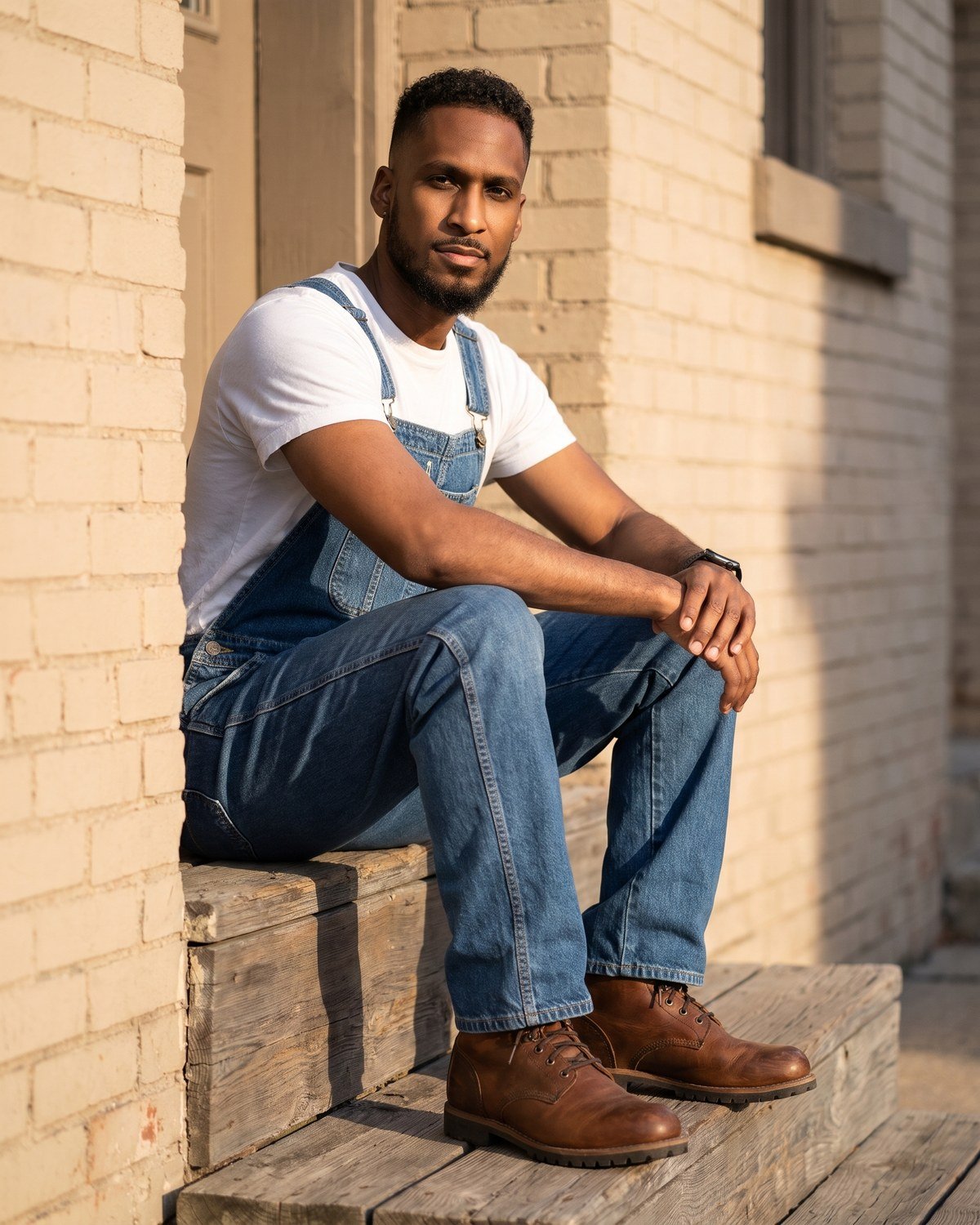
Bib overalls start as a pair of trousers. A panel of fabric, the bib, rises from the front of the waistband and covers part of the chest, and two straps run from the back over your shoulders to fasten at the bib, usually with buckles or hooks. Lee’s denim glossary describes them as one-piece garments that “feature pants, a front flap or bib, and shoulder straps with snaps or other closures that keep the bib in place.” Cambridge Dictionary’s American English definition says much the same: “a pair of pants with an extra piece of cloth that covers the chest and is held in place by a strap over each shoulder.”
Three things follow from that build. Your arms are completely free. Your back is open apart from the straps and, on many pairs, a back panel. And because the straps adjust, the bib can be raised or lowered to suit your torso. Most bib overalls also have side openings at the hip, buttoned or snapped, which help you get in and out and give the waist a little room.
Because the upper body is mostly open, the outfits in this guide pair bib overalls with a shirt underneath, and we’d recommend that for everyday wear. The shirt ends up being half the outfit.
Coveralls and boiler suits: a one-piece with sleeves
A coverall is one continuous garment: sleeves, body and legs, with no gap between top and bottom. Merriam-Webster defines a coverall as “a one-piece outer garment worn to protect other garments.” Most coveralls open down the front with a zip or buttons from the crotch or waist up to the neck, often with a collar, and they usually have plenty of pockets.
The key word in that definition is “outer.” Coveralls were designed to go over your clothes, which is why they’re cut with room to spare. Carhartt’s sizing notes for its coveralls say plainly that its measurements “assume coveralls are worn over other clothing.” Many everyday jumpsuits are cut closer than that, though not all of them.
In Britain the same garment is often called a boiler suit. Merriam-Webster lists “boilersuit” as chiefly British for a coverall. Same garment, different name.
Jumpsuits: one piece with an attached top
A jumpsuit is also a one-piece top and trousers. Merriam-Webster gives two senses: “a one-piece garment consisting of a blouse or shirt with attached trousers or shorts,” and “a coverall worn by parachutists for jumping.” That second sense explains the name, and it’s why flight suits and some uniforms are still called jumpsuits.
In everyday shopping today, “jumpsuit” often means a one-piece sold as an outfit in its own right rather than as a protective layer, though some are still made for work or layering. The cut varies with that. A jumpsuit can have long sleeves, short sleeves or none, and a sleeveless jumpsuit can even have straps at the shoulder. What sets it apart from bib overalls is the attached top section: the upper part of a jumpsuit is cut as part of the garment, not as a separate bib held up by straps. It may have a defined waist, a drawstring or a belt. It might be made of heavy cotton twill, lightweight linen or a drapey fabric that would never survive a garage. Some men’s jumpsuits look almost identical to a coverall; others are clearly fashion pieces. The word covers a wide range, so judge the specific garment, not the label.
The quick comparison
| Bib overalls | Coveralls / boiler suit | Jumpsuit | |
|---|---|---|---|
| Upper body | Separate chest bib held up by shoulder straps | Attached top with sleeves | Attached top section (sleeved or sleeveless) |
| Sleeves | None | Usually long | Long, short or none |
| How you get in | Unclip straps, step in | Front zip or buttons | Front zip, buttons or pullover, varies |
| Traditional purpose | Work trousers that protect the chest | Protect the clothes underneath | Parachuting originally; now everyday wear too |
| Usually worn with | A shirt underneath | Your clothes underneath | Varies: often on its own, sometimes over a tee or layers |
| Adjustable length | Yes, at the straps | No | Usually fixed; some styles have adjustable straps |
That last row matters more than it looks. We’ll come back to it in the fit section.

Why “Overalls” Means Two Different Things
If you’ve ever ordered “overalls” from a UK shop and received a full one-piece with sleeves, this is why. The word is commonly used for two different garments depending on where you are.
Cambridge Dictionary lists both. In UK English, “overalls” can mean “a piece of clothing that covers both the upper and lower parts of the body and is worn especially over other clothes to protect them.” In US English, “overalls” means the bib-and-straps trousers, which Cambridge notes are called dungarees in the UK. Lee’s glossary agrees on the second point: “In the U.K., overalls are called dungarees.”
So, broadly:
| In the US, people commonly say | In the UK, people commonly say | What it is |
|---|---|---|
| Overalls, bib overalls, bibs | Dungarees (sometimes overalls) | Trousers with a bib and shoulder straps |
| Coveralls | Boiler suit, overalls | Sleeved one-piece worn over clothes |
| Jumpsuit | Jumpsuit | One-piece, often worn as the outfit |
Treat that table as “commonly called,” not a rulebook. Usage overlaps. Some UK sellers do call bib styles overalls, while Carhartt’s own European site lists a bib style as “Denim Bib Dungarees.” Some American brands call a sleeved one-piece a jumpsuit, others call almost the same thing a coverall. The construction tells you what you’re actually buying. The name only tells you what the seller decided to call it.
“Dungarees” once meant the fabric
The word dungarees adds one more layer. Merriam-Webster’s first definition of “dungaree” is the fabric itself: “a heavy coarse durable cotton twill woven from colored yarns,” specifically blue denim. Over time the name moved from the cloth to garments made from it, and in British English it settled on bib overalls. In the US, Lee’s glossary describes “dungarees” as “still a historical term for denim.”
Jeans were once called overalls too
Even jeans have a place in this story. Levi Strauss & Co. says its first riveted denim trousers, made from 1873, were “originally called ‘waist overalls’ or simply ‘overalls’ to distinguish them from bib overalls.” The company says the word “jeans” replaced “overalls” in its advertising and labels in 1960, after teenagers had started using it in the 1950s. “Waist overalls” meant overalls that stopped at the waist. The bib version kept the name.
Where the one-piece came in
Lee says that in 1913 its company was the first U.S. workwear maker to offer a one-piece coverall, which it called the Union-All. According to Lee, the idea was to help chauffeurs, who often had to fix their own cars, protect their clothes. Whether or not every brand would agree it was first, the purpose fits the definition: a one-piece that goes over your clothes and keeps them clean.

Overalls vs Coveralls vs Jumpsuits: How to Tell Them Apart Online
When the name on the listing doesn’t settle it, check these in order.
- Look for a bib. A distinct chest bib attached to trousers, held up by separate shoulder straps, means bib overalls, whatever the listing says. If the top is cut as one attached section instead, with sleeves or without, it’s a jumpsuit or a coverall. Sleeveless alone doesn’t settle it, because some sleeveless jumpsuits have straps too.
- Look at the back. Bib overalls show your shirt between the straps. A coverall is usually solid fabric across the back; jumpsuit backs vary.
- Find the closure. Bib overalls fasten at the strap buckles and usually at side buttons. Coveralls typically have a long front zip or button placket. Jumpsuits vary: front zip, buttons, wrap or pullover.
- Read the fabric. Heavy canvas, duck or denim with reinforced seams leans workwear. Linen, light twill, jersey or a drapey fabric leans fashion jumpsuit.
- Check the product description for “worn over.” If the maker says its sizes assume you’ll wear it over clothes, it’s built like a coverall, with room to spare.
- Check the size chart. As you’ll see below, bibs are usually sized like trousers, and coveralls are sized like a jacket and trousers combined. The chart often tells you what the maker thinks it’s selling.
None of this makes one garment better than another. It just tells you what you’re getting before it arrives.
How Each One Fits
This is where the construction difference really shows up. All three are one-piece garments in the sense that top and bottom are joined. The difference is how the top is held up: bib overalls hang from adjustable straps, while coveralls and most jumpsuits have an attached torso section whose length is usually fixed.
Bib overalls: the straps do the adjusting
Because the bib hangs from adjustable straps, bib overalls have a built-in way to deal with different torso lengths. Lengthen the straps and the bib drops; shorten them and it rises. The waist and the legs fit like trousers, and the top half follows you. That’s why the main fit checks for bib overalls are trouser checks: waist, seat, thigh, rise and length, plus where the bib sits on your chest. Our full overalls fit guide walks through each one.
Coveralls and jumpsuits: the torso length is usually fixed
A coverall or a sleeved, shirt-style jumpsuit with an attached torso doesn’t have adjustable straps to fall back on. The distance from your shoulder to your crotch is usually sewn in. Some sleeveless jumpsuits have adjustable shoulder straps, so check the design. If the garment’s torso is shorter than yours, you’ll feel it pull at the shoulders and crotch when you bend or reach. If it’s longer than yours, the crotch hangs low and the fabric bunches at the waist. Our guide on how a jumpsuit should fit goes through each fit point.
That’s why coverall makers often offer the same chest size in different body lengths. Carhartt, for example, sorts its coveralls into short, regular and tall by height: short for about 5’3″ to 5’7″, regular for about 5’7″ to 5’11”, and tall for about 5’11” to 6’3″. Its size guide says its tall coveralls are generally 1″ longer in the torso and sleeve than regular sizes, but its X06 style runs 2″ longer in both. Those numbers are Carhartt’s, for specific Carhartt coveralls. Other makers grade differently, so check the chart for the exact garment.
On sleeved designs, sleeves are the other fixed measurement. On bib overalls, your shirt decides the sleeve. On a coverall or a sleeved jumpsuit, the sleeve is part of the garment, so it has to suit your arm length too. Roll it if it’s long; there’s not much you can do if it’s short.
Movement
Bib overalls leave your arms and back free, so reaching overhead is easy. A one-piece moves as one, so when you raise your arms the whole garment lifts with you, from the shoulders to the crotch. Workwear coveralls are cut with extra room for this. Some have features meant to help movement, like a pleated or gusseted back, but it depends on the garment. A closer-cut jumpsuit has less spare room, which is why trying the fit with a reach and a squat matters with any one-piece.
Try this in any one-piece before you cut the tags off: reach both arms overhead, then crouch down as if to tie a shoelace, then sit in a chair. If the shoulders pull, the crotch digs in, or the front zip strains, the torso is too short or the fit is too close for you.

How Each One Is Sized
The three garments are often sized in completely different ways, which catches people out when they move from one to another. The examples below come from Carhartt’s charts for specific styles. They’re not universal rules, and they’re not Kalm King sizes. Always use the chart for the specific product.
Bib overalls: waist and inseam
Bib overalls are usually sized like trousers. Carhartt’s bib overall notes say to “size to the largest part of your waist,” to size up if you fall between sizes, and to order “based on your normal pant inseam” (if you wear a 32-inch inseam in trousers, you’d wear a 32-inch inseam in bib overalls). Some of its bib charts also give a separate size column for wearing them over heavier layers, such as a thick shirt and trousers. That’s Carhartt’s allowance for those styles, so check the maker’s own layering allowance rather than assuming a rule.
Note “the largest part of your waist.” That’s not always where your trousers sit. Carhartt’s measuring guide says to find your natural waist by bending side to side, and notes it “may not be the smallest point.”
Coveralls: chest and waist, whichever is bigger
Coveralls cover your top half and your bottom half, so they’re sized by both. Carhartt’s coverall sizing says to “measure both chest and waist” and “use the larger of the two to determine coverall size.” In practice: see which size your chest points to on the chart, see which size your waist points to, and take the larger size. It also says to size up if you fall between sizes, and that its measurements “assume coveralls are worn over other clothing.” Then you choose short, regular or tall from the height chart. Other makers may handle all of this differently.
To measure your chest the way Carhartt describes, “measure just under your arms and across your shoulder blades, holding the tape firm and level.” Our guide on how to measure your chest size goes through that step by step.
Jumpsuits: read the specific chart
Jumpsuits don’t have one standard sizing approach. A workwear-style jumpsuit may be sized exactly like a coverall. A fashion jumpsuit may use S, M, L with chest, waist and hip ranges, or list garment measurements instead of body measurements. Some list a torso measurement and some don’t. The safest approach is to know your chest, waist, hip and inseam, and to compare them with whatever the maker gives you. If the chart lists a torso or body length, that’s the measurement to look at hardest, because on most designs it’s the one you can’t adjust. Our Size & Fit Reference explains how to take each body measurement and how to tell a body chart from a garment chart.
The sizing summary
| Usually sized by | Watch for | |
|---|---|---|
| Bib overalls | Waist (at its largest) and inseam | The maker’s layering allowance |
| Coveralls | The larger of the sizes your chest and waist point to, plus a height or length | Charts that assume you’ll wear it over clothes |
| Jumpsuit | Varies by maker | Torso length, if the chart lists it |

When to Wear Which
For everyday wear, the choice mostly comes down to how much of the outfit you want the garment to do.
Choose bib overalls when you want flexibility
Bib overalls are the most adjustable of the three and the easiest to style. Change the shirt underneath and you change the whole look: a plain white tee for summer, a grey long sleeve for spring, a flannel or a heavyweight tee when it’s cold. Drop one strap, cuff the hem, swap sneakers for boots. They also handle temperature well, because you can layer under them and over them. For outfit ideas, our overalls styling guide and our guide to what to wear under overalls cover the combinations that work.
Choose a coverall when you want everything covered
A coverall makes sense when the job is protecting the clothes underneath: painting, a messy weekend project, working on a car or a bike. That’s what it was designed for. Off the job, a plain coverall in a solid colour can be worn on its own like a jumpsuit, but remember it’s cut to go over clothes, so it’ll often feel roomier than an everyday jumpsuit of the same size. Some men like that easy, boxy shape. Others look for a closer cut.
One practical note: a regular coverall is not protective equipment just because it covers you. If a job requires specific protective clothing, such as flame-resistant gear or high-visibility wear, follow the employer’s or the site’s specification, not a style guide.
Choose a jumpsuit when you want one piece as the outfit
A jumpsuit suits days when you want one decision instead of two. Pick it up, zip or button it, add shoes, and you’re dressed. Many everyday jumpsuits are cut closer than a workwear coverall, with less excess fabric at the waist and seat, though some are deliberately relaxed. The closer the cut, the more fit matters. There’s nowhere to hide a short torso or a tight seat, and unless the design has adjustable straps, you can’t change the length the way you can with bib straps.

Styling Basics for Each
You don’t need a styling rulebook for any of these, but a few habits help each one look intentional.
Bib overalls. Keep the shirt underneath simple, so the overalls stay the main piece. Fitted tees and plain long sleeves work best. Check the bib height: a bib that sits too low looks sloppy, and one pulled too high looks tight. Our styling guide has full outfits.
Coveralls. Because coveralls are roomy by design, structure helps. Roll the sleeves once or twice, and if the waist is very loose, a simple belt can give it shape. Plain colours, such as navy, olive, black or a washed khaki, look cleaner off the job than bright workwear colours. A plain tee at the neck adds a finished edge if you’re wearing the zip slightly open.
Jumpsuits. Let the jumpsuit do the work and keep everything else simple. Plain sneakers, boots or loafers depending on the fabric, and minimal accessories. If the jumpsuit has a belt or drawstring, use it to set the waist where it looks natural on you, not where it happens to fall.
For all three. Match the shoes to the weight of the fabric. Heavy denim or canvas looks right with boots or sturdy sneakers. Lighter cotton or linen looks better with low-profile sneakers or loafers. And pay attention to the hem. Too long and the fabric pools over your shoes; too short and it can look like you’ve outgrown it.
Caring for One-Pieces and Bibs
Care depends on the fabric more than the garment, so the care label comes first. A few general points apply to all three.
- Close everything before washing. Fasten buckles, zips and snaps so the hardware doesn’t snag the fabric or knock around in the drum.
- Turn denim and dark colours inside out. It helps reduce fading on the outside.
- Expect cotton to shrink a little, especially in a hot wash or a hot dryer. On bib overalls you can sometimes compensate at the straps. On a one-piece, shrinkage in the torso length is harder to live with, so be careful with heat.
- Hang to dry where you can. One-pieces are heavy when wet and dry more evenly on a hanger than balled up.
Our overalls fit guide covers how washing can change the fit of bib overalls over time.
Common Mix-Ups
Ordering “overalls” from a UK shop and getting a boiler suit. Check the photos and look for sleeves before ordering, especially from UK sellers, because “overalls” may mean the sleeved one-piece.
Sizing a coverall like trousers. A coverall has a top half too. For Carhartt’s coveralls, measure your chest and your waist, check which size each one points to on the chart, and choose the larger size.
Sizing a jumpsuit to your waist alone. A jumpsuit that fits your waist but has a short torso will pull at the shoulders and crotch. Look for a torso or body length on the chart, and do the reach-and-squat test.
Assuming a jumpsuit and a coverall fit the same. A workwear coverall is usually cut with room to go over clothes. Many everyday jumpsuits are closer to the body, though cuts vary. The same chest size can feel very different.
Treating a fashion one-piece as protective gear. A one-piece that looks like workwear isn’t necessarily built for work. If a job calls for specific protection, use what the job specifies.
Bringing It Together
The difference between overalls, coveralls and jumpsuits is mostly how the top half is built. Bib overalls are trousers with a separate chest bib held up by adjustable straps, usually worn with a shirt underneath. Coveralls, or boiler suits, are sleeved one-pieces designed to protect the clothes underneath, sized by chest and waist and usually sold in different lengths. Jumpsuits have an attached top section too, sleeved or sleeveless; the word often describes everyday one-pieces, with cuts that vary widely.
The names change by country and by brand. The construction doesn’t. Check for a separate bib or an attached top, read the size chart for the exact garment, and test any one-piece with a reach and a squat before you commit.
If you want fit notes like this in your inbox, join Field Notes.
More one-piece guides: Overalls & Jumpsuits: The One-Piece Edit.
Frequently asked questions
What’s the difference between overalls and coveralls?
Bib overalls are trousers with a separate chest bib held up by shoulder straps, usually worn with a shirt underneath and your arms free. Coveralls are a one-piece with sleeves and legs, usually opening at the front, designed to be worn over your clothes to protect them. In British English, “overalls” can also mean the sleeved one-piece.
Is a boiler suit the same as a coverall?
Broadly, yes. Merriam-Webster lists “boilersuit” as a chiefly British word for a coverall: a one-piece outer garment with sleeves and legs. Different brands cut them differently, so check the specific garment.
What’s the difference between a jumpsuit and a coverall?
Both are one-pieces. A coverall is traditionally workwear worn over other clothes, so it’s cut with extra room. “Jumpsuit” originally meant a parachutist’s coverall. Today it often describes an everyday one-piece, sleeved or sleeveless, and many are closer-cut than coveralls, though cuts vary.
How do you size coveralls?
Many makers size coveralls by chest and waist. Carhartt, for example, says to measure both and use the larger of the two: check which size each measurement points to on its chart and choose the larger size, size up if you’re between sizes, and then pick a short, regular or tall length by height. Always check the chart for the specific coverall.
Sources
- Overalls (Cambridge Dictionary) (dictionary)
- Coverall (Merriam-Webster) (dictionary)
- Jumpsuit (Merriam-Webster) (dictionary)
- Boilersuit (Merriam-Webster) (dictionary)
- Dungaree (Merriam-Webster) (dictionary)
- Denim Glossary: Iconic Pieces (Lee) (manufacturer, commercial)
- The History of Denim (Levi Strauss & Co.) and Happy Birthday, Blue Jeans! (Levi Strauss & Co.) (manufacturer, commercial)
- Carhartt Size & Fit Guide (Carhartt Reworked) (manufacturer, commercial)
- Carhartt Sizing Charts PDF (hosted by a retailer) (manufacturer document, commercial)
- Denim Bib Dungarees product page (Carhartt EU) (manufacturer, commercial)
FIELD NOTES
Get the Overalls Fit Kit, free.
Your measurement card, the six fit checkpoints and a checklist to take shopping. Join Field Notes for new guides and a say in what Kalm King makes.
THE KALM KING JOURNAL
Continue reading
How Should Men’s Dress Pants Fit? Waist, Rise, Seat and Break
How should dress pants fit? Check the waist, rise, seat, thighs and hem with practical sitting tests, break options and realistic tailoring advice.
How Should a Dress Shirt Fit? A Men’s Guide to Collar, Chest and Sleeves
Check dress shirt fit at the collar, shoulders, chest, sleeves and hem. Learn what to measure, how to test movement and when to try another cut.
Men’s Capsule Wardrobe: How to Build One That Actually Works
A men’s capsule wardrobe is a small set of clothes that all work together. How to choose the pieces, colors and fit, and build one at your own pace.