
November 12, 2026
Explore: Style
How to Measure Your Inseam (Men): Body vs Garment
How to measure inseam for men: on your body, on trousers you own, and why brands end the tape in different places. Plus inseam vs outseam.
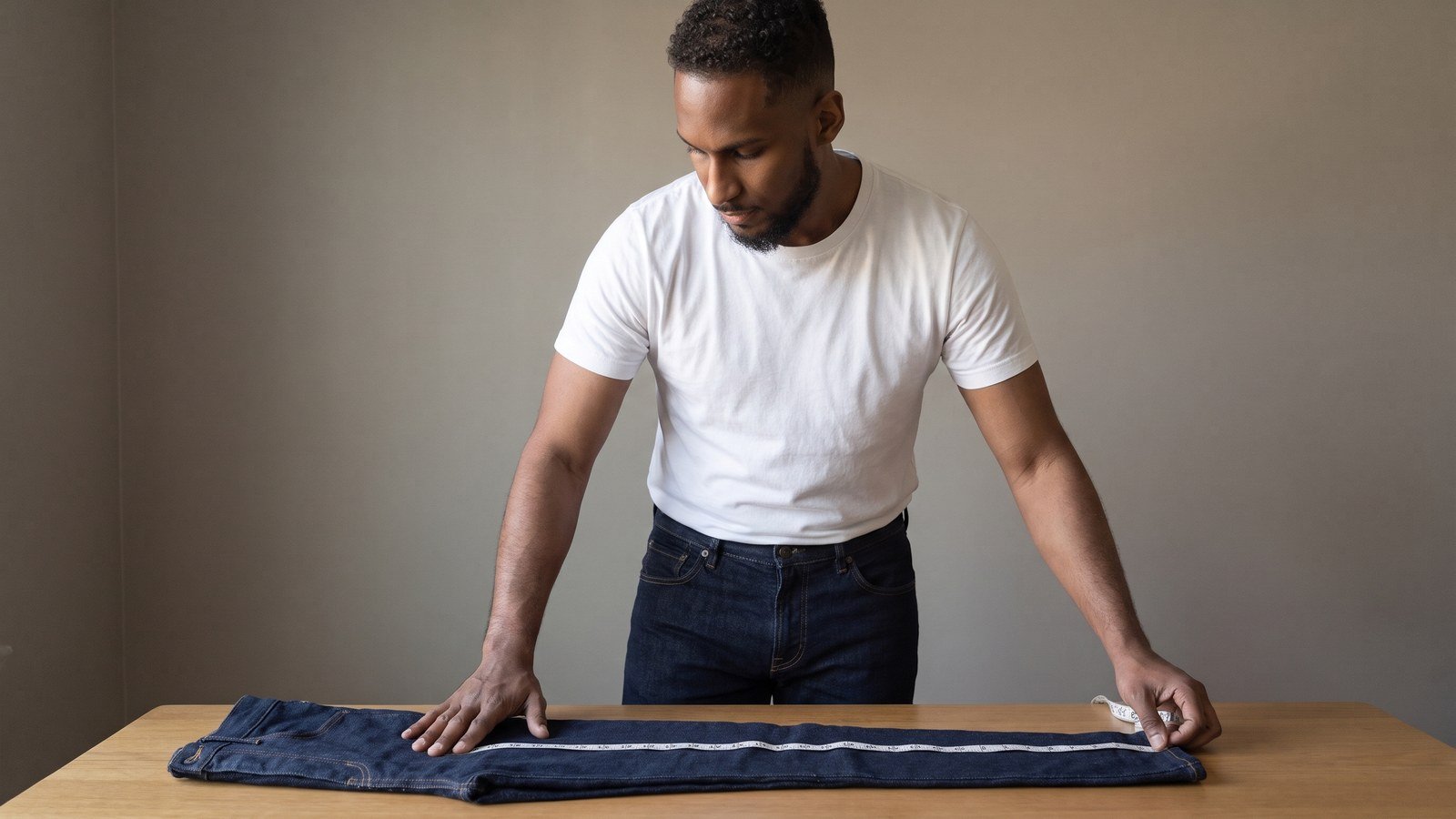
Inseam is the second number on most men’s trousers, the 32 in a 32×32, and it decides where your hem lands. Get it wrong and your trousers either pool in a heap over your shoes or flash too much sock. It sounds like the easiest measurement there is. In practice, it’s one of the most inconsistent, because brands don’t all measure it the same way.
So how do you measure inseam properly? This guide covers both methods: measuring a pair of trousers you already own, and measuring your own body. It explains why the two can give different numbers, why one brand’s chart can disagree with another’s, and how to turn your inseam into trousers, jeans, overalls and one-pieces that actually fit at the hem. Our Size & Fit Reference covers every measurement at a glance; this is the detailed inseam companion to it, alongside our guide on how to measure your chest size.
Short answer: The most reliable way to find your inseam is to measure trousers that already fit you the way you like. Lay them flat, smooth the legs, and measure along the inside leg seam from the crotch seam to the bottom of the hem. To measure your body, stand straight with your feet slightly apart and measure from your crotch down the inside of your leg. Brands end that body measurement in different places, at the floor, the ankle bone, the top of the shoe or wherever you want the hem, so follow the instructions on the chart you’re using.

What Inseam Means (and What It Doesn’t)
Inseam is the length of the inside of the leg, from the crotch seam down to the bottom of the hem. On a garment, it’s a seam you can trace with your finger. On your body, it’s the distance from your crotch down the inside of your leg.
It’s easy to confuse with two other measurements:
- Outseam runs down the outside of the leg, from the top of the waistband to the bottom of the hem. Lands’ End’s guide calls the idea that inseam runs from the top of the waistband to the hem “a common misconception,” and points out that this measurement “is in fact the outseam.”
- Rise runs from the crotch seam up to the top of the waistband. Lands’ End describes it as the distance from your front waist to your back waist by way of your crotch. A high-rise trouser and a low-rise trouser can have the same inseam and still sit very differently.
Inseam is the one that controls where the hem lands. Levi’s explains it simply: a 32×32 jean “would have a 32 inch waist and a 32 inch inseam, which is what determines the leg length.” Lands’ End notes that in the United States the inseam is “typically the number listed beside the waist on size tags.”
Two Ways to Measure Your Inseam
There are two ways to get your inseam, and they answer slightly different questions.
- Garment inseam is measured on a pair of trousers. It tells you the leg length of trousers you already know you like.
- Body inseam is measured on you. It tells you the length of your inside leg, which a brand then converts into a trouser length using its own rules.
When you can, start with the garment. It’s quicker, it doesn’t need a helper, and it already includes the way you like your trousers to fall.
How to Measure Inseam on Trousers You Already Own
Every major size guide we checked offers this method. Lands’ End says to “select a pair of your best-fitting pants of a similar material,” lay them flat and “measure from the center of the crotch to the bottom of one leg.” Carhartt says the same: lay the garment flat and “measure on the front from the crotch point along the seam to the hem.” Levi’s puts it in one line: “Measure from crotch to hem to find the inseam and your ideal leg length.”
Here’s how to do it well.
1. Pick the right pair
Choose trousers that fit you the way you want your new ones to fit, in a similar style and fabric. Jeans to measure for jeans, chinos for chinos. A pair of relaxed workwear trousers won’t tell you much about a slim dress trouser, because the leg shape and how the fabric falls are different. And choose a pair you’re happy with at the hem, not just at the waist. If they’re a little long and you always cuff them, that matters.
2. Lay them flat
Lay the trousers on a table or a hard floor, front side up. Fold one leg back out of the way, or fold the trousers in half lengthwise so the inside seam of one leg is facing you. Smooth out wrinkles without stretching the fabric. Jeans and heavier cottons are easy to flatten. Lighter or stretchy fabrics need a little care so you don’t pull them longer than they really are.
3. Find the crotch point
The crotch point is where the inside leg seams meet the seam that runs up between the legs. Put the end of your tape there.
4. Measure down the inside seam
Run the tape along the inside leg seam all the way to the bottom of the hem. Keep the tape on the seam, not angled across the leg. Lands’ End says to round to the nearest half inch.
5. Write it down
Note the inseam with the brand, the style and how you like that pair to fit. “32 in, dark jeans, slight break over boots” is more useful than “32.”

How to Measure Your Body Inseam
If you don’t own a pair that fits right, you’ll need to measure yourself. This is where it gets less consistent, because size guides don’t all agree on where the tape stops.
The basic method
Stand up straight on a hard floor with your feet slightly apart, roughly shoulder width, and your legs straight. Look straight ahead rather than down, because bending your head and shoulders changes your posture. Place the end of a soft tape at your crotch and let it run straight down the inside of your leg. A helper makes this much easier, because they can read the tape while you stand straight.
Lands’ End’s version: stand “with feet shoulder-width apart & straight legs,” hold the tip of the tape between your legs “where the seams of pants come together,” look straight ahead and “measure to the floor to the nearest ½.” Levi’s says to measure “straight down the inside leg from the crotch to the ankle.”
Wear thin, close-fitting clothing or the underwear you normally wear. Thick layers get in the way of the tape at the crotch.
Where the tape stops depends on the brand
This is the part most guides skip. Different makers end the body inseam in different places:
- The floor. Lands’ End’s men’s bottoms chart measures to the floor, in stocking feet.
- The ankle. Levi’s says crotch to ankle. Red Kap’s fit guide says “from the crotch to just below the ankle bone.”
- The top of the shoe. Dickies’ workwear sizing guide measures “from base of the crotch to top of the shoe or boot,” and adds: “For jeans, add 1″.”
- Wherever you want the hem. Carhartt says to measure “from your crotch down to the desired length on body.”
Those are four different end points, and they can easily give four different numbers on the same person. None of them is wrong. Each one matches the way that brand drew its own chart. So the rule is simple: if you’re measuring your body for a specific brand, use that brand’s instructions. If you’re measuring for your own records, write down which method you used.

Measuring alone
You can measure your own inseam, but it’s harder to stand straight while reading a tape at your feet. A few things help:
- Stand against a wall with your back and heels touching it, so you stay upright.
- Hold the tape at the crotch with one hand and let the tape fall straight down. Read it in a mirror rather than bending over.
- Measure two or three times. If the readings are close, use the middle one. If they’re far apart, something moved.
If it feels unreliable, go back to the garment method. A pair of trousers you like is a better reference than a wobbly self-measurement.
Body Inseam vs Garment Inseam: Why the Numbers Differ
Your body inseam and the inseam on trousers that fit you often won’t be the same number. That’s normal, for a few reasons.
- Where the crotch sits. On your body, the tape starts as high as it can at the crotch. Most trousers sit a little below that, depending on the rise and cut.
- Where the hem lands. A body measurement to the floor runs longer than one to the ankle bone. A trouser you wear with a slight break sits somewhere in between.
- How you like them. Some men like a clean hem with no break; others like a little fabric resting on the shoe. Neither is a body measurement. It’s a preference, and it changes the garment inseam you want.
- The fabric and the shoe. Dickies’ advice to add 1″ for jeans is a reminder that different garments and footwear call for different finished lengths.
This is why the garment method is more useful for most men. It skips all of those variables and gives you the finished length you already know works.
How to Use Your Inseam When You Shop
Once you know your inseam, here’s how to apply it.
Match the chart to your number
Check whether the chart lists a body inseam or a garment inseam. Most US trouser sizes list the garment inseam as the second number, the 32 in 32×32. If the chart asks for a body measurement, measure the way it says.
Round sensibly
Inseams are often sold in whole inches or even-number steps. Carhartt’s sizing chart for some styles says that if your inseam “falls between sizes, buy the longer size.” That’s Carhartt’s guidance for its own products; for anything else, a slightly long inseam is usually the safer choice, because a hem can be shortened, while letting one down depends on how much fabric is in the turn-up.
Think about the shoe
Your inseam should match the shoes you’ll wear most with those trousers. A pair you’ll wear with chunky boots can run a little longer than one you’ll wear with low sneakers. Dickies tells you to “ask the person being measured how he or she wears their trousers,” which is the same idea: how you wear them changes the length you need.
Think about shrinkage
If you’re buying 100% cotton, the length may change after washing. Lands’ End’s hemming guidance says to “allow an extra ½ inch” for shrinkage in 100% cotton items. Our guide on how to prevent a t-shirt from shrinking explains why heat is the main thing to watch with cotton.
Cuffs need fabric
If you like a cuffed hem, you need extra length to make the cuff. Lands’ End’s chart notes that “creating a cuff requires 2 inches of fabric,” which is why its maximum cuffed inseam is 2 inches shorter than its maximum plain hem.

Inseam for Overalls and One-Pieces
Inseam carries over to bib overalls and one-pieces, with one difference: on a one-piece, the inseam is tied to the torso.
Bib overalls are usually sized like trousers. Carhartt’s bib overall notes say to order “based on your normal pant inseam” (if you wear a 32-inch inseam in trousers, you’d wear a 32-inch inseam in bib overalls). Our guide on how men’s overalls should fit covers length and the rest of the fit.
Coveralls and jumpsuits often come in short, regular and tall lengths, and those lengths usually change the torso as well as the leg. Dickies’ coverall chart, for example, lists a 30″ inseam for short, 32″ for regular and 34″ for tall, alongside different torso lengths. So on a one-piece, check the torso before you choose a length based on inseam alone. Our guide on how a jumpsuit should fit explains why, and our Overalls & Jumpsuits hub collects every one-piece guide.
Inseam by Trouser Type
The same inseam won’t look the same on every pair. Leg shape, fabric weight and how you wear the hem all change the finished look, so it helps to think about each type on its own.
Jeans. Heavier denim holds its shape and stacks if it’s long, so a little extra length shows as folds at the ankle. Straight and relaxed legs carry a slight break well; slim and tapered legs look cleaner with less. If you cuff your jeans, add the length the cuff will take up. Dickies’ note to add 1″ for jeans reflects how often jeans are worn a little longer than work trousers.
Chinos and casual trousers. Lighter cotton twill drapes more than denim and shows a break more softly. Many men wear chinos with little or no break, especially with low sneakers or loafers, so a chino inseam is often a touch shorter than a jean inseam for the same person.
Dress trousers. Wool and wool-blend trousers are usually hemmed to a specific break, often by a tailor. Many are sold unhemmed for exactly that reason. Here, the body measurement matters less than standing in the shoes you’ll wear and deciding where you want the hem to sit.
Joggers and cuffed-ankle trousers. An elastic or ribbed ankle gathers the fabric, so the inseam is less exact. If the ankle sits too high, the trousers look short; too low and the fabric bunches. Check the brand’s listed inseam rather than assuming your jean length will work.
Workwear trousers and bib overalls. Work trousers are often cut to sit over boots, so a slightly longer inseam is common. Bib overalls follow your normal trouser inseam on many charts, as Carhartt’s notes say, but check the leg cut, because a relaxed straight leg reads differently from a tapered one.
A Worked Example
Here’s how the pieces fit together for one man.
He measures his favourite pair of dark jeans flat: 32 inches from the crotch seam to the hem. He wears them with boots and likes a slight break. That’s his garment inseam for jeans, and he writes it down as “32, dark jeans, slight break, boots.”
He then measures his body inseam with a helper, standing straight in socks, to the floor: about 33 inches. To the ankle bone it’s about 31. Neither number is wrong. They just answer different questions.
Now he’s buying chinos he’ll wear with low sneakers. The brand lists garment inseams. He starts from 32, considers that he likes chinos a little cleaner at the hem, and chooses 31 or 32 depending on whether the style is unhemmed. If the chinos are 100% cotton, he leans toward the longer option to allow for some shrinkage.
The numbers in this example are illustrative, not a sizing rule. The point is the process: start from a pair you like, note the shoe and the break, and adjust for the garment in front of you.
Reading Inseam on a Size Tag
On most US trousers, the tag shows two numbers: waist, then inseam. A 34×30 has a 34-inch waist and a 30-inch inseam. Some brands use short, regular and long labels instead, or S, M, L with a single fixed length. Some list “unhemmed” lengths that you’re meant to have shortened.
A few things to watch:
- Tag numbers aren’t always exact. The numbers on a tag are a size label. If a pair feels longer or shorter than its tag suggests, measure the garment itself.
- Unhemmed means long. Unhemmed trousers are left long on purpose so they can be finished to your length.
- Stretch fabrics can relax. A stretchy jean may grow a little in length as you wear it, especially if it’s measured stretched on the flat.
When to Re-Measure
You don’t need to measure your inseam often, but it’s worth checking again if:
- You change the shoes you wear most, for example from sneakers to boots.
- You start wearing a different rise or leg cut.
- Your favourite pair has shrunk or stretched.
- You’re buying a brand whose chart asks for a body measurement you haven’t taken that way before.
Common Inseam Mistakes
Measuring the outseam by mistake. If you start at the top of the waistband, you’re measuring the outseam, which is longer. Start at the crotch seam.
Using a pair that doesn’t fit at the hem. A pair that fits your waist but always drags on the floor will give you a long inseam. Measure the pair whose hem you like.
Mixing body and garment numbers. A body inseam taken to the floor and a garment inseam measured on jeans you cuff aren’t the same thing. Note which you have.
Ignoring the brand’s instructions. If the chart says to measure to the ankle bone, don’t measure to the floor.
Forgetting the shoe. The same trousers can look right with boots and too long with low sneakers.
Measuring once. Take it twice. It costs a minute and saves a return.

Quick Inseam Checklist
- Measure a pair of trousers that already fits at the hem, crotch seam to hem, along the inside seam.
- Round to the nearest half inch.
- If measuring your body, follow the brand’s instructions for where the tape stops.
- Note the method, the shoe and how you like the hem to fall.
- Check whether the chart wants a body or a garment inseam.
- Allow for cuffs and for shrinkage in 100% cotton.
- On one-pieces, check the torso before choosing a length.

Bringing It Together
Your inseam is one number, but it can be taken two ways. The garment inseam, measured on trousers you already like from the crotch seam to the hem, is the most reliable starting point, because it already includes how you like your trousers to fall. The body inseam, measured on you, is useful when you don’t have a good pair to copy, but brands end the tape in different places, so always follow the instructions on the chart you’re buying from.
Write your inseam down with the method, the shoe and the fit you were going for. Then use it alongside your waist, rise and the maker’s own chart, and you’ll spend a lot less time sending trousers back.


If you want fit notes like this in your inbox, join Field Notes.
Frequently asked questions
How do you measure inseam on yourself?
Stand straight with your feet slightly apart, hold a soft tape at your crotch and measure straight down the inside of your leg. Brands end the tape in different places, such as the floor, the ankle bone, the top of the shoe or your desired hem length, so follow the instructions on the chart you’re using.
What’s the difference between inseam and outseam?
Inseam runs along the inside of the leg from the crotch seam to the hem. Outseam runs down the outside of the leg from the top of the waistband to the hem, so it’s longer. Most US size tags list the inseam beside the waist.
Is it better to measure my body or my trousers?
For most men, measuring trousers that already fit you the way you like is more reliable. Lay them flat and measure along the inside seam from the crotch point to the hem. A body measurement is useful when you don’t have a pair to copy.
Should I round my inseam up or down?
Lands’ End says to measure to the nearest half inch. When you’re between lengths, a slightly longer inseam is often safer because hems can usually be shortened, though some makers give their own guidance, so check the chart.
Sources
- Men’s Bottoms Size Chart (Lands’ End) (manufacturer, commercial)
- How are Men’s Pants Measured? How to Measure Your Inseam (Lands’ End UK) (manufacturer, commercial)
- How to Measure Jeans (Levi’s) (manufacturer, commercial)
- Size Charts: How to Measure (Dickies B2B) (manufacturer, commercial)
- Fit Guide (Red Kap) (manufacturer, commercial)
- Carhartt Size & Fit Guide (Carhartt Reworked) (manufacturer, commercial)
- Men’s Coveralls Size Chart (Dickies US) (manufacturer, commercial)
- Carhartt Sizing Charts PDF (retailer-hosted copy) (manufacturer document, commercial)
FIELD NOTES
Get the Overalls Fit Kit, free.
Your measurement card, the six fit checkpoints and a checklist to take shopping. Join Field Notes for new guides and a say in what Kalm King makes.
THE KALM KING JOURNAL
Continue reading
How Should Men’s Dress Pants Fit? Waist, Rise, Seat and Break
How should dress pants fit? Check the waist, rise, seat, thighs and hem with practical sitting tests, break options and realistic tailoring advice.
How Should a Dress Shirt Fit? A Men’s Guide to Collar, Chest and Sleeves
Check dress shirt fit at the collar, shoulders, chest, sleeves and hem. Learn what to measure, how to test movement and when to try another cut.
Men’s Capsule Wardrobe: How to Build One That Actually Works
A men’s capsule wardrobe is a small set of clothes that all work together. How to choose the pieces, colors and fit, and build one at your own pace.