
November 7, 2026
Explore: Style
Boxers, Briefs, Trunks or Boxer Briefs: Choose the Shape Before the Size
Boxers vs briefs, trunks or boxer briefs? Pick the shape first: how much leg, where the band sits and what you wear over it. Then pick the size.
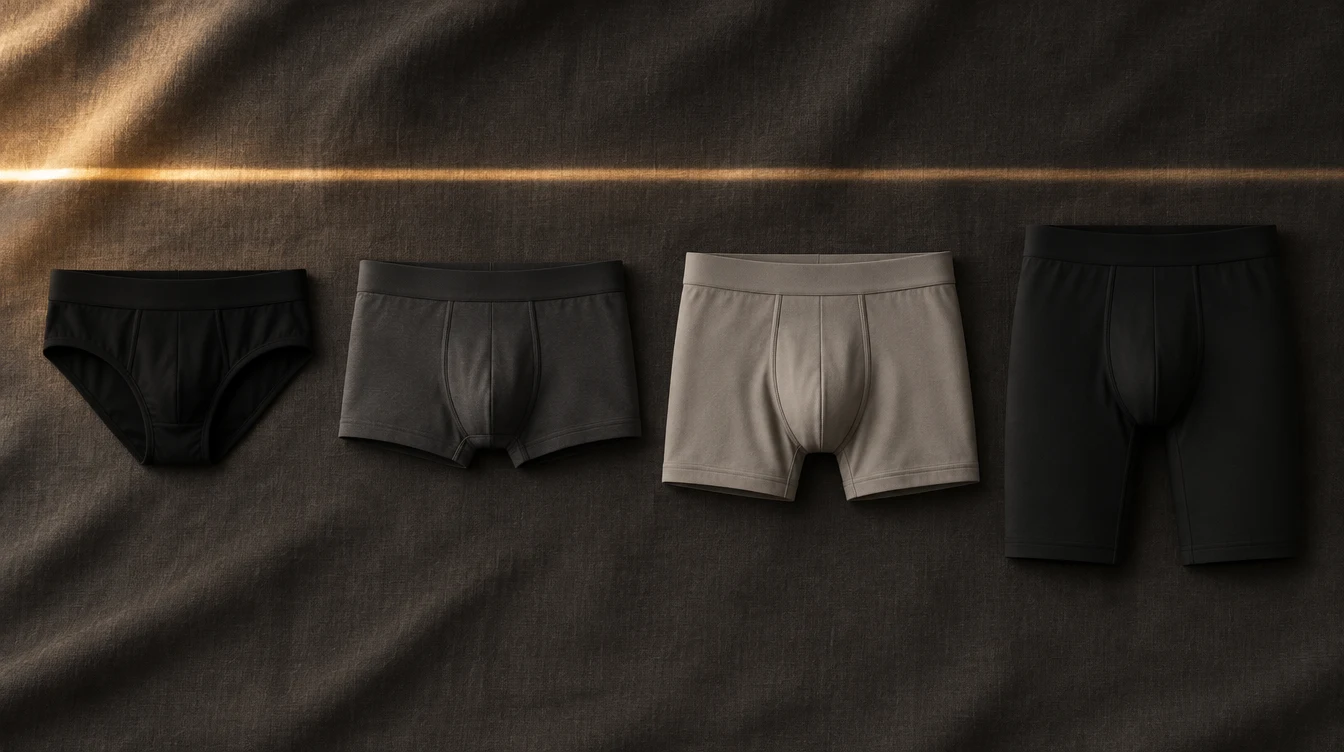
Quick Answer: Trunks vs Boxer Briefs vs Briefs
The difference between trunks vs boxer briefs, briefs and boxers comes down mostly to how much leg there is, and then to where the waistband sits and how close the leg holds your thigh.
- Briefs have no leg at all. The opening is cut up near the hip crease. SAXX and Tommy John both list a brief’s inseam as zero.
- Trunks are a short-legged boxer brief. In the brand listings we checked, examples ran from about 2¼ to 4½ inches of inseam.
- Boxer briefs cover more thigh. Most of the listings we checked sat between 5 and 8 inches, with one shorter outlier at about 3½.
- Long-leg boxer briefs go further, at about 7 to 9 inches.
- Boxers are loose and usually woven, so they hang rather than hold. One woven boxer we checked listed 5 inches.
Choose the shape before the size. Ask four things: how much thigh do you want covered, what are you wearing over it, what will you be doing, and do you want the leg to hold or to hang. Then buy one pair, test it on a normal day, and only then buy the multipack.
Table of Contents
Most of the underwear advice on this site starts after you’ve already picked a style. How Should Boxer Briefs Fit? checks the waistband, rise, thighs and length of a pair you already own. How to Stop Boxer Briefs From Riding Up fixes legs that climb. This guide comes one step earlier: which shape should be in the drawer at all?
It’s worth asking, because a lot of “fit” complaints are really shape complaints. A boxer brief that keeps peeking out under your shorts isn’t the wrong size. It’s the wrong length for those shorts. Boxers bunching inside slim jeans aren’t badly made. They’re a loose garment under a close one. Changing the size label won’t fix either, because the problem is the category.
The four shapes, in plain terms
Brands use these names loosely, and they don’t always agree with each other. Here’s what each name usually means and what it physically does on your body.
Briefs
No leg. The leg opening is cut high, near where your thigh meets your hip. Calvin Klein’s men’s size guide describes its brief as having a “high leg cut” and “full seat coverage”, and says it comes in both high and low rise. With no leg fabric, there’s nothing on the thigh to ride up. There’s also nothing between your thighs, which some men like and others don’t.
Trunks
A boxer brief with a short leg. Tommy John puts it simply: “the trunk is basically a boxer brief with a shorter inseam”. The hem sits high on the thigh. A trunk is close-fitting like a boxer brief, but it covers less of the leg.
Boxer briefs
The close-fitting shape with the most thigh coverage. Calvin Klein’s size guide calls it a “long leg cut” with a “close fit”. Its style guide on Myer says the boxer brief’s leg line “sits on mid-thigh”. Many brands also sell a long-leg version that reaches lower still.
Boxers
Loose, and usually woven rather than knitted, so the fabric hangs instead of hugging. Calvin Klein’s size guide describes its boxer as a “long leg cut, loose fit” sold in slim, traditional and relaxed versions. A classic example is Jockey’s 100% cotton woven 5″ boxer, which Jockey describes as breathable cotton with a relaxed fit and an elastic waistband, with the 5-inch length in the product name.
If you’ve been weighing boxers vs boxer briefs, this is the real split. One shape holds your leg and the other doesn’t. That changes how each one behaves under trousers far more than the inseam number does.
Boxers vs briefs: the short version
If you’re choosing between boxers and briefs, you’re choosing between the two ends of the range. Boxers are loose and usually woven, so the leg hangs rather than holds. That gives a roomier feel, but under slim trousers or jeans the extra fabric can bunch. Briefs have no leg at all and hold close, so there’s no leg fabric to bunch around the thighs, but they cover the least. If boxers bunch and briefs feel like too little, the middle shapes, trunks and boxer briefs, are the usual compromise: they hold like a brief and cover some thigh. Decide what you wear over them most days, then use the side-by-side table below.
Trunks vs boxer briefs vs briefs: the side-by-side
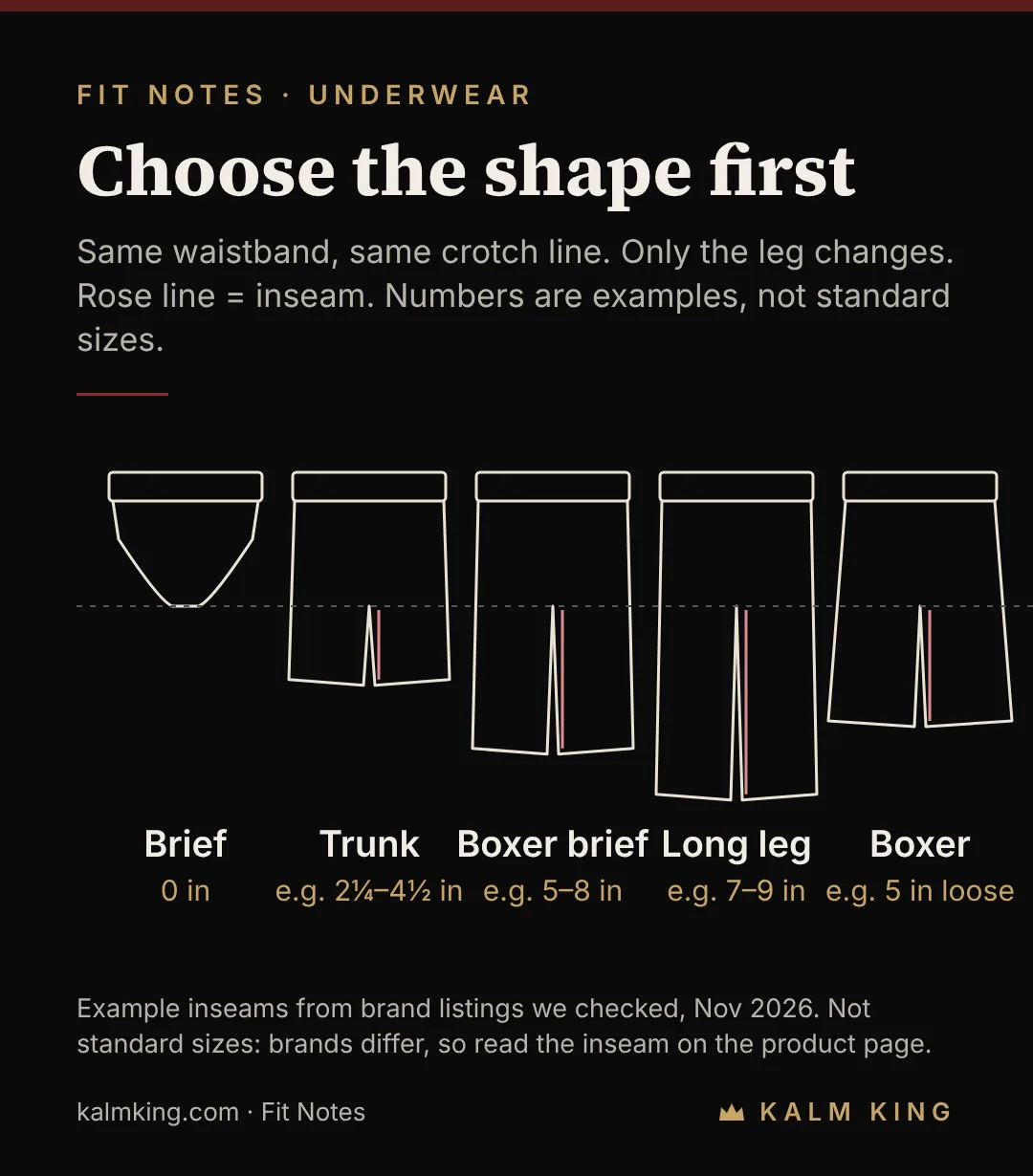
The inseam figures below come from brand pages and product listings we checked. They’re examples from specific brands, not universal sizes. No industry standard sets the inseam for any of these styles. Each brand sets its own lengths, and some of them overlap.
| Brief | Trunk | Boxer brief | Long-leg boxer brief | Boxer | |
|---|---|---|---|---|---|
| Example inseam (brand listings, not a standard) | 0 in | about 2¼–4½ in | about 5–8 in (some shorter) | about 7–9 in | about 5 in in the example checked |
| Where the leg ends | High-cut opening near the hip crease | High on the thigh | Around mid-thigh | Lower thigh | Loose, around mid-thigh |
| How the leg behaves | No leg fabric | Holds close, short | Holds close, longer | Holds close, longest | Hangs and moves |
| Thigh coverage | None | A little | Moderate | Most | Moderate, loose |
| Usual fabric build | Knit with stretch | Knit with stretch | Knit with stretch | Knit with stretch | Often woven cotton |
| Typical trouser pairing | Anything; shortest shorts | Slim trousers, shorter shorts | Most trousers and shorts | Longer shorts, full trousers | Relaxed trousers |
Where those numbers come from:
- SAXX lists its brief at 0 inches, its trunk at 3 inches, its boxer brief at 5 to 6 inches and its long leg at 7 to 9 inches in its underwear fit guide.
- Tommy John sells a Customized Flex Trunk 4″ and a Mid-Length Boxer Brief 6″. In its trunk explainer, it gives a 4.5-inch inseam for its trunks, 8 inches for its full-length boxer brief and 0 for a brief.
- Calvin Klein listings on Altitude Sports give an inseam of 2¼ inches for the Cotton Classics trunk and about 3½ inches for the Cotton Stretch boxer brief.
- Hanes sells a Moves long-leg boxer brief with an 8-inch inseam, according to the product listing.
- Jockey lists its woven boxer at 5 inches.
Look at what that list shows. A Tommy John trunk at 4½ inches is longer than a Calvin Klein boxer brief at about 3½. The names overlap. In practice, “trunk” and “boxer brief” describe a direction more than a measurement. Read the inseam number on the product page, not the style name. If a page doesn’t list one, measure a pair you already like and compare. The Size & Fit reference shows how: lay the pair flat and measure from the crotch seam to the leg hem.
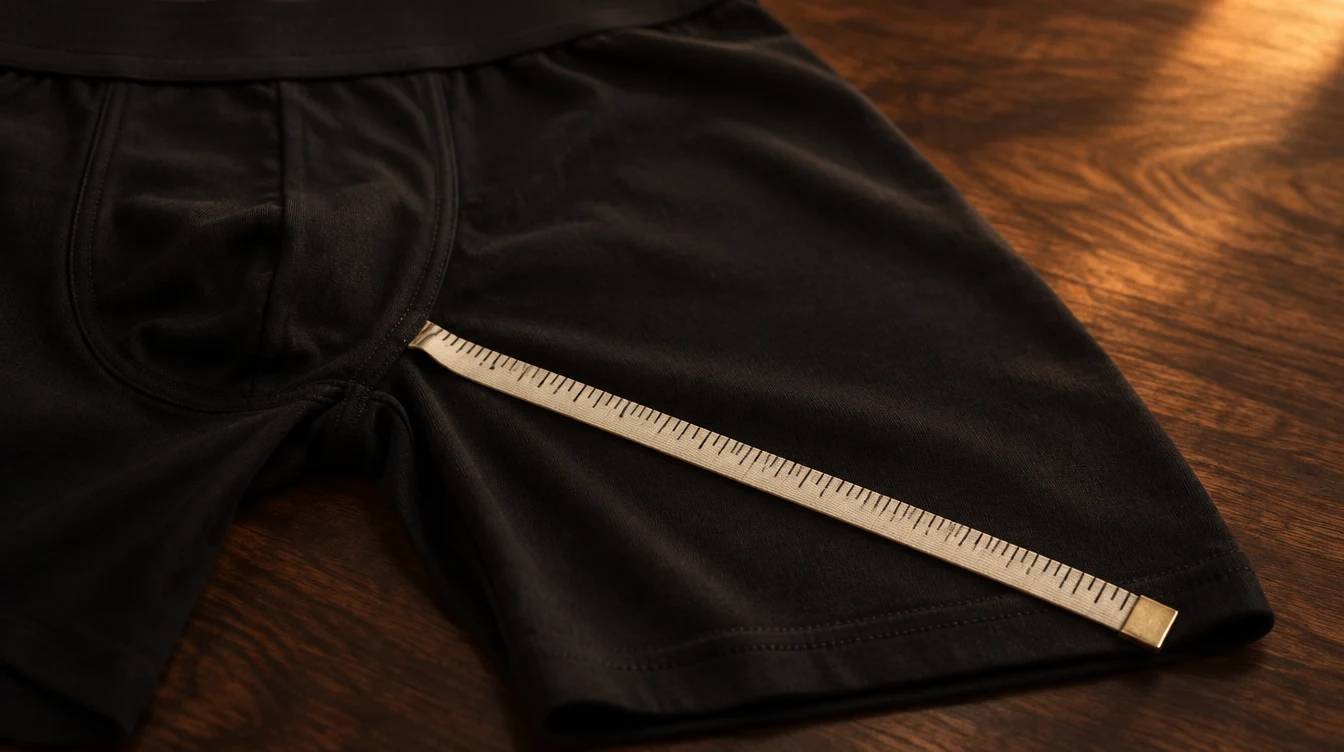
Inseam, rise and hem: the three things that set the shape
Every style name above is really a combination of three settings. Once you can read them, a product page tells you much more than its title does.
Inseam: how much thigh
Inseam runs from the crotch seam down to the leg hem. It decides how much thigh is covered, and it’s the main difference in trunks vs boxer briefs. A shorter inseam leaves more thigh bare and stays hidden under shorter shorts. A longer one covers more thigh, which can mean more fabric to sit smooth (or not) under close trousers.
Rise: where the band sits
Rise runs from the crotch up to the waistband. It decides how high the band sits on your body, and it’s separate from inseam. A pair can have a short leg and a high rise, or a long leg and a low rise. Calvin Klein’s style guide shows how much this varies inside one brand. Its low-rise trunk “sits below the hip”, its regular trunk “sits at the hip” and its boxer brief “sits above the hip”.
Rise matters when you choose a shape because it has to work with your trousers. If you wear low-rise jeans, a high-rise band may show above them when you bend. If you wear high-rise trousers or overalls, a low-rise band may sit in a different place from everything on top of it. Our overalls fit guide covers rise in outerwear, and the boxer brief fit guide covers how rise feels on the body.
Hem: where the leg stops, and how
The hem is the last thing to check, and it decides the feel. A brief’s opening sits up at the hip crease, off the thigh. A trunk’s hem sits high on the thigh. A boxer brief’s hem sits further down, often around mid-thigh. A boxer’s hem doesn’t hold your leg at all.
Where the hem lands on your leg matters as much as the inseam number. On one man, a 5-inch hem might land on a narrow part of the thigh. On another, it might land right on the widest part. That’s a big part of why two men can disagree about the same pair. If you already own a shape whose legs climb, the ride-up guide covers the fixes. Here, just note where the hem would land on you before you choose.
Try this shape first if…
This section doesn’t tell you which shape is best. It gives you a sensible first shape to test for some common situations. Your own body and day get the final say.
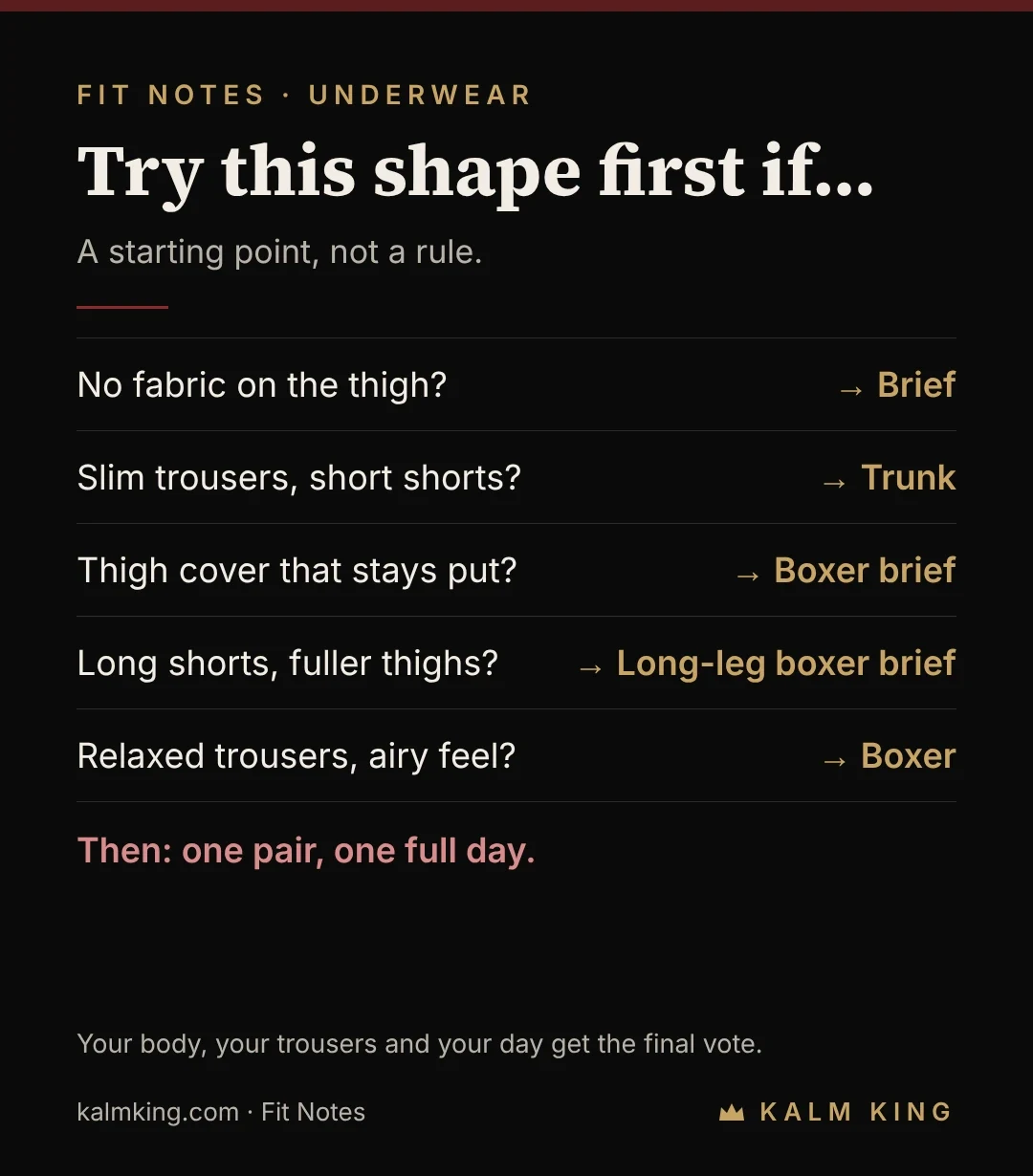
Try briefs first if you want nothing on your thighs at all, you often wear very short shorts or swim-length shorts, or leg hems of any kind bother you. The trade-off is that you lose the fabric layer between your thighs. Some men rely on that layer.
Try trunks first if you mostly wear slim or tapered trousers, you wear shorts above the knee, or you want a close fit without much leg fabric. Tommy John’s trunk explainer says trunks stay hidden under most shorts and reduce bunching under slimmer trousers. That’s a brand claim, but it fits the geometry: less leg fabric gives a slim trouser leg less to fold over.
Try boxer briefs first if you want some thigh coverage, a close hold and one shape that works under most of what you own. A mid-length boxer brief, around 5 to 6 inches on the charts above, is a common middle ground between a trunk and a long leg.
Try a long-leg boxer brief first if you want the most fabric between your thighs, you’re on your feet or moving for long stretches, and your shorts are long enough to hide a 7 to 9-inch leg. Check that last part with your actual shorts, because a long leg is the one most likely to peek out.
Try boxers first if you mostly wear relaxed trousers, you dislike close-fitting underwear, or you want a loose feel at home or on easy days. Tommy John’s men’s underwear guide suggests pairing boxers with relaxed-fit denim and wearing them when support isn’t the priority.
Not sure where to start? Pick the shape closest to the trousers you wear most days, and the leg length closest to a pair you already like. Change one thing at a time from there.
Two quick examples
These are illustrations of the reasoning, not real readers.
Example one. A man wears slim chinos five days a week and shorts that stop well above the knee in summer. His long-leg boxer briefs bunch at the knee of the chinos and show under the shorts. The size is fine. He tries a trunk in his usual size, keeps his long legs for the gym, and the bunching problem goes away.
Example two. Another man wears relaxed jeans and works on his feet. Boxers feel free, but by midday the fabric has twisted and gathered. He tries a mid-length boxer brief with a close leg. On the first day, he checks one thing: does the hem land somewhere it can stay put on his thighs? It does, so he buys more of the same.
Match the shape to your trousers
The trousers you wear most often probably narrow the choice more than anything else. Underwear sits inside them, so the shapes have to work together.
| If you mostly wear… | Shapes that usually work | What to watch |
|---|---|---|
| Slim or skinny trousers | Briefs, trunks, shorter boxer briefs | Loose boxers can fold and bunch; long legs can crease at the thigh |
| Straight or regular trousers | Any close-fitting shape | Hem landing on the widest part of your thigh |
| Relaxed or wide trousers | Boxers, boxer briefs | Boxers can twist without a close outer leg to hold them in place |
| Shorts above the knee | Briefs, trunks | Long-leg hems showing at the leg opening |
| Longer shorts | Boxer briefs, long-leg boxer briefs | Short legs riding up under a longer outer leg |
| Overalls or jumpsuits | Depends on the rise and seat | How the seat and crotch of the outer garment sit |
Some notes on that table:
Slim trousers leave less room. A loose woven boxer has nowhere to go inside a slim leg, so it folds. A close-fitting knit moves with you instead. That’s why boxers vs boxer briefs is often decided by your jeans, not by the underwear.
Shorts set an upper limit on length. Put the shorts on, sit down and look at the leg opening. If a boxer brief hem shows, you need a shorter inseam for those shorts. That might mean a second shape in the drawer, not a change of size.
Overalls and jumpsuits change the waist question. The waistband of your underwear doesn’t compete with a trouser waistband in a one-piece. The seat and crotch of the outer garment matter more. Our guide to what to wear under overalls covers the layers in detail.
Try it with the real trousers. A shape can be right with one pair of trousers and wrong with another. If the trouble only shows up with one pair, the trousers are part of the answer.
Match the shape to your day
Activity changes the job. Even brands contradict each other about which shape suits movement, which tells you this is a matter of preference.
In its trunk explainer, Tommy John recommends boxer briefs for activity because the longer leg limits rubbing, and says trunks suit only light athletic activity. Its own underwear guide says trunks suit workouts with lunges and stretching, and can give “a little more freedom of movement than boxer briefs”, though perhaps not for men with larger thighs who want more fabric. Calvin Klein’s size guide says its trunk “reduces ride-up”. If one brand can argue both sides, there’s no universal answer. Test it yourself.
Here’s a practical way to think about it:
- Desk days. Comfort while sitting matters most. Check how the band sits when you’re seated and how the hem feels after hours in a chair.
- On your feet. Walking and stairs are the test. A hem that holds while you stride matters more than one that looks neat in the mirror.
- Training. Squats, lunges and running test the leg opening and the seat. Some men like the most thigh fabric for this. Others like the least. Try a session in the shape before you trust it.
- Cycling or long rides. Repeated leg movement shows up hem problems fast. As with training, test before you buy more.
- Hot or humid days. Fabric and fit both play a part. See the next section.
- Travel. Pack for the activities you’ll actually do. Many men bring two shapes.
It’s normal to own more than one shape. A trunk for slim trousers and a long leg for the gym isn’t indecision. It’s the right tool for each job.
Fabric and hem behavior by shape
Shape and fabric work together. The same shape can feel very different in two fabrics, so look at both before you choose.
Knit vs woven
Briefs, trunks and boxer briefs are usually knitted fabrics with some stretch. That stretch lets them hug the body and recover after you move. Boxers are often woven, like the 100% cotton woven boxer above. Woven fabric doesn’t stretch the same way, which is why boxers are cut loose and hang rather than hold. Knit boxers exist too, so read the description.
Stretch content
On a label, elastane and spandex mean the same fiber. The LYCRA Company says the terms are interchangeable. Stretch helps close-fitting shapes follow your body. A higher percentage doesn’t guarantee a better fit, though. The cut matters at least as much.
The fabric label is a clue
Fibre names don’t tell you everything. Two cotton-blend boxer briefs can feel completely different depending on the knit, the thickness and the finish. Our boxer brief fit guide explains what fabric does and doesn’t change, so we won’t repeat it here. When choosing a shape, ask one simple question: will this fabric hold the hem where this shape needs it?
How the hem behaves on each shape
- Briefs: no thigh hem, so there’s no hem to ride up. Check instead that the leg opening at the hip crease doesn’t dig in when you sit.
- Trunks: a short hem that sits high. How it’s finished matters, because a short leg has less fabric to keep it in place.
- Boxer briefs and long legs: the hem lands further down the thigh, often near its widest part. A close but comfortable opening matters most here.
- Boxers: no grip. The hem moves freely. That’s the point, and it’s also why boxers bunch under close trousers.
The one-pair test before you buy a multipack
Multipacks are cheap per pair, so a wrong shape costs you more than you think. Before you buy five or six of anything new, buy one pair, or the smallest pack, and live in it for a normal day.
First, check the retailer’s return and hygiene rules. Some won’t take underwear back once it’s opened or worn. So run this test on a pair you’re allowed to try, or one you’re happy to keep either way.
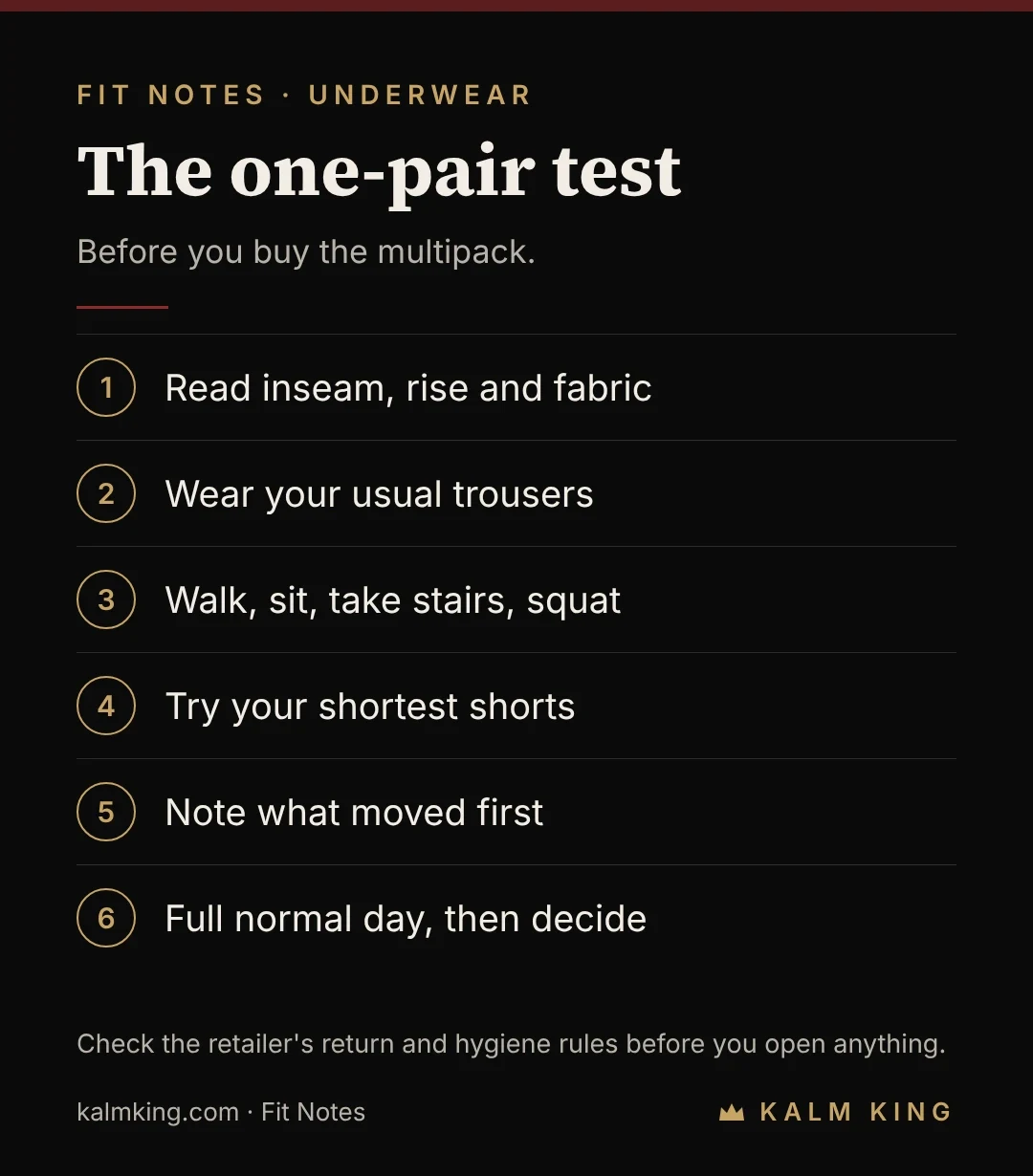
- Read the page before you buy. Note the inseam in inches or centimetres, the rise description and the fabric blend. Compare them with a pair you already like. If the page lists no inseam, ask the retailer or measure a similar pair.
- Use the brand’s own size chart. Measure where that brand tells you to. SAXX’s fit guide, for example, says to measure just under your belly button, where the waistband usually sits. Our Size & Fit reference explains the three kinds of measurement and has a Fit Card you can keep.
- Wear it with the trousers you wear most. Not your loosest pair and not your slimmest. Your usual pair.
- Move. Walk twenty steps, sit and lean forward, climb stairs two at a time, and squat as far as is comfortable.
- Check it with your shortest shorts. Sit down and look at the leg opening. If the hem shows, the shape is too long for those shorts.
- Note what moved first. The band, the front or the hem. If it’s the hem on a close-fitting shape, the ride-up guide tells you what to change. If it’s the band or the front, the fit guide covers it.
- Wear it for a full ordinary day. A pair that feels fine in the mirror can feel different by evening.
- Then decide. If the shape works, buy more of exactly the same thing. If it doesn’t, change one variable (shape, length, rise or fabric) and test again.
Change one thing at a time. If you switch from long-leg boxer briefs to trunks and change brand and change size, you won’t know which change made the difference.
Choosing for someone else
If you’re buying for a partner, a father or a brother, the safest guide is what he already wears. Look at the shape in his drawer and, if you can, the length of the pairs he reaches for first. Sticking with a shape he already wears is a safer gift than switching him to a new one. If you do want to try something new, a single pair is kinder than a multipack. Our guide to buying clothes for him without guessing has more on how to find out without asking outright.
Myths about underwear shapes
“Boxer briefs are just a bigger version of trunks.” They’re the same family, but the names overlap. One brand’s boxer brief can be shorter than another brand’s trunk. Read the inseam number.
“Briefs are old-fashioned.” A brief is a shape, not a statement about age. Briefs are one of the four main men’s underwear styles. Brands still make them in several rises.
“If it rides up, buy the next size.” Sometimes the size is fine and the shape or length is wrong for your trousers or thighs. Our fit guide explains how to tell which.
“Longer is always more comfortable.” Longer means more coverage. Whether it’s more comfortable depends on your thighs, your trousers and your day. Some men prefer a shorter leg or no leg at all.
“One shape should do everything.” You might find one that does. Many men end up with two, and that’s a perfectly reasonable answer.
Trunks vs Boxer Briefs: FAQ
What’s the difference between trunks and boxer briefs?
Mostly leg length. A trunk is a boxer brief with a shorter leg. In the brand listings we checked, trunks ran from about 2¼ to 4½ inches of inseam, and most boxer briefs ran from about 5 to 8. Those are examples, not standard sizes: brands overlap, so check the inseam on the product page.
Briefs vs boxer briefs: which should I try first?
Try briefs if you want no fabric on your thighs and wear short shorts. Try boxer briefs if you want thigh coverage and a close hold under most trousers. Neither is better for everyone. Wear one pair for a full normal day before you decide.
Briefs vs trunks: what’s the real difference?
A brief has no leg. Its opening is cut near the hip crease. A trunk adds a short leg that sits high on the thigh. Trunks give you a little thigh coverage while still staying hidden under most shorts.
Boxers vs boxer briefs: why do boxers bunch in my jeans?
Boxers are loose and often woven, so they hang instead of holding your leg. Inside slim or straight jeans, that extra fabric folds and gathers. If you like boxers, wear them with relaxed trousers and try a close-fitting shape for slim ones.
What are the main types of men’s underwear?
Briefs, trunks, boxer briefs (including long-leg versions) and boxers. Some brands add hip briefs, square cuts and low-rise trunks. Those are mostly variations in rise or leg length on the same four shapes.
Are trunks shorter than boxer briefs at every brand?
Usually, but not always. In the listings we checked, a Tommy John trunk listed at 4½ inches was longer than a Calvin Klein boxer brief listed at about 3½. Trust the inseam number, not the style name.
Which shape is best for the gym?
There’s no single answer. Even one brand recommends boxer briefs for activity on one page and trunks for lunges and stretching on another. Test the shape in a real session: squats, lunges and a few minutes of whatever you actually do.
Do I need to change my size if I change shape?
Not necessarily. Start with your usual size on that brand’s chart, measured where the brand tells you to. Change the shape first, then the size only if the waist or the fit around your body is wrong.
Boxers vs briefs: which should I choose?
Boxers are loose and usually woven, so they hang and can bunch under slim trousers. Briefs hold close with no leg. Choose by what you wear over them; trunks and boxer briefs sit between the two.
Your next step: look at the trousers you wear most and the pair of underwear you reach for first. Measure that pair’s inseam flat, from crotch seam to hem, and note it on the Fit Card in our Size & Fit reference. Then buy one pair of the shape you want to try, run the one-pair test, and only buy the multipack once a full ordinary day has passed with nothing to fix.
For more practical fit and style guides, join Kalm King Field Notes. You’ll also get the free Overalls Fit Kit.
Explore Next
- Measure once, shop with a clear head: Size & Fit Reference
- Once you’ve picked boxer briefs: How Should Boxer Briefs Fit?
- Legs that keep climbing: How to Stop Boxer Briefs From Riding Up
- The layers under a one-piece: What to Wear Under Overalls
- Rise and seat in outerwear: How Should Men’s Overalls Fit?
- Buying for him: How to Buy Clothes for Him Without Guessing
- The rest of the essentials: How Should a Men’s T-Shirt Fit? · How to Choose Everyday Socks
Final Thought: Shape First, Then Size
Most underwear frustration comes from asking the size label to fix a shape problem. Decide how much leg you want, where the band should sit and what goes on over the top. Then let the size chart do the smaller job it was made for. One pair, one ordinary day, one change at a time. That’s how you end up with a drawer you don’t have to think about.
About the Author
King is the founder of Kalm King, a menswear brand and editorial space built on one idea: composure is power. He’s a creator, model and artist based in the Washington, DC area. He trained at John Casablancas Modeling & Career Center, has walked runway for the Aveda Institute in Washington, DC, and grew up in front of the camera as the son of a photographer. Kalm King’s guides start with the fit problems men actually describe. This guide draws on published brand charts and product listings. We haven’t tested these garments, and fit is personal, so always check the maker’s own chart.
FIELD NOTES
Get the Overalls Fit Kit, free.
Your measurement card, the six fit checkpoints and a checklist to take shopping. Join Field Notes for new guides and a say in what Kalm King makes.
THE KALM KING JOURNAL
Continue reading
How Should Men’s Dress Pants Fit? Waist, Rise, Seat and Break
How should dress pants fit? Check the waist, rise, seat, thighs and hem with practical sitting tests, break options and realistic tailoring advice.
How Should a Dress Shirt Fit? A Men’s Guide to Collar, Chest and Sleeves
Check dress shirt fit at the collar, shoulders, chest, sleeves and hem. Learn what to measure, how to test movement and when to try another cut.
Men’s Capsule Wardrobe: How to Build One That Actually Works
A men’s capsule wardrobe is a small set of clothes that all work together. How to choose the pieces, colors and fit, and build one at your own pace.