
September 22, 2026
Explore: Culture
Can clothes change how you feel? What the research actually says
Can clothes affect confidence and first impressions? A research-backed look at fit, context, bias and getting dressed with intention.

Most advice about clothing and confidence skips straight to a promise: put on the right outfit and become a different man. The research is more interesting than that. Clothes can influence first impressions, change the way a situation feels and sometimes affect the wearer’s thinking. They cannot manufacture ability, erase nerves or turn an expensive jacket into proof of character.
The useful question is smaller: can getting dressed with intention help you enter a room with less friction and a clearer sense of how you want to move through it?
Short answer: How clothes affect confidence depends on comfort, context and personal meaning. Clothing can influence impressions and may affect the wearer in some settings, but the research does not support a promise that an outfit makes you capable or confident. Start with comfortable movement, the situation’s real requirements and clothes that feel like you. Treat laboratory findings as limited evidence, not a shopping prescription.
What “enclothed cognition” actually means
Psychologists Hajo Adam and Adam Galinsky introduced the term “enclothed cognition” in 2012. Their experiments used white laboratory coats and proposed that clothing can affect the wearer when two conditions meet: the garment carries a symbolic meaning and the person physically wears it. Participants who believed they were wearing a doctor’s coat showed improved attention on one task.
That finding became a tidy headline, but later evidence complicated it. A 2019 preregistered direct replication used roughly ten times as much data and did not reproduce the original selective-attention effect. That matters. The honest conclusion is not that clothing secretly rewires the brain. It is that clothes can act as contextual cues, while the size and reliability of specific cognitive effects remain unsettled.
Clothes may change the frame of mind
A separate 2015 paper tested formal clothing across five studies. The researchers found associations between formal dress and more abstract, big-picture processing. In one experiment, participants were randomly assigned to change into formal or casual clothing before completing a visual-processing task. The authors also found that a greater sense of power helped explain part of the relationship.
These were controlled studies, many with student samples, so they should not be treated as a rule that suits make people smarter. They do support a familiar experience: an outfit can help mark a transition. Work clothes, training clothes and evening clothes tell the body that the context has changed. A useful garment can become part of the routine that moves you from one role into another.
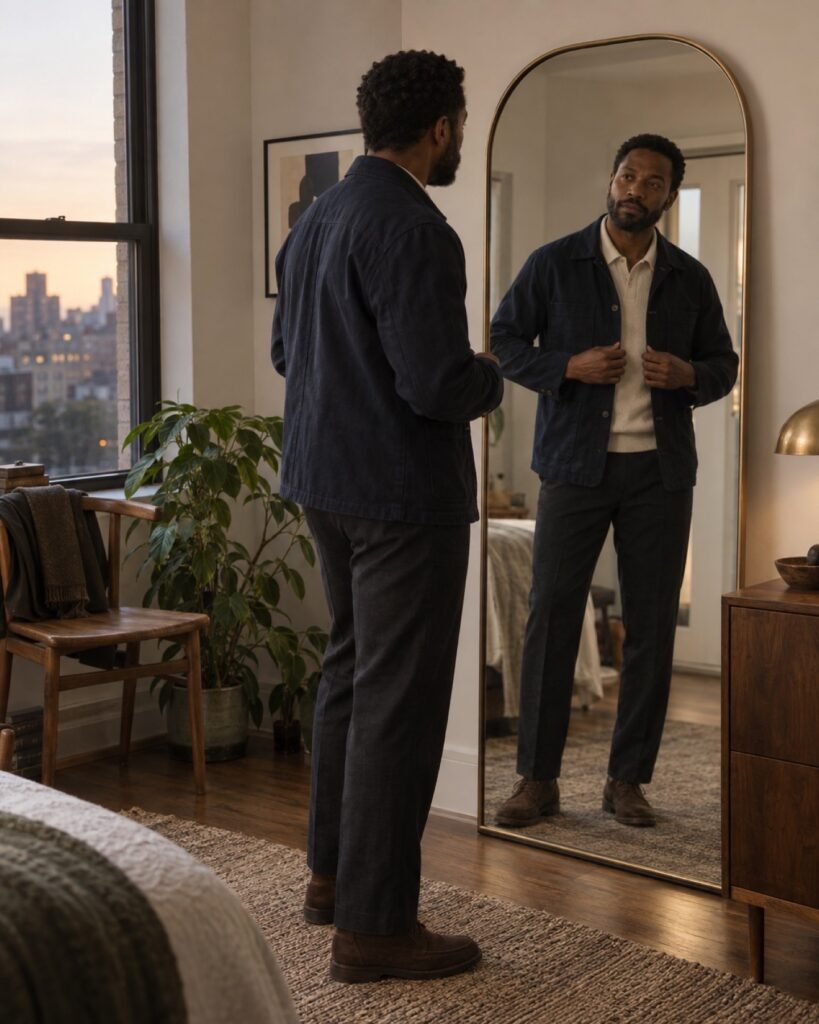
Other people notice smaller differences than we think
Clothing affects the observer as well as the wearer. In a 2013 study, 274 participants saw a faceless man for no more than five seconds. He wore either a made-to-measure suit or a standard off-the-rack version with only minor visual differences. The made-to-measure version produced higher ratings for confidence, success, salary and flexibility, though not trustworthiness.
A 2020 paper in Nature Human Behaviour went further. Across nine studies, the same faces were judged as more competent when paired with clothing that independent raters read as richer. The effect remained when images flashed for only 129 milliseconds and when participants were told to ignore the clothes. The researchers were documenting bias, not discovering a fair way to measure competence. What we wear can influence a judgment even when the judgment is wrong.
That distinction protects us from bad style advice. Looking expensive is not the same as being capable. A garment’s price cannot supply skill, generosity or good judgment. The evidence shows how quickly observers use clothes as shorthand, which is a reason to dress deliberately and a reason to question our assumptions about other people.
A practical way to dress with more confidence
Start with the situation. Name what the day asks from you before opening the closet: ease, authority, approachability, movement or some combination of them. A dinner, presentation and long travel day need different kinds of composure.
Then remove physical distractions. A collar that shifts, a waistband that pinches or a jacket that blocks your reach will keep asking for attention. Good fit is partly visual, but its greater value is that you can stop managing the garment and return your attention to the room.
For shirts and jackets, begin with the upper body: a clean shoulder line helps the collar stay put and lets the sleeve move without making you manage the garment all day.
Build a repeatable formula from clothes you already trust. It might be a knit polo, straight trouser and overshirt; a white shirt with dark trousers; or a clean T-shirt under a relaxed jacket. Repetition is useful when it reduces decisions without making you feel anonymous. Change the fabric, color or shoe while keeping the dependable structure.
Finally, choose one detail that feels intentional at conversational distance. That could be the texture of a jacket, the break of the trouser, a watch you actually wear or a collar that sits cleanly beneath a coat. You do not need a room to notice every choice. You need the outfit to feel resolved when you leave the mirror.
Confidence still has to belong to you
Clothing works best as support. It can reduce distraction, signal that a moment matters and remind you of the role you are ready to occupy. The research also shows that observers bring their own biases to what they see, so no outfit can guarantee the response you deserve.
Wear the clothes, check that you can move and then let your attention leave them. The goal is not to spend the evening thinking about a jacket. The goal is to have chosen well enough that you can think about everything else.
How clothes affect confidence in an ordinary day
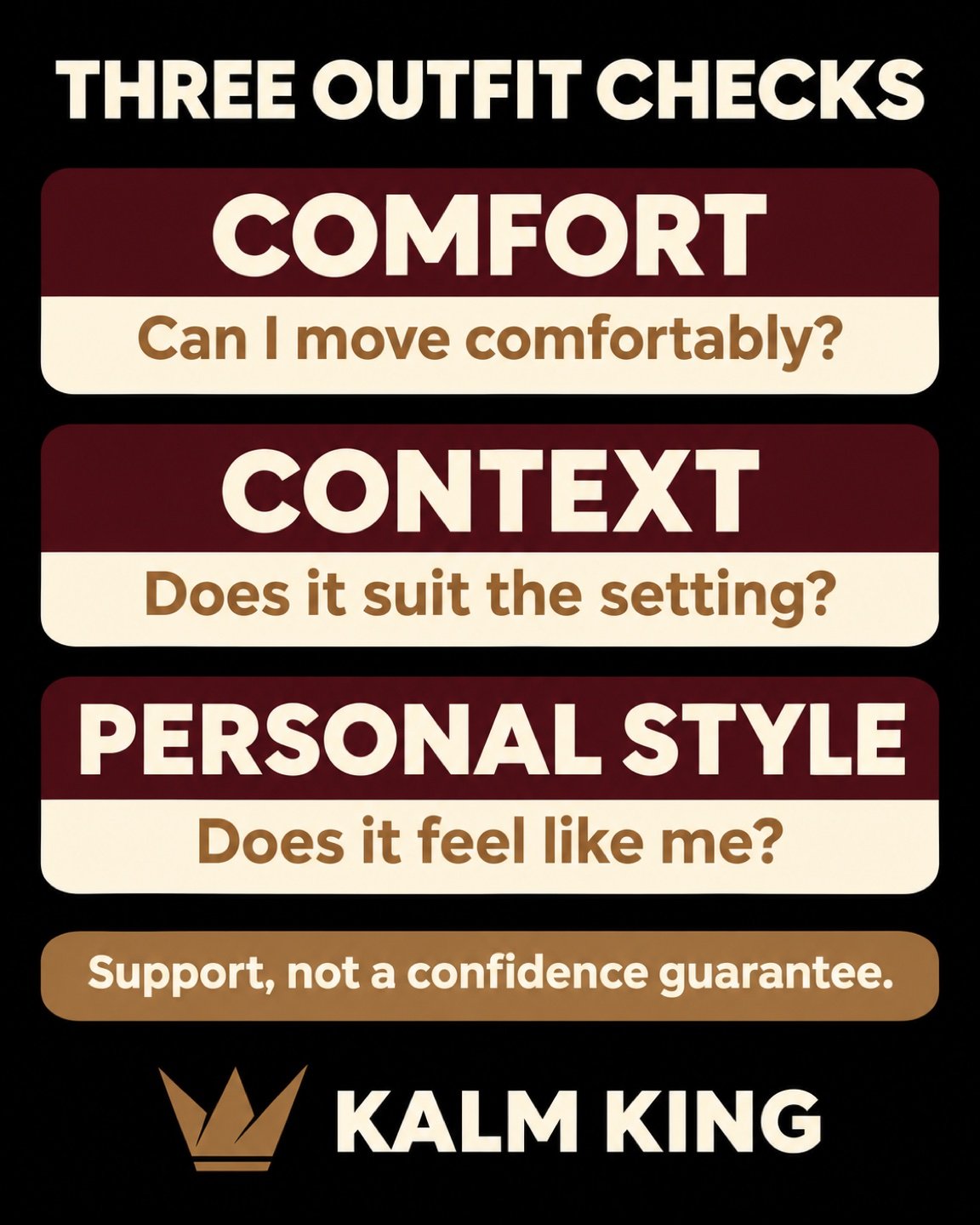
Separate three questions that often get bundled together. How does the clothing feel on your body? Does it suit what you are doing? And do you like how you look in it? An outfit can succeed at one and fail at another. A jacket may photograph beautifully but restrict your reach. Comfortable clothes may be wrong for a stated dress code. Something perfectly appropriate may still feel unlike you.
These are practical checks, not a psychological test. You are not measuring your confidence or proving a research theory by changing shirts. You are noticing which decisions make getting dressed easier and which ones leave you distracted. That smaller goal is useful even when the effect of clothing on a laboratory task is uncertain.
Start with the physical question. Sit, walk and reach in the outfit before committing to it for an important day. Check the waistband, neck opening, sleeves and shoes. A detail that feels mildly irritating at the mirror may be something you notice repeatedly later. You do not have to accept discomfort because the outfit looks more “confident” to somebody else.
Use the setting as information, not a costume brief
Find out what the situation actually requires. If there is a dress code, read it. If you are unsure, asking the host or organizer is more reliable than guessing from a social-media image. Consider the weather, the amount of walking and whether you will be sitting for hours. Practical preparation can matter more than making the outfit impressive.
Then decide where your own preferences fit within those requirements. You might choose a familiar color, a softer fabric or a less formal version of an allowed garment. The goal is not to look identical to everybody else. It is to avoid spending the event wondering whether a choice you could have checked beforehand is working against you.
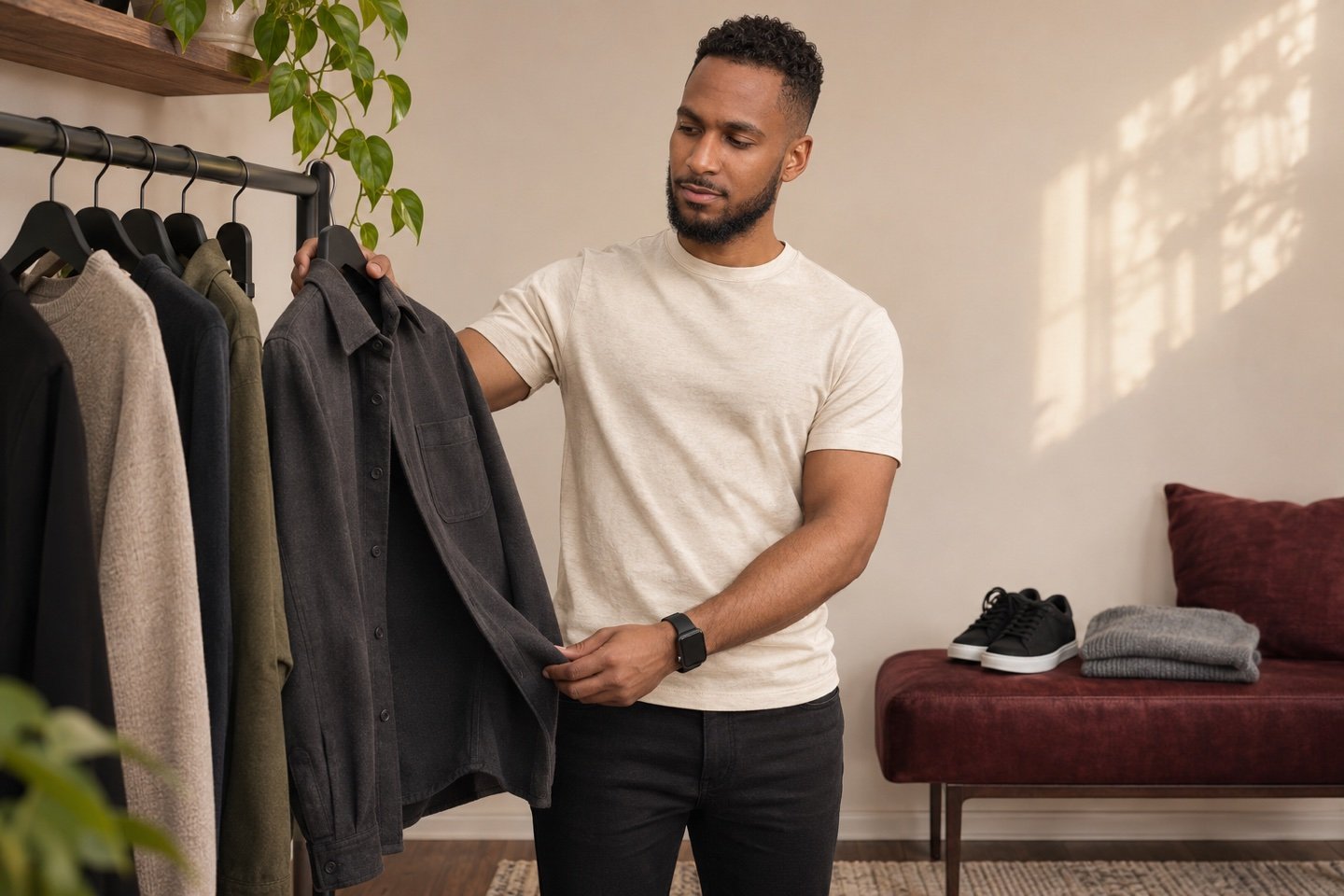
How clothes affect confidence without a new purchase
Before shopping, choose one outfit you already like and identify what makes it dependable. Is it the easy waist, the proportion between top and trousers, the shoes you can walk in or the fact that nothing needs adjusting? Write down those concrete details. “I look better in expensive clothes” gives you a shopping problem. “I like this neckline and this trouser rise” gives you useful criteria.
Build a second outfit around one of those criteria using what you own. Keep the trousers and try a different top, or keep the comfortable shoes and change the outer layer. Comparing one element at a time makes it easier to notice what you prefer. This is a wardrobe exercise, not evidence that the outfit caused a change in your personality.
Check the condition of the pieces before deciding they need replacing. Follow their care labels, remove visible lint and see whether a loose button or a simple repair is worth addressing. If you are considering tailoring, ask for a quote and a realistic assessment first. A small improvement may help, but not every garment is worth altering and not every fit problem can be fixed.
Make a repeatable formula
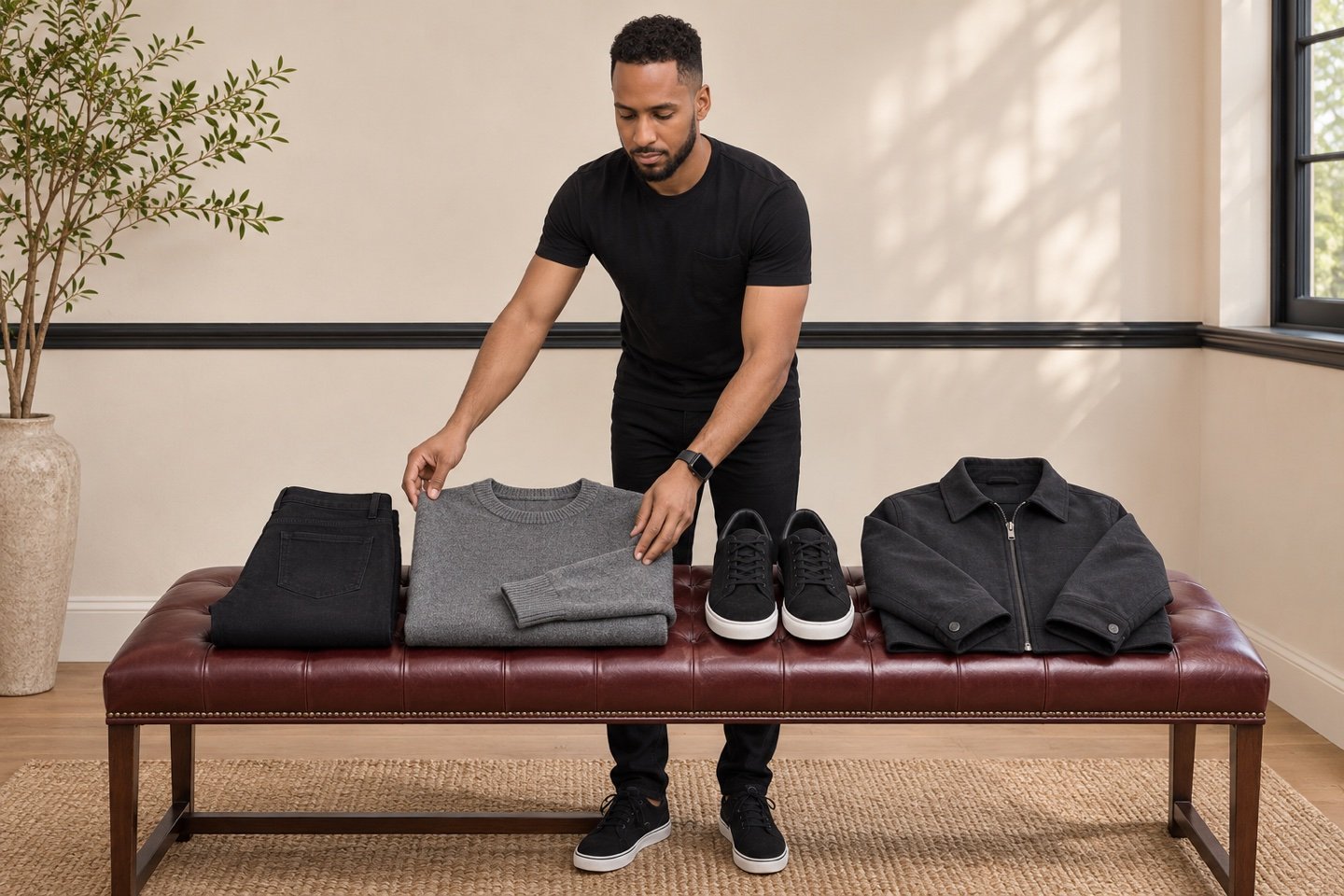
A formula is a combination you can adapt, not a uniform you must follow forever. Try a familiar tee, straight trousers and an overshirt; a knit with jeans; or a shirt with comfortable shoes suited to the setting. The particular items are less important than knowing that their proportions, layers and movement work together for you.
Save a brief note about the complete combination, including the shoes and underlayer. Otherwise, it is easy to remember that an outfit worked while forgetting the detail that made it comfortable. Our capsule wardrobe guide explains how to build around compatible pieces, and the Outfit Library offers combinations to adapt rather than rules about what every man should wear.
Four situations, four different dressing decisions
These examples are hypothetical. They are intended to show a decision process, not to promise better interviews, dates or social outcomes. Other people’s responses depend on far more than your outfit.
An interview or important meeting
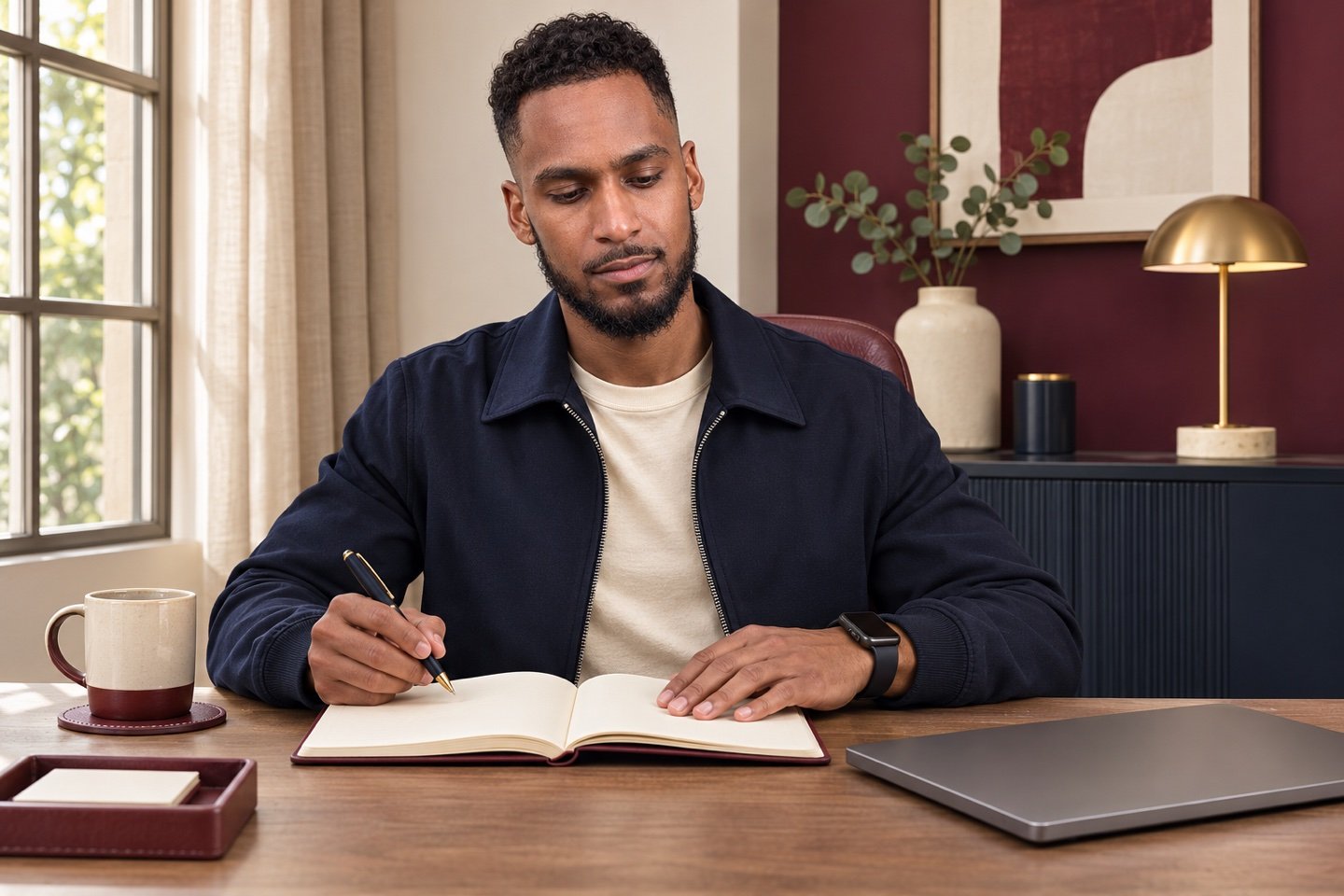
Confirm the expected dress level if you can, then choose something you have already tried on and moved in. Check how it behaves when seated, whether the shirt stays comfortable under the jacket and whether the shoes suit the journey. If the meeting is online, check the visible outfit in the actual camera setup rather than assuming a mirror tells you how it will appear.
Do that preparation early enough that clothing is not competing with the substantive work. Practicing your answers, understanding the role and arriving prepared matter in their own right. The outfit supports those tasks; it does not replace them. A sharp jacket is not a qualification, and a nervous moment is not proof that you dressed incorrectly.
A social event where you know few people
Choose an outfit that fits the occasion and contains something familiar. Trying a completely new silhouette, unfamiliar shoes and an unusual fabric at the same time can make it difficult to tell what feels wrong if you become uncomfortable. If you want to experiment, change one part and keep the rest dependable.
Give yourself a stopping point at the mirror. Check the fit and the practical details, then leave the outfit alone unless something actually needs attention. You do not need to monitor every fold throughout a conversation. Clothing can help you feel prepared, but it cannot guarantee that a room will respond warmly or remove the ordinary uncertainty of meeting people.
A long travel or errand day
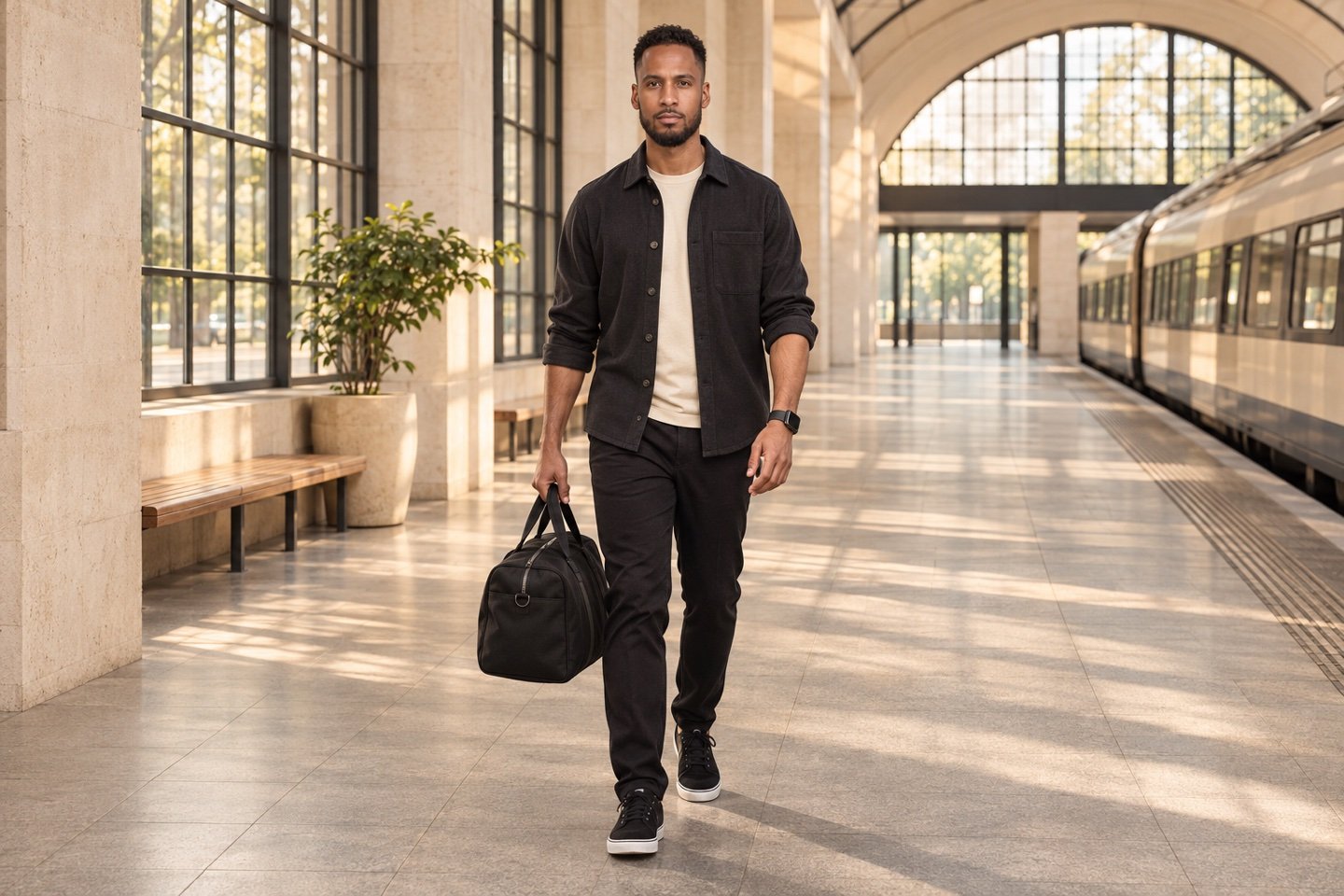
Here, movement and changing conditions may matter more than a crisp silhouette. Think about sitting, bending, carrying a bag and moving between indoor and outdoor temperatures. Choose layers you can manage and pockets that work for what you carry. An outfit that requires constant adjustment is unlikely to become more convenient because it looked good before you left home.
Comfort is personal. A fabric or waistband that suits one person may not suit another. Test the actual garment rather than buying a broad claim that a particular style is universally comfortable. If you want a more deliberate look, use color and proportion within your comfort requirements rather than treating ease as something you have to sacrifice.
A day when your usual clothes do not feel like you
Your preferences can change, and so can the fit you need. Start with what is comfortable now instead of treating a past size or silhouette as the target you must return to. You can make one small change without rebuilding the wardrobe. A different layer, a familiar outfit in a new combination or choosing the less restrictive option may be enough for that day.
Clothing is not treatment for persistent distress about your body or your worth. If getting dressed is tied to ongoing distress, support from an appropriate professional or someone you trust can matter more than another purchase. No style guide should make your right to participate in life depend on looking a particular way.
How to read clothing research without buying the headline
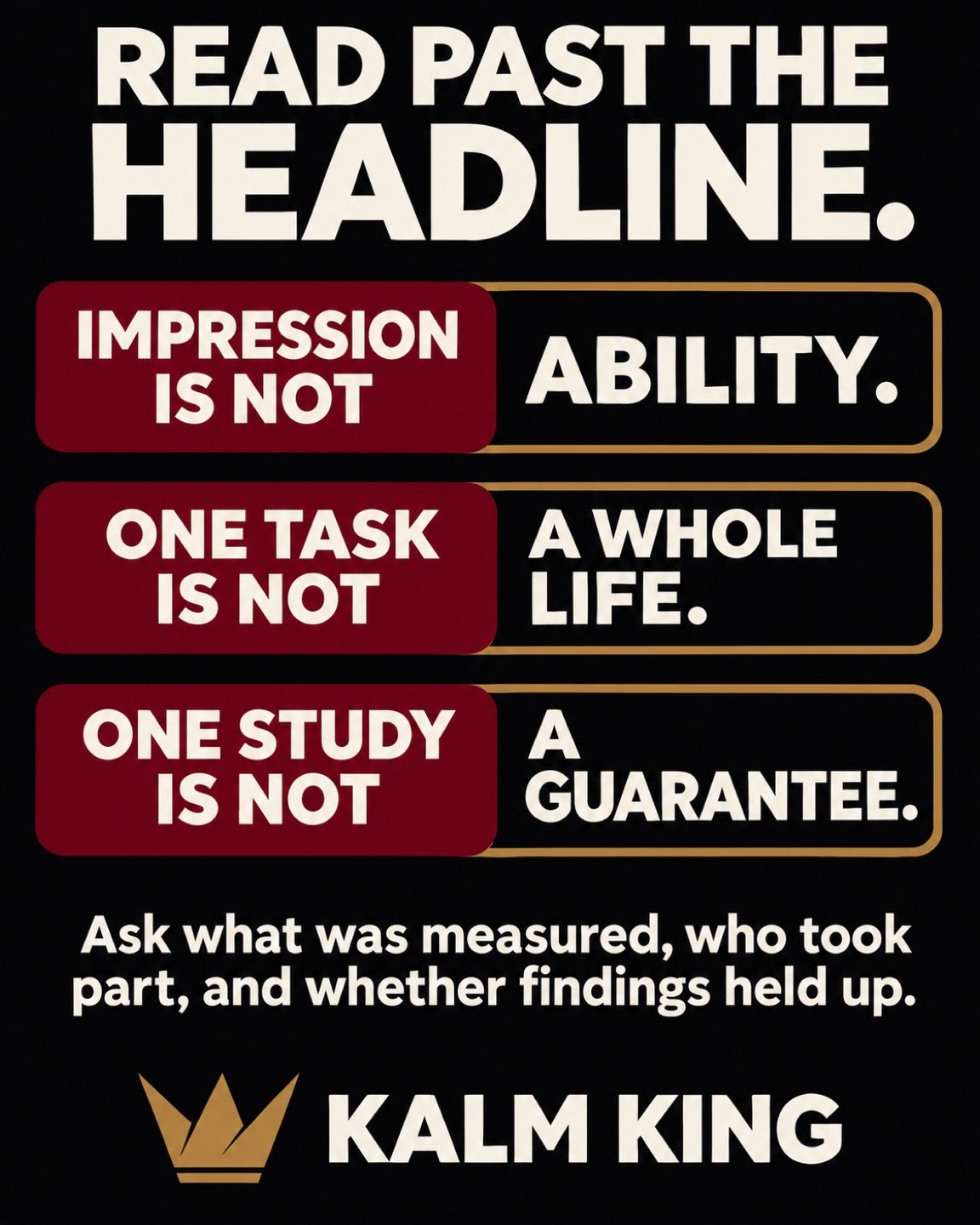
Ask what the study actually measured. A rating of someone’s apparent competence is not a measurement of their real competence. A brief attention task is not the same as long-term job performance. A result about formal clothing is not a comparison of every possible garment, wearer and situation. Those distinctions prevent a narrow finding from turning into a universal shopping rule.
Also ask who took part and what the comparison was. The studies discussed above use particular samples, tasks and clothing manipulations. That does not make them useless, but it limits what you can reasonably infer. If a result did not replicate, the uncertainty belongs in the explanation, not hidden beneath a confident slogan.
Finally, distinguish an observation from a recommendation. Evidence that people make status-based judgments from clothes does not mean those judgments are fair, accurate or something everyone should have to accommodate. You can use information about a setting without endorsing the bias. You can also notice when you are making the same shortcut about somebody else.
Do not make price the explanation for everything
If you like an outfit more after replacing one piece, ask what changed besides the price. The cut may suit you better, the fabric may be more comfortable or the color may work with the rest of your clothes. Those are more useful shopping lessons than assuming the amount on the receipt supplied the improvement.
A limited budget does not make somebody less capable, less serious or less deserving of respect. Clothes also reflect access, work requirements, culture, disability-related needs and personal preference. A guide to first impressions should make those limits clearer, not turn appearance into a moral score.
A one-week wardrobe observation
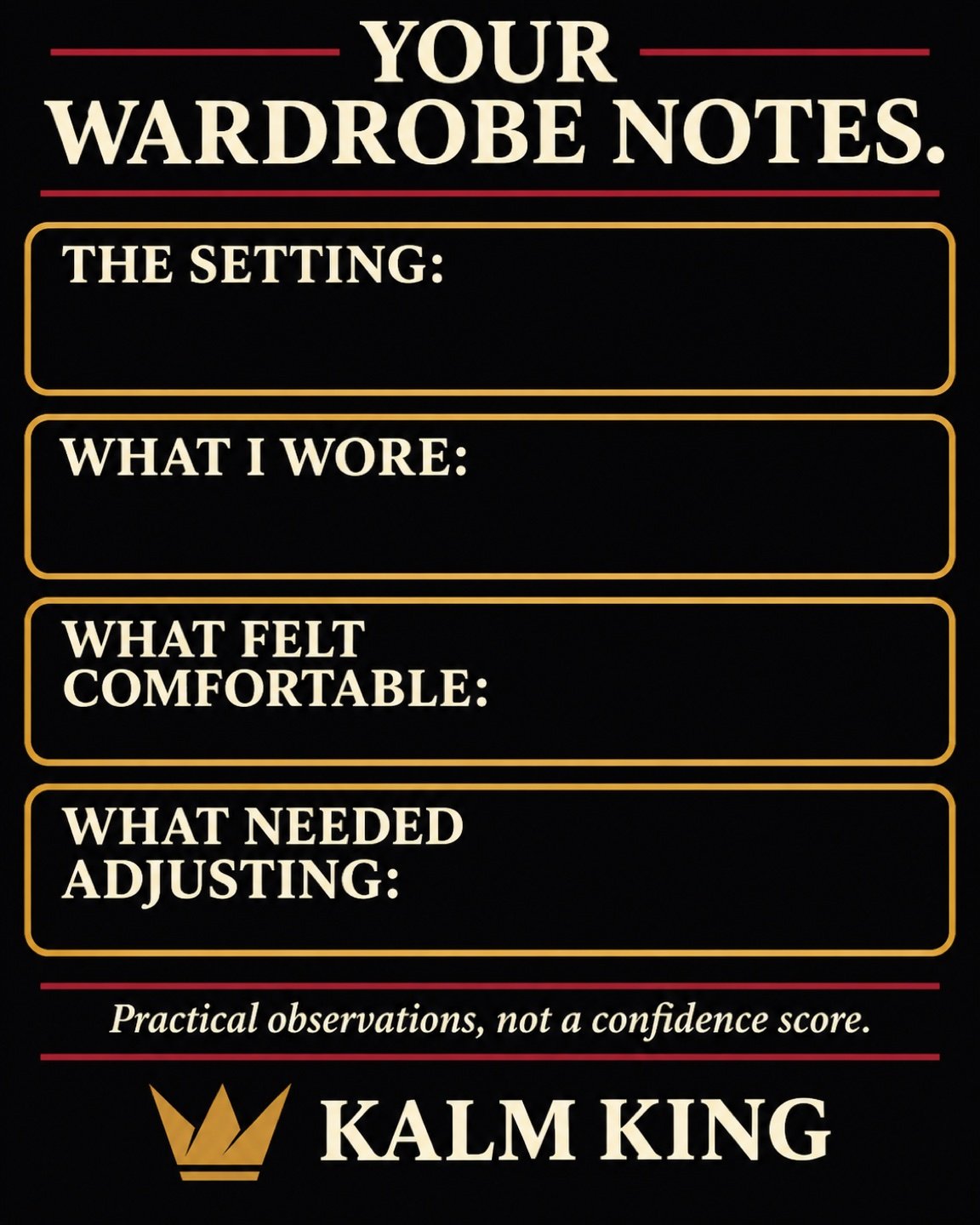
If you want to learn what works for you, keep a simple note for a few ordinary days. Record the setting, what you wore and any concrete distraction: a collar you kept fixing, shoes you avoided walking in or sleeves that felt comfortable at the desk. Also record what worked. You are collecting practical information, not assigning yourself a confidence grade.
At the end, look for a repeated issue you can address. If one pair of trousers only bothers you when sitting, try a different cut for desk days. If every outfit feels unfinished because you cannot find a suitable layer, identify that specific gap before browsing. If the same combination works repeatedly, keep it in rotation without apologizing for repeating clothes.
Do not interpret the notes as an experiment proving cause and effect. Sleep, stress, the people around you and the demands of the day all change too. The value is simpler: you may learn which wardrobe choices are dependable and which need a closer look.
Know when the outfit is finished
Before leaving, check four things: the clothing suits the setting, you can move comfortably, the pieces are in the condition you intend and you recognize yourself in the result. If those are true, you do not need to keep improving the outfit until it becomes somebody else’s idea of a confident man.
Let the final step be practical rather than another purchase. Put the required items in your bag, check the journey or prepare what you need to say. The best outcome is not that clothes occupy more of your attention. It is that you have made a considered choice and can give the rest of the day your attention instead.
Research notes
- Adam and Galinsky (2012), “Enclothed cognition”, Journal of Experimental Social Psychology.
- Burns et al. (2019), preregistered direct replication, Journal of Experimental Social Psychology.
- Slepian et al. (2015), “The Cognitive Consequences of Formal Clothing”, Social Psychological and Personality Science.
- Howlett et al. (2013), rapid first impressions from minor changes in male attire, Journal of Fashion Marketing and Management.
- Oh, Shafir and Todorov (2020), clothing-status cues and perceived competence, Nature Human Behaviour.
Continue reading
Put the research into practice with three ways to make black feel considered, or use the evidence-first system in how to buy clothes for him without guessing.
Frequently asked questions
Can clothes make you more confident?
They can influence self-perception, comfort and behavior, but no garment guarantees confidence. Fit, context and how closely the clothing matches your sense of self all matter.
Do first impressions depend only on clothing?
No. Clothing is one signal among posture, expression, grooming, speech and the setting. The strongest impression usually comes from those signals working together.
Is expensive clothing more effective?
No. Price is not a reliable substitute for fit, appropriateness or comfort. A well-fitting garment that suits the situation can communicate more clearly than an expensive piece that feels wrong.
How can I dress more confidently without buying new clothes?
Start with an outfit you already find comfortable and suitable for the setting. Identify what works about its fit, fabric and proportions, then adapt one element at a time using what you own. Follow care labels and assess worthwhile repairs. These are practical ways to reduce wardrobe friction, not a guarantee of confidence or a substitute for support if getting dressed causes persistent distress.
FIELD NOTES
Get the Overalls Fit Kit, free.
Your measurement card, the six fit checkpoints and a checklist to take shopping. Join Field Notes for new guides and a say in what Kalm King makes.
THE KALM KING JOURNAL
Continue reading

How to Remove Pilling From Clothes (and Stop It Coming Back)
How to remove pilling from clothes with a fabric shaver, comb or razor without damage, which fabrics pill most, and how to wash so pills don’t come back.

How to Measure Sleeve Length for Men: Shirts, Jackets and Knits
How to measure sleeve length for men: center back to wrist for shirts, shoulder seam for jackets, how to convert between them and what 34/35 means.
Men’s Underwear Size Chart: How to Find Your Size in Any Brand
Men’s underwear size chart from six brands’ published charts, plus how to measure, what to do between sizes, and EU, UK and big and tall sizes.