
October 20, 2026
Explore: Style
How Should a Men’s T-Shirt Fit? A Practical Guide to Size, Shape and Length
How a men's T-shirt should fit: check the cut, shoulders, sleeves and length, measure a tee you like, and tell a size problem from a washing one.
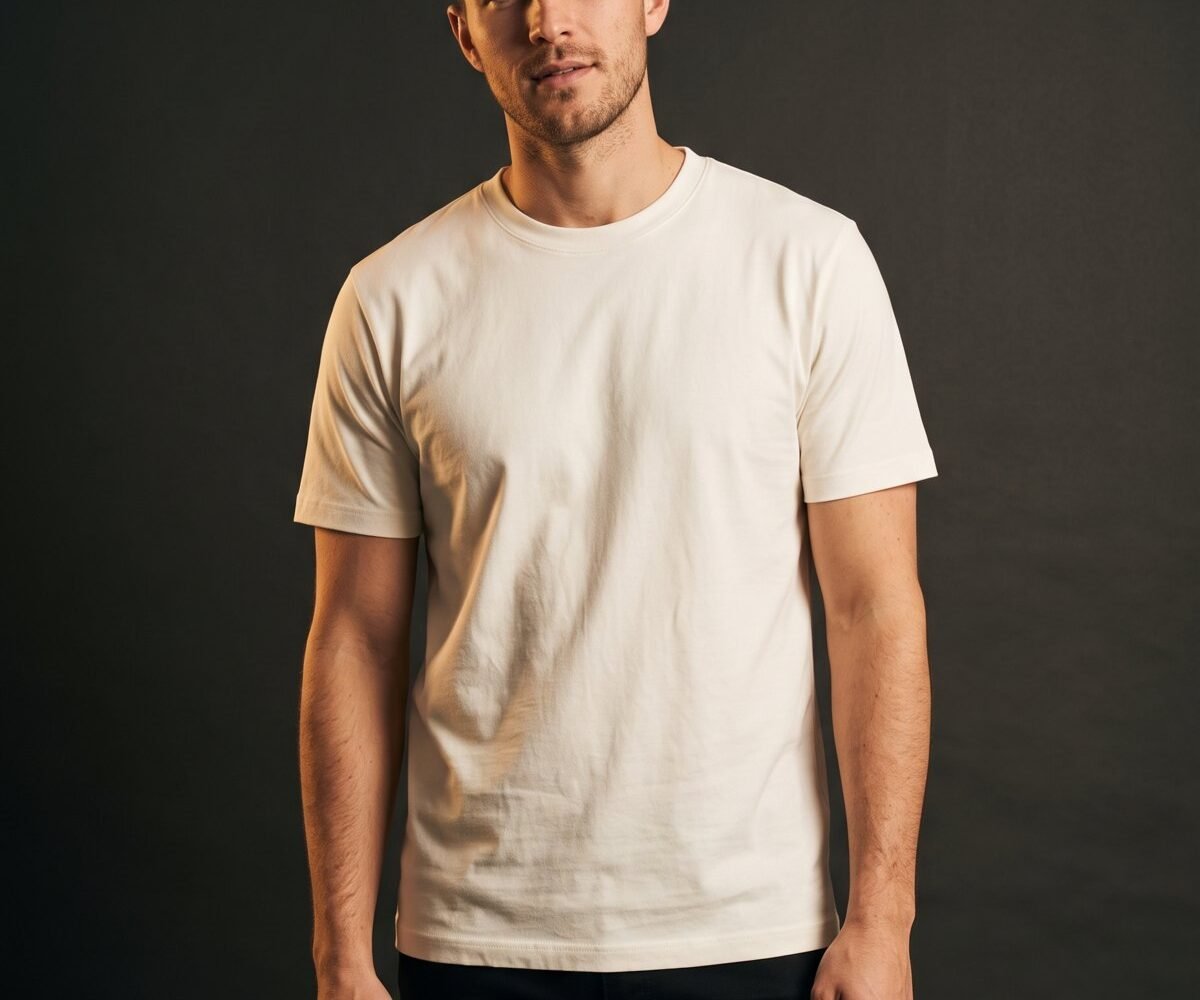
You find a tee that sits perfectly across the shoulders. Then you look down and the hem is halfway to your knees. So you try the smaller size, and now the chest pulls every time you reach for something. Or the one that fitted beautifully in the changing room comes out of the first wash looking like it belongs to someone else.
None of that means your body is the wrong shape. It means one part of the shirt doesn’t match one part of you, and changing the size label changes every part at once. This guide helps you work out whether the problem is the size, the cut, or something that changed after washing, so you fix the right thing.
The short answer: a well-fitting T-shirt lets you move, breathe and sit without pulling, gives you the coverage you want, and doesn’t need tugging back into place. The neckline lies where it was designed to, the shoulders and sleeves match the cut, the body skims rather than grips or tents (unless the tent is the point), and the hem works with the trousers you actually wear. Before judging any of that, decide what kind of tee it’s meant to be.
Tip: tap any diagram to open it full size.
Start with the cut it was designed to be
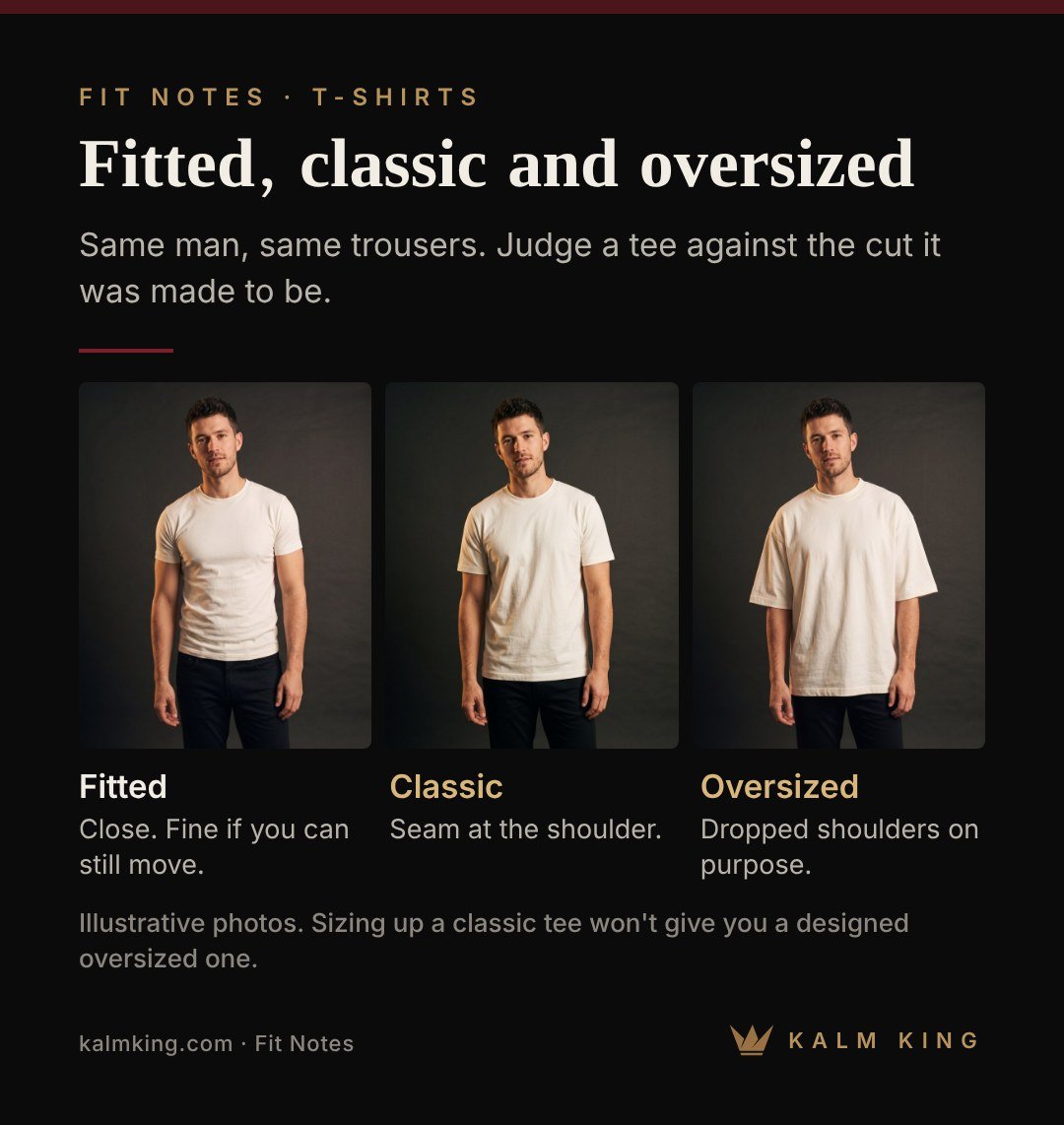
Most fit advice quietly assumes one kind of T-shirt: the classic cut. That’s a useful reference, but it isn’t the only valid design. Judge a tee against what it was made to do.
- Classic. Shoulder seam close to your shoulder point, sleeves near the arm without gripping, a little room in the body, and a hem somewhere around the hips. Most “how a tee should fit” rules describe this cut.
- Relaxed. More room through the chest and body, often a slightly wider sleeve, and a shoulder seam that may sit a little past the shoulder point. It should look easy, not borrowed.
- Oversized. Deliberately wide, with dropped shoulders and fuller sleeves. UNIQLO’s oversized half-sleeve tee, for example, is described as an oversized cut with half-length sleeves and dropped shoulders. On that shirt, a seam hanging off your shoulder is the design working, not a sizing mistake.
- Cropped or boxy. Cropped describes a shorter body length; boxy describes a wider, straighter shape. A tee can be either or both, and the proportions are meant to be judged together.
Here’s the catch: sizing up a classic tee doesn’t give you an oversized tee. It gives you a classic tee that’s bigger everywhere, including longer in the body and sleeves. A designed oversized shirt adds width while keeping length and neckline in proportion. If you like the relaxed look, shop for that cut in your usual size.
Check the whole tee, top to bottom
Wear the tee with the trousers you’d normally pair it with, stand naturally, and look from the front, side and back. Use your phone for the back view. Then work down.
Neckline
The opening should sit comfortably where its design places it. A crew neck shouldn’t press on your throat or leave a mark, and it shouldn’t stand away from your neck when you stand straight. If the neckline is the only thing that bothers you, try a different neckline or cut, not a different size.
Shoulders and upper back
On a classic tee, the shoulder seam sits close to where your shoulder ends and your arm begins. A seam pulled up onto the top of your shoulder usually means the shirt is too narrow; a seam drifting down your arm means it’s wider than a classic cut, which is fine if that’s the design. Our guide on why the shoulder changes everything covers how to find your shoulder point, so we’ll keep this short.
Sleeves and armholes
Raise your arms forward and overhead. A sleeve that cuts into your upper arm is too tight for you in that cut. If lifting your arms drags the whole shirt up, the armhole and sleeve shape may be the problem, not just the size; a low armhole can also pull the body upwards. Some hem movement is normal. A common starting point for a classic tee is a sleeve ending around mid-bicep, but that’s a style preference, not a standard. Relaxed and oversized designs often end lower on purpose.
If your sleeves flare, standing off your arm like small wings, the opening is usually wider than your arm or the fabric is stiff enough to hold its own shape. That’s a cut or fabric issue more than a size issue.
Armholes matter more than they get credit for. One man who measured a long run of tees against his ideal dimensions found one that matched his numbers almost everywhere except the armhole, and it still bunched under his arm. He also noticed that in one range the armhole barely changed between sizes, even though the chest did.
Chest and midsection
You should be able to breathe deeply, cross your arms and reach forward without the fabric straining. Horizontal pull lines across the chest when you move suggest it’s too narrow. A soft drape that follows your body and a straighter, boxier hang can both be good fits, as long as the shape looks intended. If the chest fits but there’s a lot of fabric at the waist, look for a tapered or athletic cut rather than dropping a size.
Hem
Check front and back. A hem that rides up at the front may be getting pulled over your chest. One that bunches at your hips may simply be too long for how you wear it. Length deserves its own section, because it depends most on what else you’re wearing.
How long should a T-shirt be? It depends on the trousers
You’ll see rules like “a few inches below the belt” or “mid-fly”. Treat them as starting points at best. The right length depends on where your trousers sit, whether you tuck, your torso length, and how much coverage you want when you move.
Length complaints run in both directions. In one discussion about T-shirt lengths, a 167 cm poster wanted a hem that sits on the hip bone and couldn’t find one, and other shorter men described tees going past the belt or looking like a nightdress. A 188 cm man replied that his tees are mostly too short, because sizes get wider much faster than they get longer, so he’s stuck choosing between too baggy and too short. Another said he’s “90% legs”, a reminder that height and torso length aren’t the same thing.
It isn’t only Reddit. On a public customer request board for shorter tees, one customer was clear that only the body needed shortening because the sleeves already fit, and another said a tee he liked mostly stays in the drawer because it’s too long to wear untucked.
So check length like this:
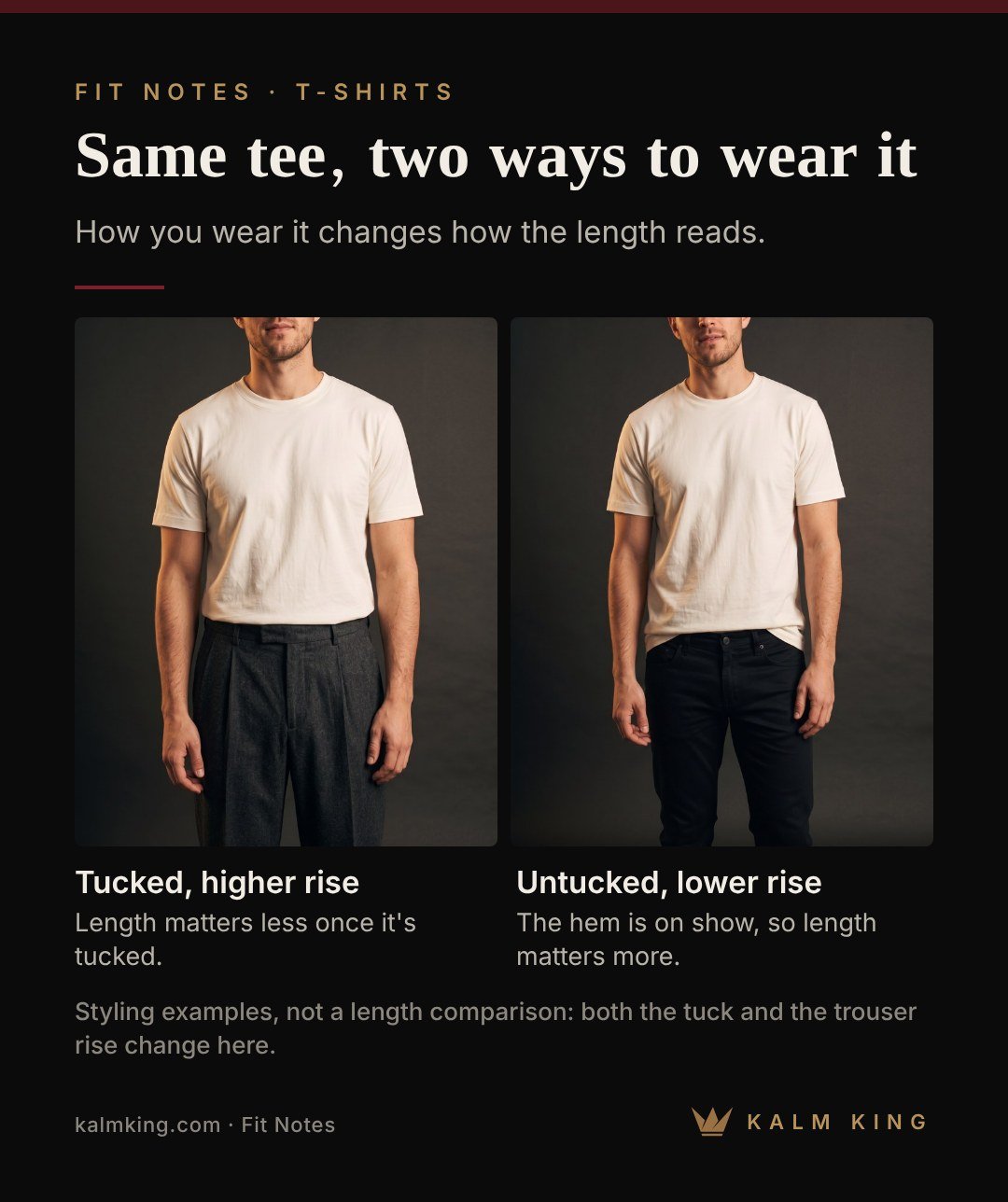
- Use your real trousers. A higher rise covers more of your torso, so a shorter tee can look balanced. With a lower rise, the same tee may show skin when you reach. A tee can work with one pair and not another without being the wrong size.
- Decide tucked or untucked first. A tucked tee needs enough length to stay in when you sit. An untucked one looks cleaner when it doesn’t hang far past your seat.
- Check front and back. A full chest or a curved lower back can lift one side.
- Think torso, not height. Two men of the same height can need very different body lengths.
The 30-second movement check
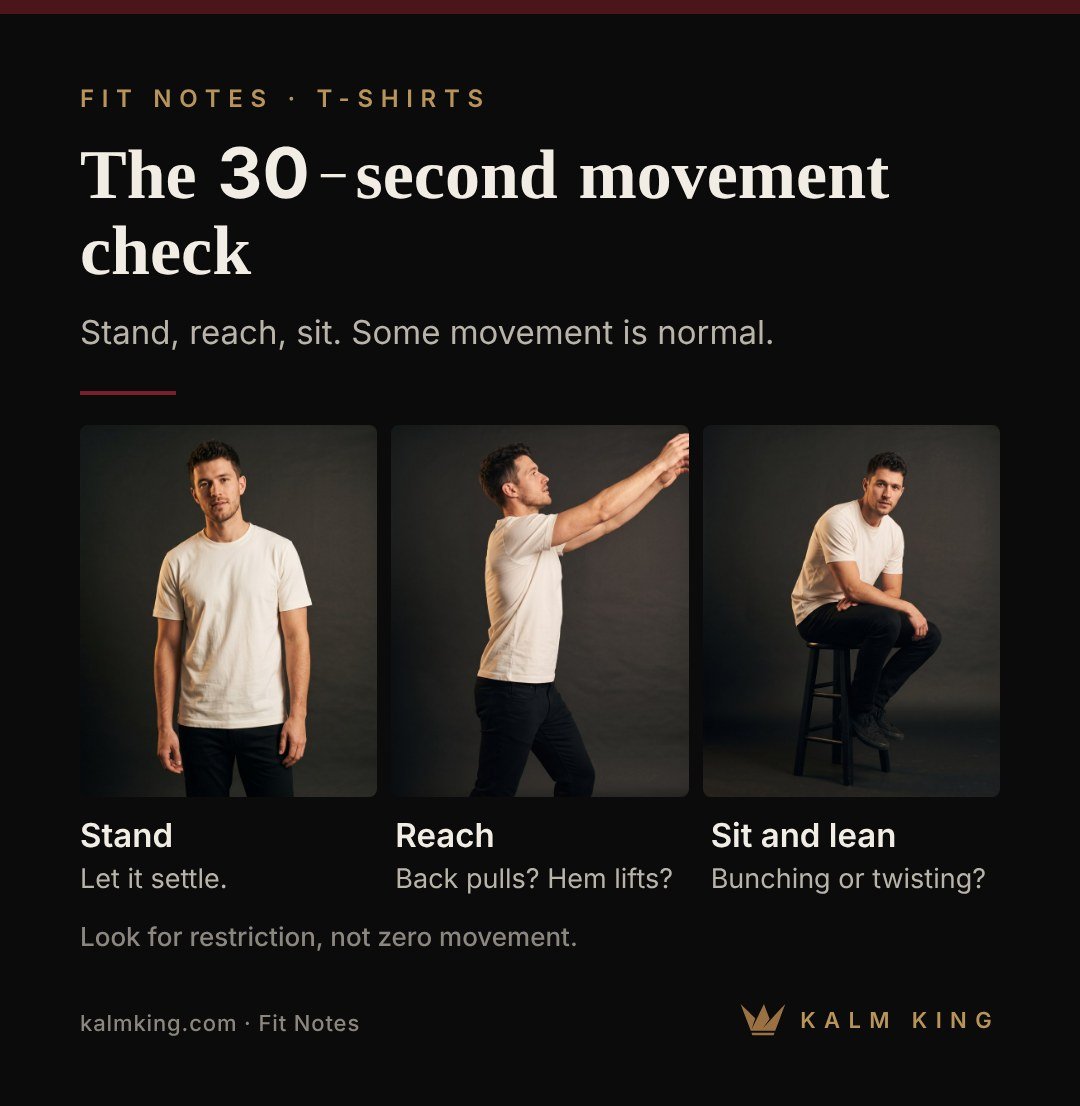
A mirror shows you a tee standing still. You don’t live standing still. Run this on any tee you’re allowed to try on, or one you’ve decided to keep.
- Stand normally and let the shirt settle without arranging it.
- Reach forward as if grabbing something off a shelf. Does the back pull tight or the hem clear your waistband?
- Raise both arms overhead. Do the armholes drag the body up? Are you comfortable with how much shows?
- Sit and lean forward. Does the hem bunch, twist or untuck? Does the neckline gape?
- Stand back up without fixing anything. Does the shirt drop back into place, or stay twisted?
Some movement is normal. A hem rises when you lift your arms; that’s physics, not a fit failure. You’re looking for restriction, coverage you’re not happy with, or fabric that needs resetting every time you move.
Size, cut or length? What to try next
Once you know which part is failing, the next step is usually clear. The mistake is changing every dimension to fix one.
One man summed up the problem in a thread about shirt sizing: he’d tried medium, medium tall, large, large tall and XL, and everything was too wide, too short, or both, or fitted in the store and shrank after the first wash. A reply from a broad-shouldered man described a shirt snug through the chest with “a tent through the middle”. Those are different problems with different fixes.
| What you notice | Try next | Avoid |
|---|---|---|
| Tight in several places: chest, armholes, sleeves | The next size up, then repeat the movement check | Hoping a stretchier fabric fixes a cut that’s too small |
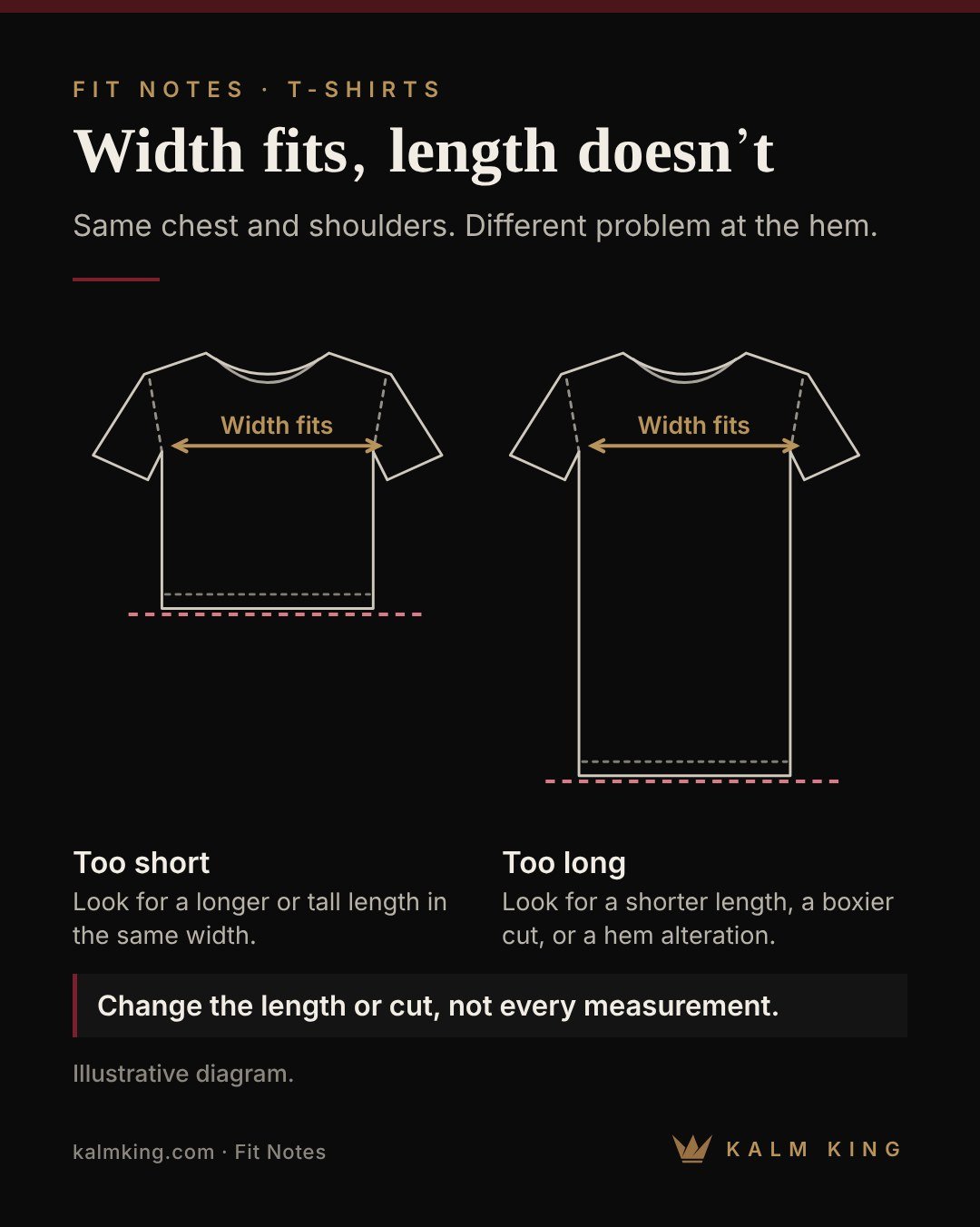
| Chest and shoulders fit, body too long | A shorter length option, a boxier cut, or a hem alteration | Sizing down and losing the chest room |
| Width fits, body too short | A tall or long length in the same width | Sizing up and gaining width you didn’t need |
| Chest fits, billowy at the waist | A tapered or athletic cut | Sizing down and squeezing the chest |
| Sleeves flare off the arm | A narrower sleeve, a softer fabric or another cut | Blaming your arms |
| Only the neckline feels wrong | A different neckline | Changing the whole size for one opening |
| An oversized tee feels wide | Compare it with how the design is meant to look | Treating intended width as a failure |
| Fitted at first, changed after washing | Measure and compare (see below) | Buying the next size up and hoping |
Brands that sell more than one length per size solve the width-versus-length trade-off directly. ASKET, for instance, offers three body lengths in every size of its crew-neck tee, 3 cm apart. Nike’s men’s tops chart lists tall sizes with the same chest ranges as regular ones and about 4.5 cm more length, though only in selected styles.
Measure a tee you already like
A tee that fits you well is the most useful measuring tool you own. Turn it into numbers once, and you can check any product page against it.
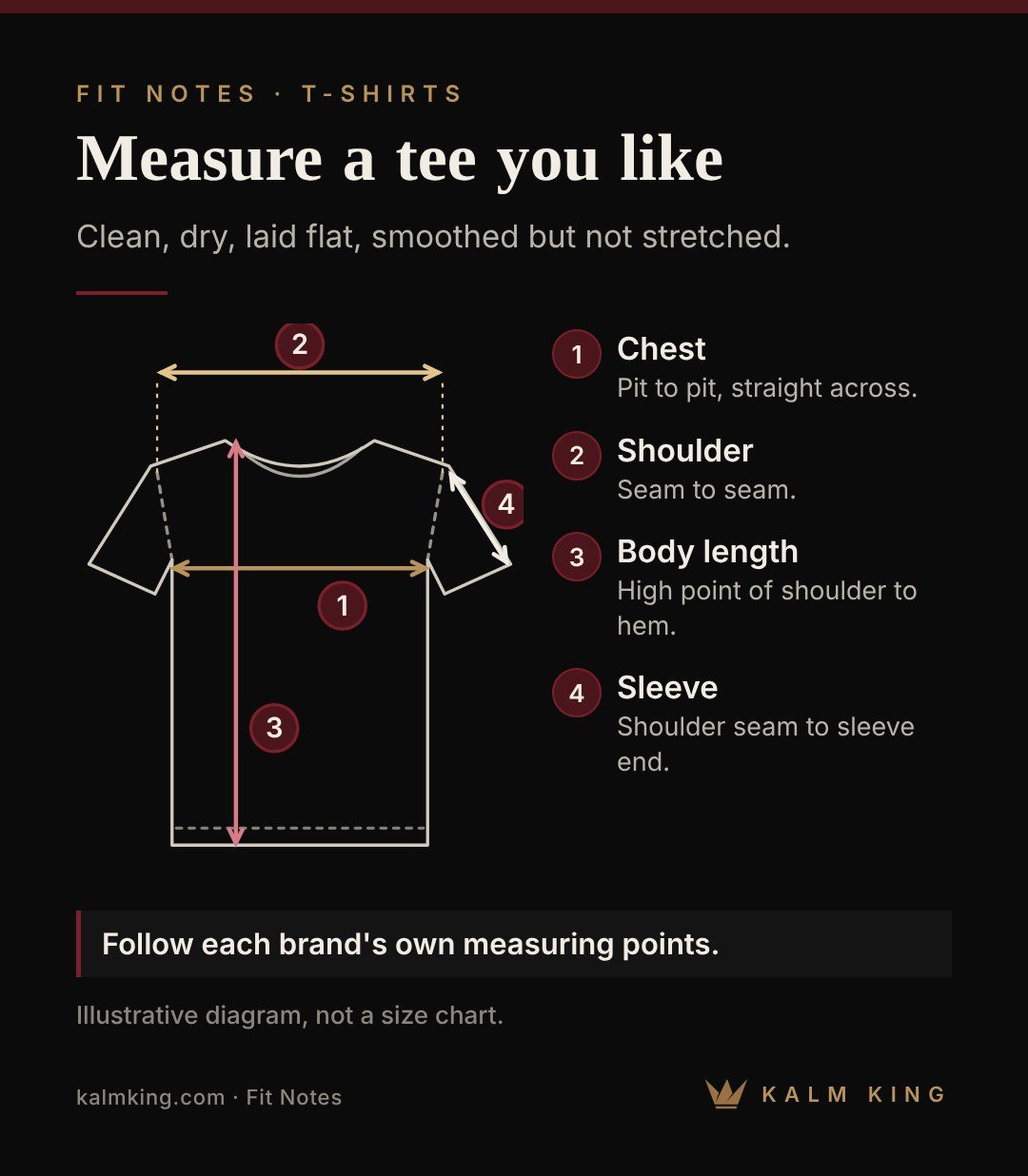
- Use a clean, fully dry tee you’re happy with. Note roughly how it’s been washed and dried.
- Lay it flat, front up, and smooth it without stretching.
- Chest (pit-to-pit): straight across, just below the armholes. Some brands measure a set distance below the armpit, so check their method.
- Shoulder: seam to seam, straight across.
- Body length: from the highest point of the shoulder, beside the collar, straight down to the hem.
- Sleeve: from the shoulder seam to the sleeve end.
Write the numbers down with a note on how it fits. “Great length, slightly tight in the arms” is more useful than numbers alone. If a product page doesn’t list garment measurements, ask the retailer. You can also save your numbers on the Fit Card in our Size & Fit Reference, and if fabric weight is part of the question, see what a heavyweight t-shirt is.
Flat measurements and body measurements are different numbers
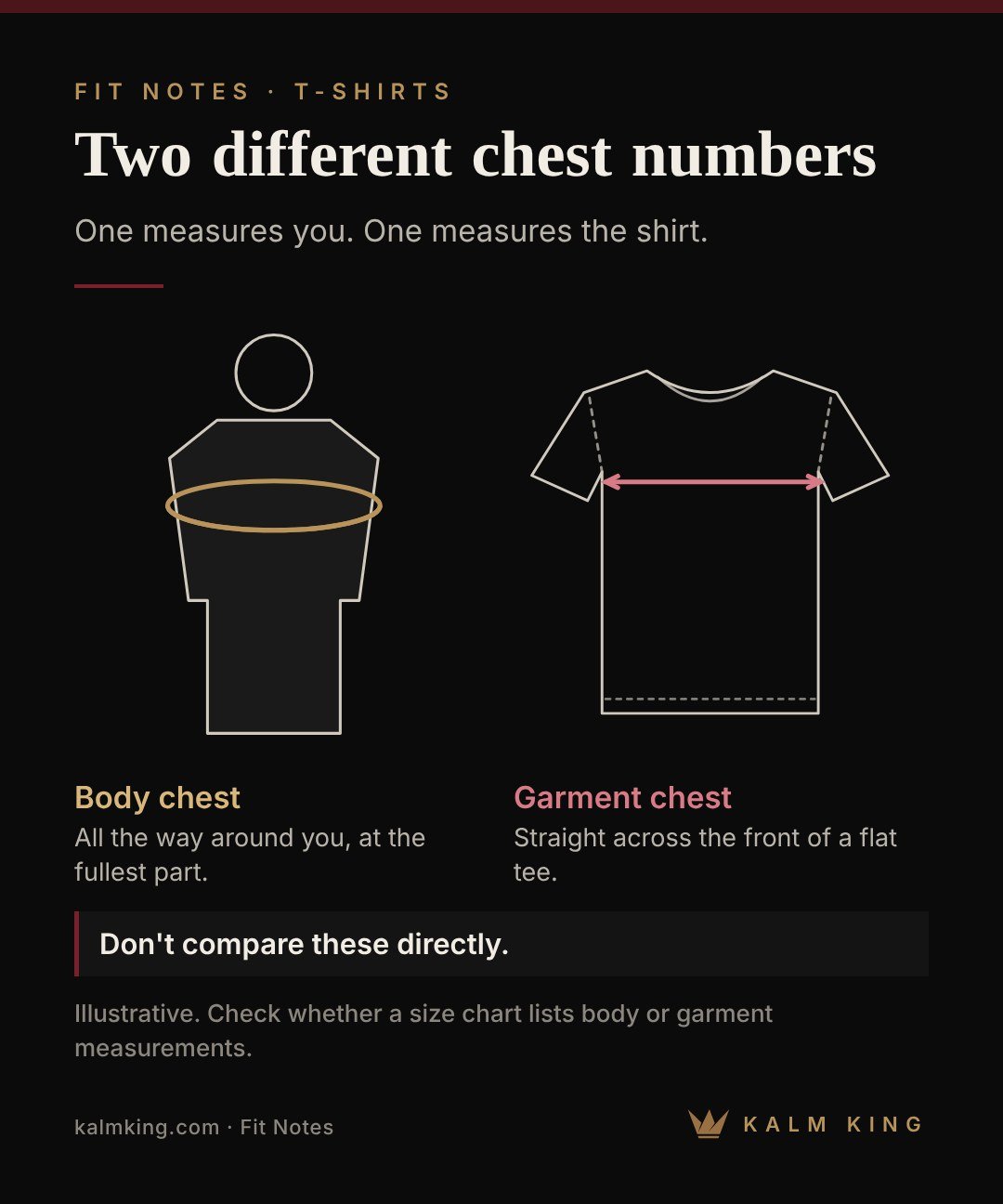
Size charts come in two kinds, and they measure different things.
- Body measurements describe you. Nike’s chart says its numbers are body measurements and tells you to measure around the fullest part of your chest. That’s a circumference.
- Garment measurements describe the shirt. ASKET’s chart says its figures are taken on the garment lying flat, not on the body. Its chest figure is a straight line across the front only.
Never compare a flat chest width with your body chest. They’re different kinds of number.
A hypothetical example, with made-up figures. Your chest measures 100 cm around. Your favorite tee measures 53 cm pit-to-pit, laid flat. A product page lists size M with a 52 cm chest. If that’s a flat garment measurement, compare it with your tee’s 53 cm: the new one is slightly narrower, so expect a slightly closer fit. If it’s a body measurement, compare it with your 100 cm instead. Doubling a flat width gives a rough idea of the shirt’s own circumference, but not how much room you should have. The room you like is already built into the tee you measured, which is why it’s the best reference.
Check the tolerance too. ASKET notes its garment measurements can vary by up to 1.5 cm either way, so a 1 cm difference on a chart may not show up on the shirt that arrives.
Fabric weight: what the number does and doesn’t tell you
Heavyweight tees are usually listed by GSM (grams per square meter) or ounces per square yard. Same thing, different units: 1 oz/yd² is about 33.9 g/m², so a 6 oz tee is roughly 203 GSM.
Men compare these numbers a lot. In one thread on heavyweight tees, one commenter said he checks the oz per square yard and tends to like anything over about 6. Others ranked their heavy tees from trim to boxy, and one compared a heavy tee to “a cardboard sweater”. Heavy doesn’t automatically mean boxy, and it doesn’t automatically mean better.
- Drape and stretch. Weight alone doesn’t tell you whether a tee will cling, hold its shape or stretch. Fibers, yarn, knit and finishing matter too, so two tees with the same GSM can feel and hang differently.
- Opacity. Lighter tees, especially white ones, are more likely to be see-through. If that’s your complaint, a heavier or denser fabric is a reasonable next step.
- Warmth. More fabric usually means a warmer shirt. Great in autumn, hard work in a humid summer.
Choose weight for the job, not because a bigger number sounds premium.
Check the fit after washing, the right way
“Fits perfectly in the store, shrank on the first wash” is a familiar complaint. The dryer usually gets the blame, but that’s too simple. For the full picture, see why T-shirts shrink and how to help prevent it.
The cotton industry’s CottonWorks learning hub explains that shrinkage and skewing are affected by fiber, yarn, knit construction, wet processing, finishing, cut-and-sew methods and garment care, and that knits are generally more open in structure than wovens, so more prone to change. It also counts seam skew and changes in fit as part of the same picture. Two cotton tees washed identically can come out very differently, for reasons set long before the shirt reached you.
Cotton Incorporated’s technical guide to cotton shrinkage performance, written for product sourcers, describes cotton knits as especially sensitive to applied forces and says it may take several cycles of wetting and drying to reach fully relaxed dimensions. The first wash may not tell the whole story.
- Check the return rules before you wash anything. Some retailers won’t take a tee back once it’s been washed, so do your try-on and movement check first.
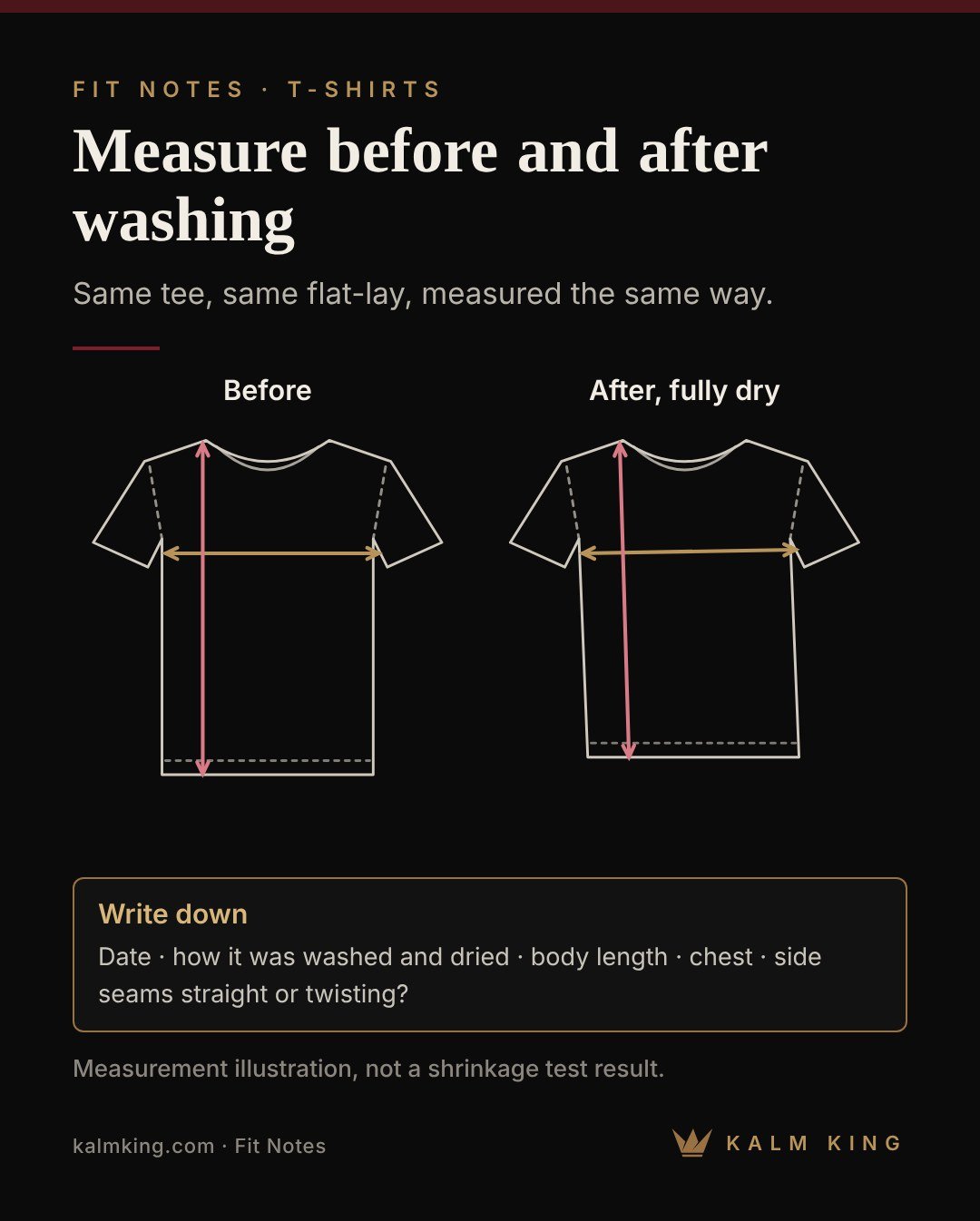
- Record the starting measurements of a tee you’re keeping: chest, length, sleeve, and how the side seams sit.
- Follow the care label. Under the US Care Labeling Rule, manufacturers must tell you how to clean what you buy, so the label is the starting point for that garment.
- Remeasure when fully dry, laid flat the same way. Compare length and width separately; they don’t always change together.
- Check again after a few more washes if the fit is borderline.
Look beyond size. A side seam twisting toward the front, a waving hem and a relaxed neckline are different changes without one shared cause, so don’t diagnose them from a glance.
And skip buying one size up “for shrinkage”. You can’t know in advance how much a particular tee will change, and a bigger size changes chest, sleeves and length all at once. If a tee you like keeps getting shorter, look for a longer length option instead.
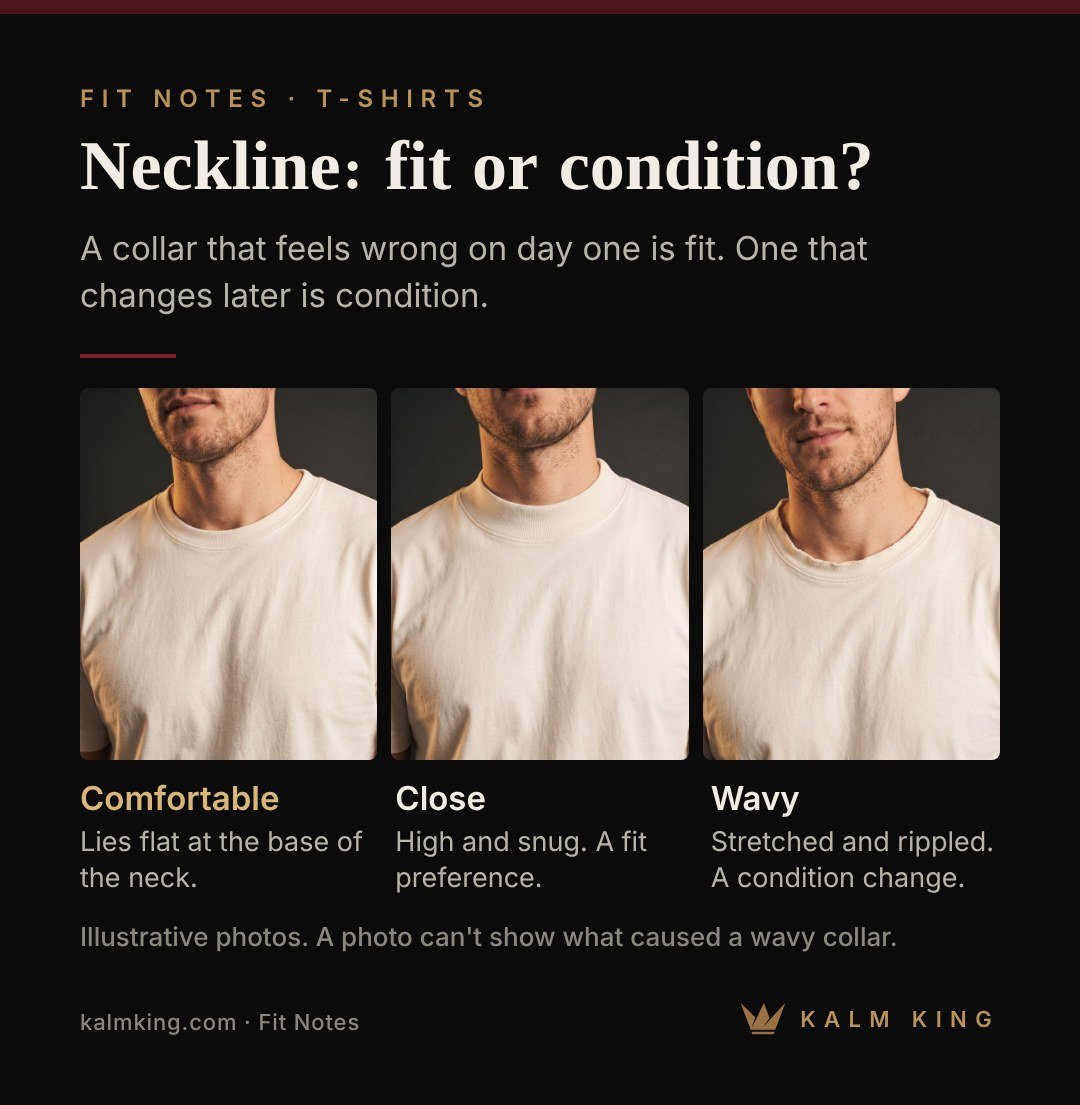
Wavy “bacon neck” collars
A bacon neck is a collar gone rippled while the rest of the shirt still looks fine. One poster asked for tees that won’t bacon neck after several new shirts went wavy fast. Don’t assume every wavy collar has the same cause, or that one home fix will work for every tee. Our collar guide covers washing, drying and what to try once it has happened.
Separate two things. A neckline that felt wrong from day one is a fit or design issue. A neckline that changed later is a condition issue. On the care side, ASKET advises storing its tees folded and, if you hang them, inserting the hanger from the bottom rather than stretching it through the collar. That’s one manufacturer’s advice for its own product, not a guaranteed cure, but it costs nothing.
When no size solves it
Sometimes a tee just isn’t cut for your proportions, in any size. That’s a pattern problem, not a body problem. Your options:
- Switch cut, not size: athletic, relaxed, boxy or tall in the size that fits your chest.
- Look for length options from brands that sell short, regular and long bodies.
- Alter the hem. A tailor can often shorten a plain tee, though a curved hem or hem detail makes it trickier.
- Change the garment: a different weight or brand may simply suit you better.
A tee that works on its own can need different length and bulk under something else. If you’re wearing one under overalls, our guide to what to wear under overalls covers how the bib and straps change things. Going sleeveless? See how a men’s tank top should fit.
To build a small wardrobe around tees that fit, see our men’s capsule wardrobe guide.
Quick answers
Is a T-shirt supposed to be tight?
Only if that’s the look you want and you can still move freely. A fitted tee follows your shape without pulling; a tight one strains when you reach. Neither is more correct than a relaxed fit.
My shoulder seams hang past my shoulders. Is the tee too big?
On a classic cut, probably. On a relaxed or oversized design with dropped shoulders, that’s how it’s meant to look. Read the product description before deciding.
What if I’m between two sizes?
Let the restrictive part decide. If the smaller size limits your chest or arms, it’s too small, whatever else it gets right. If the bigger size only fails on length, look for a shorter-length option before compromising.
Should I buy a tall size if I’m tall?
Only if you need the length. On charts like Nike’s, tall sizes keep the same chest range and add length. If you’re tall with a shorter torso, regular length may fit fine.
For more practical fit and style guides, join Kalm King Field Notes. Interested in overalls too? You’ll also get the free Overalls Fit Kit.
FIELD NOTES
Practical fit notes for everyday style.
Join Field Notes for guidance on fit, care and everyday style, from T-shirts and other essentials to statement pieces. Your free welcome bonus is the Overalls Fit Kit: a printable measurement card, six fit checkpoints and a shopping checklist for overalls, ready to download as soon as you sign up.
THE KALM KING JOURNAL
Continue reading
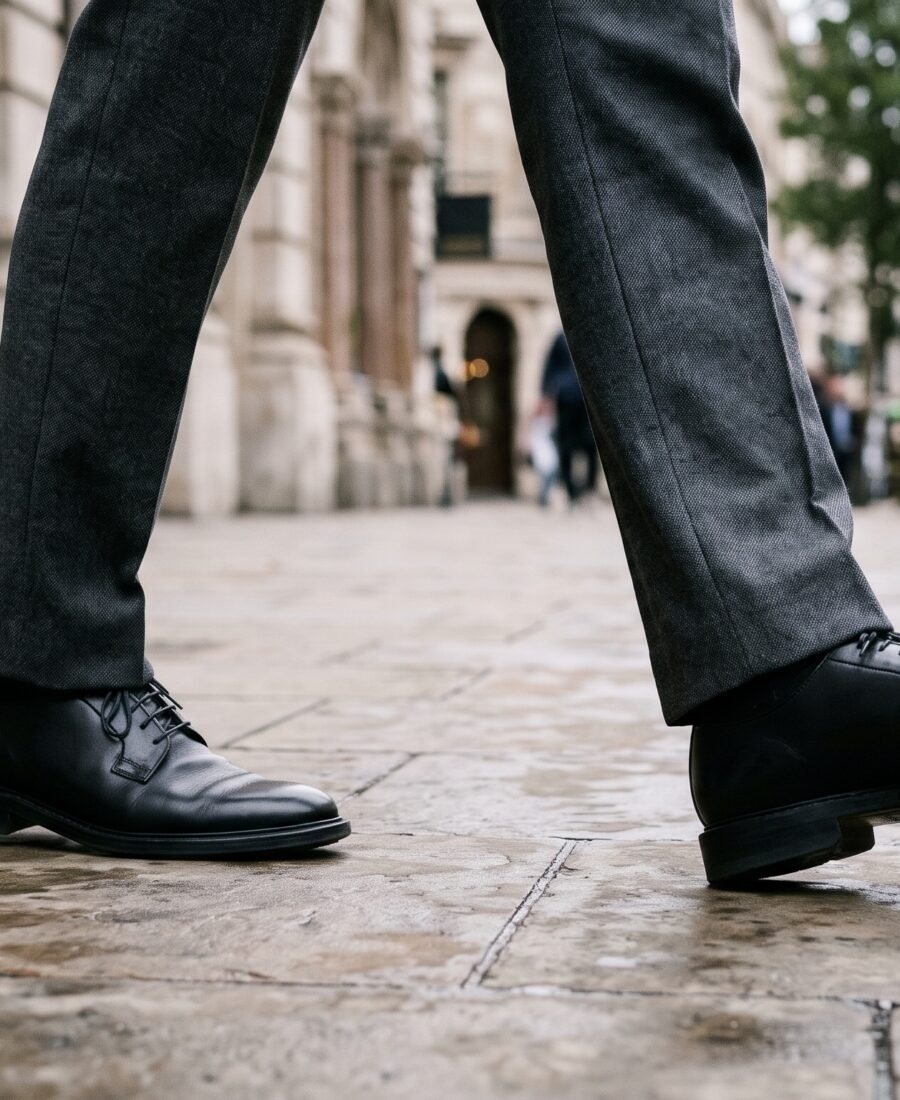
How Should Men’s Dress Pants Fit? Waist, Rise, Seat and Break
How should dress pants fit? Check the waist, rise, seat, thighs and hem with practical sitting tests, break options and realistic tailoring advice.
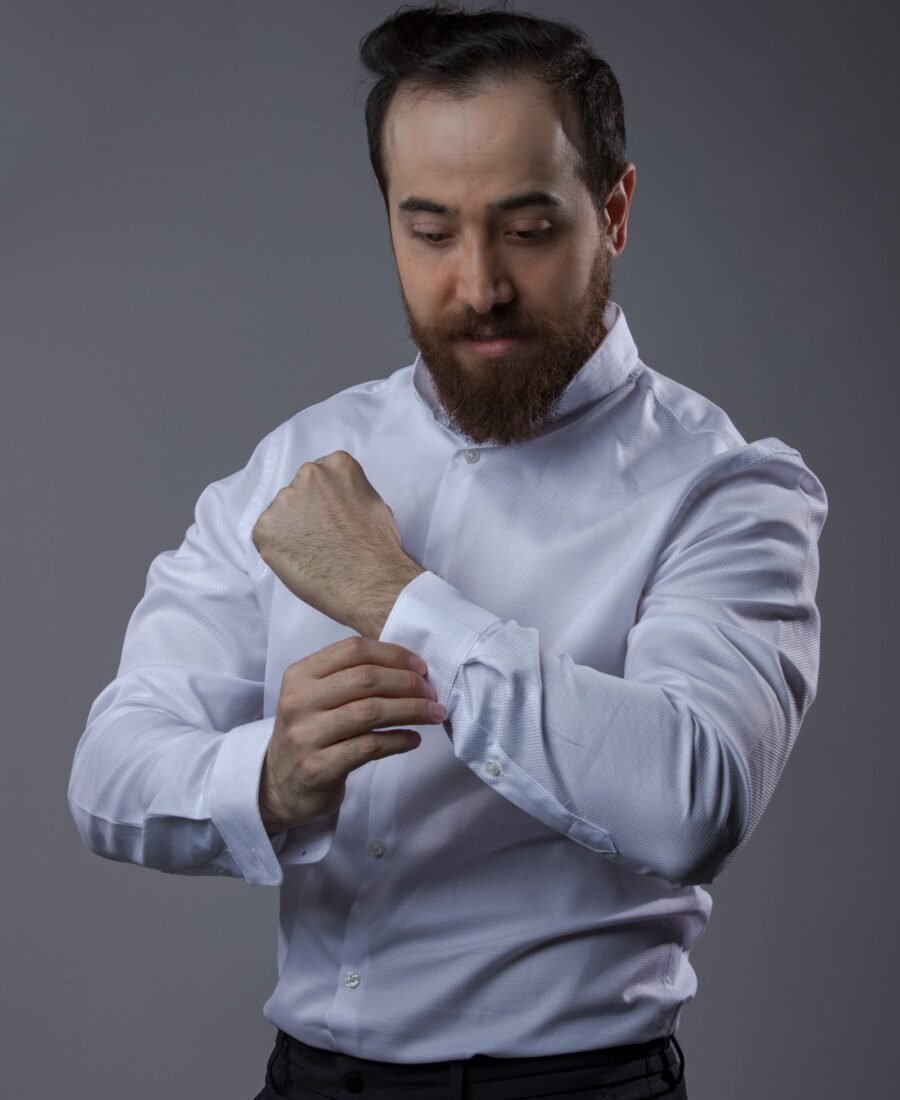
How Should a Dress Shirt Fit? A Men’s Guide to Collar, Chest and Sleeves
Check dress shirt fit at the collar, shoulders, chest, sleeves and hem. Learn what to measure, how to test movement and when to try another cut.
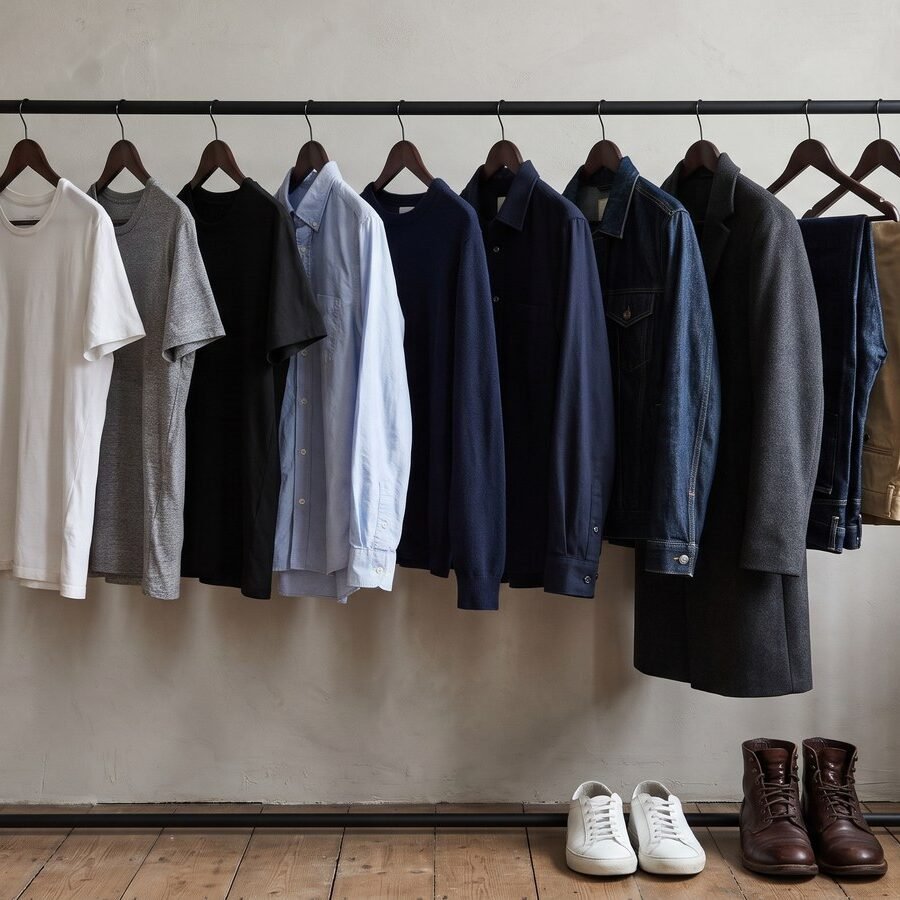
Men’s Capsule Wardrobe: How to Build One That Actually Works
A men’s capsule wardrobe is a small set of clothes that all work together. How to choose the pieces, colors and fit, and build one at your own pace.