
November 1, 2026
Explore: Style
How to Keep Socks From Sliding Down (and Slipping Off Your Heel)
How to keep socks from sliding down: check the cuff, size, grip and shoe fit, plus fixes for no-show, crew, dress and boot socks and care tips.

If you want to know how to keep socks from sliding down, start by finding out why they slide. A sock that bunches at your ankle by lunch, or a no-show liner that ends up balled under your arch, is telling you something about its cuff, its size, its grip, its fabric or the shoe you put it in. Once you know which one it is, the fix is usually simple. Sometimes it’s a different size. Sometimes it’s a different length. Sometimes it’s how you wash them.
Below are the causes, fixes by sock type, care tips and a checklist.
Short answer: Socks slide when the cuff can’t grip your leg firmly enough to fight gravity and the pull of your shoe. A tired cuff can be one cause; check size and grip too. Pick socks sized for your foot and calf, with some spandex in the knit, match the sock length to your shoe or boot, and wash them in cool water away from high dryer heat.
Shopping for new socks? How to Choose Everyday Socks covers fit, fabric and which height goes with which shoes. This guide is for the pairs that won’t stay put.
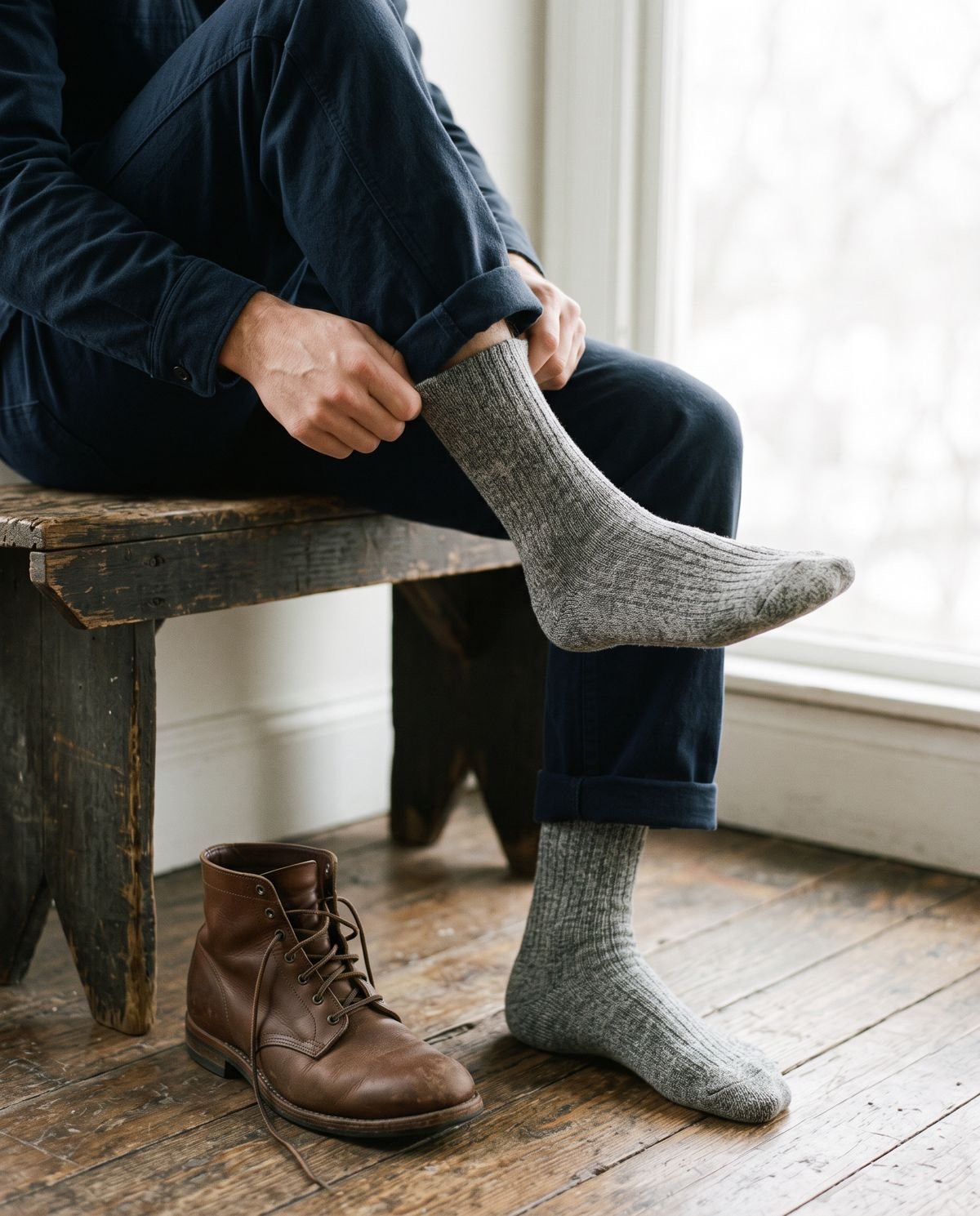
Why Do My Socks Keep Falling Down?
Often two or three small problems stack up. Here are the usual causes.
Elastic that no longer springs back
A sock stays up because stretchy yarn in the knit is pulled slightly open around your leg and keeps trying to return to its original size. That return is called recovery. Spandex is the fiber that does most of this work in modern socks. The American Fiber Manufacturers Association describes spandex as a fiber that can be stretched more than 500% without breaking and that recovers to very near its original length after repeated stretching.
Very near is not the same as fully. Over time, and especially with heat, the elastic in a sock can lose some of its snap. One sock brand’s guide calls the elastic “the primary failure point” of a dress sock, ahead of the fabric. That’s a brand’s view, not an independent test, but it matches what you see in an old drawer: the fabric looks fine while the top has gone slack.
The cuff, also called the welt
The cuff, or welt, is the band at the top of the sock. Its job is to hold. One sock brand points out that a single thin elastic band concentrates all the force in one line. That can dig in, and once it stretches out, nothing else is holding the sock up. The same guide prefers double layer or graduated tension cuffs that spread the pressure over a wider area.
Grip against your skin
Some socks add friction where they meet your skin: silicone strips, textured knitting or extra elastic zones. A smooth inner cuff has less to hold on with. You see this most clearly in no-show socks, where a silicone heel grip is often the only thing keeping the sock on your foot.
Size and calf fit
Size works in both directions. A sock that’s too big has extra fabric with nowhere to go, so it bunches and wrinkles. REI’s sock guide warns that oversized socks can wrinkle and rub enough to cause a blister. But too small is a problem too: the same guide says undersized socks can cause pressure points and sock slippage. A sock that’s too short in the foot gets pulled down into the shoe with every step.
Calf size matters for anything taller than an ankle sock. One sock brand argues that sizing by shoe size alone, or “one size fits most”, ignores calf circumference and how your leg tapers, so the cuff ends up too loose or too tight for your leg.
Fabric and weight
Fabric changes how much friction a sock has and how well it holds its shape. REI says spandex “helps socks hold their shape and keep bunching and wrinkling to a minimum,” while nylon adds durability. One sock brand also suggests that very lightweight socks give less passive friction against the leg than mid-weight ones. If your thinnest dress socks are the ones that always slide, that may be part of the reason.
Length
Where the cuff sits changes how well it holds. One sock brand argues that mid-calf socks have the hardest job because the cuff sits at the widest part of the calf. That’s a brand’s reasoning, not measured data, but it’s worth knowing if your mid-calf pairs give you trouble.
Shoes and boots
Your footwear pulls on your socks all day. A loose shoe lets your heel lift with every step, and the sock goes with it. Effortless Gent puts it simply when talking about no-show socks: a looser loafer means more potential for sock slippage than a laced shoe that’s secure on your foot. A boot shaft that rubs the top of a sock can also push it down as you walk.

How to Keep Socks From Sliding Down: Quick Fixes
Try these before you throw anything out.
- Check the size first. Look at the size range on the label and compare it with your shoe size. If you’re at the very edge of a range, the sock may be too big or too small for you. REI suggests sizing down if you’re between sizes, to avoid excess material.
- Line up the heel. Pull the sock on so the heel cup sits on your heel, not above it or below it. REI says a good fit is snug but not overly tight, with the heel cup lined up with the heel of your foot. A sock with the heel sitting too high will creep down into the shoe.
- Test the cuff. One sock brand suggests stretching the cuff to about one and a half times its width and watching whether it snaps back within a second or two. If it stays wavy and loose, the elastic is probably tired.
- Match the length to the job. Short shoes take short socks. Tall boots take taller socks. More on that below.
- Fix the shoe, not just the sock. If your heel lifts out of your shoe as you walk, lace it tighter or consider a better fitting shoe. No sock can fully make up for a shoe that’s too big.
- Change how you wash them. Wash in cool or lukewarm water and use low heat or air dry. Details are in the care section.
A tired cuff can be one cause; check size and grip too. It’s tempting to blame the elastic every time, but a brand new sock in the wrong size will slide just as much as an old one.
How to Keep Socks From Slipping Off Your Heel
No-show socks have a harder job than any other sock. They have no cuff around your leg to grip. Instead, they hang on to the curve of your heel and the top of your foot, and your shoe tries to pull them off with every step.
Why no show socks slip
Effortless Gent, which tested several brands, makes a point that’s worth remembering: the more invisible and low cut a sock is, the less likely it is to actually stay on your foot. That’s the trade-off. A sock with a smaller, higher opening grips better, but it’s more likely to show above a low-vamp loafer.
Loose shoes make it worse. If your heel lifts as you walk, the back of the sock lifts with it and slides off.
What helps
- Look for a real heel grip. Many no-show socks have silicone on the inside of the heel. Effortless Gent found that the amount of silicone varies between brands, and that more substantial grips held better. One pair it tested used three padded silicone strips at the inside heel. Even good grips aren’t perfect. The reviewer noted that slipping “sometimes” still happens.
- Get the size right. In the same review, the author found one brand’s larger size more comfortable for his slightly wide, flat feet. If your no-show socks are stretched hard across your foot, the opening may be pulling them off.
- Match the cut to the shoe. A very low cut suits loafers and low-vamp shoes. A slightly higher cut suits sneakers and lace-ups, and is likely to stay on better. The reviewer expected readers to try a handful of brands before landing on the right one, and so should you.
- Think about insoles. Effortless Gent also mentions insoles designed to replace no-show socks altogether. They’re worth a look if no liner ever stays put in your loafers.

How to Keep Crew Socks From Rolling Down
Crew socks sit above the ankle bone and below the widest part of the calf. When they roll or slouch, it’s usually the cuff or the size.
Common crew sock problems
- The cuff rolls over on itself. A thin, single band cuff can fold and roll, especially if it’s been stretched out. A wider ribbed cuff gives more surface to hold.
- The sock is too big. Extra fabric in the leg sags and pulls the cuff down with it.
- The sock is too small. If the heel sits above your actual heel, every step pulls the sock down into the shoe.
- The shoe rubs the leg. A high-top sneaker or a chunky shoe collar can push a crew sock down as you walk.
Fixes for crew socks
Look for a ribbed leg with some spandex in it, a cuff that springs back when you stretch it, and a heel that lines up with yours. If your crew socks are cotton with little or no stretch fiber listed on the label, that may be why they slouch. Keep a few pairs aside for lounging and buy better ones for long days.

Dress Socks: Why Over the Calf Stays Up
Dress socks are thin, which helps under fitted trousers but leaves less fabric to grip your leg. Bare shin when you sit down is a recurring complaint.
Mid calf versus over the calf
Most dress socks come in two heights. Mid calf socks end partway up the calf. Over the calf socks run up past the calf muscle to just below the knee. One sock brand argues that over the calf socks stay up most reliably because the calf muscle acts as an anchor: the cuff sits above the widest point and can’t easily slide past it. That’s a practical argument from a brand that sells them, not an independent study, but the logic is easy to test yourself.
What to look for in dress socks
- Spandex through the leg. One sock brand recommends roughly 3% to 5% spandex and says it should run through the whole leg, not just the cuff. Treat that as one brand’s guideline. It’s still useful as a starting point when you read labels.
- A wider cuff. A broad cuff spreads the hold over more skin and is less likely to dig in.
- Sizing by calf, if offered. Some brands size dress socks by calf circumference as well as foot size. If your calves are larger or smaller than average, that can make a real difference.
- A fair test. The same brand suggests wearing new socks for at least four hours and checking them through sitting, standing and walking before you decide.
What about sock garters?
Garters clip the sock to a strap around your calf. They work, but they’re an extra layer of hardware. One sock brand describes garters as a workaround for a construction problem rather than a fix. MedlinePlus, the US National Library of Medicine’s health site, includes avoiding tight clothing or garters on the thighs among home care tips for people with leg swelling. If you choose garters, keep them comfortable rather than tight, and try better fitting socks first.
When your dress socks are right, they disappear. If you want the rest of the outfit to read as cleanly, the same thinking applies to fit elsewhere. Our piece on why the shoulder changes everything covers the fit point that does the most work on shirts and jackets.

Boot Socks That Stay Up
Boots ask a lot of socks. The shaft rubs the sock, the heel works up and down, and a thick sock can wrinkle inside a stiff boot.
Match sock height to boot height
REI’s guidance is simple: the higher the cuffs on your boots or shoes, the taller you want your socks to be. A sock that ends at or just below the top of the boot shaft gets pushed down with every step. A sock that sits clearly above the boot top has a cuff the boot can’t reach.
Fit inside the boot
REI recommends a snug but not overly tight sock with the heel cup lined up with your heel. Too big, and the sock wrinkles and can rub. Too small, and you get pressure points and slippage. Spandex helps socks hold their shape and limits bunching and wrinkling, while nylon adds durability. REI’s footwear specialists favor merino wool, which it calls essentially itch-free compared with older ragg wool socks.
Thickness matters as well. REI notes that thicker socks are warmer and can make your feet sweat. If your boots were fitted with thin socks, a thick pair can crowd your foot. If they were fitted with thick socks, a thin pair can let your heel lift, and your sock goes with it. Try boots on with the socks you plan to wear.
Socks with boots and overalls
Overalls and work boots are a natural pair, and they’re a good test of your socks. The hem of your overalls sits on or over the boot, and if your socks slide down inside the boot, you’ll feel it by midmorning.
A few tips:
- Wear socks that clear the boot top. If your boots have a tall shaft, choose a sock that ends well above it.
- Keep the hem off your socks. If your overall hems are bunching at the boot, the leg may be too long. Our guide on how men’s overalls should fit covers length and break.
- Think about the whole layer. For more on base layers under bibs, see what to wear under overalls.

Why Do My Socks Leave Marks on My Ankles?
Here’s the trade-off. The obvious way to stop socks sliding is to buy tighter ones. But a tighter cuff presses harder on your skin, and that pressure can leave a ring around your ankle or calf when you take your socks off.
A cuff that feels painfully tight or digs in is a fit problem. Try a better size or a broader cuff rather than choosing the tightest sock you can tolerate.
Mild sock marks are common after a long day. If you notice swelling in your feet, ankles or legs that doesn’t go away, or keeps getting worse, talk to a doctor. MedlinePlus advises contacting a provider if self-care doesn’t help or the swelling gets worse, and contacting one right away for new or worse swelling in only one leg, or a swollen leg that’s red or warm. It advises calling emergency services if you’re short of breath or have chest pain.
How to Care for Socks: Heat and Spandex
How you wash socks can matter as much as which socks you buy. Spandex is the stretch fiber in most socks that stay up, and it has specific care needs.
What the fiber makers say
The American Fiber Manufacturers Association gives these care tips for fabrics containing spandex:
- Wash by hand or machine in lukewarm water.
- Drip dry, or machine dry at a low temperature.
- Iron at a low setting, and don’t leave the iron in one spot for too long.
- Do not use chlorine bleach on any fabric containing spandex. Oxygen or sodium perborate bleaches are listed as alternatives.
The fiber association’s practical care advice is lukewarm washing and low-temperature drying. Follow the sock’s own care instructions rather than using industrial heat-setting as a rule for home laundry.
What sock brands add
One sock brand goes further, saying hot water and high heat drying break down elastic much faster than cool washing and air drying, and that bleach and harsh detergents damage spandex. That’s a seller’s view, but it points the same way as the fiber makers’ advice.
A simple routine
- Turn socks inside out to wash.
- Use a cool or lukewarm cycle.
- Skip chlorine bleach.
- Air dry, or tumble on low.
- Always follow the care label on the pair you own.

When to Replace Socks
Even good socks wear out. Signs a pair is done:
- The cuff stays wavy after you stretch it. If it doesn’t spring back, it won’t hold.
- The top looks wider than the leg below it. A flared cuff has lost its recovery.
- The sock slides even after you’ve checked size, heel position and shoes. If you’ve ruled out everything else, the sock is probably the problem.
- Thin spots or holes at the heel or toe. These don’t make socks slide, but they’re a good reason to retire a pair.
How long that takes depends on the sock and how you treat it. One sock brand claims budget elastic can lose recovery after 20 to 30 washes, while better spandex can last far longer. That’s a seller’s estimate, so don’t count washes. Watch the cuff instead.
Replacing a whole drawer? Test one pair through a few wears and washes first.
How to Keep Socks From Sliding Down: Your Checklist
Run through this before you blame the sock, and again before you buy.
Before you buy:
- Does your shoe size sit comfortably in the middle of the sock’s size range?
- If you have larger or smaller calves, does the brand offer calf sizing?
- Does the label list spandex or elastane?
- Is the cuff wide and ribbed, not a thin single band?
- For no-show socks, is there a real silicone heel grip?
- Is the length right for your shoe or boot?
When you put them on:
- Is the heel cup on your heel?
- Is the sock snug but not tight?
- Does your shoe hold your heel without lifting?
When you wash them:
- Cool or lukewarm water.
- No chlorine bleach.
- Air dry or low heat.
When to let them go:
- The cuff no longer springs back.
- The sock slides even when everything else is right.

Buying Socks That Stay Up
A few final points that will save you money.
Read the label. Look for spandex in the fiber list. The American Fiber Manufacturers Association notes it’s also known as elastane, and you’ll often see that name on labels. The amount varies a lot. The no-show socks Effortless Gent reviewed ranged from 1% to 2% elastane, so even a small amount is normal.
Buy for your shoes. If you mostly wear loafers, you need good no-show socks. If you mostly wear boots, you need taller socks with some cushion. If you wear dress shoes with trousers, over the calf socks may be worth a try.
Buying for someone else? Socks are an easy gift to get wrong. Shoe size is the minimum you need to know, and calf fit matters for taller socks. Our guide on how to buy clothes for him without guessing has more on getting sizes right without asking directly.
Join Field Notes and get the free Overalls Fit Kit.
The Bottom Line
Socks slide for reasons you can usually find: a cuff that’s lost its spring, a size that doesn’t fit your foot or calf, a smooth inner cuff with nothing to grip, a length that doesn’t suit your shoes, or footwear that lets your heel lift. Fix the cause and the sliding usually stops.
Start with the free fixes: size, heel position, shoes and washing. If a pair still won’t stay up, retire it. A tired cuff can be one cause; check size and grip too.
Frequently asked questions
How do I keep my socks from sliding down?
Start by checking the size, lining the heel cup up with your heel, and making sure your shoes don’t let your heel lift. Look for socks with spandex in the leg and a wide cuff that springs back when stretched. Wash them in cool or lukewarm water and air dry or use low heat.
How do I keep no-show socks from slipping off my heel?
Choose no-show socks with a real silicone heel grip and the right size for your foot. Very low cut socks are harder to keep on, so pick a slightly higher cut if your shoes allow it. If they slip in one pair of shoes but not another, the shoe fit is likely part of the problem.
Why do my socks keep falling down?
A tired cuff can be one cause; check size and grip too. Socks that are too big bunch and sag, while socks that are too small can get pulled down into the shoe. Sock length, fabric and a loose shoe or boot can also play a part.
Why do my socks leave marks on my ankles?
Socks leave marks when the cuff presses on your skin, and tighter cuffs press harder. A wider cuff and a better size can hold a sock up without digging in. If you notice swelling that doesn’t go away or keeps getting worse, talk to a doctor.
Sources
- Spandex, American Fiber Manufacturers Association (Fiber Tutor) (industry body)
- Foot, leg, and ankle swelling, MedlinePlus Medical Encyclopedia, US National Library of Medicine (standards or government)
- How to Choose Hiking Socks, REI Expert Advice (brand guide: retailer)
- The Best No Show Socks For Men (From Budget to High End), Effortless Gent (review analysis: hands-on reviews by a style publication with affiliate links)
- Why Do Dress Socks Fall Down? The Engineering Behind Socks That Stay Up, Dead Soxy (brand guide)
FIELD NOTES
Get the Overalls Fit Kit, free.
Your measurement card, the six fit checkpoints and a checklist to take shopping. Join Field Notes for new guides and a say in what Kalm King makes.
THE KALM KING JOURNAL
Continue reading
How Should Men’s Dress Pants Fit? Waist, Rise, Seat and Break
How should dress pants fit? Check the waist, rise, seat, thighs and hem with practical sitting tests, break options and realistic tailoring advice.
How Should a Dress Shirt Fit? A Men’s Guide to Collar, Chest and Sleeves
Check dress shirt fit at the collar, shoulders, chest, sleeves and hem. Learn what to measure, how to test movement and when to try another cut.
Men’s Capsule Wardrobe: How to Build One That Actually Works
A men’s capsule wardrobe is a small set of clothes that all work together. How to choose the pieces, colors and fit, and build one at your own pace.