
November 23, 2026
Explore: Fit Notes
How to Measure Neck Size for a Dress Shirt
Measure your neck size for a dress shirt in two minutes: where the tape goes, how much room to add, how to read collar sizes, and how a collar should fit.

A dress shirt can fit beautifully through the chest and sleeves and still be ruined by the collar. Too tight, and you spend the day tugging at it, with the fabric puckering under your tie. Too loose, and the collar slumps, the tie knot sits in a gap, and the whole outfit looks borrowed.
The fix is one number: your neck size. It takes two minutes to measure, and once you know it you can read any traditional shirt label, check a brand’s size chart, and stop guessing.
This guide shows how to measure your neck accurately, how much room to add, how to measure the collar of a shirt you already own, what numbers like 16 34/35 mean, and how to tell whether a collar fits once it’s on.
Short answer: Stand up straight and look ahead. Wrap a soft tape measure around your neck where a shirt collar sits, at or just below your Adam’s apple. Keep it level and snug against the skin, then add room: either slip one finger under the tape as you measure, or measure snugly and add about half an inch (around 1 cm). Use one method, not both. Round up to the nearest half inch. That number is your collar size. When a shirt is buttoned, you should be able to slide one finger, or at most two, between the collar and your neck.
Why Neck Size Matters
Your neck measurement is the starting point for any traditional dress shirt. It’s the first number on the label, and it’s the one area a tailor can’t easily fix. A tailor can take in a shirt’s body or shorten its sleeves, but making a collar bigger isn’t practical.
A collar that’s too small doesn’t just look strained. Research has looked at what a tight collar and tie actually do. A study in the British Journal of Ophthalmology found that a tight necktie raised pressure inside the eye in healthy volunteers, and a 2018 study in Neuroradiology measured reduced blood flow to the brain while volunteers wore a tight tie. These were small studies of short-term effects, and none of them suggest a normal, well-fitted collar is a problem. What they do show is that “tight enough to hurt” is worth avoiding.
It’s also very common to get it wrong. A paper on neckties and blood flow published in PubMed Central cites an American study suggesting that around 70% of middle-aged men wear a shirt collar at least one size too small.
What You’ll Need
- A soft tape measure, the flexible kind used for sewing. A metal tape can’t wrap around your neck.
- A mirror, so you can see that the tape is level.
- A helper, if you have one. It’s easier for someone else to read the tape at the back.
- A pen or your phone to record the number.
How to Measure Your Neck Size
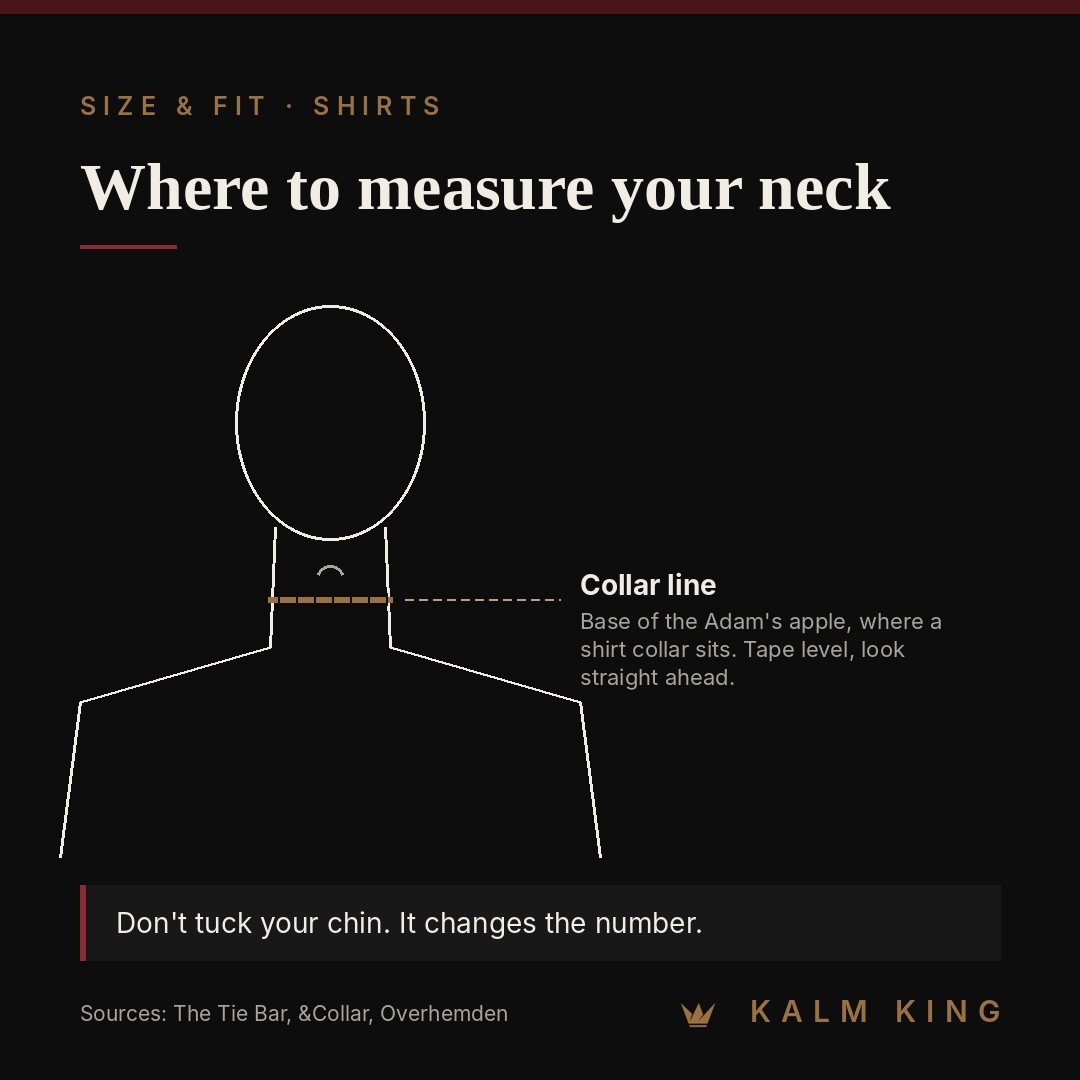
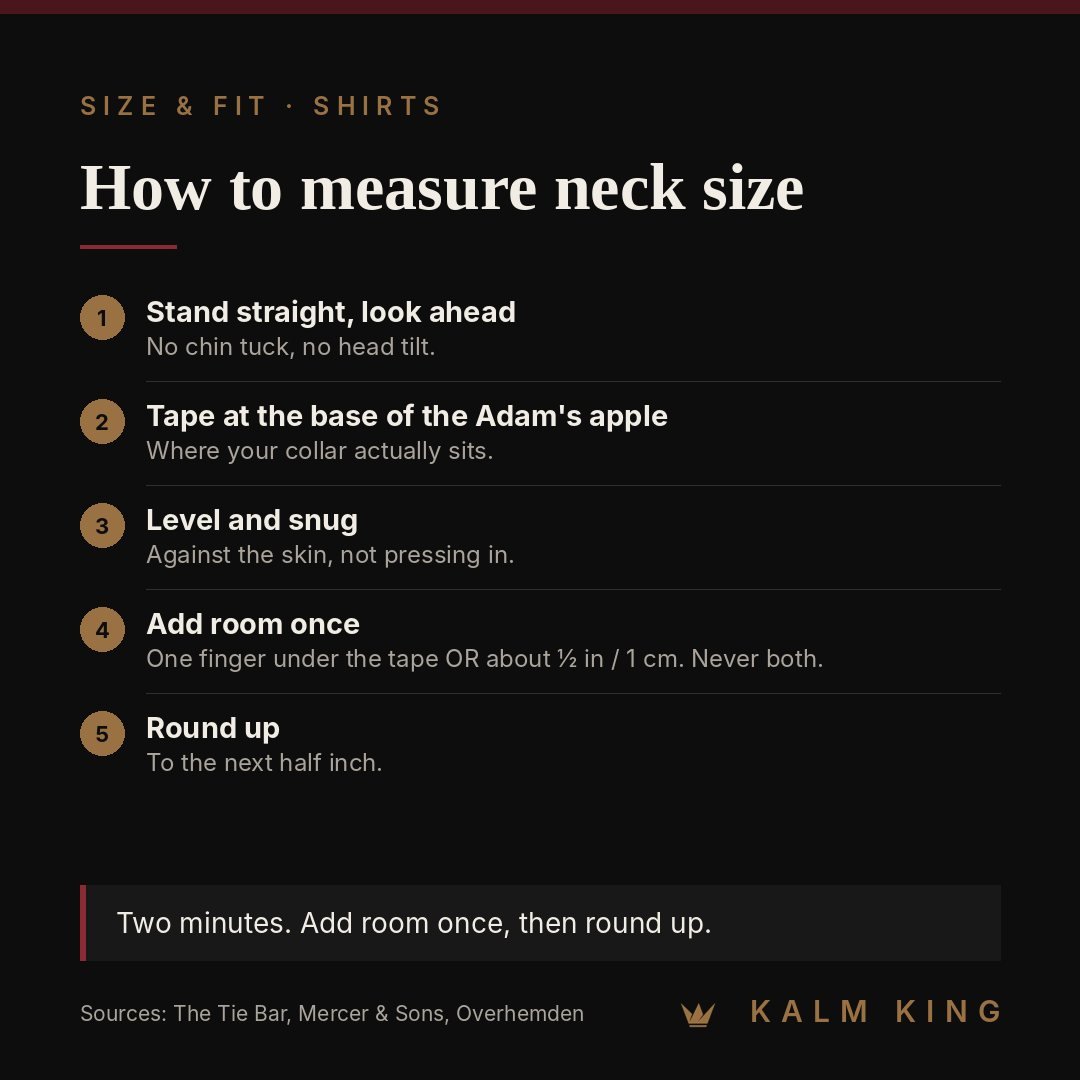
- Stand up straight and look ahead. Don’t tuck your chin or tilt your head back. &Collar’s sizing guide specifically warns against tucking your chin, which changes the reading.
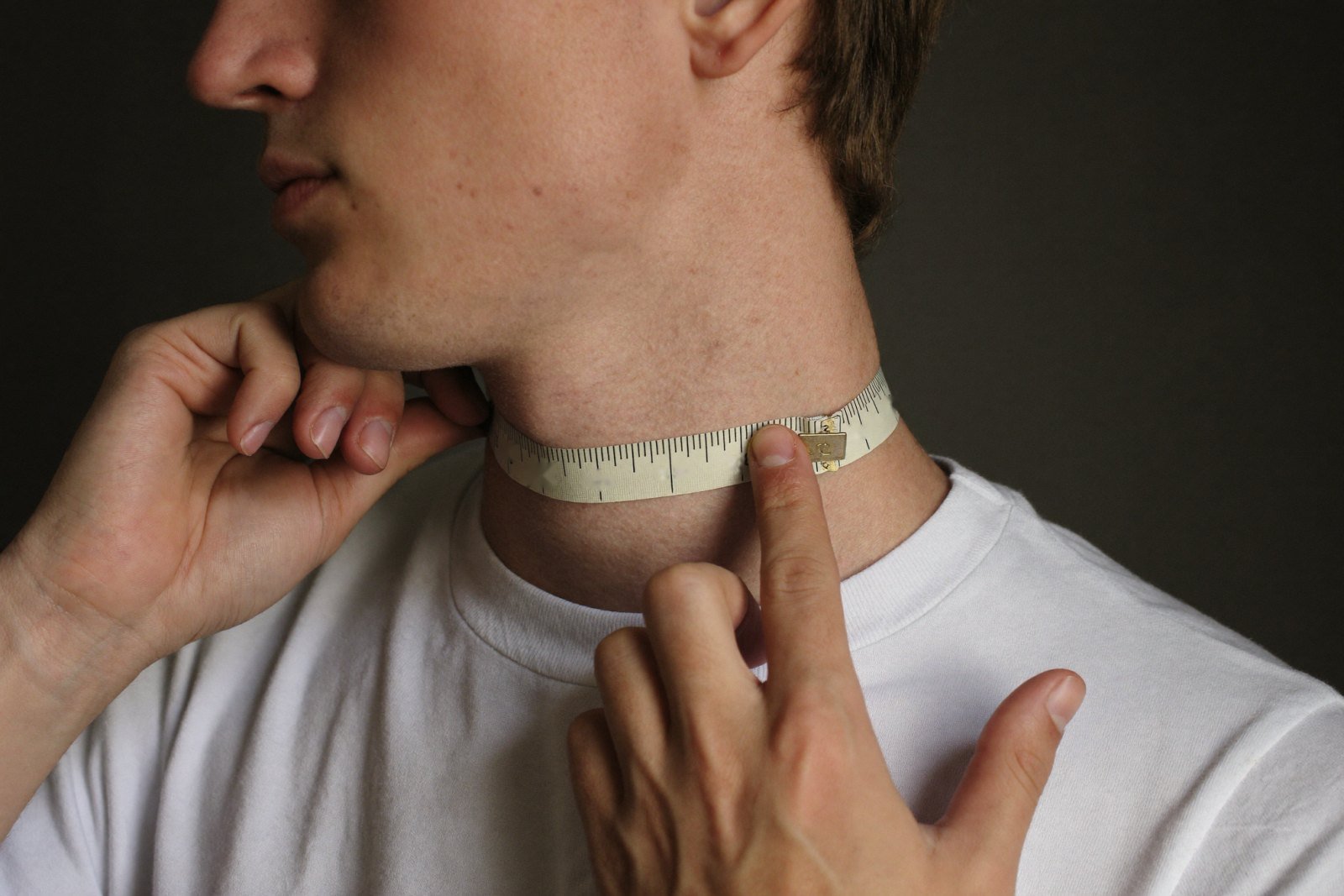
- Find the right spot. Place the tape around your neck where a shirt collar would sit, at the base of your Adam’s apple (the larynx). The Tie Bar, a US shirt and tie retailer, measures at the bottom of the Adam’s apple. If you don’t have a prominent Adam’s apple, use the point roughly midway between your jaw and collarbone where a collar naturally rests.
- Keep the tape level. Check in the mirror that it doesn’t drop at the front or rise at the back.
- Make it snug but relaxed. The tape should sit against your skin without pressing in. Don’t swallow, tense or hold your breath.
- Add room for comfort. Use one of these two methods, never both:
- The finger method: slip one finger between the tape and your neck as you measure. Mercer & Sons, &Collar and the Dutch shirt retailer Overhemden all describe this approach.
- The add-on method: measure snugly, then add a small allowance. The Tie Bar adds half an inch. Mercer & Sons adds a quarter of an inch. Overhemden adds about 1 centimetre.
- Round up. Shirts are usually sold in half-inch neck sizes. If you’re between sizes, round up to the next half inch, as Mercer & Sons and &Collar both advise.
- Write it down, along with how you measured.
Overhemden is explicit about the most common mistake: don’t use both methods at once. If you measured with a finger under the tape, don’t add extra on top.
Why Allowances Differ Between Brands
You’ll notice the sources above don’t agree on exactly how much to add: a quarter inch, half an inch, about a centimetre or one finger. That’s normal. Each brand designs its collars slightly differently, and the allowance they recommend matches how they cut their own shirts.
The practical takeaway:
- If you’re buying from one brand, follow that brand’s measuring instructions exactly.
- If you just want a general number, one finger of room or about half an inch is a reliable middle ground.
- If you wear a tie often, lean towards a little more room rather than less, because a knot tightens the collar slightly.
Time of Day and Other Things That Change the Number
Your neck isn’t the same size all day. The Tie Bar notes that neck size can vary with hydration and posture, and that the body can swell slightly towards the end of the day. To get a reliable reading:
- Measure at a time of day when you’d normally wear a shirt.
- Measure two or three times and use the larger reading.
- Re-measure if you’ve gained or lost weight, or started training your neck and upper back.
How to Measure the Collar of a Shirt You Already Own
If you have a shirt whose collar fits perfectly, measuring it is the most reliable way to buy another.
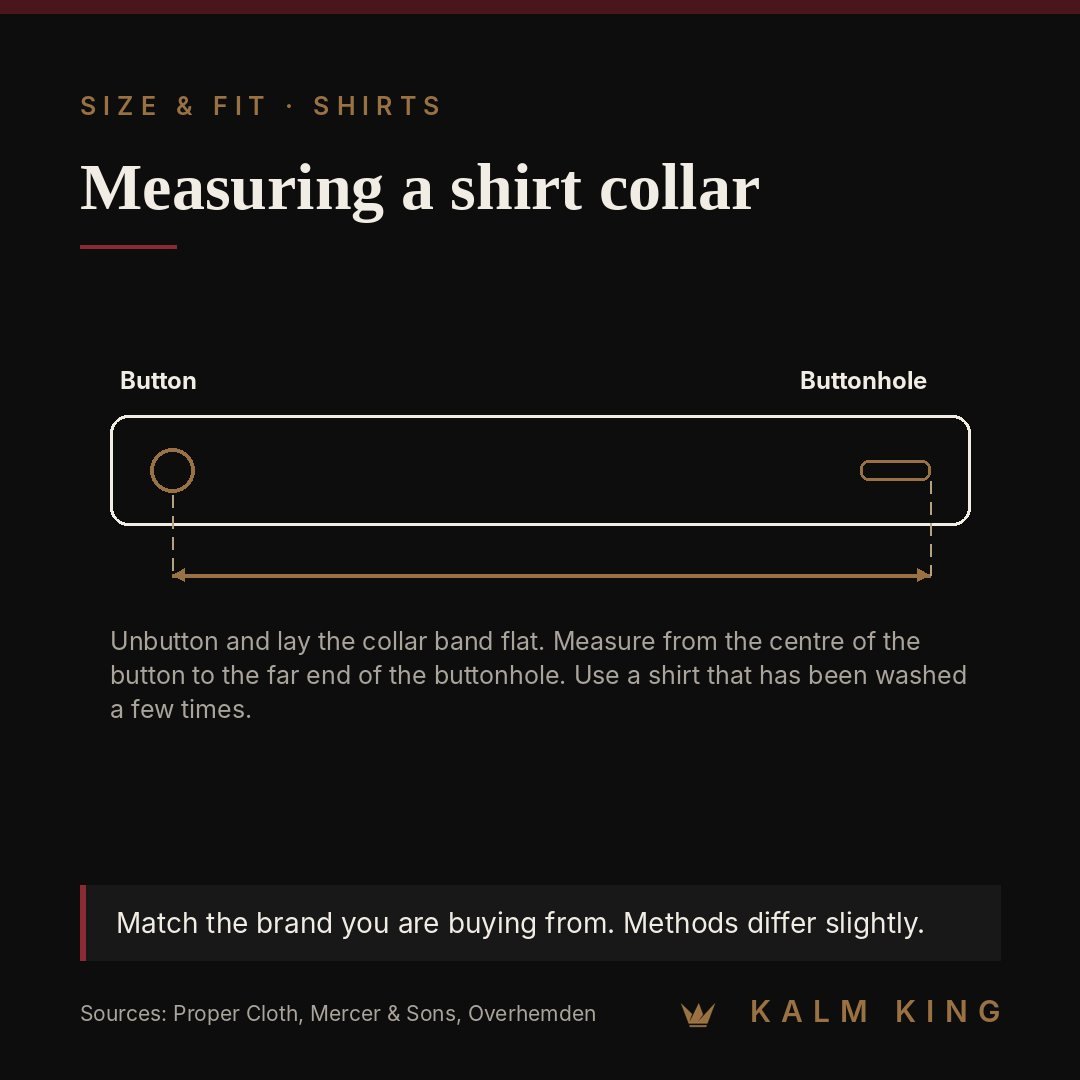
- Unbutton the collar and lay the shirt flat, with the collar opened out.
- Straighten the collar band so the curve lies flat.
- Measure from the centre of the top button along the band to the buttonhole. Proper Cloth, a made-to-measure shirt maker, measures from the centre of the button to the far edge of the buttonhole. Mercer & Sons measures to about 1/8 inch short of the buttonhole’s far end. The difference is small, but it’s worth matching the brand you’re buying from.
- Round to the nearest quarter inch, then compare with the brand’s collar sizes.
Use a shirt that has already been washed a few times. A new cotton shirt may not have finished shrinking.
Shirt Collars and Shrinkage
Cotton dress shirts can shrink a little, and the collar is where you’ll feel it first.
- The Tie Bar suggests factoring in shrinkage of 1 to 2% for cotton shirts.
- Mercer & Sons says its shirts are cut with about half an inch of extra room in the collar to allow for normal shrinkage.
- Proper Cloth adds 0.4 inch to its collar measurements to allow for shrinkage, and treats a variation of about 0.3 inch either way as normal.
What this means for you: many brands have already built in shrinkage, so don’t add your own extra on top unless the brand tells you to. To keep a well-fitting collar from shrinking further, wash shirts cool and avoid a hot dryer. Our guide to whether cotton shrinks explains why heat is the main culprit.
How to Read Dress Shirt Sizes
Traditional dress shirts are labelled with two measurements in inches. Take 16 34/35:
- 16 is the neck (collar) size.
- 34/35 is the sleeve length. &Collar explains that a two-number sleeve means an average sleeve cut to fit either length, often with an extra cuff button so you can tighten it.
- A single sleeve number, such as 16 34, means an exact sleeve length.
Our guide on how to measure sleeve length shows how to find the second number.
Neck size in inches and centimetres
European shirts often use centimetres. One inch is 2.54 centimetres. The common conversions:
| Inches | Centimetres (approx.) |
|---|---|
| 14 | 36 |
| 14.5 | 37 |
| 15 | 38 |
| 15.5 | 39 to 40 |
| 16 | 41 |
| 16.5 | 42 |
| 17 | 43 |
| 17.5 | 44 to 45 |
| 18 | 46 |
| 18.5 | 47 |
Brands round differently, so a 15.5 might be labelled 39 by one brand and 40 by another. Always check the brand’s own chart.

What about S, M and L?
Many casual and some dress shirts use letter sizes instead of collar numbers. There’s no universal conversion. &Collar notes that every brand sets its own ranges, and that a 16-inch neck often falls in a medium or a large depending on the brand. Use your neck measurement with that brand’s chart rather than guessing from the letter.
How Should a Shirt Collar Fit?
Once you’ve found your number, test the fit with the top button fastened.
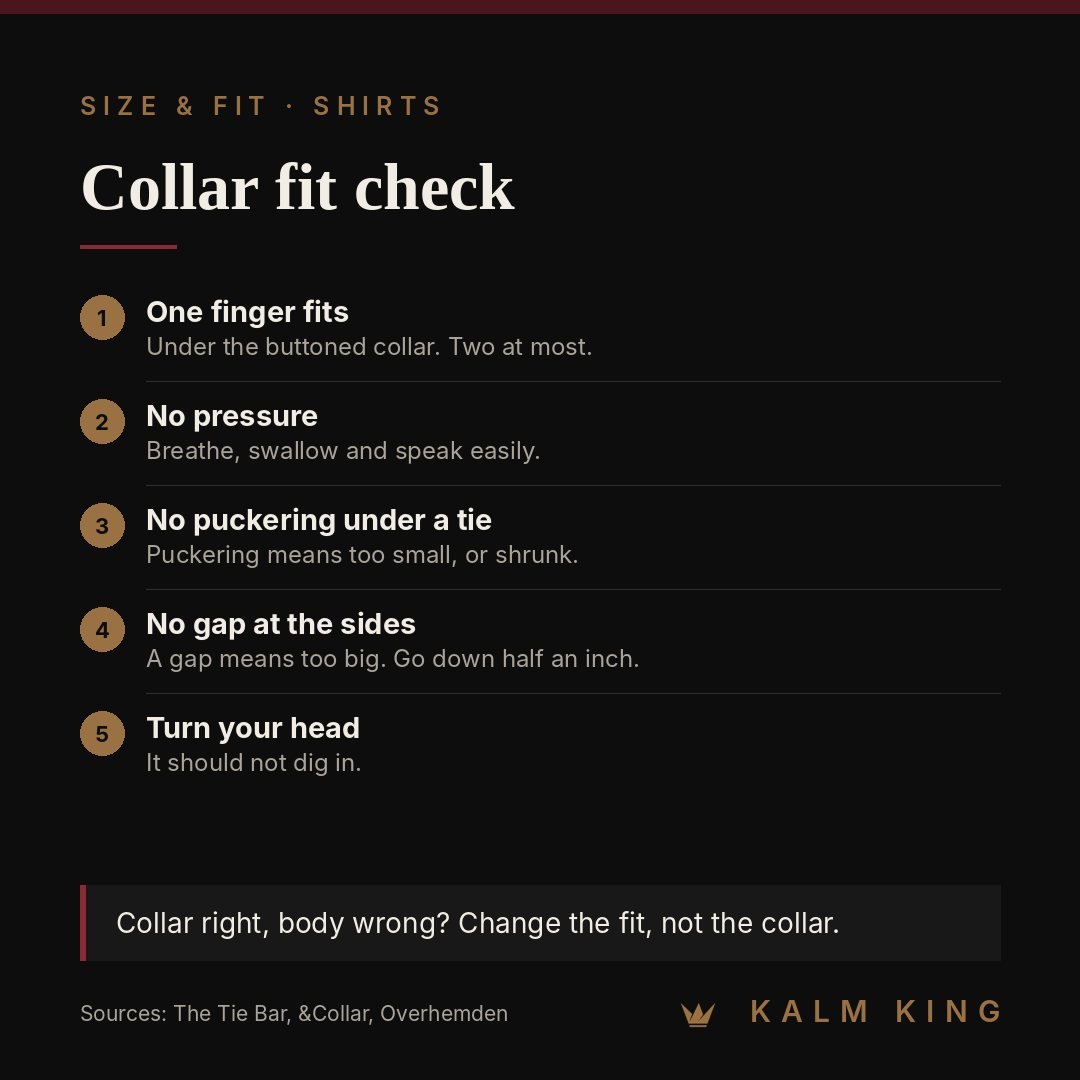
- The finger test. You should be able to slide one finger between the collar and your neck. The Tie Bar allows one or two fingers. If you can’t fit one, it’s too tight. If you can fit three or more, it’s too loose.
- No pressure. The collar should sit close all the way round without pressing on your neck. Overhemden’s guidance is that you should be able to breathe and move comfortably, especially with a tie.
- No puckering. A collar that’s too tight wrinkles and bunches under a tie knot.
- No gap. A collar that’s too loose leaves a visible gap at the sides or back, and the tie knot sits low.
- Turn your head. The collar shouldn’t dig in when you look over your shoulder.
Troubleshooting collar fit
| What you notice | What it means | What to do |
|---|---|---|
| Can’t fit a finger under the collar | Collar too small | Go up half an inch |
| Collar puckers under your tie | Collar too small, or shrunk | Go up half an inch, and wash cooler |
| Visible gap at the sides | Collar too big | Go down half an inch |
| Collar fits but chest pulls | Body too slim for you | Same collar, different fit (regular or athletic) |
| Collar fits but body is baggy | Body too full for you | Same collar, slimmer fit |
| Fits in the morning, tight by evening | Neck size varies through the day | Size up half an inch |
| New shirt fits, tight after washing | Cotton shrinkage | Cooler washes, no hot dryer, or size up |
Overhemden makes a useful point: if the collar fits but the rest of the shirt doesn’t, don’t change your collar size. Change the fit, from slim to regular or athletic, and keep the same collar. &Collar gives similar advice: for shirts you’ll button with a tie, let the collar decide; for shirts you’ll wear open, let the chest and shoulders decide.
For the full picture of how a dress shirt should fit through the shoulders, chest, sleeves and length, see our guide on how a dress shirt should fit. If your chest measurement is the issue, our guide to measuring chest size will help.

Measuring Someone Else’s Neck
If you’re buying a shirt as a gift or helping a friend, the method is the same, but a few habits make it more accurate:
- Have them stand naturally and look at a fixed point straight ahead.
- Stand slightly to one side rather than directly in front, so you can see that the tape is level at the back.
- Place the tape at the base of the Adam’s apple, or where their usual shirt collar sits.
- Use the finger method if you’re unsure how much to add: slide one of your fingers under the tape, then read it.
- Read the number at the side of the neck, not the front, so you don’t pull the tape tighter as you lean in.
If you can’t measure them, measure the collar of a shirt they already wear and like. That’s often more reliable than a guess.
Neck Size for Athletic Builds
Men who lift, wrestle, play rugby or train their upper back often find that a collar big enough for their neck comes with a shirt body that’s far too large. That’s not a measuring error. Traditional sizing scales the whole shirt up with the collar.
- Measure honestly. Don’t squeeze into a smaller collar to get a slimmer body.
- Look for athletic or “muscle” fits, which pair a larger collar with more room in the chest and shoulders and a slimmer waist.
- Consider made-to-measure. If standard fits never work, a made-to-measure shirt lets you choose your collar and body measurements separately.
- Check the collar height too. A taller collar can feel tighter on a thick neck even at the right circumference.
How Collar Style Affects Fit
The collar circumference is the same whatever the style, but different collars feel and look different on the same neck.
- Button-down collars are casual and relaxed. They’re often worn open, so a little extra room is fine.
- Point collars are classic and narrow. They show any gap clearly, so fit matters.
- Spread and cutaway collars frame a wider tie knot. A collar that’s slightly too small pulls the points apart awkwardly.
- Band collars have no points. They sit close around the neck, so measure carefully.
- Taller collars cover more of the neck and can feel more restrictive, even at the correct size.
When you find a brand and collar style that fit well, note both. Collar shapes vary as much as sizes do.
Common Neck Measuring Mistakes
- Adding room twice. Measuring with a finger under the tape and then adding half an inch on top makes the collar too big.
- Pulling the tape tight. You’ll end up with a collar that only fits if you don’t swallow.
- Measuring too high or too low. Measure where the collar actually sits, not around your jaw or down at your collarbone.
- Tilting your head. Looking down or up changes the reading.
- Using an old, shrunken shirt as your reference without checking it still fits.
- Assuming you’re the same size you were years ago. Weight and training change neck size.
- Guessing from letter sizes. S, M and L mean different things at different brands.
Neck Size for Different Shirts
- Dress shirts worn with a tie: the collar matters most. Fit the collar first.
- Business shirts worn open-necked: the collar matters less. Prioritise shoulders and chest, but the collar should still close comfortably.
- Polo shirts and casual shirts: usually sized S, M and L. Your neck measurement still helps you choose between sizes.
- Overshirts and outerwear: rarely sized by collar. Focus on chest and shoulders.
- Shirts for formal events: if you’ll be wearing a tie or bow tie for hours, be generous with the room.
When to Go to a Tailor or Shirt Maker
Most men can measure their own neck accurately. A professional fitting is worth it when:
- You’re buying a shirt for a wedding, interview or formal event and want certainty.
- Your measurements fall between sizes in several places at once.
- Standard shirts never fit your collar and body at the same time.
- You’re ordering made-to-measure for the first time.
A shirt maker will measure your neck and usually take a few other measurements, such as shoulder width and arm length, so it’s worth bringing your own numbers to compare.
Keep Your Measurements Together
Your neck size is most useful alongside your other measurements. Keep a simple note on your phone:
| Measurement | Your number |
|---|---|
| Neck (collar size) | |
| Sleeve length | |
| Chest | |
| Waist | |
| Favourite shirt: collar button to buttonhole |
Our size and fit guide brings all of our measuring guides together in one place.
The Kalm King Take
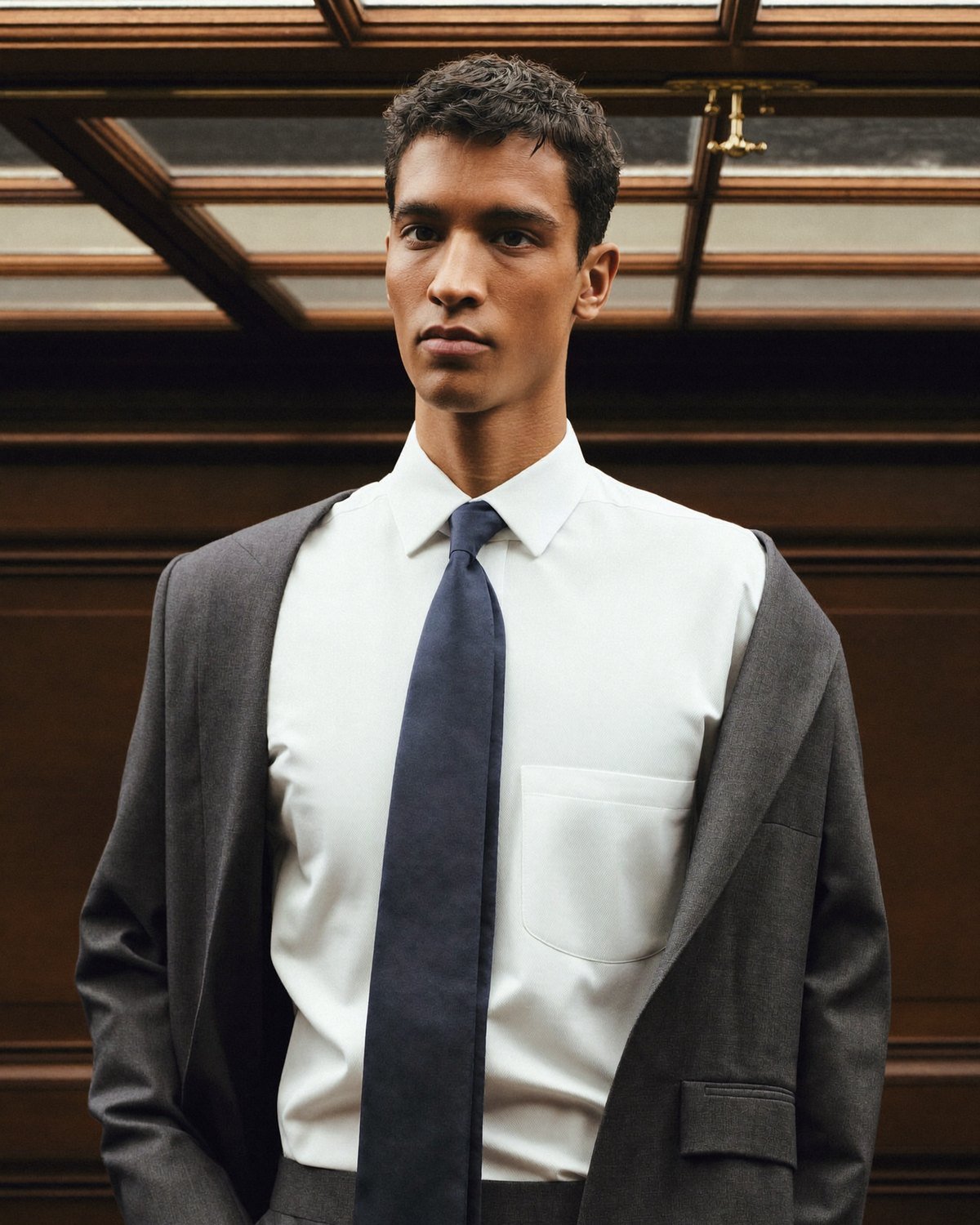
A well-fitting collar is one of those details nobody notices when it’s right and everybody notices when it’s wrong. It’s the frame around your face. It should sit close, stay put and let you breathe, move and speak without thinking about it.
Two minutes with a tape measure gets you there. Measure where the collar sits, add room once, round up, and judge the rest of the shirt separately. We’re building our own essentials with the same attention to fit. If you want to hear about them first, along with more fit and care notes, join Field Notes.
Frequently asked questions
How do I measure my neck for a dress shirt?
Stand straight and look ahead. Wrap a soft tape around your neck where a collar sits, at the base of your Adam’s apple, keeping it level and snug. Then add room: slip one finger under the tape, or measure snugly and add about half an inch. Round up to the nearest half inch.
Should I add an inch to my neck size?
Usually not a full inch. Most brands recommend adding between a quarter and half an inch, or about 1 centimetre, to a snug measurement, or measuring with one finger under the tape instead. Use one method only, and follow the brand’s own instructions if it gives them.
How tight should a shirt collar be?
When it’s buttoned, you should be able to slide one finger, or at most two, between the collar and your neck. It should sit close all the way round without pressure, puckering or a visible gap.
What does 16 34/35 mean on a dress shirt?
The first number, 16, is the neck size in inches. The second, 34/35, is the sleeve length in inches. A two-number sleeve means an average length that fits either measurement, often with an extra cuff button.
Is a 16 neck a medium or large?
It depends on the brand. A 16-inch neck often falls into a medium or a large, but letter sizes aren’t standardised. Check the brand’s size chart against your neck measurement.
How do you measure the collar of a shirt?
Unbutton the collar and lay it flat. Measure along the collar band from the centre of the top button to the far end of the buttonhole. Compare the result with the brand’s collar sizes, and use a shirt that has already been washed a few times.
Does neck size change during the day?
Slightly, yes. Hydration, posture and normal swelling can make your neck a little bigger later in the day. Measure two or three times, use the larger reading, and if a collar feels tight by evening, size up half an inch.
Sources
- The Tie Bar: How to Measure Neck Size for Dress Shirts (shirt and tie retailer)
- Mercer & Sons: How to Measure (shirt maker)
- Overhemden.com: How to measure collar size and find the right shirt size (shirt retailer)
- &Collar: Dress Shirt Sizes Explained, Neck and Sleeve Numbers (shirt brand)
- Proper Cloth: How to Measure a Shirt, Collar Around (made-to-measure shirt maker)
- Teng et al., Effect of a tight necktie on intraocular pressure, British Journal of Ophthalmology (2003) (peer-reviewed study)
- Lüddecke et al., Neckties and cerebral blood flow, Neuroradiology (2018) (peer-reviewed study)
- Rafferty et al., Neckties and Cerebrovascular Reactivity in Young Healthy Males: A Pilot Randomised Crossover Trial (PMC2976510) (peer-reviewed study)
FIELD NOTES
Get the Overalls Fit Kit, free.
Your measurement card, the six fit checkpoints and a checklist to take shopping. Join Field Notes for new guides and a say in what Kalm King makes.
THE KALM KING JOURNAL
Continue reading
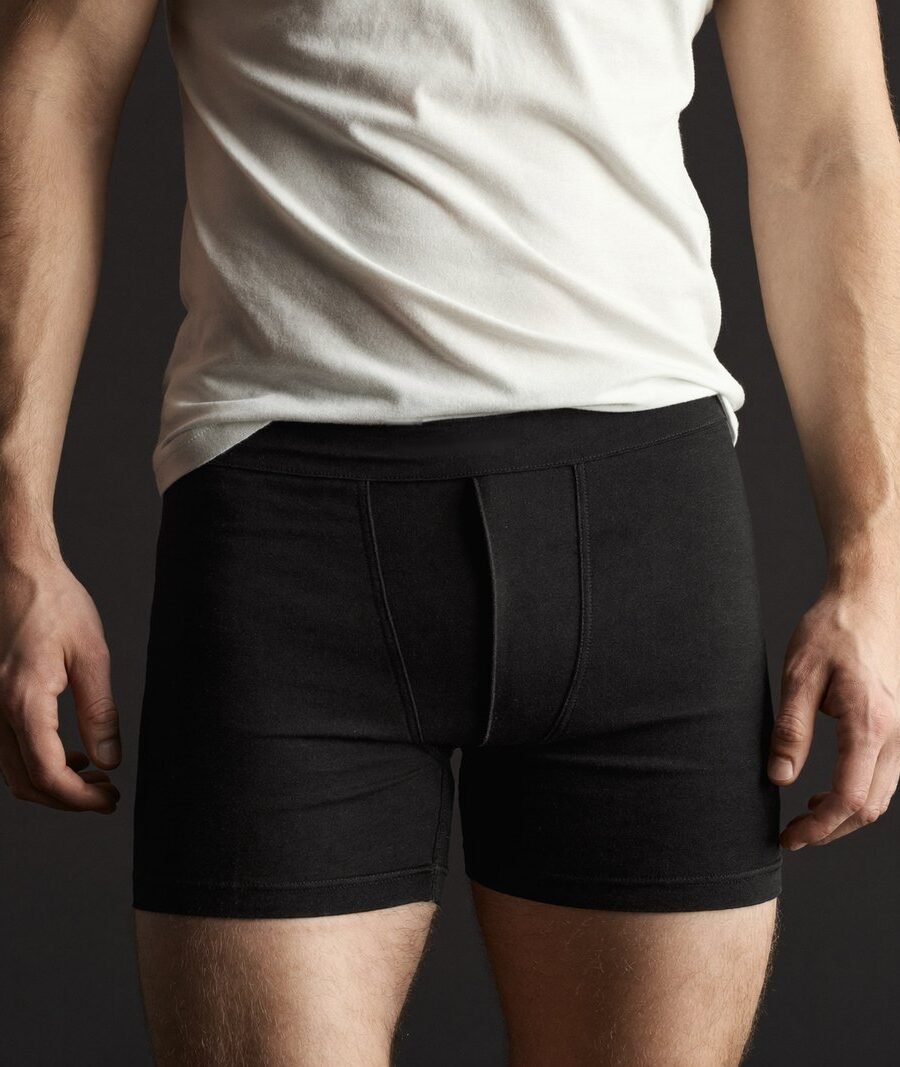
What Is Pouch Underwear? Benefits, Designs and Fit
Pouch underwear gives everything its own shaped space. Here’s how the main designs work, what they can and can’t do, and how a pouch should fit.
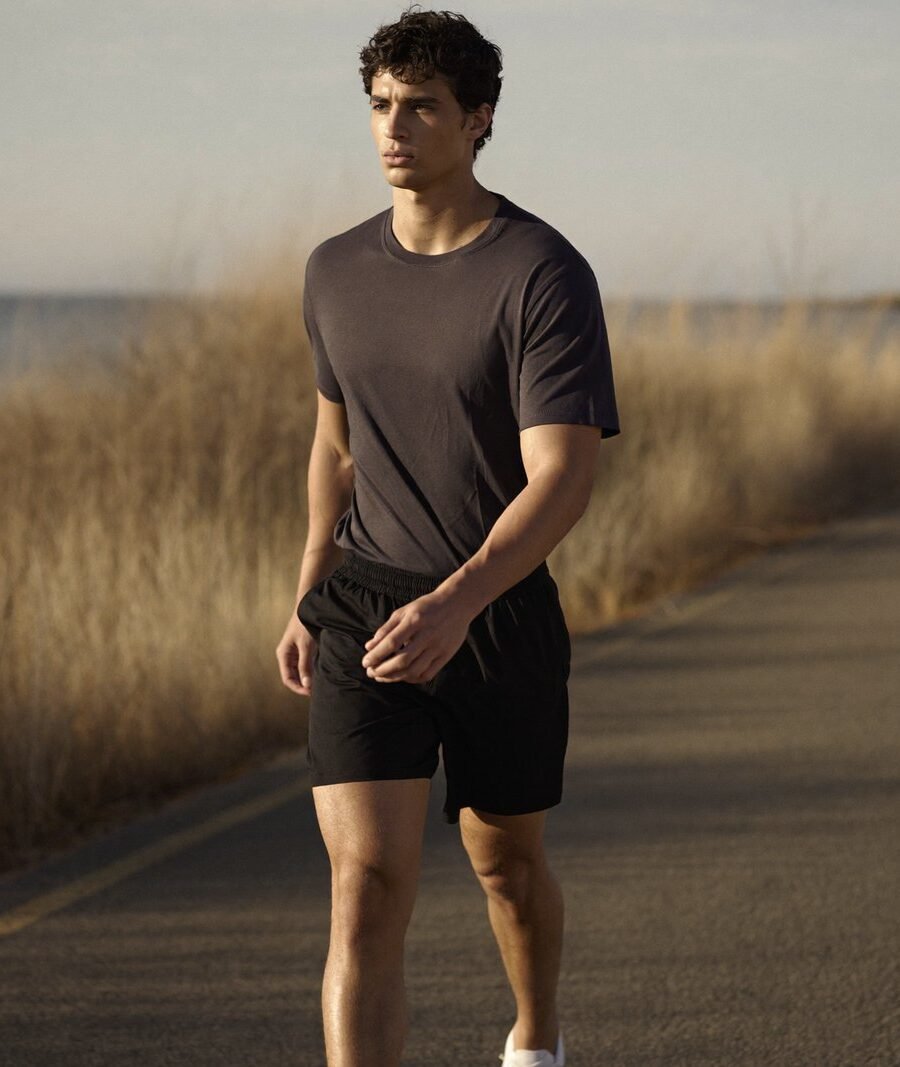
How to Prevent Thigh Chafing for Men
Stop thigh chafing before it starts: the layers, fabrics, balms and habits that keep your inner thighs comfortable, plus how to treat a rub that’s already sore.
How to Keep Black Clothes From Fading
Black clothes fade from dye loss, friction, heat and sun. Here’s how to wash, dry and store black so it stays black, and what to do when it’s already gone grey.