
November 23, 2026
Explore: Style
How to Measure Your Waist for Pants (Men): Body, Trousers and the Tag
Measure your waist for pants the right way: where to put the tape, how to measure a pair you own, and why your tape and tag rarely match.

You wrap a tape around your middle, it says 35, and the jeans that fit you best say 32 on the tag. Or you order your usual size from a new brand and it slides off your hips by lunchtime. Measuring your waist for pants sounds like the simplest job in menswear. It is simple, once you know which waist you’re measuring and what the number on a tag actually means. Most of the frustration comes from mixing up three different things that all get called “waist.”
This guide shows you how to measure your waist on your body, how to measure the waist of trousers you already own, why the two numbers rarely match the size label, and how to turn all of it into pants that stay put without squeezing. It is the waist companion to our inseam guide and our chest measurement guide, and every measurement is collected at a glance in our Size & Fit Reference.
Short answer: To measure your waist for pants, take off your belt, stand relaxed and wrap a soft tape measure level around your body where you normally wear your pants, which for most modern trousers is a little below your natural waist. Keep the tape snug but not tight, breathe normally, and read the number where the tape meets its start. To check a pair you already own, button the pants, lay them flat, measure straight across the top of the waistband from edge to edge, and double it. Then compare your number with the brand’s own chart, because many size labels run smaller than the actual waistband.

Why “Your Waist” Can Mean Three Different Numbers
Before you pick up a tape, decide which waist you need. There are three in common use, and they sit at different heights on your body.
Your natural waist is the narrowest part of your torso, usually a little above your belly button and below your ribs. Sewing and pattern-fitting guides often start here. New Mexico State University’s extension guide to fitting pants tells you to measure “the smallest part of the waist.”
The health waist is the one doctors use. The US National Heart, Lung, and Blood Institute says to place the tape “around your middle, just above your hipbones,” and to measure “just after you breathe out.” That’s a health screening measurement, taken a specific way for a specific purpose. It’s not designed for buying trousers.
The pants waist is where your trousers actually sit. Lands’ End’s men’s bottoms chart says to “measure your waist where you normally wear your pants.” Dickies’ workwear sizing guide takes it “at the top of the hipbone over shirt (not over pants).” For most modern jeans and chinos, that line is lower than your natural waist, often around or just below the belly button.
On a lot of men, the gap between the natural waist and the line where low or mid-rise pants sit is an inch or more. If you measure your natural waist and buy pants designed to sit lower, they can feel loose. If you measure low and buy a high-rise dress trouser, it can feel tight. Neither number is wrong. They answer different questions.
| Waist | Where it sits | Who uses it | Use it for pants? |
|---|---|---|---|
| Natural waist | Narrowest part of the torso, above the navel | Sewing and pattern guides | Only for high-rise trousers designed to sit there |
| Health waist | Just above the hipbones, measured after breathing out | Doctors and health guidance | No, it’s a health measurement |
| Pants waist | Where your trousers normally sit | Most clothing brands’ size charts | Yes, this is usually the one you want |
What You Need
- A soft tape measure. A cloth or fibreglass tailor’s tape bends around your body. A metal tape from the toolbox doesn’t, and it will give you a bigger number than reality.
- Thin clothing or underwear. Measure over a thin T-shirt or the underwear you usually wear. Don’t measure over jeans, a hoodie or a thick sweater.
- A mirror. It helps you check the tape is level all the way around, especially at the back.
- A pen and somewhere to write it down. You’ll want the number, the height you measured at and the date.
- A pair of trousers that fit you well (optional). If you have one, you can measure it too, and the comparison is often the most useful result of the whole exercise.
No tape at home? A piece of string or a phone charging cable will do in a pinch. Wrap it around, pinch the point where it meets, then lay it along a ruler or a steel tape. It’s less precise, so measure twice.
How to Measure Your Waist for Pants: Step by Step
1. Find where your pants sit
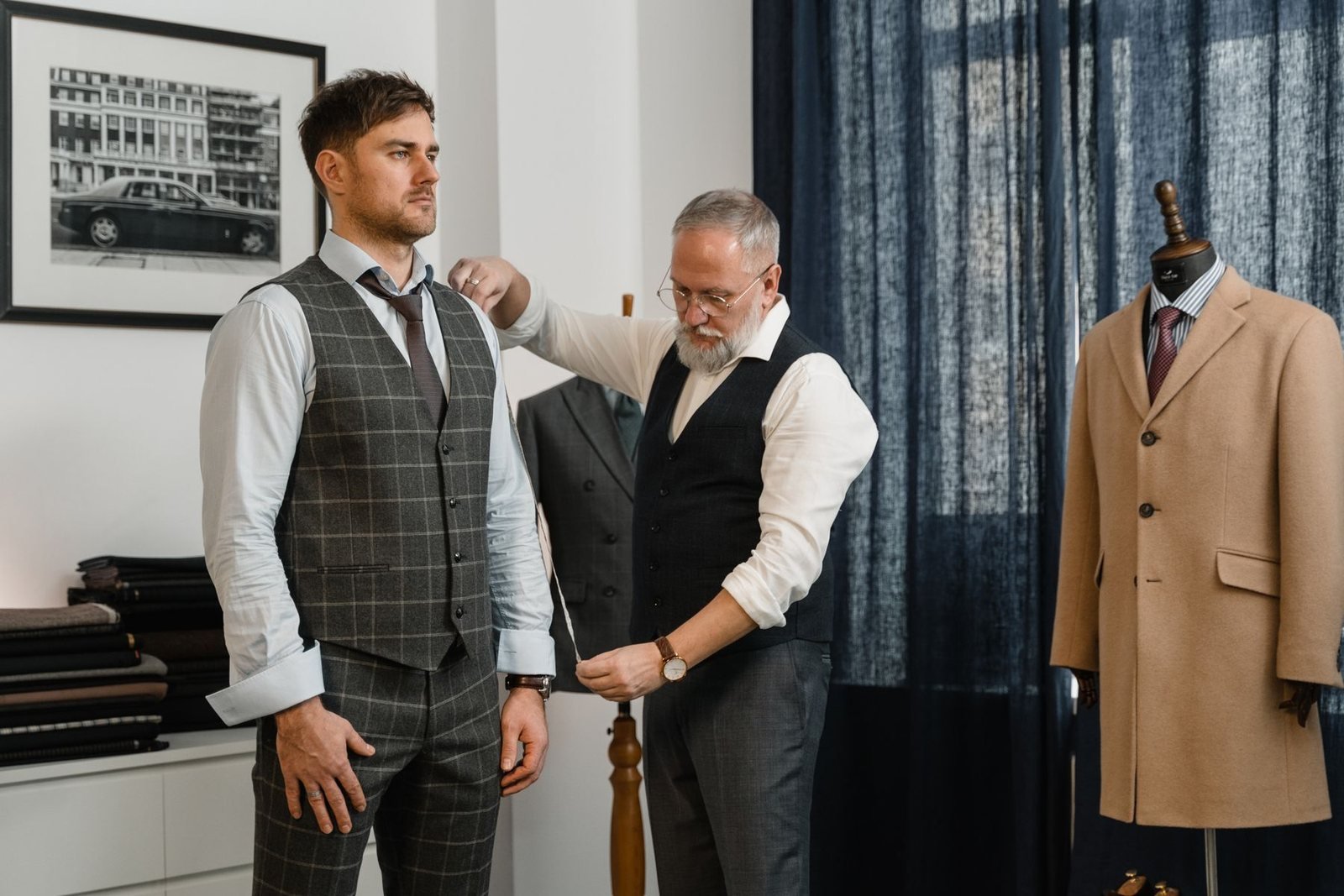
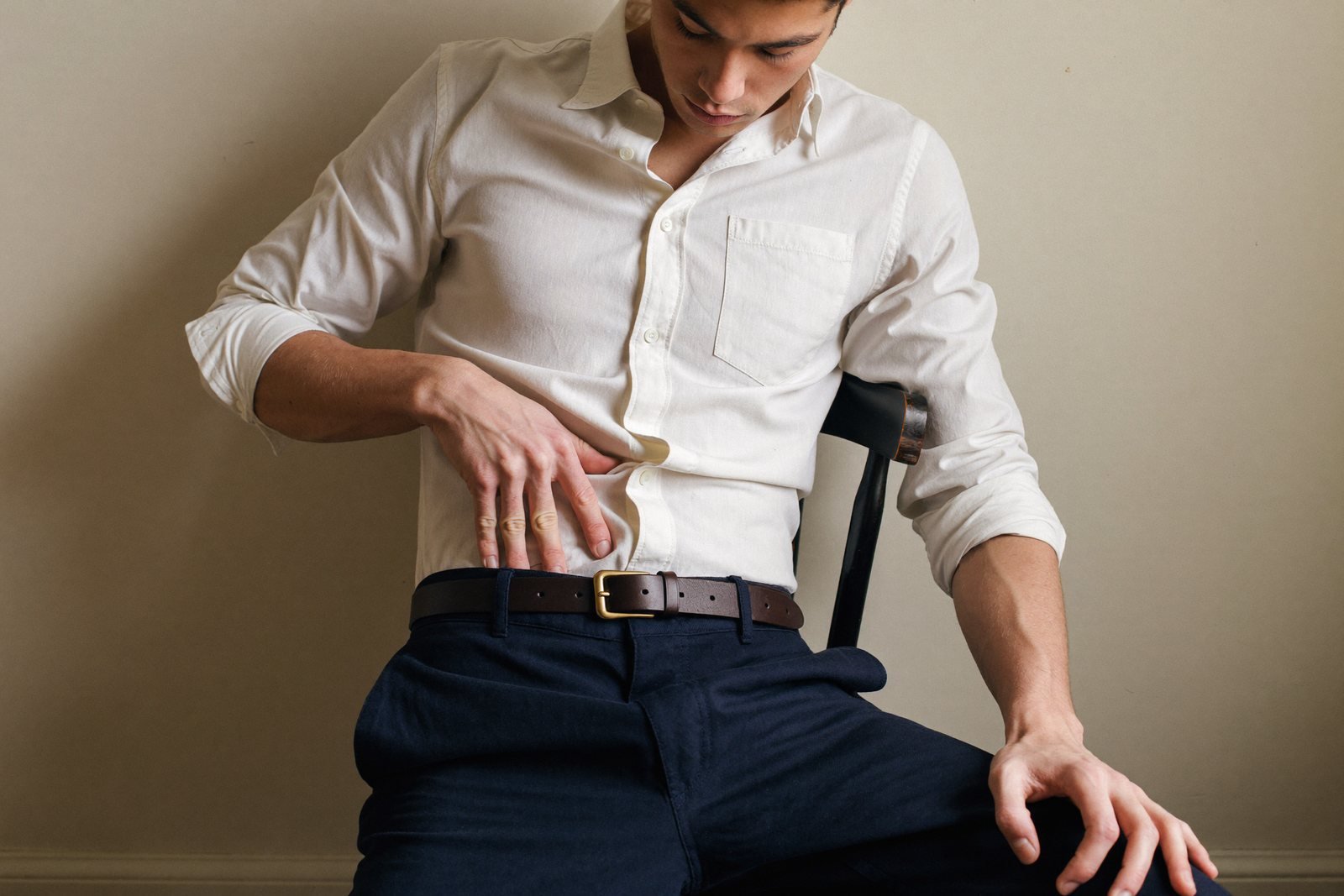
Put on a pair of trousers you like the fit of and notice where the waistband lands. Then take them off and find that same line on your body. On many men it’s around or just below the belly button, roughly at the top of the hipbones. If you prefer a higher-rise trouser, it will be higher. This is the line you’re going to measure.
Vans’ pants measurement guide describes the same idea: measure “slightly below your natural waistline—where you normally wear your pants.”
2. Take off your belt and empty your pockets
Lands’ End’s chart starts with “Remove your belt.” A belt adds bulk and pulls the waist in, and a phone or wallet distorts the line. Stand in thin underwear or a thin tee.
3. Stand naturally and breathe normally
Stand up straight with your feet roughly hip-width apart and your weight even. Don’t suck your stomach in and don’t push it out. Breathe normally and take the reading at a relaxed moment. Pants have to fit the body you live in, not the one you hold for three seconds in front of a mirror.
4. Wrap the tape level all the way around
Hold the start of the tape at the front, wrap it around your back and bring it to meet the start. Check in the mirror that it isn’t dipping at the back or riding up at the sides. A tape that slopes down at the back is the most common cause of a reading that’s too big.
5. Snug, not tight
The tape should sit flat against your body without pressing into it. Lands’ End’s recommendation is to “keep one finger between the tape and your body.” Levi’s says “not too snug, not too loose.” Dickies says “snug not tight.” The intent in all three is the same: you’re measuring what a waistband will sit on comfortably, not the smallest number you can squeeze out.
6. Read and round
Read the number where the end of the tape meets the start. If it falls between marks, write down the exact number first, such as 33.75 inches, and round later when you compare it with a specific chart.
7. Measure two or three times
Take the tape off, put it back and measure again. If the readings are within a quarter inch of each other, you’re done. If they’re further apart, the tape moved or your posture changed. Use the middle reading.
8. Write it down with context
“Waist 34 in, at top of hipbones, over thin tee, relaxed” is far more useful six months from now than “34.” Note the height you measured at, because a measurement taken at your natural waist and one taken at your hipbones are two different numbers, and you’ll want to compare like with like.
Measuring alone
You can do this without a helper. Stand side-on to a mirror to check the back of the tape. Hold the start with your thumb at your belly button area and let the tape go around you. If you struggle to keep it level, tuck the start of the tape under a thin waistband of your underwear to hold it while you wrap. Then measure once more facing the mirror to confirm.
Waist done? Now measure your hips and thighs.
How to Measure the Waist of Pants You Already Own
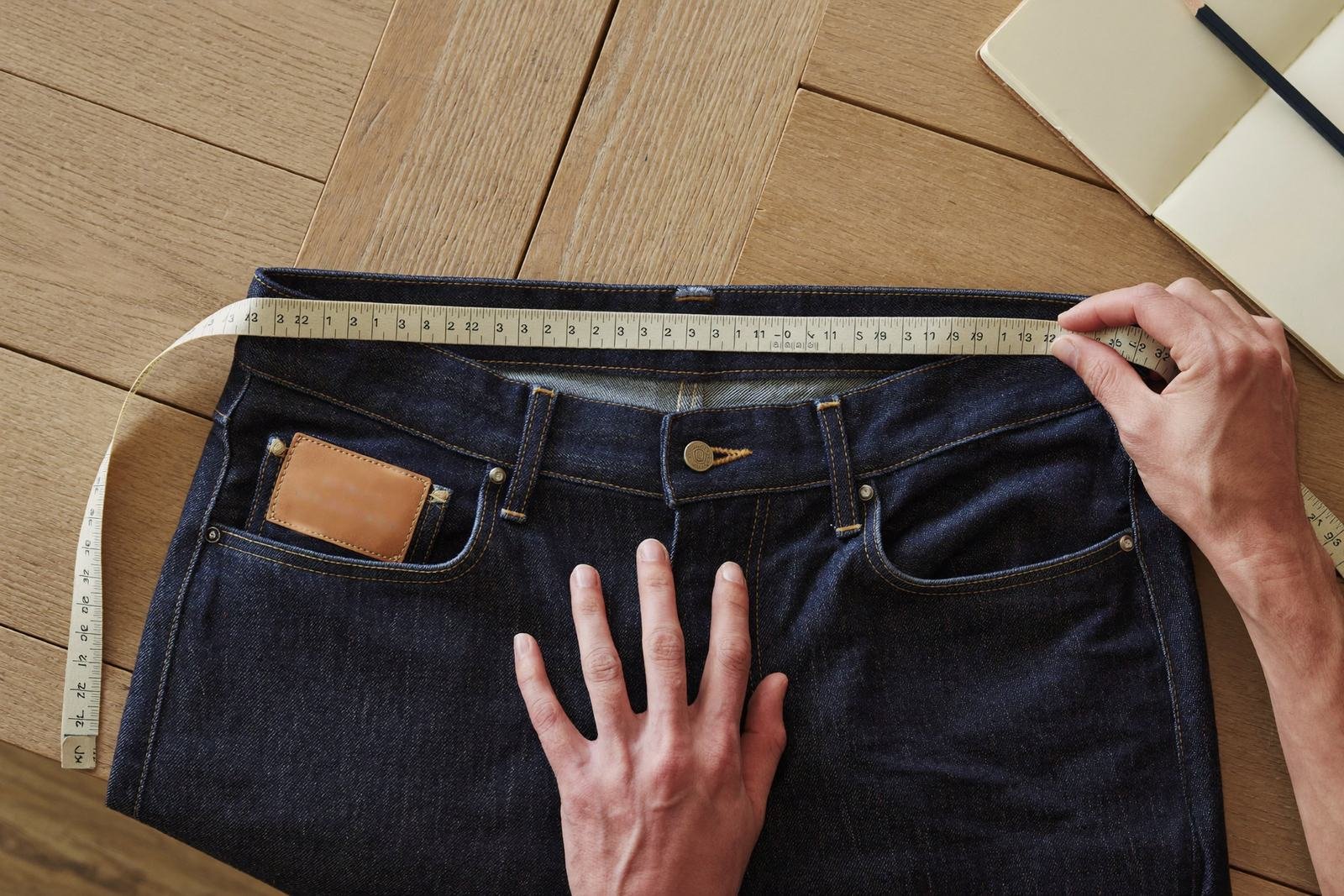
If you own a pair of trousers that fits well at the waist, measuring them is often more useful than measuring yourself. It tells you the actual finished waistband size you’re comfortable in, which you can then match against any brand that publishes garment measurements.
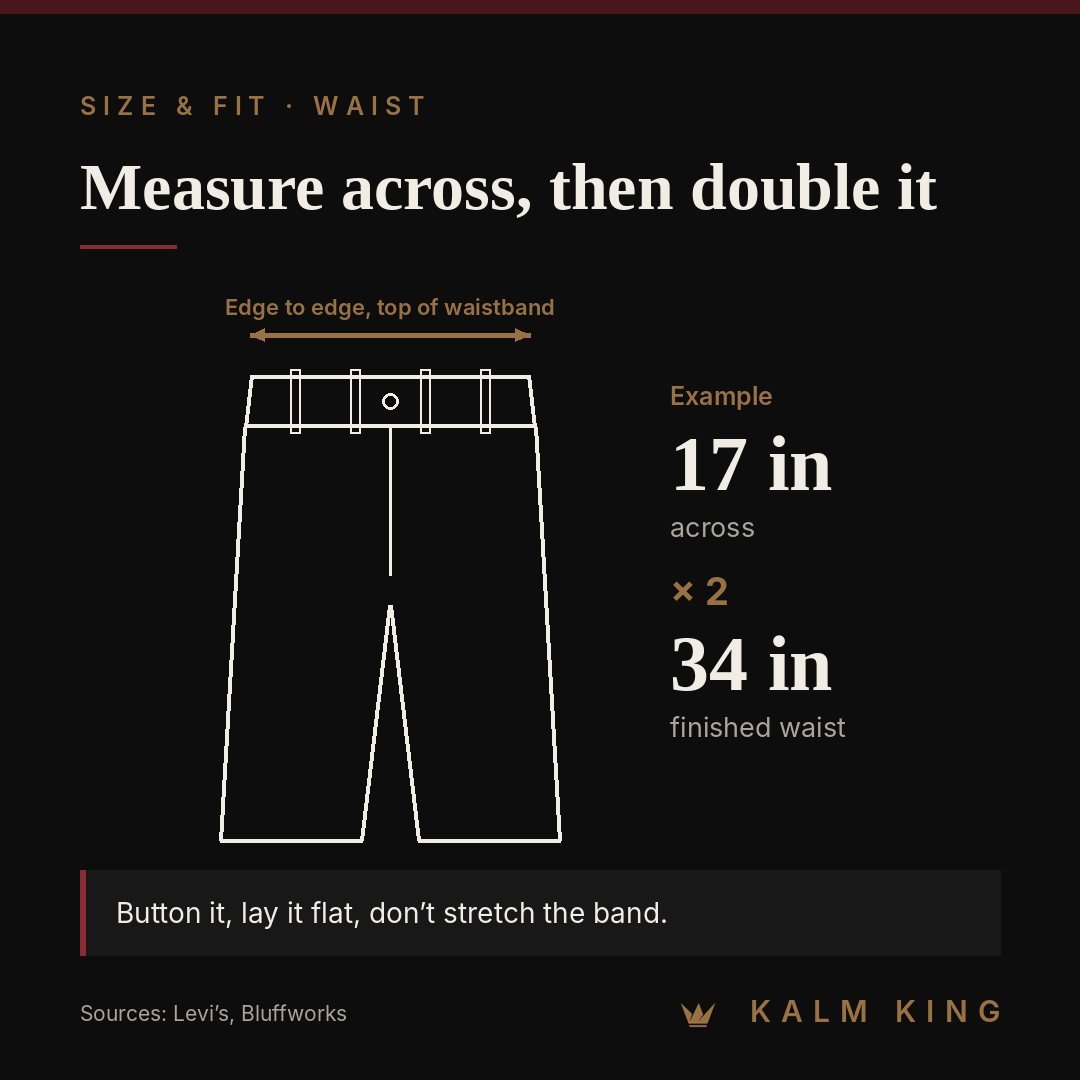
Levi’s puts it in one line: “Measure the waistband and double it for your waist size.”
Here’s how to do it well:
- Button and zip them. A waistband measured open isn’t a waistband.
- Lay them flat, front side up, on a table or hard floor. Smooth the waistband so it isn’t twisted, folded or rolled.
- Measure straight across the top edge of the waistband, from one side edge to the other. Keep the tape straight and level, not following a curve down to the button.
- Don’t stretch the fabric. Stretch denim and elastic waists will happily grow an inch if you pull them. Lay the tape on the fabric, not the fabric on the tape.
- Double the number. If the waistband measures 17 inches across, the finished waist is about 34 inches around.
- Write it down with the brand, style and size on the tag. “Tag 32, measured 34, mid-rise straight jeans” is gold the next time you shop.
A few notes:
- Curved and contoured waistbands sit at an angle on the body, and some dip lower at the front. Lay them as flat as they’ll go and measure along the top edge. If the waistband won’t lie flat without folding, measure the top edge carefully and accept that the result is approximate.
- Elastic and drawstring waists have two measurements: relaxed and stretched. The relaxed number is the one that matters for whether they’ll stay up. Measure relaxed.
- Side adjusters on dress trousers change the waist by a small amount. Set them to the middle or to where you wear them before you measure.
Why Your Tape and Your Tag Disagree
This is the part that confuses most men. You measure your waist at 34 or 35 inches, and yet the trousers that fit say 32. People on menswear forums describe exactly this: a measured waist a couple of inches bigger than the tag size they actually wear, and a 34 that has to be cinched with a belt to stay up. There are a few reasons, and they stack.
The label is a size, not a measurement
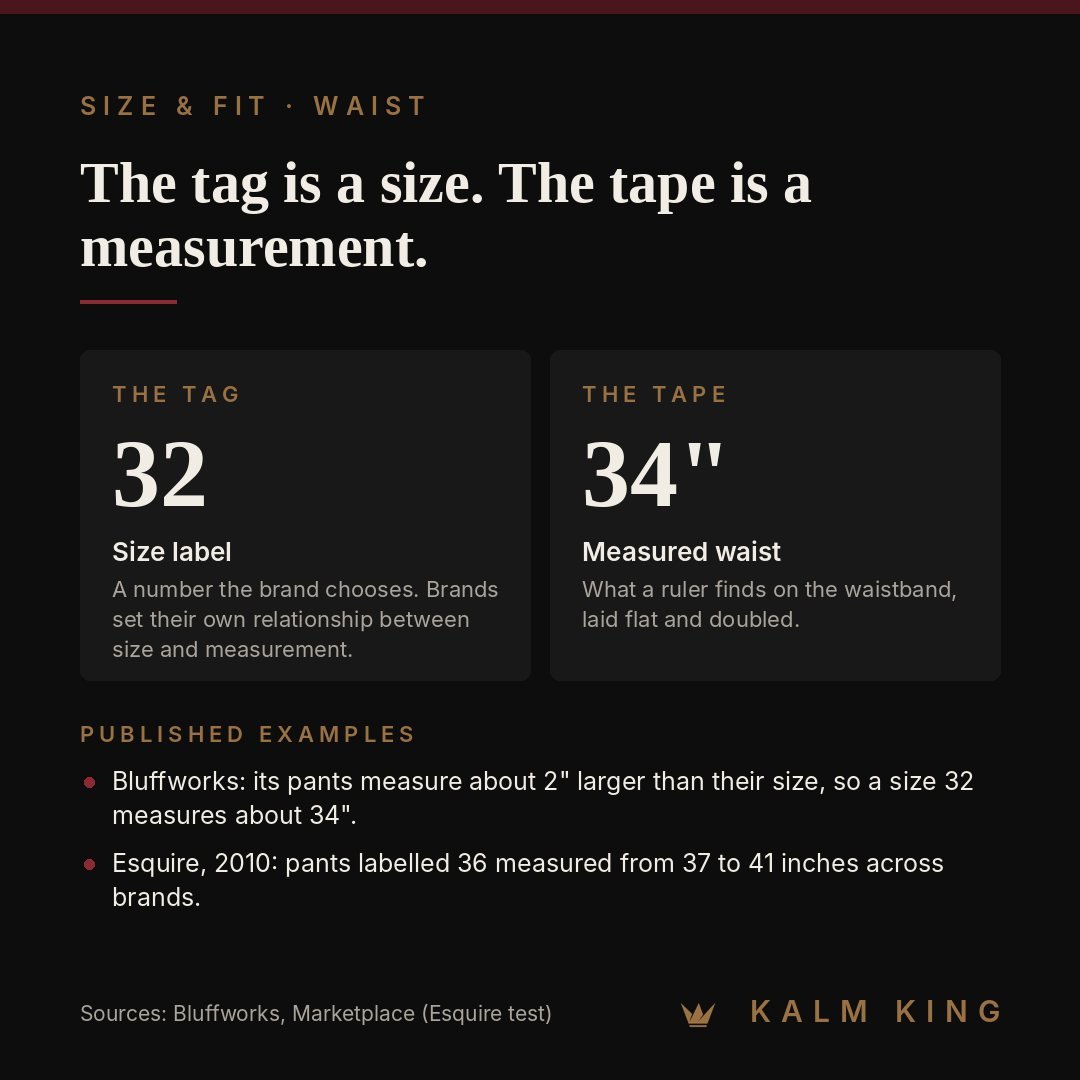
The number on a tag is a size name. It’s often expressed in inches, but it isn’t promised to be the circumference of the finished waistband. Brands decide how their sizes relate to real measurements, and they don’t all decide the same way.
Bluffworks, a trouser maker, explains its own approach plainly: “Bluffworks pants measure about 2″ larger than their size. (So a size 32 will measure about 34″).” The same article says, “many brands go further.”
Vanity sizing
Vanity sizing means labelling clothes smaller than they measure. It’s usually discussed as a women’s clothing issue, but men’s trousers aren’t exempt. In 2010, Esquire writer Abram Sauer measured several pairs of trousers labelled with a 36-inch waist at different US retailers. Marketplace reported his findings: at H&M the 36s had a real waist of 37 inches, and at Old Navy the 36s measured 41 inches. Wikipedia’s article on vanity sizing summarizes the same test as a range of 37 to 41 inches.
That’s one person’s test at one moment, and stores change their patterns, so don’t treat those as current figures for any brand. The useful lesson is the size of the spread. Two pairs with the same tag can be several inches apart at the waist.
Rise changes where the waist sits
Bluffworks also explains the history. When trousers were worn high, at the natural waist, the waistband sat on the narrowest part of the body. As fashion moved trousers down to the hips, the top of the pattern was effectively cut lower, where the body is wider, so the waistband got bigger while the size names stayed the same.
That’s why rise matters as much as the tag. A low-rise jean sits lower on your hips, where you’re usually wider. A high-rise trouser sits higher, closer to your natural waist. The same body can wear different “waist sizes” in different rises.
Stretch fabric
Stretch denim and stretch chinos give, and many relax further as you wear them. A stretch pair can fit a body slightly bigger than its measured waistband. A rigid, non-stretch pair needs its full waist measurement plus a little room. Two pairs with identical flat measurements can feel different for this reason alone.
Brands ask for different things
Lands’ End’s chart says to measure where you wear your pants, then “(Subtract 1″).” Bluffworks says to keep the tape “slightly loose” where you want your pants to sit and use its chart, which tells a man with a 34-inch measurement to buy a 32. Each instruction is designed to work with that brand’s own chart. Neither is a universal rule. Follow the instructions of the chart you’re buying from.
Body Measurement vs Garment Measurement: Which to Use
You now have up to two numbers: your body waist at the height your pants sit, and the flat-doubled waist of trousers that fit. Here’s when each one earns its keep.
| Situation | Use | Why |
|---|---|---|
| The brand’s chart lists body measurements | Your body waist | That’s what the chart was built around |
| The brand lists garment or “product” measurements | Your favourite pair’s flat waist, doubled | You’re comparing like with like |
| Shopping a brand you’ve never worn | Both | Check the chart, then sanity-check against a pair you own |
| Buying dress trousers to be tailored | Body waist, then try on | A tailor works from the real waistband on your body |
| Buying stretch or elastic-waist pants | Body waist, relaxed | The garment stretches, so a flat measurement can mislead |
If you only take one number, take the garment one from a pair that fits well. It already includes the rise, fabric and ease you’re comfortable with. The body measurement is your fallback and your cross-check.
How to Turn Your Waist Measurement Into the Right Size
Read what the chart is asking for
Every good size chart tells you whether its numbers are body measurements or garment measurements. If it says “waist” with a diagram of a person, it’s body. If it says “waistband” or “product measurements” or “measured flat,” it’s the garment. If it doesn’t say, ask the retailer before you guess.
Match the rise
Check whether the trousers are low, mid or high rise and measure at the matching height. If the product page lists a front rise in inches, compare it with the rise of a pair you own. A rise that’s very different from what you usually wear will move the waistband to a part of your body you didn’t measure.
When you’re between sizes
There’s no universal rule, but a few practical points help:
- Rigid fabric: lean toward the larger size. Taking in a waist is generally easier than letting one out, and letting out depends on how much spare fabric the maker left in the seam.
- Stretch fabric: the smaller size often works, because the fabric gives. Check the brand’s notes about stretch.
- Tucked shirts: if you tuck heavier shirts or knits, you need a little more room at the waist than you’d need for a tee worn untucked.
- Belt or no belt: a belt should finish an outfit or make a small adjustment, not hold up trousers that are two sizes too big.
Account for the wash
100% cotton trousers can tighten after washing and drying, particularly if they go through a hot dryer. Our guide to whether cotton shrinks explains why heat is the thing to watch. If a rigid cotton pair fits perfectly at the waist before its first wash, it may be snug after.
A Worked Example
Here’s how it fits together for one man. The numbers are illustrative, not a sizing rule.
He measures his body at the top of his hipbones, relaxed, over a thin tee: 34.5 inches. He measures his favourite mid-rise stretch chinos, flat and buttoned: 17 inches across, so 34 inches around. The tag on those chinos says 32.
Now he’s buying jeans from a new brand. Its chart lists body measurements and says a size 33 fits a 34 to 35 inch waist. He’s at 34.5 on his body, so 33 looks right. He then checks the product measurements: the size 33 waistband is listed at 35 inches. That’s an inch more than his favourite chinos, but the jeans are rigid denim with no stretch, so a little extra room is reasonable. He orders the 33 and plans to try it with a tucked shirt and sit down in it before he cuts off the tags.
Notice what he didn’t do. He didn’t buy a 32 because “he’s a 32,” and he didn’t buy a 35 because his tape said 34.5. He used both numbers and the brand’s own chart.
Waist Fit by Pant Type
Jeans
Rise varies a lot in jeans, and so does stretch. Measure at the height the jeans are designed to sit, and check whether the denim is rigid or stretch. Rigid denim can relax a little with wear. Stretch denim can relax more. If you like your jeans to stay up without a belt, prioritize the waist over the label.
Chinos and casual trousers
Chinos usually sit mid-rise and often include a little stretch. They’re where the gap between your body waist and the tag size is most noticeable. Measuring a pair you already own is especially useful here.
Dress trousers
Dress trousers are more likely to be mid or high rise and are often designed to sit closer to the natural waist. Some have side adjusters, and many can be taken in or let out a little by a tailor, depending on the seam allowance. Our dress pants fit guide covers the waistband, rise and seat in detail. The short version: the waistband should fasten without a struggle and stay where it’s designed to sit without a tight belt.
Workwear and overalls
Work trousers are often cut with a little more room, and workwear charts tend to be specific about where to measure. Dickies’ instruction to measure “at the top of the hipbone over shirt” is a good example. Bib overalls are a special case: the bib and straps carry most of the weight, so the waist doesn’t hold them up the way a trouser waistband does. Many bib overalls are still sized by waist and inseam, so you need the number, but how the side openings and seat fit matters too. Our guide on how men’s overalls should fit explains the rest.
Joggers and elastic waists
Elastic waists cover a range of sizes, so the chart will usually give you a span such as 32 to 34 inches. Measure relaxed, at the height the waistband sits, and choose the size whose range includes your number. If you’re at the very top of a range, the elastic may feel tight by the end of the day.
Waist Fit Troubleshooting
Measurements get you close. The try-on finishes the job. Here’s what common waist problems usually mean and what to try.
| What you notice | What it often means | What to try |
|---|---|---|
| Gap at the back of the waistband | Your waist is smaller relative to your seat than the pattern assumes | A different cut, or a tailor taking in the back seam |
| Waistband digs in when you sit | Too small, or the rise is wrong for where it sits | Next size up, or a different rise |
| Trousers slide down without a belt | Waist too big, or the rise sits below your widest point | Smaller waist, higher rise, or side adjusters |
| Front pockets flare open | Waist or hips are tight | A size up or a roomier cut; empty your pockets first |
| Waist fits but seat or thighs are tight | The cut is wrong for your shape, not the waist | A relaxed or athletic cut in the same waist |
| Waist fits standing but rolls over when you sit | The waistband is too soft or too small for its height | A firmer waistband or more room |
Two of these are worth expanding on.
The back gap is one of the most common fit complaints, especially for men with a fuller seat or thighs relative to their waist. Buying a smaller waist rarely fixes it, because then the seat gets tight. A cut designed with more room in the seat and thighs, or a simple tailoring adjustment at the back seam, usually works better.
The sliding waistband often isn’t a waist size problem at all. If a low-rise jean sits below the widest part of your hips, it has nothing to hold on to and will slide down no matter how well it fits on paper. A mid or high rise can solve it without changing the waist size.
Common Mistakes When Measuring Your Waist for Pants
Measuring the wrong height. Taking your natural waist and buying pants that sit lower, or the other way round. Measure where the pants will sit.
Measuring over clothes. Jeans, a belt or a thick sweater can add an inch or more.
Sucking in. You’ll get a smaller number and trousers you can’t sit down in.
Letting the tape drop at the back. Check it in a mirror. A sloped tape reads larger.
Using your tag size as your measurement. “I’m a 32” describes a size from certain brands, not your body. Your tape and your favourite pair are better references.
Stretching the garment while measuring it. Lay the tape on the fabric. Don’t pull the waistband to the tape.
Ignoring the brand’s instructions. If the chart says subtract an inch, or measure over a shirt, or measure loose, do what it says. That’s how the chart was built.
Measuring once. It takes a minute to do it twice.

When to Re-Measure
Your waist measurement isn’t a once-in-a-lifetime number. Check it again if:
- Your weight or training has changed and your trousers feel different.
- You’re moving to a different rise, such as from low-rise jeans to high-rise trousers.
- You’re buying from a brand you haven’t worn before.
- Your favourite pair has shrunk, stretched or been altered.
Quick Waist Checklist
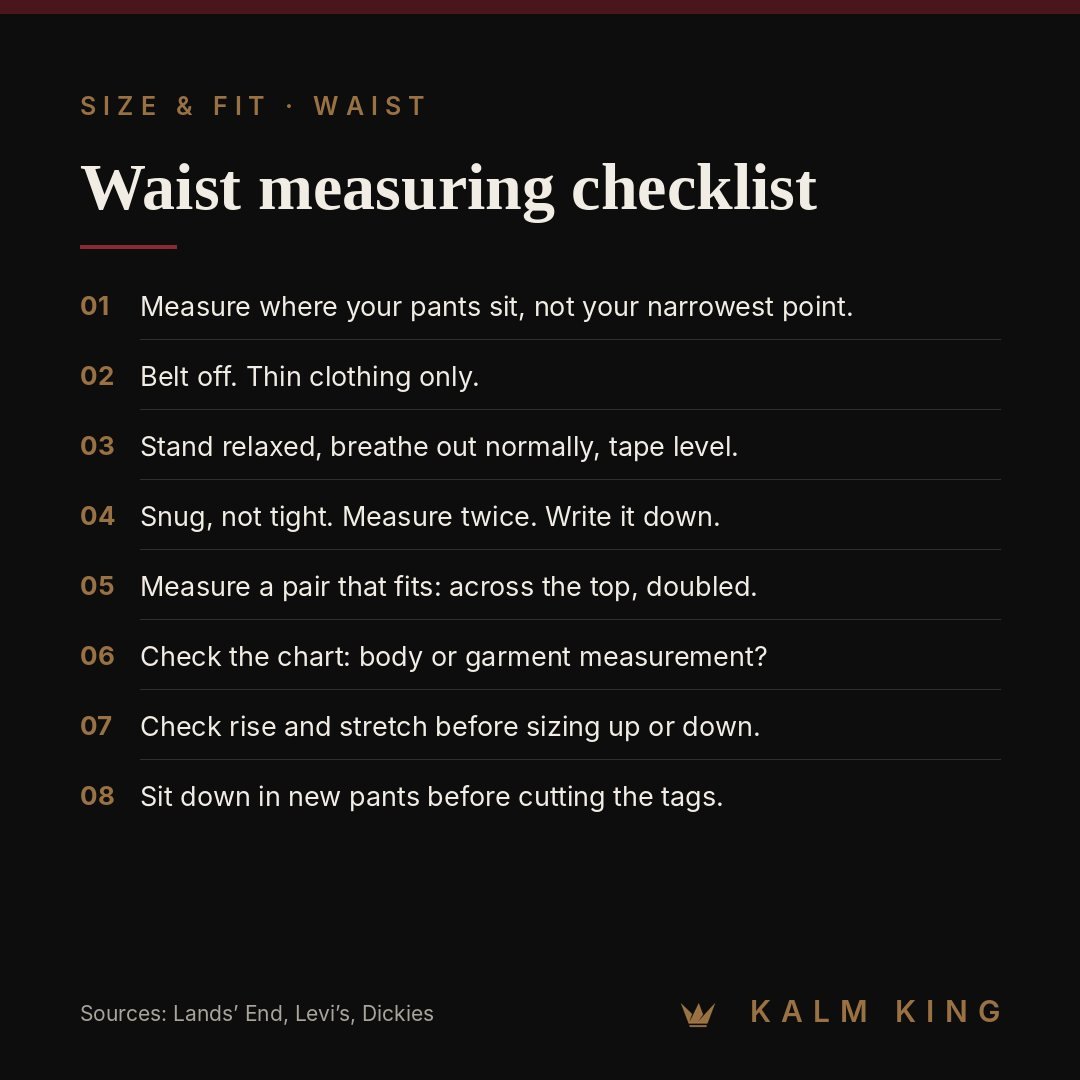
- Decide which waist you need: for pants, it’s where your pants sit.
- Remove your belt and measure over thin clothing.
- Stand relaxed, breathe normally and keep the tape level.
- Snug, not tight. Read it, measure it again and write it down.
- Measure a pair that fits: flat across the top of the buttoned waistband, then double it.
- Read the chart: body or garment measurement?
- Check the rise and the stretch before choosing between sizes.
- Sit down in new trousers before you take the tags off.
The Kalm King Take
Your waist isn’t one number. It’s a line on your body, a width on a waistband, and a size name a brand chose. Once you measure the line where your trousers actually sit and the waistband of a pair you already trust, the size on the tag stops being a mystery and becomes one more thing to check. Write your numbers down, keep them with your inseam and chest, and every future order gets easier.
We’re building our own essentials with exactly this in mind: clear measurements, honest sizing and fits built for how men actually move. If you want to hear about them first, along with fit notes like this, join Field Notes.
Frequently asked questions
Where should I measure my waist for pants?
Measure where you normally wear your pants, which for most modern jeans and chinos is a little below your natural waist, around the top of your hipbones. Higher-rise trousers sit closer to your natural waist. Follow the instructions on the brand’s chart, because some ask for a slightly different spot.
Is my waist size the same as my pant size?
Often not. Many brands label trousers smaller than the waistband actually measures, and some add a lot more room than others. Bluffworks, for example, says its pants measure about 2 inches larger than their size. Compare your tape measurement with the brand’s chart instead of assuming the numbers match.
How do I measure the waist of a pair of pants?
Button and zip them, lay them flat, and measure straight across the top of the waistband from one side edge to the other without stretching it. Double that number to get the waist circumference. Levi’s describes it as measuring the waistband and doubling it.
Should I round my waist measurement up or down?
Write down the exact number first, then compare it with the specific chart. If you fall between sizes in rigid fabric, the larger size is usually the safer choice, because taking a waist in is generally easier than letting one out. Stretch fabrics often allow the smaller size.
Do I measure my waist with or without clothes?
Measure over thin clothing or underwear, never over jeans or a belt. Most guides say to remove your belt first. Dickies’ workwear guide measures over a shirt but not over pants.
Sources
- Lands' End Business: Men's bottoms size chart (manufacturer, commercial)
- Levi's: How to measure jeans (manufacturer, commercial)
- Dickies: Size charts (manufacturer, commercial)
- Bluffworks: Why pant measurements don't match their size (manufacturer, commercial)
- Vans: Pants measurement guide (manufacturer, commercial)
- NHLBI: Aim for a healthy weight (US government health agency)
- New Mexico State University Extension: Body measurements for pattern fitting (Guide C-209) (university extension)
- Marketplace: Your waist doesn't lie, your pants do (news, public radio)
- Wikipedia: Vanity sizing (reference)
FIELD NOTES
Get the Overalls Fit Kit, free.
Your measurement card, the six fit checkpoints and a checklist to take shopping. Join Field Notes for new guides and a say in what Kalm King makes.
THE KALM KING JOURNAL
Continue reading
What Is Pouch Underwear? Benefits, Designs and Fit
Pouch underwear gives everything its own shaped space. Here’s how the main designs work, what they can and can’t do, and how a pouch should fit.
How to Prevent Thigh Chafing for Men
Stop thigh chafing before it starts: the layers, fabrics, balms and habits that keep your inner thighs comfortable, plus how to treat a rub that’s already sore.
How to Keep Black Clothes From Fading
Black clothes fade from dye loss, friction, heat and sun. Here’s how to wash, dry and store black so it stays black, and what to do when it’s already gone grey.