
November 23, 2026
Explore: Style
How to Measure Sleeve Length for Men: Shirts, Jackets and Knits
How to measure sleeve length for men: center back to wrist for shirts, shoulder seam for jackets, how to convert between them and what 34/35 means.
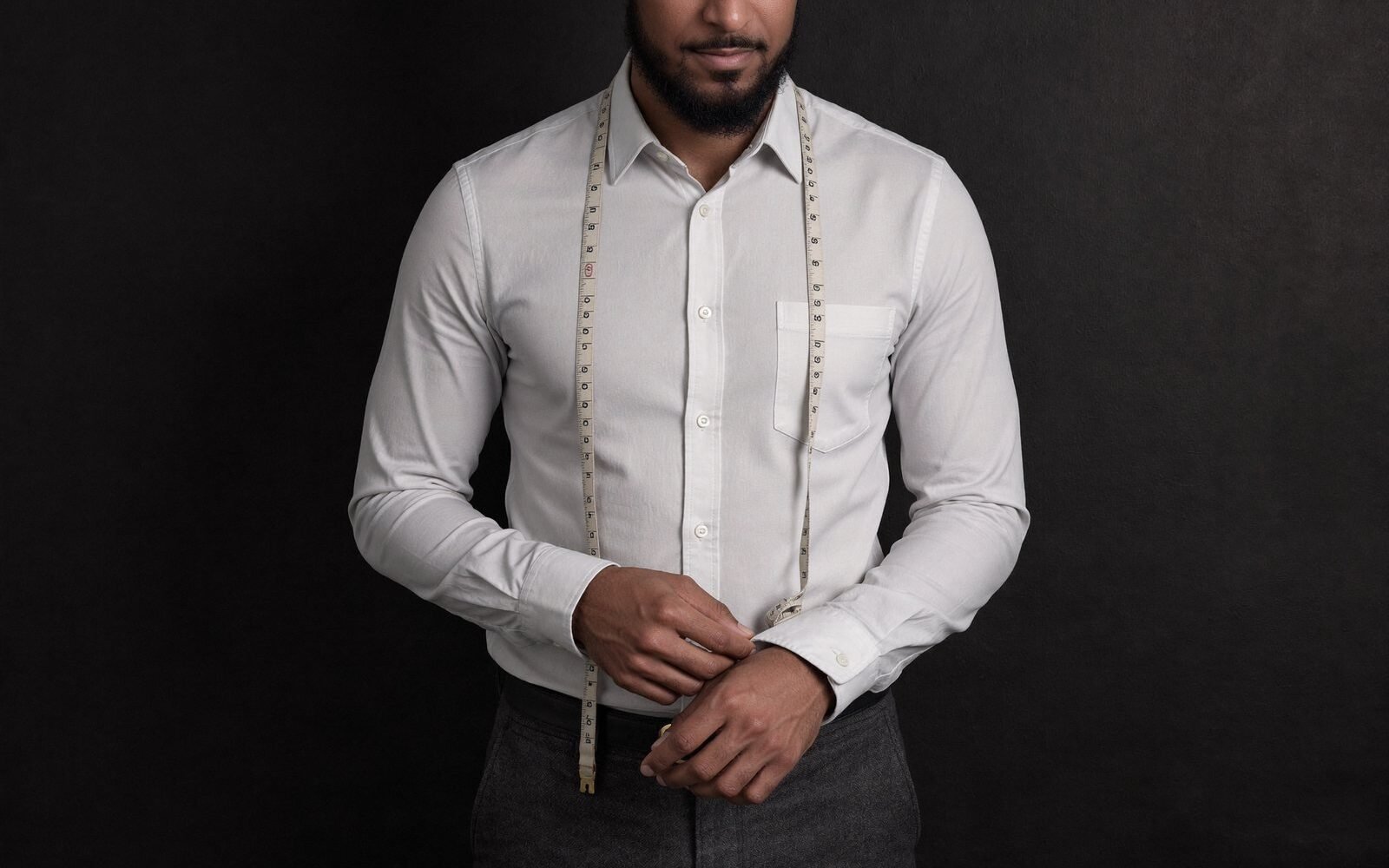
Your shirt says 34/35 and the cuff still disappears into your hand. Or you order a medium sweater and the sleeves stop an inch short of your wrist. Sleeve length causes more confusion than almost any other measurement because brands don’t agree on where the tape starts. Some measure from the back of your neck, some from the shoulder seam, and a few from the armpit. Same arm, three different numbers.
This guide shows you how to measure your sleeve length on your body, alone or with help, how to measure the sleeve of a shirt or jacket you already own, how to convert between the different methods, and how to read the sleeve numbers on a label. If you’re also working out shirt fit, our dress shirt fit guide covers collar, chest and cuffs, and every measurement you take here belongs in our Size & Fit Reference.
Short answer: To measure sleeve length for a dress shirt, stand relaxed with your arm at your side and your elbow slightly bent. Have someone place a soft tape at the center back of your neck, just below the collar, then run it across the top of your shoulder, down the outside of your arm, over the elbow and stop at your wrist bone. That total, usually somewhere in the low-to-mid 30s in inches for adult men, is your shirt sleeve length. Jackets, sweaters and T-shirts are often measured from the shoulder seam instead, so check which starting point the brand uses before you compare numbers.
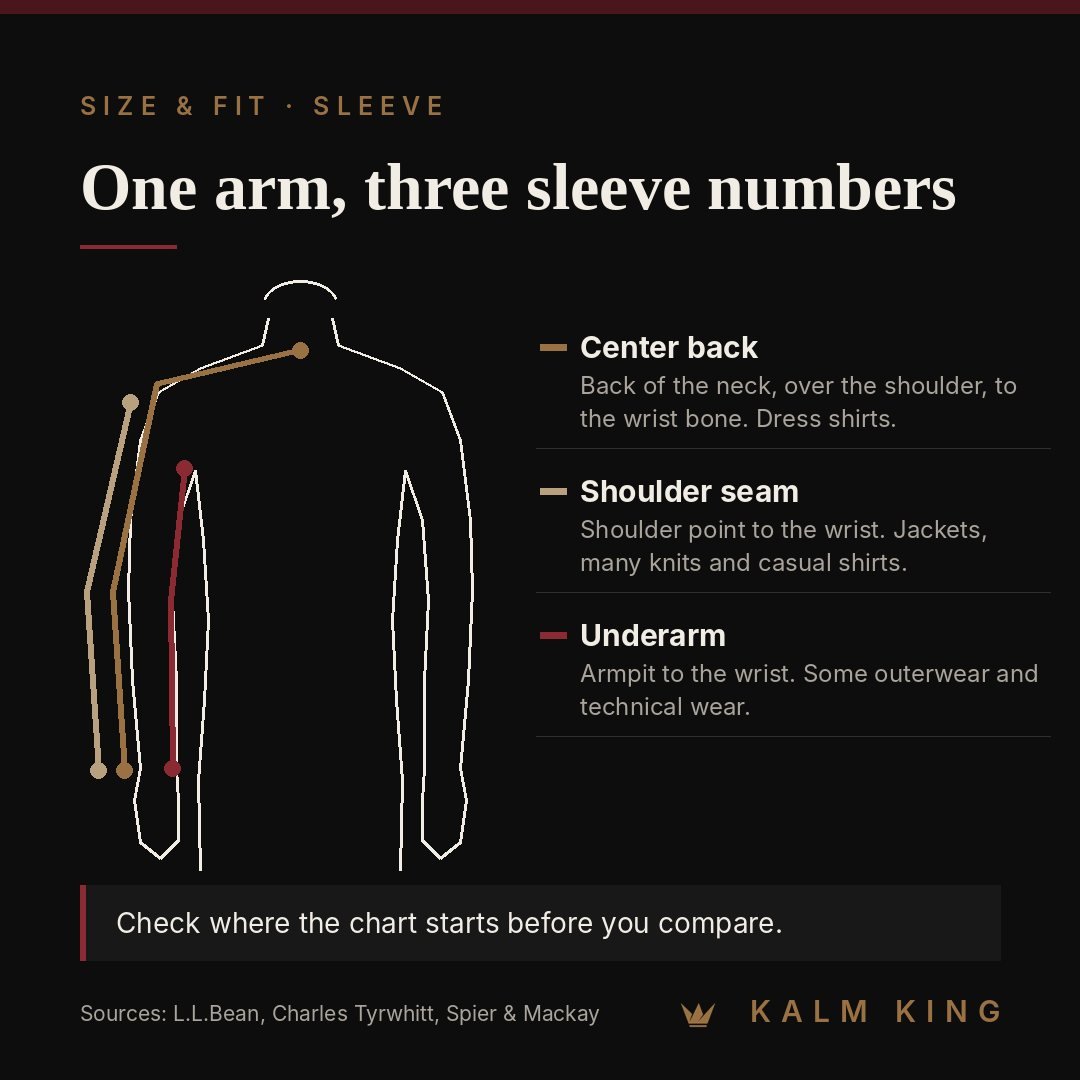
Why Sleeve Length Has Three Different Answers
Ask three brands for your sleeve length and you can get three honest, completely different numbers. None of them is wrong. They’re measuring different distances.
| Method | Where the tape starts | Where it ends | Commonly used for | Typical size of the number |
|---|---|---|---|---|
| Center back to wrist | Middle of the back of your neck, just below the collar | Wrist bone | Dress shirts with neck/sleeve sizing (e.g. 16/34) | Largest of the three |
| Shoulder to wrist | The shoulder point or shoulder seam | Wrist bone or end of cuff | Jackets, blazers, many sweaters and casual shirts | Several inches shorter |
| Underarm to wrist | The armpit (sleeve seam) | Wrist | Some outerwear and technical garments | Shortest |
The center-back method is the dress shirt standard because a shirt’s sleeve length depends on both your arm and the width of your upper back. Two men with identical arms but different shoulder widths need different shirt sleeves. Starting at the spine captures both.
L.L.Bean’s instructions are typical of the dress shirt approach: “With arm relaxed at your side and slightly bent, measure from center back neck, over point of shoulder, down the outside of the arm to the wrist.” Charles Tyrwhitt breaks the same distance into three pieces you add together: center back to the peak of the shoulder, shoulder to elbow, then elbow to “just above the wrist bone, or wherever you prefer the shirt cuff to sit.”
Garment charts for knitwear and jackets often switch methods. Spier & Mackay’s cotton crewneck sweater chart, for example, lists its sleeve as “Sleeve (From Shoulder),” measured separately from a seam-to-seam shoulder width. That number will be several inches shorter than the 34 on your dress shirt label, and it’s supposed to be.
The practical rule: never compare two sleeve numbers until you know where each one starts. Write the method next to every measurement you record.
What You Need
- A soft tailor’s tape measure. A metal tape can’t follow the curve of your shoulder and elbow.
- A shirt that fits well across the shoulders. Wear it while you’re measured. It gives your helper a visible shoulder seam and keeps the tape from slipping on skin.
- A helper, if you can get one. Measuring from the back of your own neck is awkward. There’s a solo method below, but a second pair of hands is more accurate.
- A mirror if you’re on your own.
- Somewhere to write the number, with the method beside it.
How to Measure Sleeve Length on Your Body: Step by Step

This is the center-back method used for dress shirts. It’s also the measurement to take if you only take one, because you can convert it for jackets and knits later.
1. Stand naturally
Stand up straight but relaxed, feet under your hips, looking forward. Don’t pull your shoulders back for the mirror. Your posture changes the distance across your back, and you want the number for how you actually stand.
2. Bend your elbow slightly
Let your arm hang at your side with the elbow bent a little, as if you’re about to reach for something. Several manufacturer guides, including L.L.Bean and Cutter & Buck, specify a slight bend. A dead-straight arm gives a shorter reading than the sleeve you’ll need once you start moving.
If the brand you’re buying from describes a different arm position, use theirs and note it.
3. Find the center back of your neck
Your helper finds the prominent bone at the base of the back of your neck, then places the tape at the center, just below where a shirt collar would sit. Charles Tyrwhitt describes this point as “the top of the centre back, just below the collar.”
4. Run the tape across the top of your shoulder
The tape travels across your upper back and over the outer point of your shoulder, the bony edge where your shoulder turns down into your arm. On a well-fitting shirt, that’s roughly where the shoulder seam sits. Keep the tape flat against your body, not floating in the air above the shoulder.
5. Follow the outside of your arm, over the elbow
From the shoulder point, the tape runs down the outside of your upper arm, over the point of your bent elbow and on down the forearm. Holding it on the outside of the arm, not the inside, is what keeps the number consistent.
6. Stop at the wrist bone
Stop at the wrist bone, the small knob on the outside of your wrist below your little finger. For a sleeve that ends slightly lower on the hand, some guides stop where your wrist meets your hand. Pick one and be consistent. The wrist bone is the most common reference.
7. Read the total
Read the number at the wrist. That’s your center-back sleeve length. For most adult men it falls somewhere in the low-to-mid 30s in inches. L.L.Bean’s men’s chart, for example, runs regular sleeve lengths from 32–33 inches for a small up to 36–37 for an XXL.
8. Measure both arms, then repeat
Arms are rarely identical. Measure the other side too. If the numbers differ, use the longer one: a slightly long sleeve can be shortened, and a short one can’t be lengthened much. Then repeat the whole thing once more. If two readings differ by more than about half an inch, measure a third time and use the middle number.
Measuring in three parts (Charles Tyrwhitt’s method)
If following one long tape around the shoulder and elbow is awkward, break it into segments and add them up:
- Center back of the neck to the peak of the shoulder.
- Peak of the shoulder to the elbow.
- Elbow to just above the wrist bone.
Add the three numbers together. It’s the same total distance, just easier to hold in place. This is also the easiest way to measure alone.

Measuring alone
You can’t easily see or reach the back of your own neck, so use the segment method and a mirror:
- Center back to shoulder: Hold the tape’s end at the center of the back of your neck with one hand (pinning it under a shirt collar helps), then bring the tape over your shoulder to the shoulder point and read it in the mirror. Alternatively, measure a well-fitting shirt’s back from the center of the collar to the shoulder seam and use that.
- Shoulder to wrist: Put the tape’s end on your shoulder point, hold it with your opposite hand, and let it run down the outside of your slightly bent arm to the wrist bone.
- Add the two.
Solo measurements are less precise. Treat the result as a starting point and cross-check it against a shirt that already fits, using the method in the next section.
How to Measure the Sleeve of a Shirt You Already Own

A shirt whose sleeves you like is often a better guide than your arm, because it already includes the cuff, the ease and the fit you’re comfortable with. Proper Cloth’s method for copying a shirt is a good template:
- Button the front and the cuffs. An open cuff hangs differently and changes the length.
- Lay the shirt face down on a table and spread it out flat.
- Pull the sleeve out away from the body so it’s fully extended. “Do not stretch the sleeve, but be sure it is fully extended and laying flat,” as Proper Cloth puts it.
- Start at the center back of the collar, just below the collar band.
- Run the tape to the edge of the yoke seam, where the shoulder meets the sleeve.
- Pivot at the seam and run the tape straight down the sleeve to the end of the cuff.
- Record the total, along with the brand, the size on the label and whether you like where the cuff sits.
Charles Tyrwhitt describes its garment sleeve the same way: it “starts at the middle of the collar from the back, down past the shoulder seam and to the end of the cuff.”
Jackets, sweaters and tees
For a jacket, blazer or most knitwear, the garment sleeve is usually measured from the shoulder seam (the top of the sleeve where it joins the body) down to the end of the sleeve. Lay the garment flat, smooth the sleeve without stretching it, and measure along the top edge. If the sleeve is a raglan style, with a diagonal seam running to the collar, there is no shoulder seam to start from, and brands typically measure from the center back of the collar instead. Check the chart’s diagram.
How to Convert Between Sleeve Methods
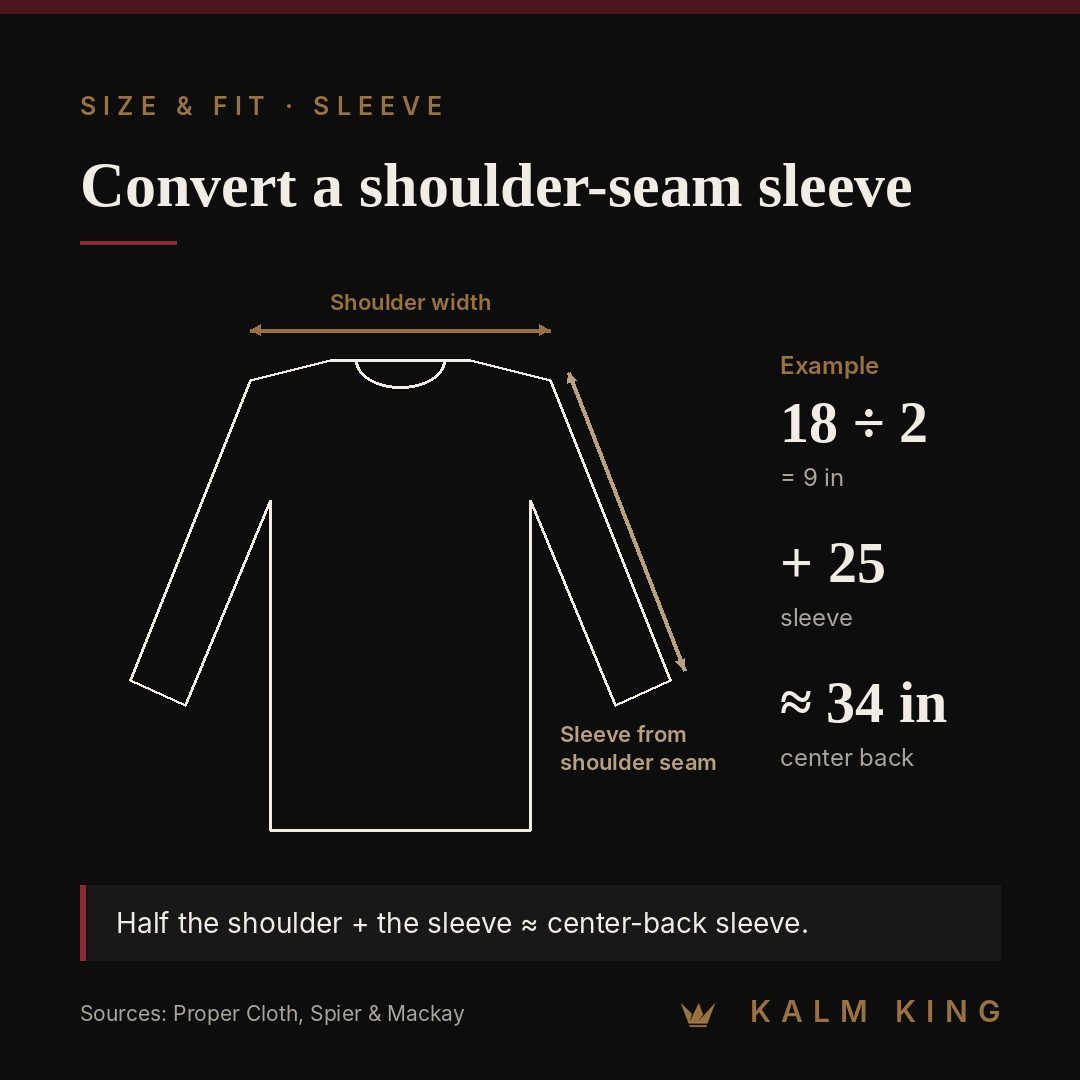
Here’s the useful bit most guides skip. Because the center-back method is just “half your back plus your arm,” you can estimate one number from the other when a brand gives you shoulder width and sleeve length separately.
Center-back sleeve ≈ (shoulder width ÷ 2) + shoulder-seam sleeve
For example, a sweater with an 18-inch shoulder width and a 25-inch sleeve measured from the shoulder seam works out to about 9 + 25 = 34 inches from the center back. That’s directly comparable to a 34-inch dress shirt sleeve. (This example is an illustration of the arithmetic, not a measurement of any particular garment.)
With a real chart: Spier & Mackay’s cotton crewneck sweater in medium lists a 16.5-inch shoulder (seam to seam) and a 26-inch sleeve measured from the shoulder. Half of 16.5 is 8.25, so the sleeve reaches about 34.25 inches from the center back, close to a 34/35 dress shirt.
It works in reverse too. If your dress shirts are 35 inches and a jacket chart lists an 18.5-inch shoulder, the sleeve from the shoulder seam would need to be around 35 − 9.25 = 25.75 inches to land in the same place. Jackets are meant to be slightly shorter than shirts, so you’d look for a jacket sleeve a little under that.
Treat the result as a close estimate, not a precise conversion. Shoulder slope, padding, the curve of the yoke and how a garment is cut through the armhole all nudge the real number by a fraction of an inch. It’s more than good enough to tell you whether a chart is in your range, and that’s the decision you’re actually making.
How to Read Sleeve Length on a Label
Dress shirts: neck and sleeve
A dress shirt labelled 16/34 has a 16-inch collar and a 34-inch sleeve, measured from the center back. Metric labels work the same way in centimeters.
A label like 16 34/35 means the shirt is built to work for a sleeve measurement anywhere from 34 to 35 inches. Many brands do this to cover two lengths with one garment, often with a cuff that has two button positions so you can tighten it and stop the sleeve sliding down. If your measurement is 34.5, a 34/35 shirt is designed for you. If you’re a 34 with slim wrists, use the tighter cuff button.
Brands with full sizing, Charles Tyrwhitt among them, offer specific sleeve lengths for each collar size: its size guide shows a 16-inch neck available in 33, 34, 35 and 36-inch sleeves. That spread is the reason the collar and sleeve are listed separately in the first place.

Dress shirts are labelled neck then sleeve. Here’s how to measure neck size.
Casual shirts and knits: S, M, L
Letter sizes bundle sleeve length into the size. A brand decides what sleeve a medium gets, and you can’t change it independently. L.L.Bean’s chart shows how that maps to body measurements in one brand:
| L.L.Bean size | Regular sleeve (in) | Tall sleeve (in) |
|---|---|---|
| S | 32–33 | 33–34 |
| M | 33–34 | 34–35 |
| L | 34–35 | 35–36 |
| XL | 35–36 | 36–37 |
| XXL | 36–37 | 37–38 |
Source: L.L.Bean for Business men’s regular body measurements. Other brands use different ranges.
If your arms are long for your chest size, look for “tall” sizing, which typically keeps the chest and adds sleeve and body length. L.L.Bean’s tall range, for example, adds an inch of sleeve at each size. If your arms are short for your size, a shirt with a single-button cuff will usually let the sleeve fall further than one with an adjustable cuff, so pay attention to cuff style.

Shirt Sleeves vs Jacket Sleeves: How They Work Together
If you wear tailoring, your shirt and jacket sleeves need to be measured with each other in mind. The classic proportion is a jacket sleeve that ends slightly shorter than the shirt sleeve, so a sliver of shirt cuff shows.
Suitsupply puts it this way: jacket sleeves “should reach just slightly above where your thumb bone meets your wrist, leaving half an inch (1.5cm) of your shirt sleeve visible.” The custom tailoring house Articles of Style aims for about half an inch as a general rule, and adjusts for proportion: closer to three-quarters of an inch for clients with shorter arms, and closer to a quarter inch for long-armed clients.
That’s a style preference, not a fixed standard, and our dress shirt fit guide is right that the relationship matters more than the fraction. What it means for measuring:
- Measure your shirt sleeve first, to the wrist bone.
- Your jacket sleeve should land a little shorter. If you’re converting from a jacket chart, aim for a sleeve that ends just above where your shirt cuff does.
- Try them together. A jacket sleeve that’s fine on its own can swallow a shirt cuff that’s a touch short, and vice versa.
Articles of Style makes one more point worth remembering: a shirt sleeve should carry a little extra fabric above the cuff, so that when you extend your arms the cuff doesn’t ride up your forearm. If the sleeve only just reaches your hand with the cuff unbuttoned, it’s too short.
A Worked Example
Here’s how the measurements come together for one illustrative shopper. The numbers below are an example of the process, not measurements of a real person or product.
- Body measurement (center back to wrist bone, slight bend): 34.75 inches on the right arm, 34.5 on the left. He records 34.75.
- His favorite shirt, laid flat: 35 inches from the center back of the collar to the end of the cuff. Label: 15.5/34-35.
- Dress shirts: He buys 34/35 or 35. A 34-only sleeve is likely to feel short when he reaches.
- A sweater chart lists: 17.5-inch shoulder, 25.5-inch sleeve from the shoulder seam. Converted: 8.75 + 25.5 = 34.25. Close to his number, and knit cuffs are forgiving, so it should work.
- A blazer chart lists: 18-inch shoulder, 25-inch sleeve. Converted: 9 + 25 = 34. That’s about three-quarters of an inch shorter than his shirt sleeve, which would show a little more shirt cuff than the half-inch classic. He tries it on or plans a small alteration.
Three numbers, all from one tape and a pen, and every chart becomes readable.
Sleeve Length by Garment
Dress shirts
Measure center back to wrist bone. Buy by neck and sleeve where you can. If you’re between lengths, the longer one is usually safer, because a sleeve shortened at the cuff is a routine alteration while a short sleeve generally can’t be fixed. Shirts with two cuff buttons give you a little adjustment either way.
Casual button-up shirts
Often sold in S/M/L, with a sleeve the brand chose. Check the product’s measurement chart for its sleeve number and starting point. Casual shirts are frequently worn with sleeves rolled, which hides a lot, but a shirt worn buttoned should still reach your wrist bone.
Suit jackets and blazers
Usually measured from the shoulder seam on the garment. Aim for a sleeve that ends just above where your shirt cuff does. Sleeve length is one of the most common jacket alterations, but how much can be changed depends on how the cuff is made. Working buttonholes on the cuff, for instance, make shortening more involved. Ask a tailor before you buy if you’ll need more than a small change.
Sweaters and knitwear
Usually measured from the shoulder seam to the end of the cuff. Ribbed cuffs grip the wrist, so a knit sleeve can run a little longer without looking sloppy, and it will bunch slightly at the wrist. Drop-shoulder knits have a seam that sits down the arm, so the sleeve number will be shorter. Convert using the shoulder width before you judge it.
T-shirts and short sleeves
Sleeve length on a tee is about style and proportion, not wrist position, and charts usually measure it from the shoulder seam to the hem of the sleeve. Our T-shirt fit guide covers where a short sleeve should land.
Outerwear
Coats are worn over other layers, so their sleeves are often cut longer to cover a jacket sleeve underneath. Some technical and outerwear charts measure from the underarm. Check the diagram, and try the coat over what you’ll actually wear beneath it.
Sleeve Length Troubleshooting
| Problem | Likely cause | What to do |
|---|---|---|
| Cuff disappears into your hand | Sleeve too long, or cuff too loose so it slides down | Try the tighter cuff button first. If it still covers your hand, go down a sleeve length or shorten |
| Cuff rides up your forearm when you reach | Sleeve too short, or not enough room in the upper arm or armhole | Measure with a slight bend. Look for a longer sleeve or a cut with more upper-arm room |
| Sleeves fit, but the body is too big | Your arms are long for your chest size | Look for tall sizing or neck/sleeve dress shirts rather than letter sizes |
| Body fits, sleeves too long | Your arms are short for your chest size | Neck/sleeve sizing, adjustable cuffs, or a tailor shortening at the cuff |
| No shirt cuff shows under the jacket | Jacket sleeve too long, or shirt sleeve too short | Measure both. Shorten the jacket sleeve or lengthen the shirt sleeve you buy |
| Your number doesn’t match the brand’s | Different starting point | Check whether the chart is center back or shoulder seam, then convert |
| One sleeve always looks longer | Your arms differ | Normal. Fit the longer arm; a tailor can adjust one sleeve |
| Sleeve shorter after washing | Fabric shrinkage | Check the care label and any shrinkage notes from the maker. See our cotton shrinkage guide |
Common Mistakes When Measuring Sleeve Length
Starting at the shoulder for a dress shirt. This is the most common mistake. A shoulder-to-wrist measurement will read several inches shorter than the center-back sleeve on a shirt label. Order a shirt with that number and the sleeves will be far too short.
Measuring with a dead-straight arm. A locked-straight arm reads short. Keep the slight bend most guides ask for.
Running the tape inside the arm. The inside of the arm is shorter than the outside. Keep the tape over the shoulder point and the elbow.
Stopping at the wrong spot. Stopping halfway up the forearm or down on the palm can change the number by an inch or more. Use the wrist bone unless the brand says otherwise.
Pulling the tape tight around the shoulder. The tape should lie on the body, not cut across it. A tight tape shortcuts the curve.
Measuring a stretched sleeve. When you measure a garment, smooth the sleeve flat. Don’t pull it to straighten it.
Comparing numbers from different methods. A 25-inch jacket sleeve and a 34-inch shirt sleeve can fit the same arm. Always write the starting point next to the number.
Measuring once. Measure twice per arm. It takes a minute and it catches most errors.
When to Re-Measure
- When you start buying from a new brand, especially if it uses a different starting point.
- When you move between garment types, such as dress shirts to blazers or knits.
- After significant changes in your build. Your arm length doesn’t change, but a broader or narrower upper back changes the center-back number.
- If your shirts suddenly fit differently, before blaming the shirt.
Keep the number with your chest, waist and inseam so you have the full set in one place.
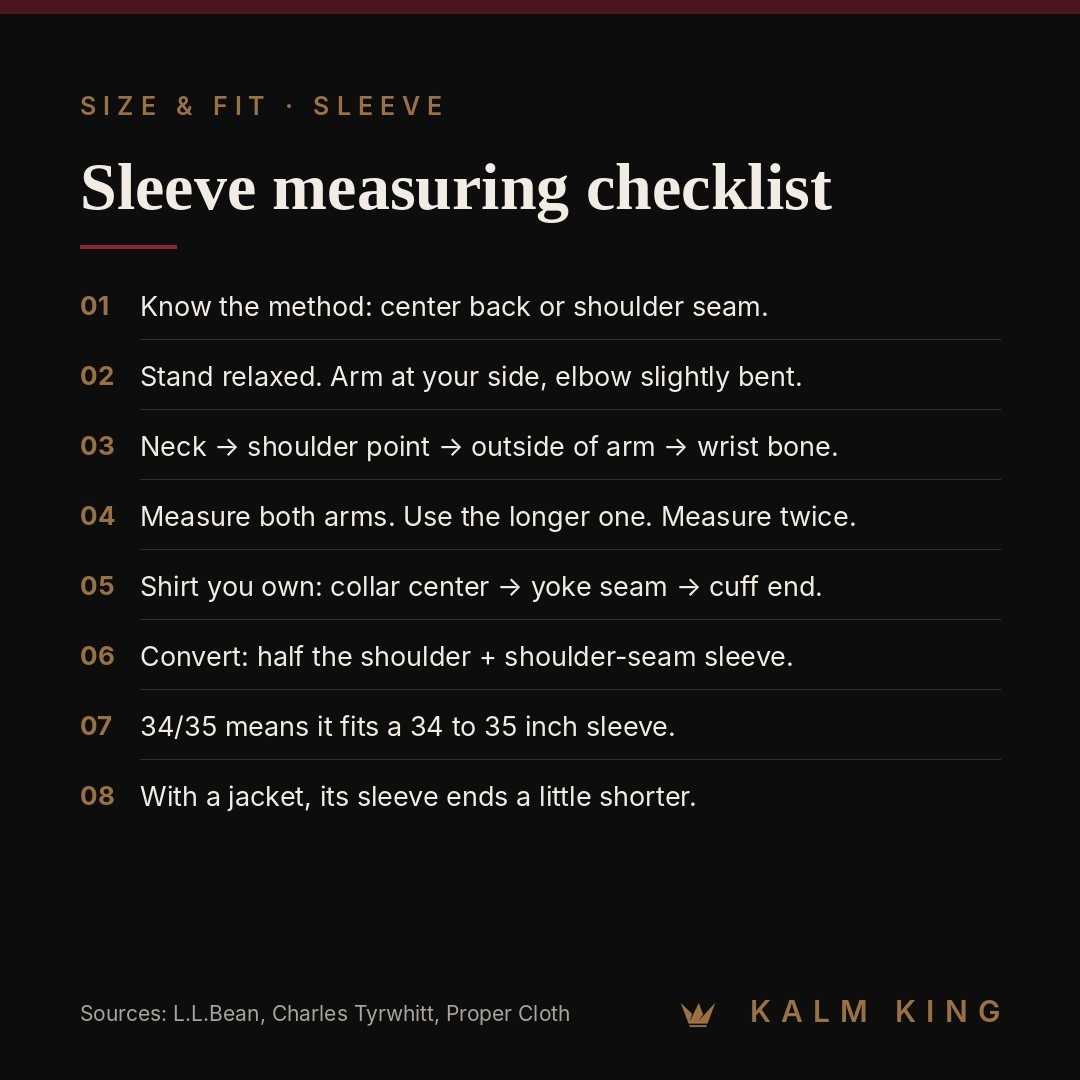
Quick Sleeve Length Checklist
- Know which method you need: center back (dress shirts) or shoulder seam (jackets, knits).
- Stand relaxed, arm at your side, elbow slightly bent.
- Center back of the neck → over the shoulder point → down the outside of the arm → wrist bone.
- Measure both arms. Use the longer one. Measure twice.
- On a shirt you own: center back of the collar → yoke seam → end of the cuff, sleeve flat but not stretched.
- To convert: center back ≈ half the shoulder width + sleeve from the shoulder seam.
- Read 34/35 as “works for 34 to 35 inches.”
- With a jacket, aim for its sleeve to end a little shorter than your shirt cuff.
The Kalm King Take
A sleeve that ends in the right place is one of those details nobody notices until it’s wrong. Then it’s all anyone sees: hands swallowed by fabric, or a cuff stuck halfway up the forearm every time you reach for something. The fix is one honest measurement and knowing where it starts. Take it once, write down the method next to the number, and you can read any size chart on the internet.
We’re building our own essentials around the same idea: clear measurements and fits made for how men actually move. If you want to hear about them first, along with more fit notes like this, join Field Notes.
Frequently asked questions
How do you measure sleeve length for a men’s dress shirt?
Stand relaxed with your arm at your side and your elbow slightly bent. Start the tape at the center back of your neck, just below the collar, run it over the top of your shoulder and down the outside of your arm, over the elbow, and stop at the wrist bone. That total is your dress shirt sleeve length.
Is sleeve length measured from the shoulder or the neck?
It depends on the garment and the brand. Dress shirts are measured from the center back of the neck. Jackets, blazers, many sweaters and casual shirts are usually measured from the shoulder seam, which gives a number several inches shorter. Check the brand’s chart before comparing.
What does a 34/35 sleeve mean?
It means the shirt is designed for a sleeve measurement of 34 to 35 inches, measured from the center back of the neck to the wrist. Shirts sized this way often have a two-button cuff so you can tighten it if you’re at the shorter end of the range.
How do I measure my sleeve length by myself?
Measure in two parts with a mirror: from the center back of your neck to your shoulder point, then from the shoulder point down the outside of your slightly bent arm to your wrist bone. Add them together. Cross-check the result against a shirt that fits by measuring it flat from the center back of the collar to the end of the cuff.
What sleeve length is a medium shirt?
There is no universal answer, because every brand sets its own. As one example, L.L.Bean’s chart lists a regular medium for men with a 33 to 34-inch sleeve, measured from the center back. Always check the specific brand’s chart.
How much shirt cuff should show under a jacket?
A common tailoring preference is about half an inch. Suitsupply recommends half an inch (1.5 cm), and some tailors adjust it slightly for arm length. Treat it as a guide to proportion rather than a strict rule.
Sources
- L.L.Bean for Business: Men's size chart and how to measure (manufacturer, commercial)
- Charles Tyrwhitt: How to measure for a shirt (manufacturer, commercial)
- Proper Cloth: How to measure a dress shirt (manufacturer, commercial)
- Cutter & Buck: Fit and size chart (manufacturer, commercial)
- Spier & Mackay: Cotton crewneck sweater size chart (manufacturer, commercial)
- Suitsupply: How it should fit (manufacturer, commercial)
- Articles of Style: A guide to shirt and jacket sleeve length (custom tailor, commercial)
FIELD NOTES
Get the Overalls Fit Kit, free.
Your measurement card, the six fit checkpoints and a checklist to take shopping. Join Field Notes for new guides and a say in what Kalm King makes.
THE KALM KING JOURNAL
Continue reading
What Is Pouch Underwear? Benefits, Designs and Fit
Pouch underwear gives everything its own shaped space. Here’s how the main designs work, what they can and can’t do, and how a pouch should fit.
How to Prevent Thigh Chafing for Men
Stop thigh chafing before it starts: the layers, fabrics, balms and habits that keep your inner thighs comfortable, plus how to treat a rub that’s already sore.
How to Keep Black Clothes From Fading
Black clothes fade from dye loss, friction, heat and sun. Here’s how to wash, dry and store black so it stays black, and what to do when it’s already gone grey.