
November 9, 2026
Explore: Fabric & Care
What Is a Heavyweight T-Shirt? GSM, Drape and When to Wear One
What makes a heavyweight t-shirt, what GSM and oz/yd² mean, how to convert them, and when a heavier tee beats a lighter one for fit, heat and layering.
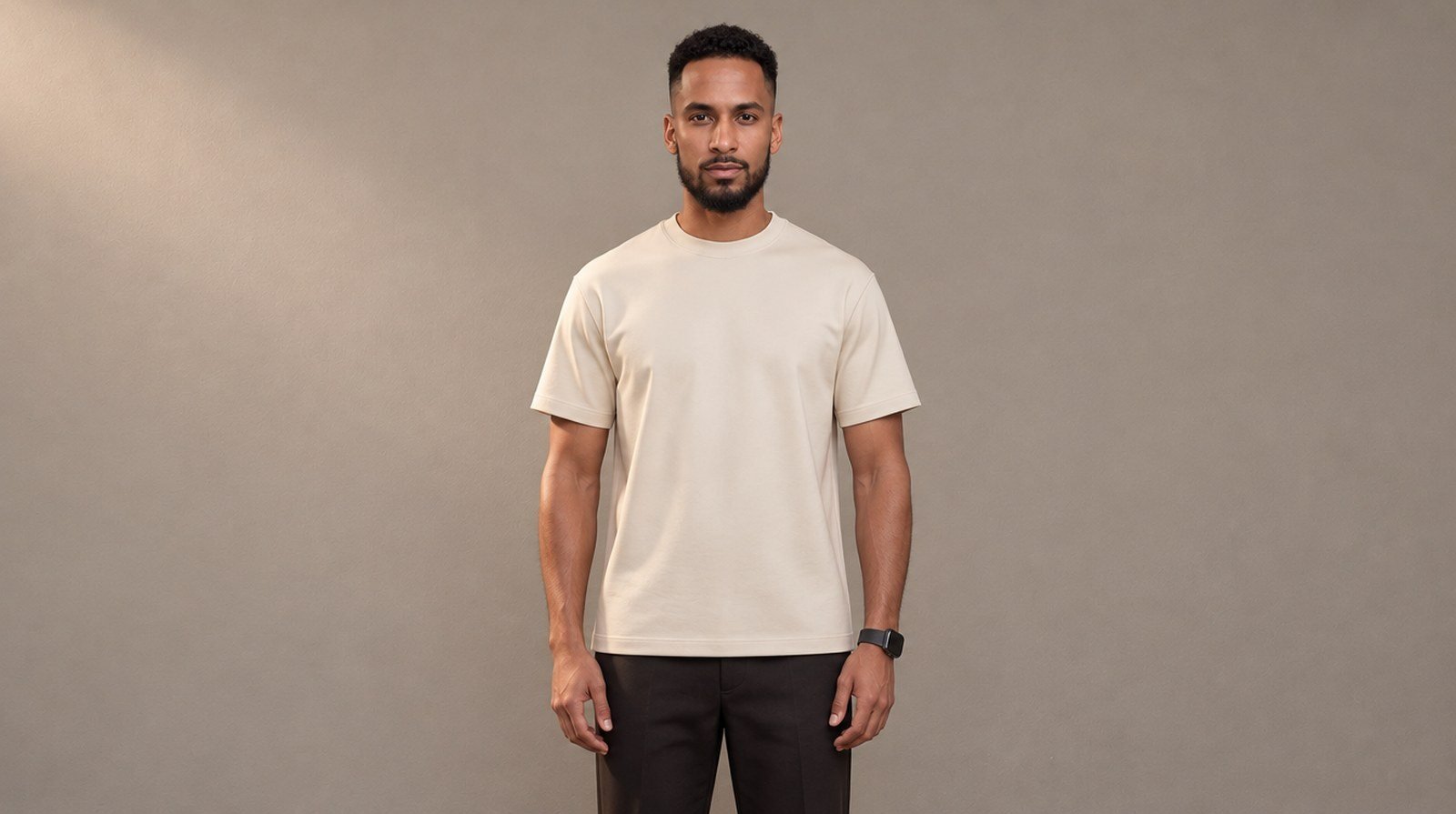
Pick up two plain white tees in the same size and one can feel like a dress shirt’s undershirt while the other feels closer to a light sweatshirt. That difference has a name. A heavyweight t shirt is cut from a heavier fabric, and the listing usually tells you how heavy with a number like 220 GSM or 6.5 oz. The trouble is that the number gets treated as a quality score, and it isn’t one.
Below: what GSM and oz/yd² measure, how to convert between them, what counts as heavyweight according to one widely used guide, what else changes how a tee feels and hangs, and when a heavier tee is the better choice. There’s a shopping checklist at the end.
Short answer: A heavyweight t-shirt is made from fabric with a higher weight per area, usually listed in grams per square meter (GSM) or ounces per square yard (oz/yd²). Printful’s guide puts heavyweight tees at 5.3–7.5 oz/yd², about 180–254 GSM, though brands draw these lines differently. Weight tells you how much fabric is in each square meter. It doesn’t, on its own, tell you how thick, stiff, opaque, soft or well made the tee is.

What GSM Means
GSM stands for grams per square meter. It’s the mass of one square meter of the fabric, not the weight of the finished shirt. ASTM International, the standards body, publishes the test method for it, ASTM D3776/D3776M. Its scope describes the method as measuring “fabric mass per unit area,” which it notes is traditionally referred to as “fabric weight.”
That distinction matters more than it sounds. A large tee and a small tee cut from the same roll share the same GSM, but the large one weighs more because it uses more fabric. Printful’s weight guide makes the same point: larger sizes use more fabric, which increases total garment weight, and fitted cuts use less fabric than oversized or relaxed cuts, so they weigh less at the same GSM.
So when a listing says 240 GSM, read it as a description of the cloth. It’s telling you how much mass each patch of fabric carries. It doesn’t measure thickness, stiffness or opacity directly. Those often rise along with the number, but they also depend on the knit, the yarn and the finish, so two fabrics at the same GSM can look and feel different.
What oz/yd² means
In the US you’ll also see weight in ounces per square yard, written oz/yd², or often shortened to “oz.” It measures the same thing in different units: how many ounces one square yard of the fabric weighs.
The shortening can cause confusion, because a bare “6 oz” doesn’t say what area it refers to. If the number matters to you, look for “oz/yd²” written out, or a GSM figure alongside it, so you know you’re comparing like with like.
How to Convert GSM to oz/yd² (and Back)
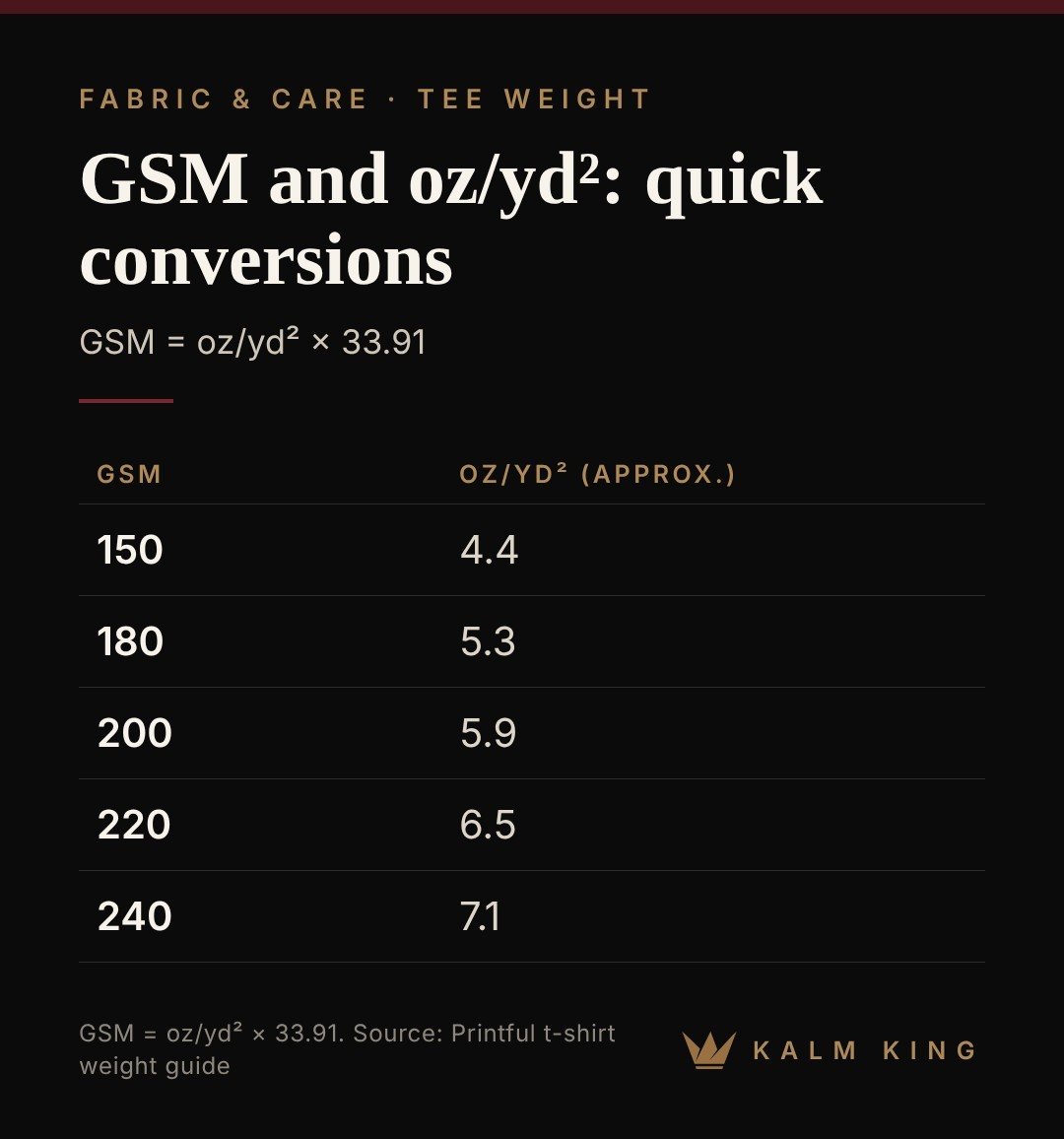
The conversion is a single number. Printful’s weight guide gives it as: multiply oz/yd² by 33.91 to convert to GSM. That figure follows from the units themselves, since an ounce is about 28.35 grams and a square yard is about 0.836 square meters, which works out to roughly 33.9 grams per square meter for each ounce per square yard.
- oz/yd² to GSM: multiply by 33.91.
- GSM to oz/yd²: divide by 33.91.
A few worked examples, using that factor and rounded to sensible precision:
- 150 GSM is about 4.4 oz/yd².
- 180 GSM is about 5.3 oz/yd².
- 200 GSM is about 5.9 oz/yd².
- 240 GSM is about 7.1 oz/yd².
- 6 oz/yd² is about 203 GSM.
- 7.5 oz/yd² is about 254 GSM.
You don’t need the full decimal when you’re shopping. Multiplying ounces by 34, or dividing GSM by 34, gets you close enough to compare two listings. Just don’t round twice in a row, or the small errors start to add up when two tees are close.
What Counts as a Heavyweight T Shirt?
Here’s where you need to be careful. There’s no single legal or industry-wide cutoff for “heavyweight.” The ASTM method covers how to measure fabric weight; it doesn’t define what counts as light or heavy. So the labels come from brands, printers and retailers, and they don’t all agree.
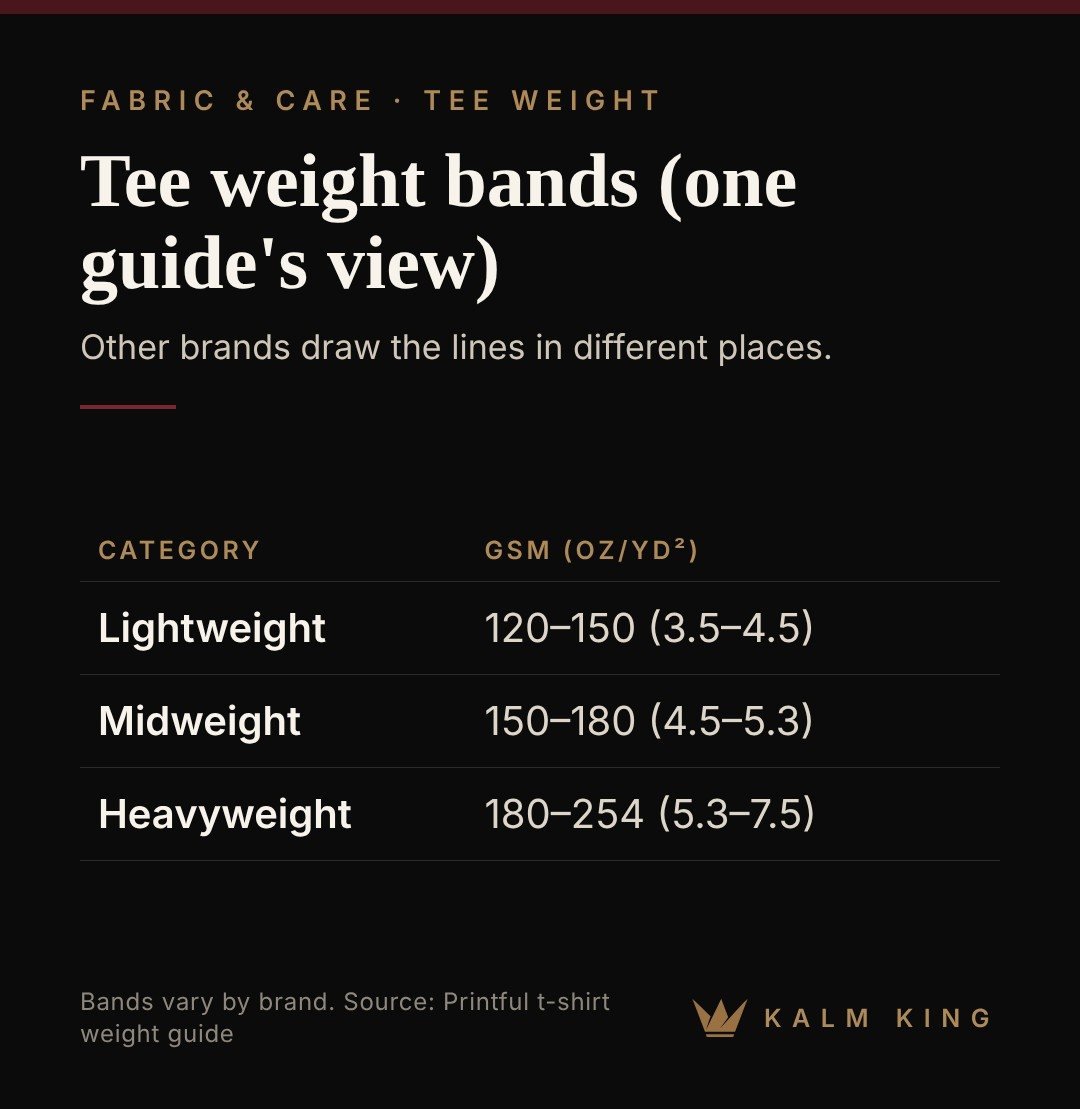
One widely used reference is Printful’s t-shirt weight guide. Printful is a print-on-demand company, so it’s a commercial source with a catalog to sell, but its bands are clearly stated:
| Category (Printful’s guide) | oz/yd² | GSM |
|---|---|---|
| Lightweight | 3.5–4.5 | 120–150 |
| Midweight | 4.5–5.3 | 150–180 |
| Heavyweight | 5.3–7.5 | 180–254 |
Treat this as one company’s map, not a rule. Printful itself notes that weights are approximate and vary by fabric composition, fit and construction. Another brand might call a 180 GSM tee midweight and reserve “heavyweight” for something well over 200, while others use the word loosely as a marketing term. When you see the word heavyweight on a listing, look for the number behind it. If there isn’t one, the word on its own tells you very little.
GSM Is Not a Quality Score
It’s tempting to read a higher GSM as “better.” It isn’t that simple. Even Printful’s own guide, which sorts tees by weight, says that no single measurement defines quality.
Think about what GSM leaves out. It doesn’t tell you which fiber was used, how the yarn was spun, how tightly the fabric was knitted or how it was finished. Two tees can share a GSM and feel nothing alike. A 220 GSM tee made from coarse, uneven yarn can feel rougher than a well-made 160 GSM tee. And a heavier fabric isn’t automatically the right fabric for a hot afternoon or for layering under a jacket.
What GSM does tell you is useful, just narrower. It tells you roughly how much fabric is packed into each patch of the shirt. A higher number often goes with more body, meaning the fabric holds more of its own shape instead of following yours. Often, not always: the knit, the yarn and the finish decide how much of that weight turns into thickness, stiffness or drape. Printful, describing typical examples, calls a thick fabric at 220 GSM one that “holds its shape, resists stretching, and feels more substantial,” and a thinner one at 130 GSM one that “drapes loosely and feels airy.”
So use weight as one clue among several. Then look at what the fabric is made from and how.
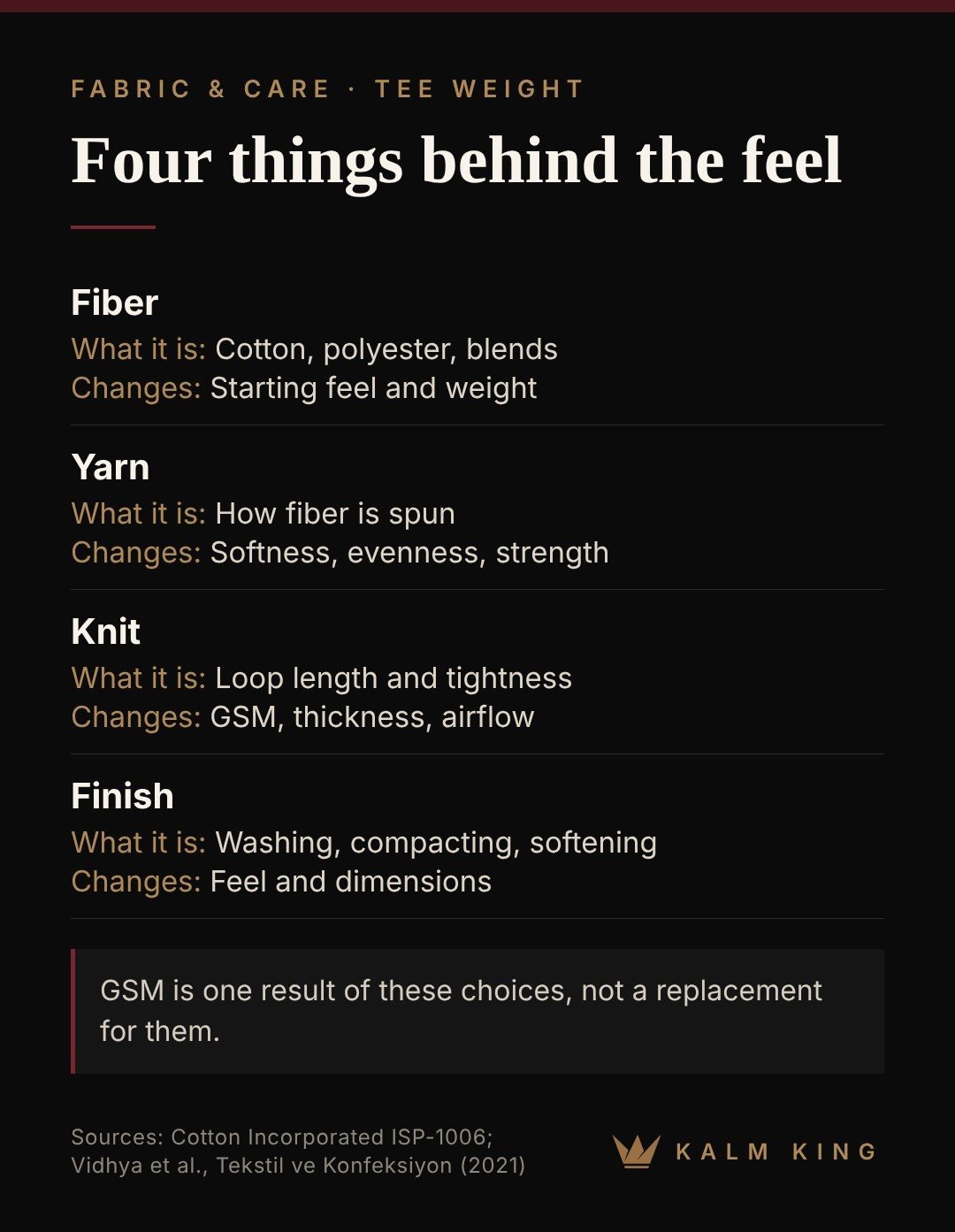
What Else Changes How a Tee Feels
If weight is the “how much,” these are the “what” and “how.” They’re worth separating, because listings often blur them together.
Fiber
Fiber is the raw material: cotton, polyester, a blend, or something else. It sets the starting point for how the fabric feels and how it behaves in the wash. Most heavyweight tees you’ll see are cotton or cotton-rich, but blends exist, and the fiber can shift the weight too. In one peer-reviewed study of single jersey fabrics made from cotton and polyester core-spun yarns, published in Tekstil ve Konfeksiyon, the researchers report that increasing the polyester content decreased the fabric’s thickness and weight. That was one set of lab fabrics with a specific yarn type, so it’s not a rule for every blend, but it shows that fiber and weight aren’t independent.
Yarn: ringspun, open-end and combed
Yarn is the fiber twisted into thread. Two tees can both be 100% cotton and still feel very different, because of how that cotton was spun.
Cotton Incorporated, the research and marketing body for US cotton, compares spinning systems in its technical bulletin on cotton spun yarns for knit and woven fabrics:
- Ring spun: described as the “strongest yarn” and the “softest yarn,” though also “more hairy, generally” and the “most uneven.”
- Open-end (rotor): described as “not as strong” with a “harsher hand (feel),” but “more even” with “fewer imperfections.”
That trade-off is useful when you read a listing. “Ringspun” suggests a softer hand. Open-end yarn, common in sturdy everyday blanks, tends toward a drier, rougher feel by this bulletin’s description, but it’s more even. Neither is wrong. They’re different results.
Combing is a separate step that happens before spinning. The same bulletin says combing “removes short fibers, neps, and trash particles,” and that it can significantly improve yarn uniformity, hand (softness), strength, luster and overall appearance. It adds that combed yarns generate less lint. So “combed ringspun cotton” on a listing is describing two separate choices, both aimed at a smoother, softer yarn.
Knit and stitch length
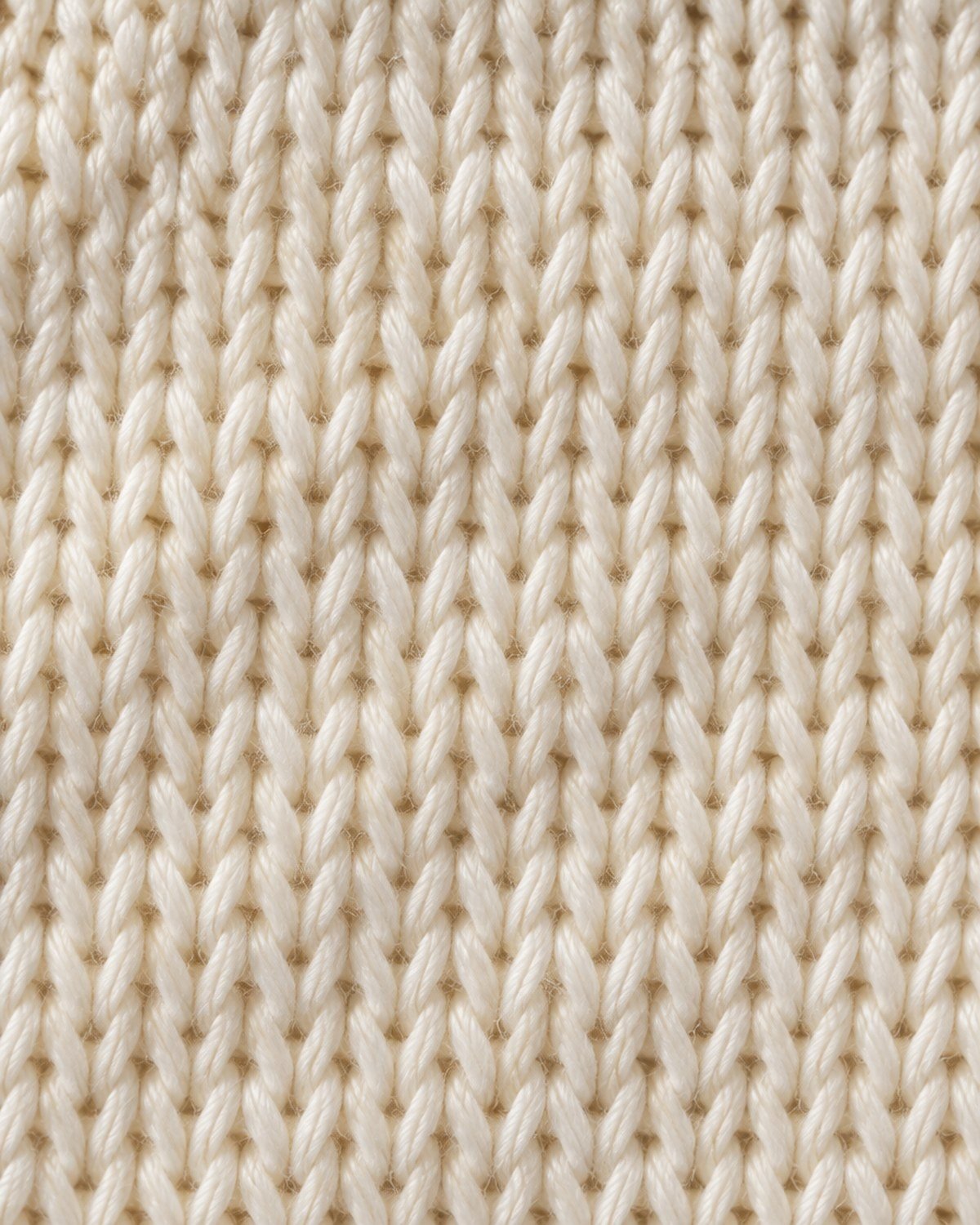
A tee is knitted, not woven. Most are jersey, a knit made of rows of interlocking loops. How long each loop is, called loop length or stitch length, has a big effect on the fabric’s weight and structure.
The Tekstil ve Konfeksiyon study mentioned above reports that increased loop length produced lower GSM and thickness, and that as loop length increased, fabric porosity and air permeability also increased. Its abstract describes the tight structure as producing a thicker, less porous fabric with higher thermal resistance and lower air permeability and water-vapor transmission.
In plain terms, in that study’s fabrics: shorter, tighter loops packed more yarn into each square meter, which raised the GSM, and the fabric got thicker and let less air through. Longer, looser loops did the opposite. That’s one reason the weight of a tee can change without the fiber changing at all. It’s also a reminder that the knit, not the GSM number itself, is what made those fabrics thicker.
Finishing
Finishing covers what happens to the fabric after knitting, such as washing, dyeing, compacting and softening. It can change both feel and dimensions. Our guide on how to prevent a t-shirt from shrinking explains how compaction and pre-washing work, so we won’t repeat it here. The point for weight is simple arithmetic: GSM is mass divided by area. If a fabric shrinks in area while keeping its mass, its GSM goes up. A listed GSM is a snapshot of the fabric at whatever stage it was measured, and the listing may not say which.
Heavyweight vs Midweight vs Lightweight: The Trade-Offs
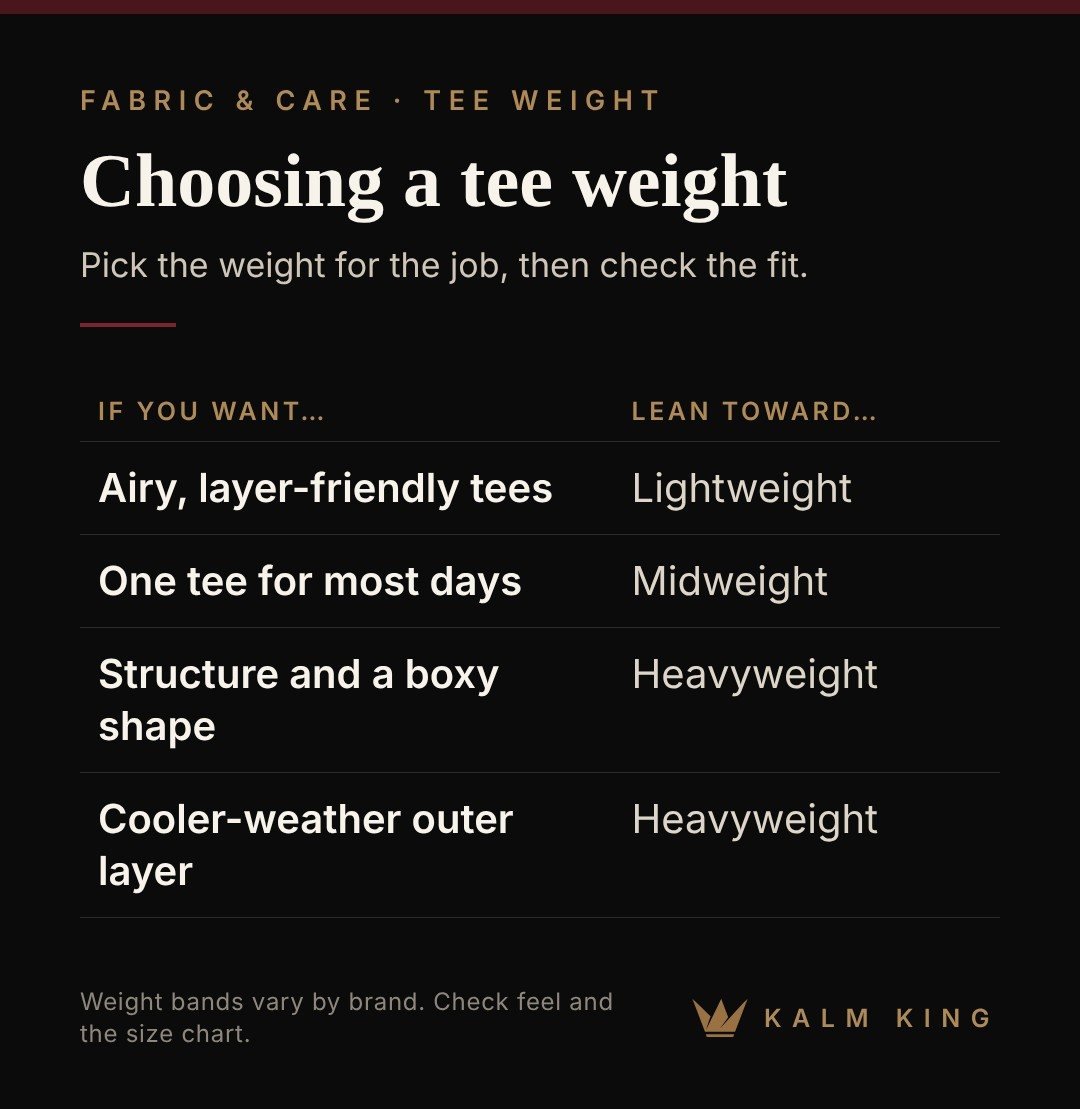
None of these weights is the “right” one. Each suits a different job. Here’s how they compare in practice.
Structure and drape
This is often the most visible difference. Heavier tees frequently hold a line from shoulder to hem and keep more of their own shape, and Printful describes its 220 GSM example that way. Lighter fabrics more often follow your body and move more. But GSM alone doesn’t guarantee either result. A loosely knitted heavy fabric or a heavily softened finish can drape more than you’d expect, so judge the structure in hand, not just from the number.
That isn’t better or worse. If you want a tee that skims your shape, lighter fabric does it. If you want the shirt to keep a clean outline of its own, a heavier fabric often helps, as long as the knit and finish give it body too.
Heat and breathability
Printful describes lightweight tees as the default choice for summer wear, athletic wear and layering, and says heavyweight tees suit cooler climates. The Tekstil ve Konfeksiyon study lines up with that in a lab sense: its tighter, thicker fabrics let through less air and less water vapor. That was one study on one set of fabrics, so don’t treat it as a promise about any particular tee, but the direction is consistent.
In practice, a heavyweight tee on a humid summer day may feel warmer than a lighter one of a similar fiber. On a cool spring evening, that same extra body can be what you want.
Drying time
Drying time is a trade-off people often raise with heavier tees. None of the sources cited here measured how long tees of different weights take to dry, so we won’t put a number on it. If it matters to you, for travel or for line drying in winter, compare how your own tees dry in your normal routine before buying several of one weight.
Layering
Under a shirt, a sweater or a jacket, bulk adds up. A lighter tee often lies flatter under other layers, which is part of why Printful lists layering among the uses for lightweight tees. A heavyweight tee works best as the outer layer, or under something cut with room, like an open overshirt or a chore coat.
Under overalls
Overalls are a special case. The bib and straps sit over the tee, and your arms and upper chest are on display. A tee with more body can keep a cleaner line under the straps and look less crumpled at the sides. A lighter one can feel better in heat, but it may show more wrinkling where the bib presses on it. For the full picture on what works underneath, see what to wear under overalls.
Boxy and oversized fits
Boxy and relaxed cuts rely on the fabric to hold the shape the pattern was designed for. A fabric with enough body to hold its shape tends to keep a boxy silhouette standing away from the body. A higher GSM often helps with that, but the knit and finish matter as well. The same cut in a very soft, light fabric can collapse and cling, which reads more like a tee in the wrong size than a deliberate shape. If you like a boxy fit, check the listed weight and then how the fabric actually holds up in hand.

How to Judge Tee Weight When Shopping Online
You can’t feel a tee through a screen, but you can read the listing more carefully than most people do.
Look for the number, and its unit
A GSM figure or an oz/yd² figure is the most useful single clue. Convert one into the other if two listings use different units. If you only see “heavyweight” with no number, treat the word as a description, not a spec.
Read the fabric description as a set
Put the weight next to everything else the listing says:
- Fiber: 100% cotton, or a blend. A blend can change how the fabric weighs and behaves.
- Yarn: “ringspun” and “combed” point toward a softer, smoother yarn, per Cotton Incorporated’s description. Open-end tends toward a harsher hand but more evenness.
- Knit: most tees are jersey. Some heavier tees use other knits. The knit structure affects weight and feel along with the loop length.
- Finish: words like “pre-washed,” “garment dyed” or “enzyme washed” tell you the fabric went through extra processing. They don’t tell you exactly how it feels.
Check the size chart, not just the weight
A heavier fabric doesn’t change how you should measure. Compare the chest, body length and shoulder of a tee that already fits you to the brand’s chart. Our Size & Fit Reference explains how to measure a garment you own and use those numbers when you shop.
Read reviews for the right words
Search reviews for words like “thick,” “sheer,” “stiff,” “soft” and “boxy.” Look for patterns across many reviews, not one strong opinion.
How to Judge Tee Weight in Person
In a store, your hands and eyes do most of the work. None of these checks is a lab test. They’re quick ways to compare two tees side by side.
- Hold it up to the light. Look at how much light passes through the body. Comparing two tees this way shows you which is more open or more solid.
- Pinch and rub a single layer. Feel for thickness and surface. A smooth, even surface and a coarser, drier one can both appear at the same weight, which is the yarn showing through.
- Drape it over your hand. A fabric with more body tends to hold a fold or a shape. A softer one tends to fall and cling. This tells you more about structure than the GSM number does.
- Stretch the body gently and let go. Watch whether the fabric springs back or stays slightly stretched. That tells you something about the knit beyond weight alone.
- Look at the collar. Check that the neckband lies flat and sits evenly with the body, rather than rippling or standing away from it.
- Try it on. Fit decides more than weight does. A heavy tee that’s too short or too wide in the shoulder still won’t look right.

Fit Comes First, Weight Second
A heavier fabric makes fit problems easier to see, not harder. Because a heavyweight t shirt often holds more of its own shape, a shoulder seam that’s too far down the arm or a hem that’s too long stays visible instead of melting into folds.
Shoulders
The shoulder seam is the first thing to check, and it matters more with a structured fabric. Our piece on why the shoulder changes everything explains why the seam’s position shapes the whole shirt. With a boxy or dropped-shoulder design, the seam is meant to sit lower, so check whether the drop looks intended or just oversized.
Length and width
A fabric with more body tends to stand away from the body rather than collapse. A little extra width reads as shape. A lot reads as too big. For a full rundown of chest, length and sleeve, see our guide on how a men’s t-shirt should fit.
Sleeves
Sleeves cut from a fabric with more body can hold their shape and stand out from the arm. A sleeve that sits around mid-bicep and lies close without gripping usually looks most deliberate. If they flare a lot, the shirt may simply be too big for you.
Care and Shrinkage
Start with the care label. The maker chose those instructions for that specific garment, and they come before any general advice.
Beyond that, a heavyweight cotton tee isn’t exempt from shrinkage just because it’s heavy. Cotton knits can shrink as tension from manufacturing relaxes, and the dryer plays a big role. Our guide on how to prevent a t-shirt from shrinking explains why, what “preshrunk” and “garment dyed” do and don’t mean, and how to wash and dry around it. If fit matters, that guide is worth reading before your first wash.
A few plain points that apply to any weight:
- Follow the label for temperature and drying. If it says dry flat or line dry, do that.
- Dry it in its shape. Smooth the body and sleeves before it dries so a structured fabric doesn’t set with creases.
- Fold it, or use a wide hanger. Either way, support the shoulders so they keep their shape.
- Wash dark tees inside out. It protects the outer face of the fabric.
Common Mistakes With Heavyweight Tees
- Treating GSM as a quality score. It measures weight per area. Fiber, yarn, knit and finish decide most of the feel.
- Comparing garment weight to fabric weight. A shirt’s total weight depends on size and cut. GSM is the fabric alone, so a large and a small from the same fabric share a GSM.
- Trusting “heavyweight” without a number. There’s no universal cutoff. Look for GSM or oz/yd².
- Mixing up units. Convert before comparing. 6 oz/yd² is about 203 GSM, not 600.
- Buying heavy for every season. In the cited study, tighter, thicker knits let less air through. Keep lighter tees for heat and layering.
- Sizing up to make a tee feel “heavier.” A bigger size adds width and length, not fabric weight. It just makes the shirt too big.
- Assuming more GSM always means more structure. Thickness, stiffness and opacity often go with weight, but knit, yarn and finish decide them too. Check the fabric in hand.
- Skipping the shrinkage question. A heavy cotton tee can still shrink. Read the label and our shrinkage guide.
Your Heavyweight Tee Checklist
Use this before you buy.
Online
- [ ] Find the GSM or oz/yd² figure, not just the word “heavyweight.”
- [ ] Convert units if two listings differ (× or ÷ 33.91).
- [ ] Read fiber, yarn and finish together with the weight.
- [ ] Compare the size chart to a tee that already fits you.
- [ ] Search reviews for “thick,” “sheer,” “stiff” and “boxy.”
In person
- [ ] Hold it up to the light next to another tee.
- [ ] Feel a single layer for thickness and surface.
- [ ] Drape it over your hand to see how it falls.
- [ ] Stretch gently and check it springs back.
- [ ] Try it on and check the shoulder seam first.
Before you choose a weight
- [ ] Hot days and layering: lean lighter.
- [ ] Cool weather, outer layer or boxy fits: consider heavier.
- [ ] Under overalls: think about structure versus heat.
- [ ] Read the care label before the first wash.
Bringing It Together
A heavyweight t-shirt is cut from fabric with more weight per area, usually listed as GSM or oz/yd², and you can convert between them with a factor of about 33.91. By one widely used guide, heavyweight starts around 180 GSM, but brands draw the line in different places. The number tells you how much fabric there is, not how good, thick or stiff it is, even though those often travel together. Read it alongside the fiber, the yarn and the knit, choose a weight for the season and the job, and let fit decide the rest.
Keep going in Fabric & Care: what modal fabric is, whether polyester shrinks, and how to measure your chest before you compare tee sizes.
Frequently asked questions
What GSM is a heavyweight t-shirt?
There’s no universal cutoff. Printful’s t-shirt weight guide puts heavyweight tees at 5.3–7.5 oz/yd², which it gives as about 180–254 GSM, but other brands draw the line differently, so check the listed number rather than the label.
How do you convert GSM to oz/yd²?
Divide GSM by 33.91 to get ounces per square yard, or multiply oz/yd² by 33.91 to get GSM. That’s the factor Printful’s weight guide gives; for example, 180 GSM is about 5.3 oz/yd².
Is a higher GSM t-shirt better quality?
Not by itself. GSM measures mass per area, not thickness, stiffness or opacity; fiber, yarn spinning, knit and finishing shape how a tee feels, and even Printful’s weight guide says no single measurement defines quality.
Are heavyweight t-shirts hot in summer?
They can feel warmer. Printful describes lightweight tees as the default for summer and heavyweight tees as suited to cooler climates, and one peer-reviewed study found tighter, thicker jersey fabrics let through less air and water vapor.
Sources
- ASTM D3776/D3776M-20: Standard Test Methods for Mass Per Unit Area (Weight) of Fabric (ASTM International) (standards body)
- Technical Bulletin ISP-1006: Cotton Spun Yarns for Knit and Woven Fabrics (Cotton Incorporated) (fiber association / industry research body)
- Vidhya M. et al., “Study on Single Jersey Knitted Fabrics Made from Cotton/Polyester Core Spun Yarns. Part I: Thermal Comfort Properties,” Tekstil ve Konfeksiyon 31(4), 2021 (peer-reviewed)
- T-Shirt Weight Guide (Printful) (manufacturer / print-on-demand company, commercial)
FIELD NOTES
Get the Overalls Fit Kit, free.
Your measurement card, the six fit checkpoints and a checklist to take shopping. Join Field Notes for new guides and a say in what Kalm King makes.
THE KALM KING JOURNAL
Continue reading
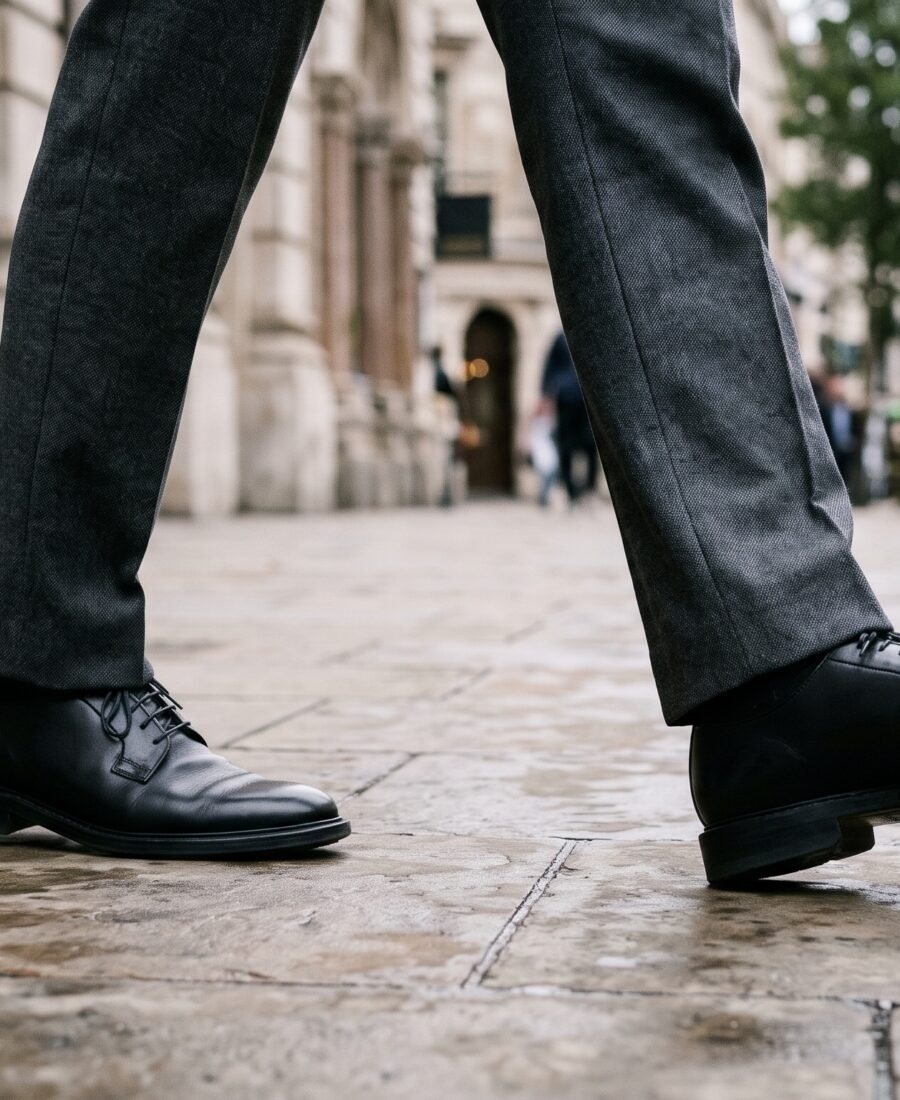
How Should Men’s Dress Pants Fit? Waist, Rise, Seat and Break
How should dress pants fit? Check the waist, rise, seat, thighs and hem with practical sitting tests, break options and realistic tailoring advice.
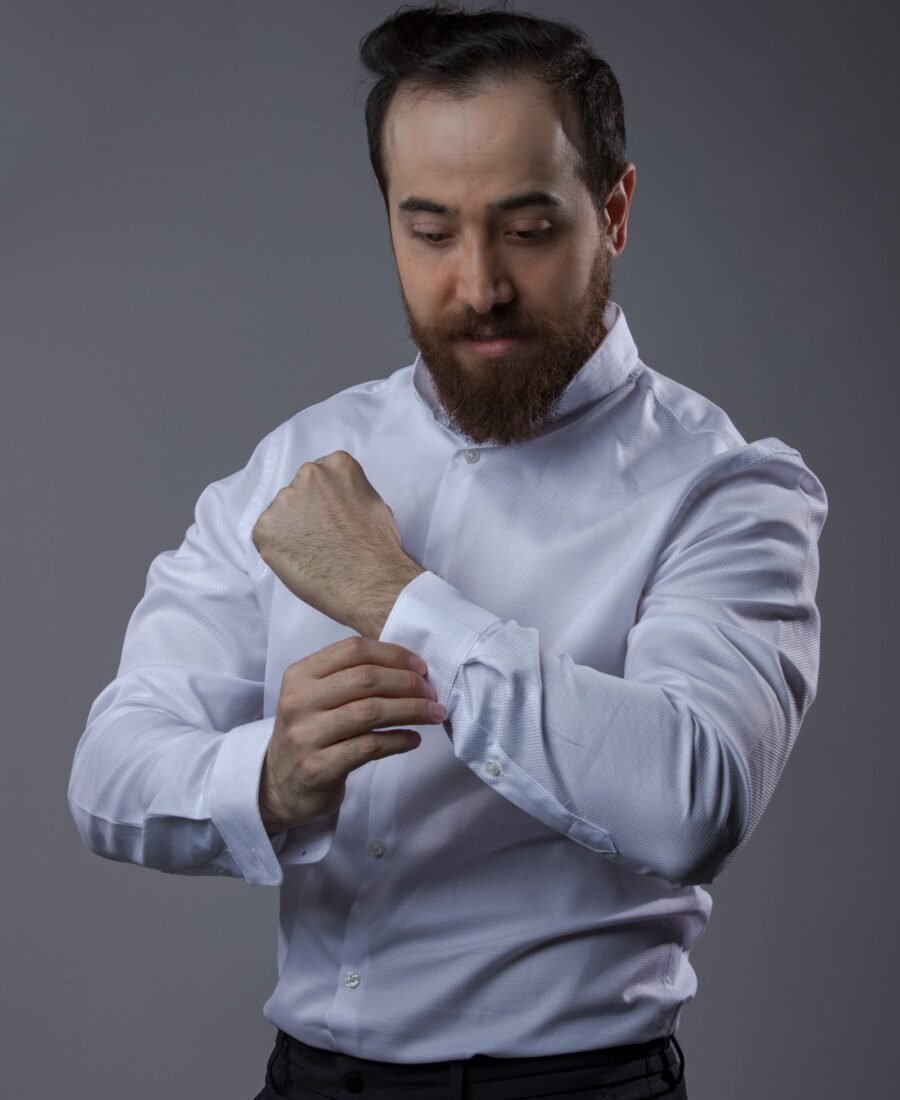
How Should a Dress Shirt Fit? A Men’s Guide to Collar, Chest and Sleeves
Check dress shirt fit at the collar, shoulders, chest, sleeves and hem. Learn what to measure, how to test movement and when to try another cut.
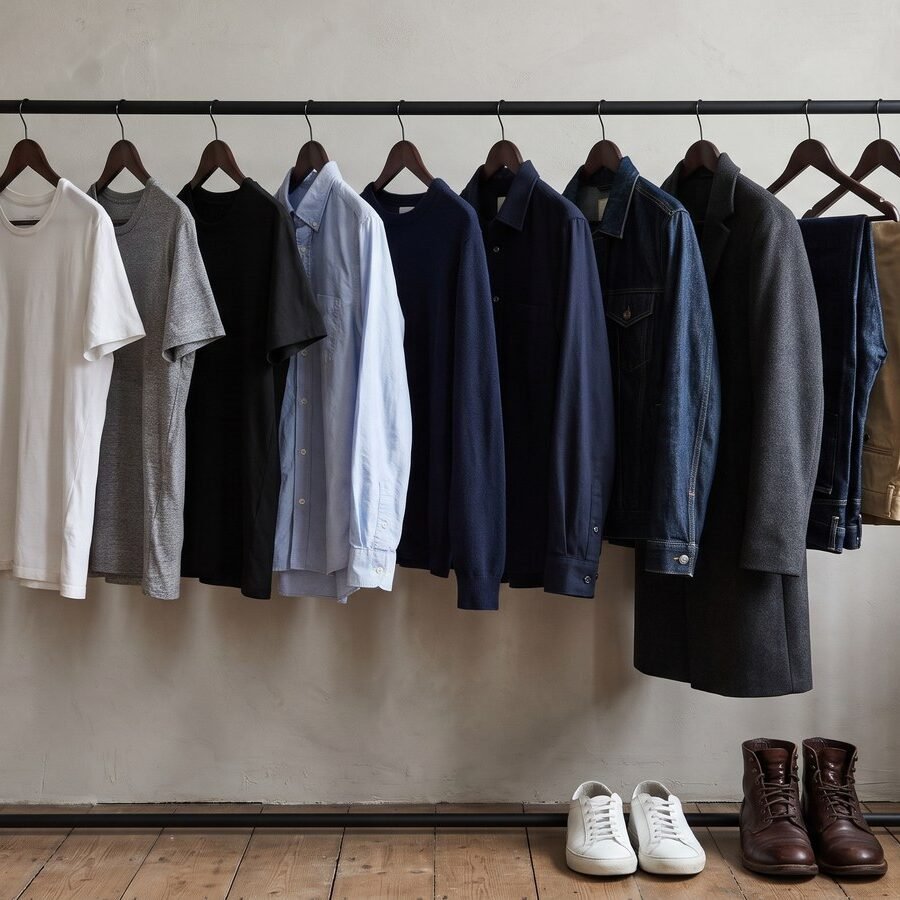
Men’s Capsule Wardrobe: How to Build One That Actually Works
A men’s capsule wardrobe is a small set of clothes that all work together. How to choose the pieces, colors and fit, and build one at your own pace.