
November 23, 2026
Explore: Fabric & Care
Best Underwear Material for Men: Cotton, Modal, Merino and Synthetics Compared
The best underwear material for men depends on your day. Cotton, modal, nylon, polyester, merino and silk compared for comfort, sweat, odour and care.
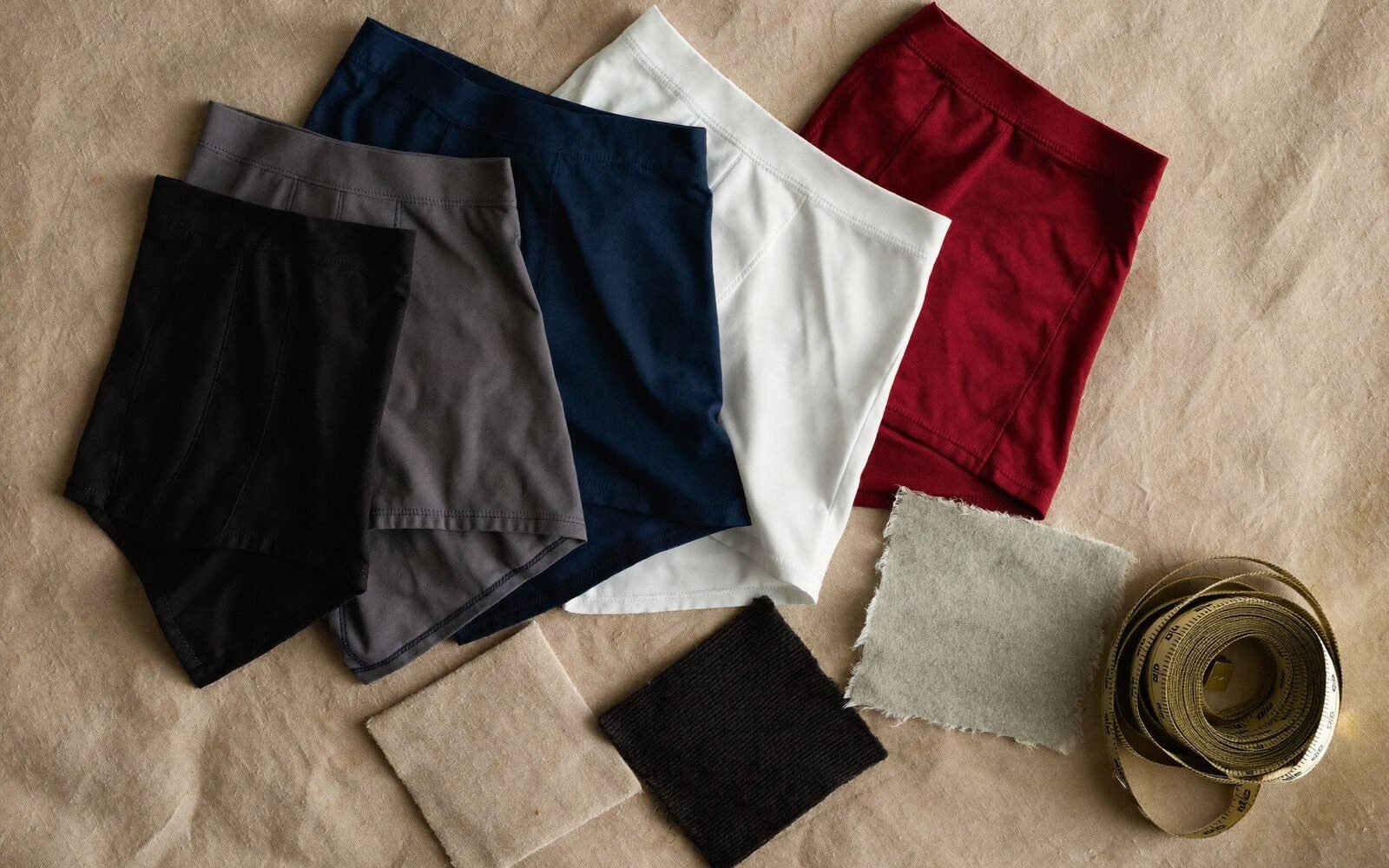
You stand in front of a wall of multipacks. One says 100% cotton. One says modal. One says “bamboo.” The gym pair says polyester and spandex, and a travel brand wants three times the price for merino wool. Each package promises “breathable” and “all-day comfort,” and none of them says what you actually want to know: which material is best for the way you spend your day.
This guide compares the main underwear materials for men side by side: cotton, modal and micromodal, other rayons (including “bamboo”), nylon, polyester, merino wool and silk, plus the elastane that makes them stretch. It covers what each one does well, where it falls short, what the research says about sweat and odour, and how to read a content label so the package can’t fool you. If you want the full story on one fiber, our guide to what modal fabric is goes deeper. If your problem is fit rather than fabric, start with how boxer briefs should fit.
Short answer: There is no single best underwear material for every man. For everyday wear, a soft cellulose knit with a little elastane is the safest start: cotton-elastane if you want something familiar, durable and easy to wash, or a modal or micromodal blend if you want a smoother, softer feel. For hard exercise and heat, nylon or polyester blends dry faster, though polyester holds body odour more than cotton in the studies cited here. Fine merino wool is the strongest choice for multi-day wear and travel because it resists odour and moderates moisture, but it costs more and needs gentler care. Whatever the fiber, fit and construction matter as much as the label.
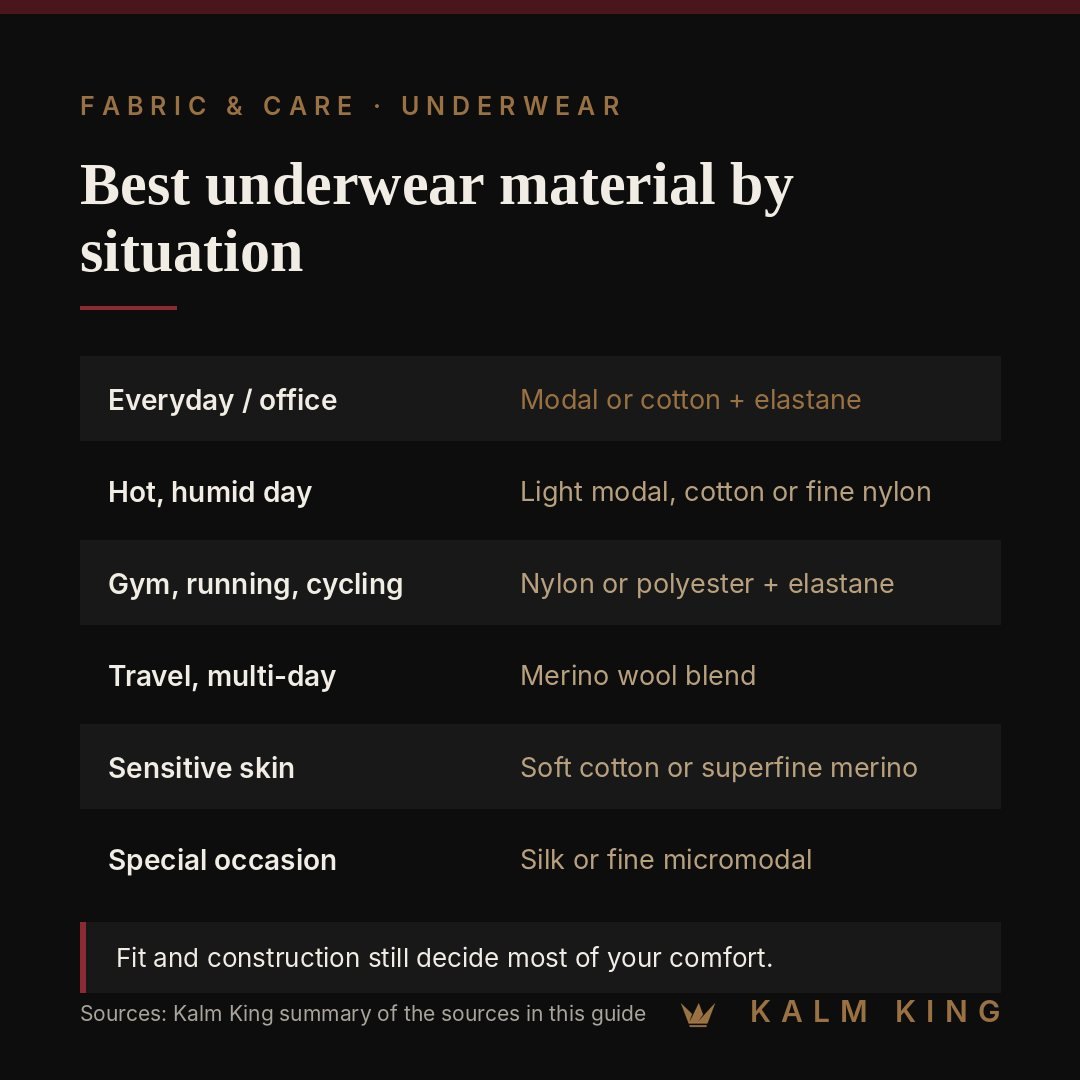
The Quick Pick: Best Underwear Material by Situation
If you only read one section, read this one. Find the row that sounds like your day.
| Your day | Best first choice | Good alternative | Watch out for |
|---|---|---|---|
| Desk, errands, everyday wear | Modal or micromodal blend with a few percent elastane | Cotton with a little elastane | 100% cotton with no stretch, which can sag by evening |
| Hot, humid day | Light modal or cotton blend, or a fine nylon blend | Fine merino blend | Thick cotton that stays damp once soaked |
| Gym, running, cycling | Nylon or polyester blend with elastane | Fine merino blend | Plain cotton, which holds sweat against the skin |
| Travel, several days, washing in a sink | Merino wool blend | Nylon blend (dries fast) | Thick cotton, which is slow to dry overnight |
| Sensitive or easily irritated skin | Soft cotton or a fine merino (superfine grade) | Modal blend | Rough seams and scratchy labels, whatever the fiber |
| Prone to jock itch or heavy sweating | Loose-fitting cotton, or a wicking synthetic that dries fast | Merino blend | Tight underwear of any fiber |
| A special occasion | Silk or a fine micromodal | High-quality cotton | Silk needs delicate care |
Two things this table does not tell you. First, a fabric’s knit, weight and finish change how a fiber behaves, so two “modal” pairs can feel very different. Second, sizing and cut still decide most of your comfort. The wrong leg opening will ride up in any fabric.
What “Best” Actually Means for Underwear
Underwear is the garment worn closest to the body for the longest time, usually all day, often in heat, and almost always under a layer that traps warmth. That gives it a harder job than a shirt. When people say a material is “best,” they usually mean some mix of seven things:
- Softness against the skin. How smooth the fabric feels, especially at the seams and waistband.
- Moisture handling. Whether the fabric soaks up sweat, moves it away from the skin, or lets it sit there.
- Drying speed. How quickly it stops feeling damp after a workout, or after a sink wash on a trip.
- Odour. How much body odour the fabric develops and keeps, before and after washing.
- Stretch and recovery. Whether the waistband and legs return to shape after hours of sitting and moving.
- Durability. How long the fabric resists thinning, holes and pilling where it rubs.
- Care. Whether it tolerates a normal wash and dry, or needs cool water and air drying.
No fiber wins all seven. Cotton is strong on softness and durability but slow to dry. Polyester dries quickly but scores poorly on odour. Merino handles odour and temperature well but costs more and needs care. Most good underwear is a blend because blending trades one strength against another.
Underwear Materials Compared
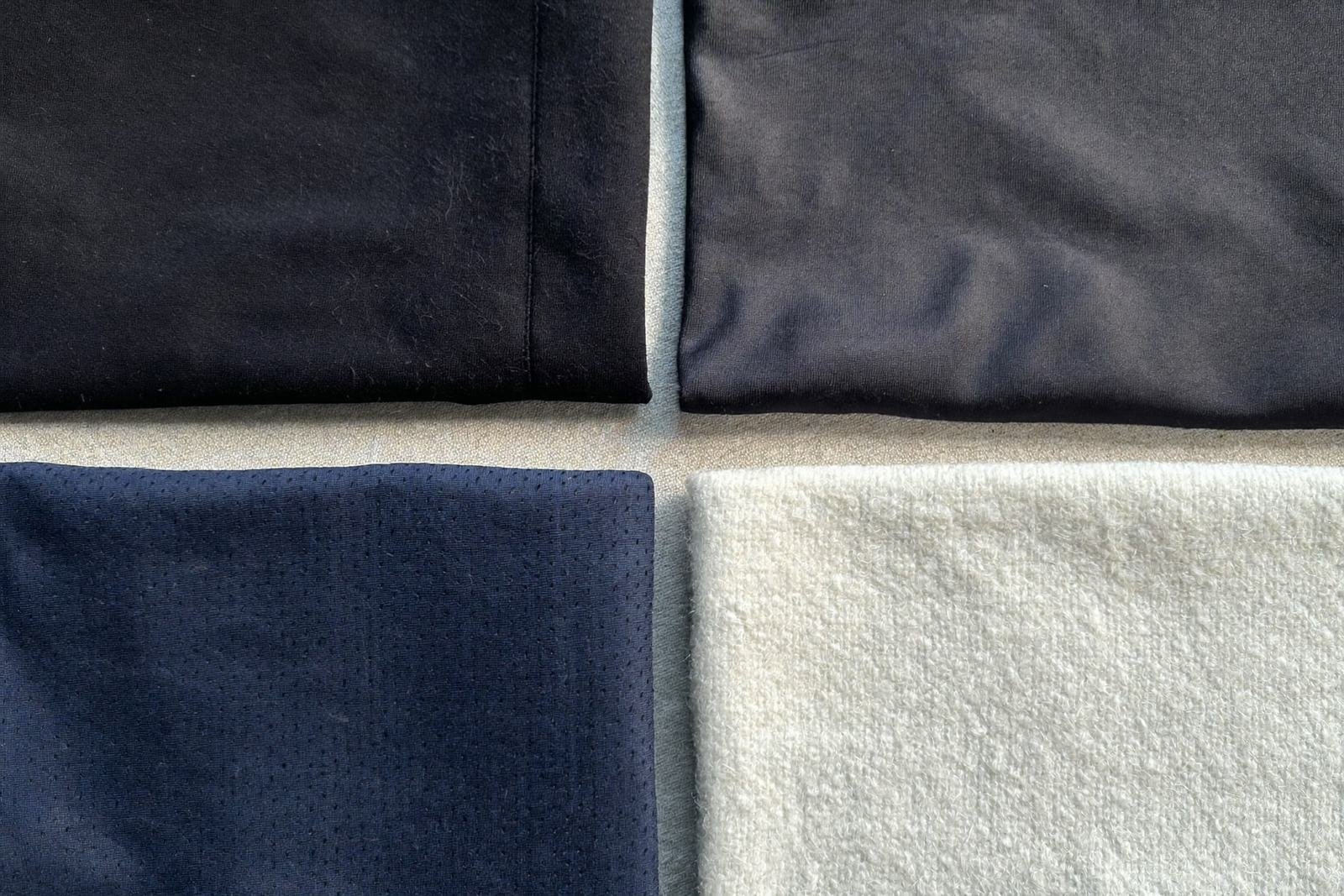
Here is how the main fibers compare at a glance. The ratings are a summary of the sources cited below and general textile references, not lab results for any specific garment.
| Material | Feel | Moisture | Drying | Odour | Durability | Care | Typical price |
|---|---|---|---|---|---|---|---|
| Cotton | Soft, familiar | Absorbs readily | Slow | Lower than polyester in the studies cited | Durable | Easy, tolerates heat | Low |
| Modal / micromodal | Very smooth, silky | Absorbs readily | Moderate | Not well studied in underwear | Good, softer surface | Gentle cycle preferred | Medium |
| Viscose / “bamboo” rayon | Soft, drapey | Absorbs readily | Moderate | Not well studied in underwear | Weaker when wet | Gentle care | Low to medium |
| Nylon (polyamide) | Smooth, slick | Absorbs little | Fast | Can hold oils and odour | Very strong, abrasion resistant | Easy, avoid high heat | Medium |
| Polyester | Smooth, can feel plasticky | Absorbs little | Fast | Highest in the studies cited | Strong | Easy, avoid high heat | Low to medium |
| Merino wool | Soft if fine grade | Absorbs vapour well | Moderate | Lowest in odour studies cited | Moderate, can wear at friction points | Cool wash, no high heat | High |
| Silk | Very smooth, light | Absorbent | Moderate | Not well studied | Weaker when wet, sensitive to sweat | Delicate | High |
| Elastane (spandex) | Adds stretch only | Absorbs little | — | — | Damaged by heat and chlorine | Low heat, no chlorine bleach | Small share of blend |
Now the details, one material at a time.
Cotton
Cotton is the default for a reason. The University of Georgia Extension’s fiber guide describes it as absorbent, cool, comfortable to wear, durable and economical, and its main listed drawback is wrinkling, which doesn’t matter in underwear. Cotton tolerates warm washes and normal drying better than most of the fibers below, so it is the easiest to live with.
Its weakness is moisture. Cotton soaks up sweat well, but it holds on to it. On an ordinary day that’s fine. During hard exercise or a long, hot afternoon, a heavy cotton pair can feel damp and heavy, and men who run or cycle often say so. Cotton with no elastane also tends to loosen during the day, which is why most modern cotton underwear includes a few percent of stretch.
Cotton’s strength shows up in odour research. In a 20-session field trial led by University of Alberta textile researchers, published in the International Journal of Clothing Science and Technology, trained panels rated worn cotton fabrics as markedly less smelly than matched polyester fabrics, both before and after washing (details in the odour section below). The authors suggest cotton releases odorous compounds more readily in the wash.
Best for: everyday wear, men who want simple care, sensitive skin, and anyone who sweats moderately rather than heavily.
Look for: combed or ring-spun cotton on the product page, which usually indicates a smoother yarn, and a few percent of elastane so the pair holds its shape.
Modal and Micromodal
Modal is a regenerated cellulose fiber, a type of rayon made from wood pulp. The international fiber-name standard (ISO 2076) defines it by its high strength and high wet modulus, meaning it resists stretching out when wet better than ordinary viscose. In the US, a label may call it either modal or rayon. Our modal explainer covers the definitions and the one controlled study comparing it with cotton.
What matters here is how it feels and behaves in underwear. Modal is known for softness and a smooth, almost silky hand. Lenzing, the company behind TENCEL Modal, says the fiber’s cross-section and tenacity “favor fabric softness” and help it withstand repeated washing and drying. That is a manufacturer’s claim about its own fiber, not an independent test, but it matches what most men notice in the hand.
Micromodal is simply a finer version of the fiber. Lenzing describes modal made with its Micro technology as “the finest fibers within the TENCEL portfolio,” which it says leads to increased softness. Finer fibers make a smoother, lighter fabric, which is why micromodal shows up in premium underwear. You pay more for it.
Modal absorbs moisture readily, like cotton. Some men find a modal pair feels damp on long, sweaty days, and switch to synthetics for hiking or sport. In everyday conditions, the smooth surface is its real advantage: less friction against the skin, especially at the inner thigh.
Best for: everyday and office wear, men who find cotton rough or heavy, warm-weather days that aren’t full workouts.
Look for: a blend with a few percent of elastane for recovery, flat or covered seams, and the generic fiber name on the content label. “TENCEL” is a trademark, not a fiber type.
Viscose, Rayon and “Bamboo”
Viscose is the most common type of rayon. It is soft and drapey like modal but defined by its manufacturing process rather than by strength, and the University of Georgia guide notes that conventional rayon is weaker when wet and may shrink or stretch unless treated. In underwear, that can mean a pair that loses its shape sooner than a modal or cotton one. Our viscose guide explains how it relates to modal and lyocell.
“Bamboo” underwear deserves its own warning. Most soft “bamboo” fabric is rayon that happens to be made from bamboo pulp. The bamboo plant is dissolved and re-formed into fiber, just like wood pulp in modal. The US Federal Trade Commission says the word “bamboo” can only be used for textiles made from fibers taken directly from the bamboo plant, without the chemical process that makes rayon. In 2022, the FTC sought penalties of $2.5 million from Kohl’s and $3 million from Walmart for marketing rayon products as bamboo, and for claiming environmental benefits the FTC said were false.
So when you see “bamboo” on underwear, check the content label. If it reads “rayon from bamboo” or “viscose from bamboo,” you are buying a rayon. That isn’t a bad thing; rayon can be soft and comfortable. Just don’t pay extra for a natural or green claim the label doesn’t support.
Best for: men who like a very soft, drapey feel and don’t mind gentler care.
Nylon (Polyamide)
Nylon is the workhorse of performance underwear. The University of Georgia guide lists it as extremely strong, extremely durable and very resistant to abrasion, with low moisture absorption. In practice, a nylon-elastane pair feels smooth and slick, dries quickly, and survives the rubbing of running and cycling better than most fibers.
Its downsides show up over time. The same guide notes that nylon “absorbs and holds body oils and perspiration stains,” builds static, and can grey or yellow with age and poor care. Nylon is also heat-sensitive, so a hot dryer is a bad idea. In a microbiology study of worn clothing by Callewaert and colleagues, nylon selectively grew bacteria associated with sharp, acidic foot odour in lab tests, which is one reason nylon socks are notorious. That finding came from textile samples in a lab, not underwear trials, but it is worth knowing.
Best for: gym, running, cycling, hiking, travel when you need fast drying.
Look for: a nylon-elastane blend in a light mesh or micro knit, with flatlock seams that won’t rub when you move.
Polyester
Polyester is cheaper than nylon and dries just as fast. The University of Georgia guide credits it with strength and “superior wash-wear performance,” and lists its limitations bluntly: it absorbs body oils, may pill and attract lint, and “absorbs perspiration odor.” For pills that do form, see how to remove pilling from clothes.
That last point is where most of the research sits. Two separate lines of evidence point the same way:
- The Ghent study (2014). Callewaert and colleagues had 26 people wear cotton, polyester and blended shirts for an hour of indoor cycling. A trained odour panel found polyester shirts smelled significantly worse than cotton after incubation, and bacteria linked to sweat odour (Micrococcus) grew selectively on polyester.
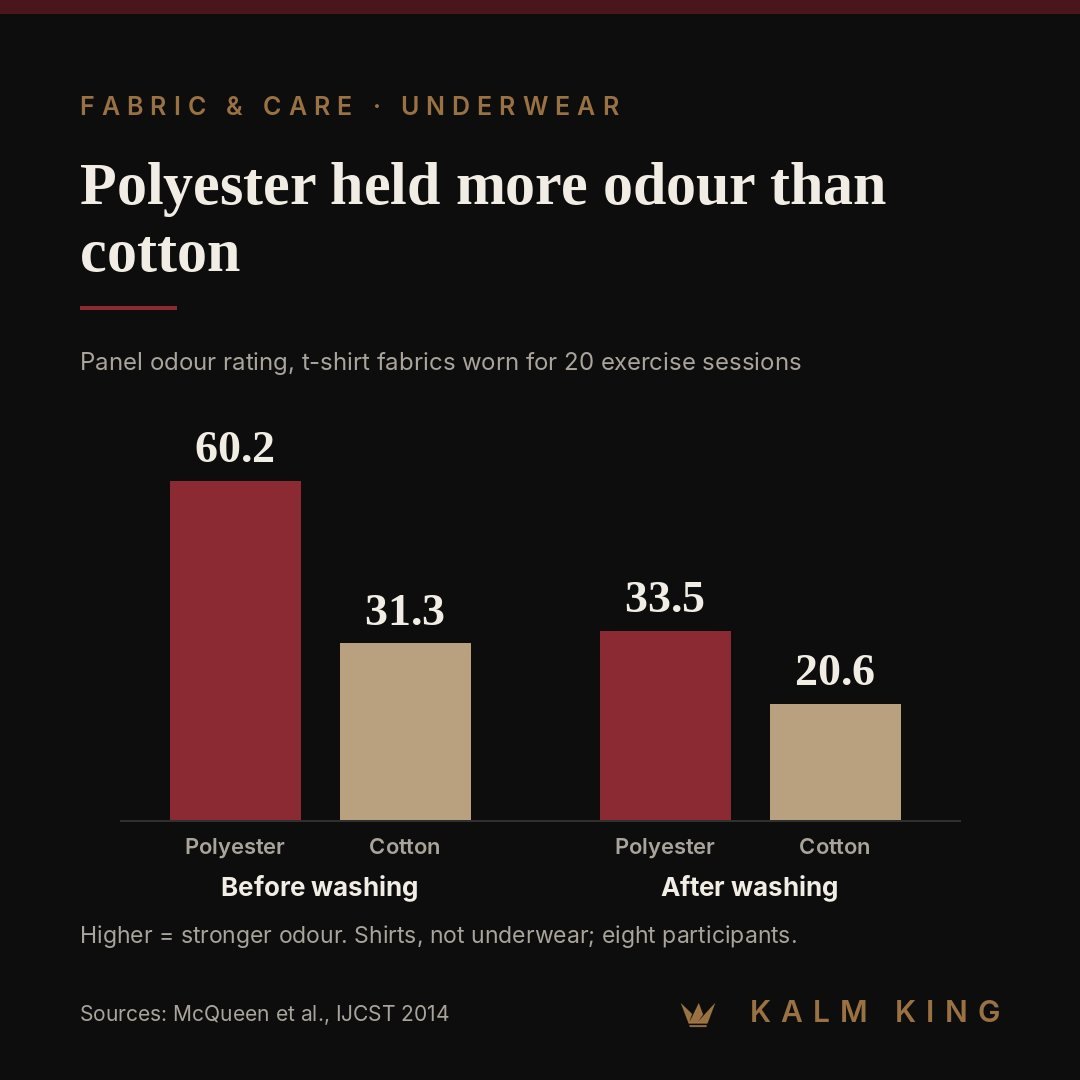
- The Alberta field trial. McQueen and colleagues had eight participants wear cotton/polyester t-shirts through 20 exercise sessions over ten weeks. Polyester was rated about twice as odorous as cotton before washing (average panel scores of 60.2 vs 31.3) and was still rated higher after washing (33.5 vs 20.6). The authors found odorous fatty acids were “less effectively removed from polyester fabrics by washing,” which suggests odour can build up in polyester over many wears.
These were studies of shirts worn during exercise, not underwear, and both were small. But they agree with what many men notice in old gym gear: the smell that comes back as soon as the fabric warms up. If you wear polyester underwear for sport, wash it after every use.
Best for: budget sport underwear, short workouts, situations where drying speed matters more than odour.
Merino Wool
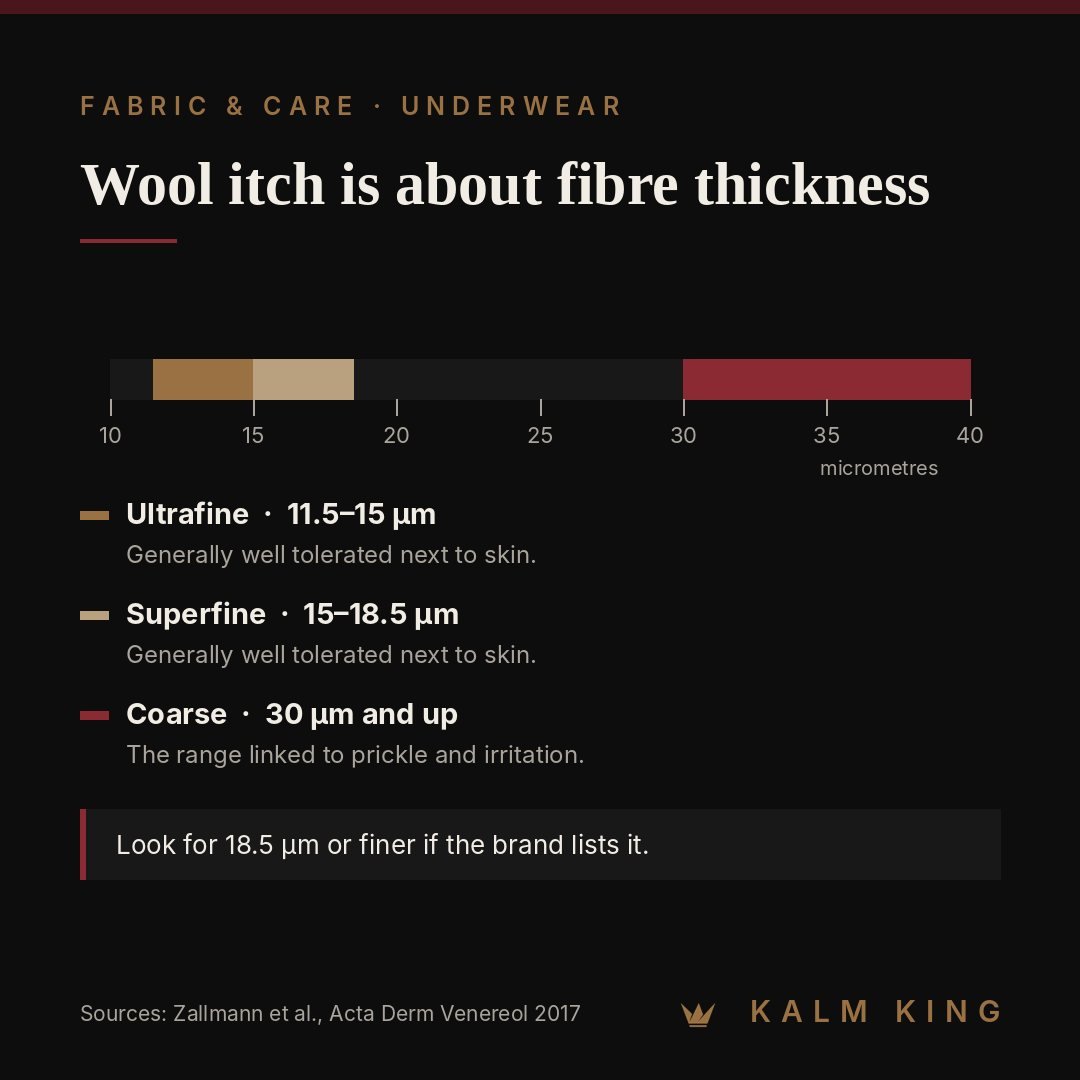
Merino surprises men who remember itchy school sweaters. The itch was never about wool itself. A review in Acta Dermato-Venereologica concluded that irritation from wool “relates to high fibre diameters,” in the range of 30–32 micrometres and above, and that superfine (about 15–18.5 µm) and ultrafine (about 11.5–15 µm) merino do not trigger the nerve fibres that cause the prickle. Coarse fibres of any kind can irritate; it is a thickness problem, not a wool problem.
Fine merino also has the best odour record of the fibers here. The Ghent researchers noted that in earlier work, wool fabrics drew the lowest odour intensity ratings, even though wool hosted plenty of bacteria. Wool absorbs water vapour well, which helps keep the air between skin and fabric more stable. A 2019 clinical study in Dermatitis found that people with mild to moderate eczema who wore fine-diameter merino garments improved more than those in their usual clothing, which challenges the idea that wool is always bad for sensitive skin.
The trade-offs are price and care. Merino underwear costs far more than cotton, it can wear thin at high-friction points, and the University of Georgia guide notes wool is “damaged by chlorine bleach” and “damaged by dry heat” and may shrink and felt if laundered carelessly. Most merino underwear is blended with nylon or elastane for strength and stretch.
Best for: travel, multi-day hikes, cold weather, men who want to wear a pair more than once between washes, and some men with sensitive skin.
Look for: a stated fibre diameter of 18.5 micrometres or finer if the brand lists it, and a nylon or elastane share for durability and stretch.
Silk
Silk is light, smooth and absorbent, and it feels luxurious. It is also delicate. The University of Georgia guide lists it as weakened by sunlight, perspiration and chlorine bleach, and says it loses strength when wet. Perspiration is the problem for underwear: sweat slowly damages the fiber. Silk boxers make sense as an occasional luxury, not as your daily rotation.
Best for: special occasions and lounging.
Elastane (Spandex)
Elastane is not a base fabric; it’s the stretch. Elastane and spandex are the same fiber under two names, and the FTC’s labeling guide allows either. A few percent of it lets a cotton or modal knit stretch over your hips and spring back, which keeps the waistband up and the legs in place. Everyday underwear usually lists it in single digits; sport and compression pairs often list more. More elastane means more hold, not necessarily a better fit.
It is also the first part of your underwear to fail. The University of Georgia guide says spandex is “damaged by chlorine bleach and heat,” and recommends warm, not hot, water, no chlorine, and drip drying or low dryer heat. When a pair’s waistband goes wavy or the legs flare open, it’s usually the elastane that has given out. See our notes on why a waistband rolls down.
Sweat, Odour and Skin: What the Research Says
Most underwear marketing talks about “breathability.” The useful questions are narrower: does the fabric soak up sweat, move it, or let it sit; does it build up odour; and does it irritate the skin?
Absorbing vs wicking. Cotton, modal, viscose and wool absorb moisture into the fiber. Polyester and nylon absorb very little, so sweat stays on the surface and spreads out, where it can evaporate faster. That’s the core reason synthetics feel drier during exercise and cotton feels heavier. Neither is “better” in all conditions. On a calm day, absorbing fibers feel comfortable. During heavy sweating, fast-drying synthetics win.
Odour builds in synthetics. The two studies above found polyester smelled worse than cotton and kept more odour after washing. The Ghent team found no bacterial growth on viscose in their lab tests and suggested it might be useful in odour-resistant clothing, but they didn’t test it in wear. Wool had the lowest odour ratings in the earlier work they cite.
Skin and jock itch. Fungal groin infections thrive on heat and moisture. Mayo Clinic advises changing underwear at least daily, choosing underwear “made of cotton or other fabric that breathes and keeps the skin drier,” and avoiding tight-fitting clothes. Cleveland Clinic gives both options: cotton underwear “to absorb moisture” or synthetic underwear “to wick away moisture,” plus loose fits. The common thread is not one fiber; it’s keeping the groin dry and not wearing anything tight. If you’re dealing with a rash that won’t clear, see a clinician rather than switching fabrics.
For hot days and long walks, read how to prevent thigh chafing.
How to Read an Underwear Label
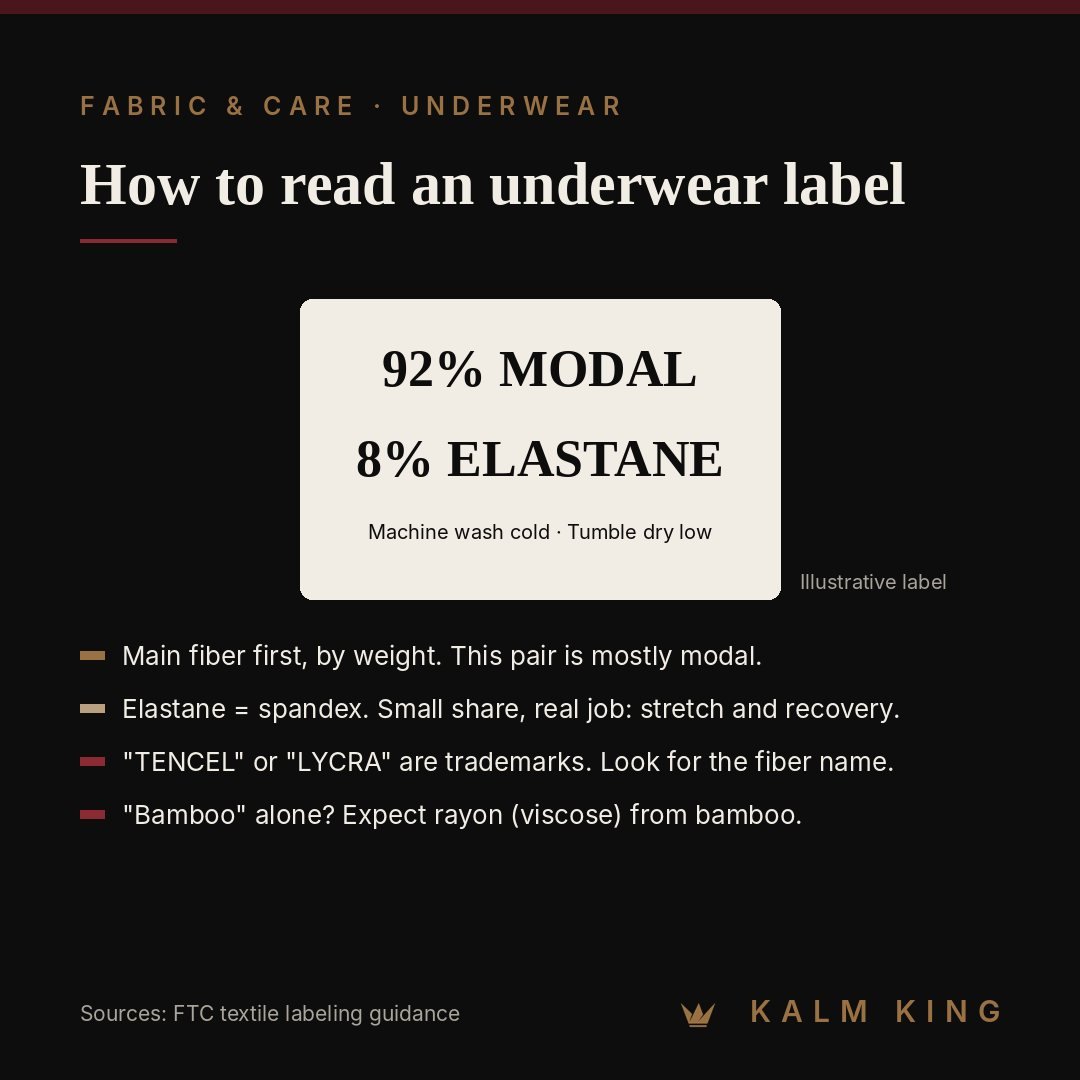
The content label is the one place a brand has to be specific. In the US, the FTC’s textile rules require the generic fiber names and their percentages by weight, listed in descending order. Fibers under 5% are normally grouped as “other fiber,” but a fiber with a clear function, like the stretch in “96% cotton, 4% spandex,” may be named. Here’s how to read it:
- The first fiber is the main one. “92% modal, 8% elastane” is mostly modal. “60% cotton, 35% polyester, 5% elastane” is a cotton-poly blend and will behave partly like each.
- Look for the generic name. TENCEL, LYCRA and similar words are trademarks. The fiber name next to them (modal, lyocell, elastane, spandex) tells you what you’re actually wearing. The FTC accepts both “elastane” and “spandex” for the same fiber.
- “Rayon” could mean viscose, modal or lyocell. If the label just says rayon, assume the more basic viscose unless the brand says otherwise.
- “Bamboo” alone is a red flag. Look for “rayon from bamboo” or “viscose from bamboo.” That’s what most soft bamboo underwear is.
- Check the gusset or pouch lining. Some synthetic pairs use a cotton lining in the pouch. Product pages sometimes list it separately.
- Read the care symbols. A pair that says “tumble dry low” or “line dry” is telling you the elastane or fiber doesn’t like heat.
Blends: Why Most Good Underwear Isn’t One Fiber
A pure fiber is rarely the best underwear fabric. Blends exist to combine strengths:
| Blend | What it’s aiming for | Common trade-off |
|---|---|---|
| Cotton + elastane | Familiar softness with shape recovery | Still slow to dry |
| Modal + elastane | Very soft and smooth, holds shape | Softer surface may wear faster at friction points |
| Modal + cotton + elastane | Softness of modal with cotton’s familiarity | Behaves between the two |
| Nylon + elastane | Fast drying, strong, smooth for sport | Can hold odour; heat-sensitive |
| Polyester + elastane | Fast drying at a lower price | Highest odour build-up in the studies cited |
| Merino + nylon (+ elastane) | Odour resistance and temperature buffering, with added strength | Price and gentler care |
A reasonable rule: the fiber listed first sets the feel, and the smaller fibers fix its weaknesses. If you want to know how a blend will act, start with the main fiber and adjust.
Construction Matters as Much as Fiber
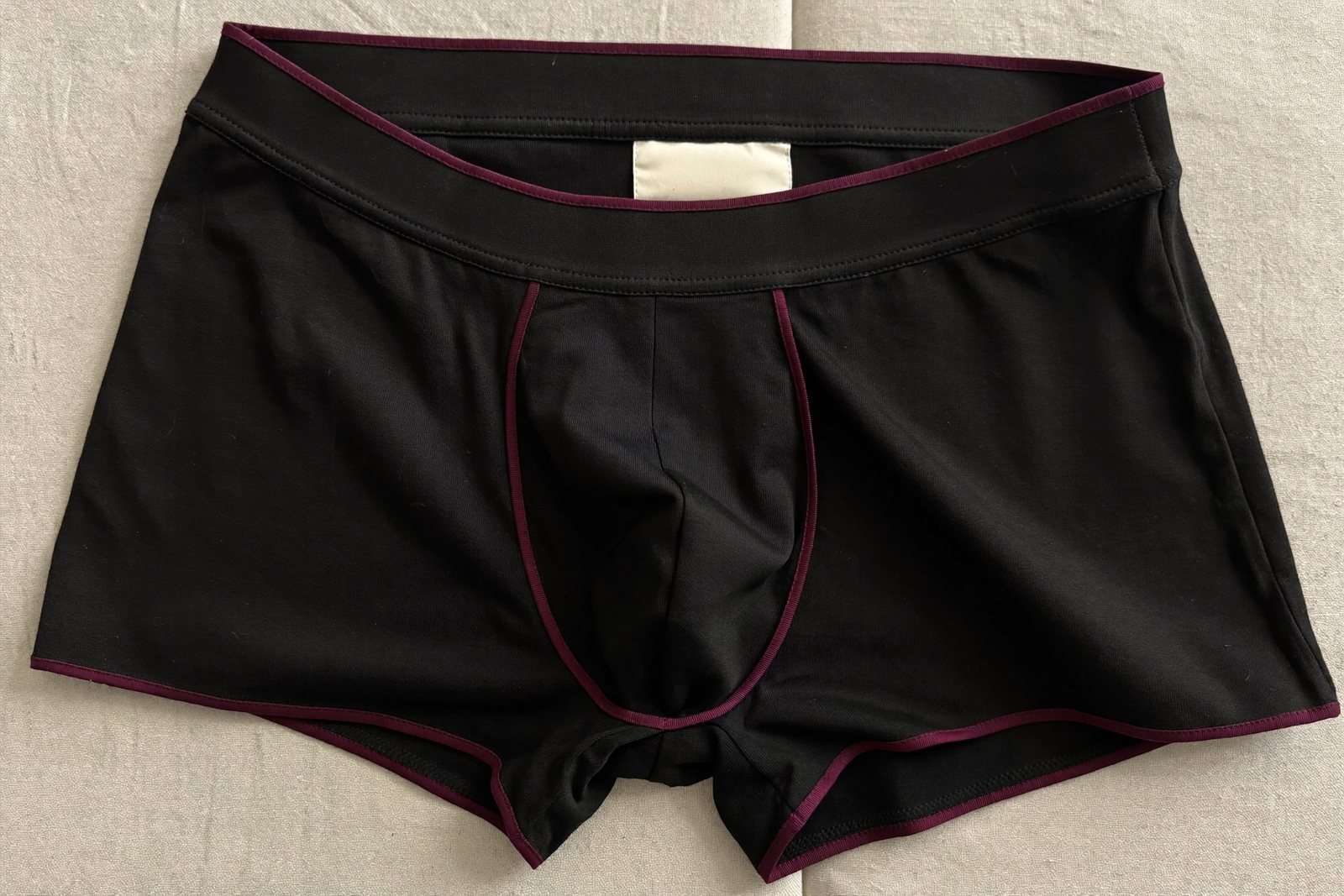
Two pairs made from the same micromodal can feel completely different. These details often matter more than the fiber name:
- Tagless labels. A printed label inside the waistband removes the scratchy tag most men cut out anyway.
- Flat or flatlock seams. Raised seams rub at the inner thigh and seat during long days and workouts.
- Covered waistband. A fabric-covered elastic band is less likely to dig or chafe than exposed elastic.
- A functional fly or a pouch. Whether you want a fly is personal; what matters is that it lies flat and doesn’t gape.
- Fabric weight. A very thin knit can feel great on day one and wear through at the seat sooner. A heavier knit lasts longer but feels warmer.
- Gusset and pouch lining. A soft, breathable lining helps in the area that sweats most.
Care by Material
Most underwear dies early in the dryer. Heat attacks elastane first, then synthetics, then wool. Follow the care label; these habits help most materials last longer. For a full routine, see our guide on how to wash men’s underwear.
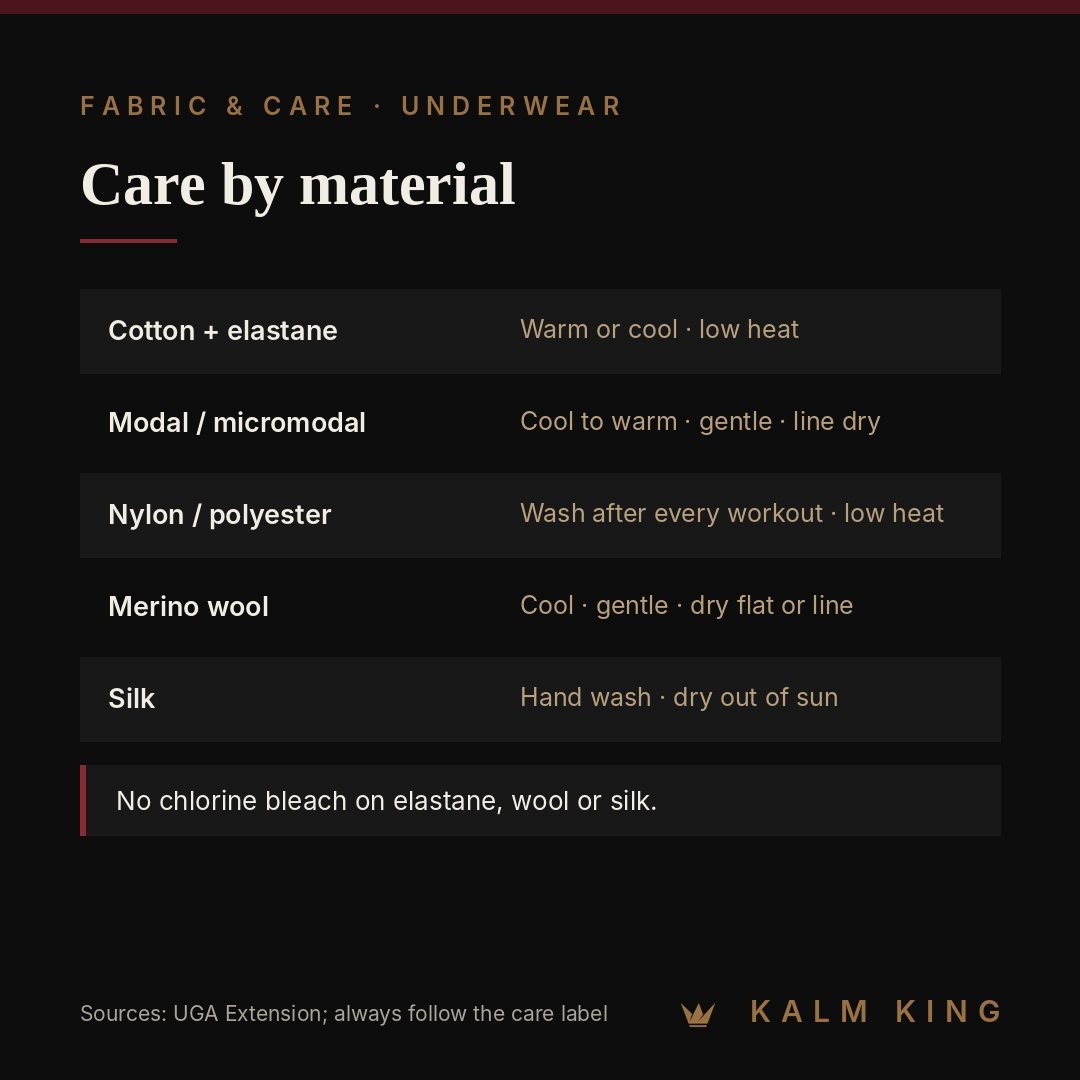
| Material | Wash | Dry | Avoid |
|---|---|---|---|
| Cotton + elastane | Warm or cool, normal cycle | Low tumble or line dry | Hot dryer (it damages the elastane), chlorine bleach on stretch blends |
| Modal / micromodal | Cool to warm, gentle cycle, inside out | Line dry or low tumble | Over-drying, rough loads with zips and Velcro |
| Viscose / bamboo rayon | Cool, gentle | Line dry | Wringing (weaker when wet) |
| Nylon / polyester | Warm, wash after every workout | Line dry or low | High heat, fabric softener on technical fabrics if the label says so |
| Merino wool | Cool, wool or gentle cycle, mild detergent | Dry flat or line dry | Chlorine bleach, hot water, tumble drying |
| Silk | Hand wash, neutral soap | Dry flat, out of sun | Chlorine bleach, high heat |
The spandex rules from the University of Georgia guide apply to nearly every pair: warm, not hot, water; no chlorine; low heat or air drying.
Troubleshooting: When Your Underwear Fabric Isn’t Working
| Problem | Likely cause | What to try |
|---|---|---|
| Feels damp and heavy by afternoon | Absorbent fiber (cotton, rayon) in heat or heavy sweat | A nylon or merino blend for hot or active days |
| Smells even after washing | Synthetic fabric holding body oils | Wash after every wear; switch sport pairs to merino or cotton-rich blends; replace old pairs |
| Waistband rolls or legs flare after a few months | Elastane damaged by heat or chlorine, or simply worn | Line dry; skip chlorine bleach; replace the pair |
| Pilling at the seat or inner thigh | Friction on a soft or loosely knit fabric | Wash inside out; avoid rough loads; choose a denser knit |
| Itchy or irritated skin | Seams, tags, coarse fibers, or a tight fit | Tagless, flat-seam pairs; a softer fiber; a looser cut |
| Chafing on long walks or runs | Legs riding up, raised seams, or a wet fabric | A smoother synthetic or modal blend, flat seams, a cut that stays put |
| Thin or holes at the seat within a year | Lightweight knit or heat damage | A slightly heavier fabric; gentler drying |
Common Mistakes
- Choosing by fiber name alone. The knit, weight, seams and fit decide as much as the material.
- Wearing cotton for hard workouts. It works for a gentle session, not for an hour of running in July.
- Wearing the same polyester gym pair twice. The research suggests odour builds in polyester; wash after each use.
- Paying extra for “bamboo.” It’s almost always rayon. Judge it as rayon.
- Hot-drying everything. Heat is the fastest way to kill elastane and synthetics.
- Assuming wool will itch. Fine merino is a different material from the coarse wool most men remember.
- Buying a multipack before testing one pair. Buy a single pair of any new material first.
How Many Pairs, and of What?
A practical rotation for most men:
- Five to seven everyday pairs in a modal or cotton blend.
- Two or three sport pairs in a nylon or merino blend, washed after every use.
- Two merino pairs if you travel or hike often.
That covers office days, workouts and trips without asking one fabric to do every job.
Your Underwear Material Checklist
Before you buy
– [ ] Decide what the pair is for: everyday, sport, heat or travel.
– [ ] Read the content label: main fiber first, generic names, not trademarks.
– [ ] Check there’s some elastane, so the pair holds its shape.
– [ ] Treat “bamboo” as rayon unless the label says otherwise.
– [ ] Look for tagless labels, flat seams and a covered waistband.
– [ ] Buy one pair before a multipack.
When you wash
– [ ] Follow the care label.
– [ ] Wash synthetic sport pairs after every wear.
– [ ] Skip chlorine bleach on anything with elastane, wool or silk.
– [ ] Line dry or use low heat.
The Kalm King Take
If you’re starting from scratch, build your everyday drawer around a soft modal or micromodal blend with enough elastane to hold its shape, and make sure the pair is tagless with flat seams and a covered waistband. That combination fixes the most common daily complaints: scratchy labels, rough seams, and a waistband that gives up by mid-afternoon. Keep a few nylon or merino pairs for the gym and for travel, and don’t ask one fabric to do every job.
Then fix the fit. The best fabric in the world won’t save a pair with the wrong leg opening or rise. Our guides on briefs, trunks and boxer briefs and how to stop boxer briefs from riding up cover the rest.
We’re building our own essentials around the same thinking: the right material for the job and a fit that stays put. If you want to hear about them first, along with more practical fit notes, join Field Notes.
Frequently asked questions
What is the best underwear material for men?
There is no single best material. For everyday wear, a modal or cotton blend with a little elastane is the safest choice. For exercise and heat, nylon or polyester blends dry faster. For travel and multi-day wear, fine merino wool resists odour best. Fit and construction matter as much as the fiber.
Is cotton or modal better for underwear?
Both are absorbent cellulose fibers. Modal feels smoother and silkier and is often blended with elastane for a close fit. Cotton is cheaper, very durable and tolerates warmer washing. If cotton feels rough or heavy to you, try a modal blend; if you want simple care, cotton is hard to beat.
What underwear fabric is best for sweating?
For heavy sweating during exercise, a nylon or polyester blend dries fastest, though polyester can hold more body odour. Fine merino wool is a strong alternative because it handles moisture vapour and resists odour. For everyday sweating, loose-fitting cotton or a breathable blend helps keep the groin drier, and you should change underwear at least daily.
Is bamboo underwear really bamboo?
Usually not in the way the word suggests. Most soft bamboo underwear is rayon made from bamboo pulp. The US Federal Trade Commission says “bamboo” should only be used for fibers taken directly from the plant, and it has penalized retailers for marketing rayon products as bamboo. Check the label for “rayon from bamboo” or “viscose from bamboo.”
Does merino wool underwear itch?
Fine merino generally doesn’t. Research links wool’s prickle to coarse fibres, about 30 micrometres and thicker. Superfine and ultrafine merino are much finer than that and are generally well tolerated next to the skin. Look for 18.5 micrometres or finer if the brand lists it.
Why does my polyester underwear smell even after washing?
Studies of worn exercise shirts found polyester developed stronger body odour than cotton and kept more of it after washing, because some odour compounds cling to the fiber. Wash synthetic underwear after every wear, avoid leaving it damp, and consider merino or cotton-rich blends for sport.
Sources
- University of Georgia Extension: Understand your fibers (university extension)
- Callewaert et al., "Microbial Odor Profile of Polyester and Cotton Clothes after a Fitness Session," Applied and Environmental Microbiology, 2014 (PMC) (peer-reviewed)
- McQueen et al., "Axillary odour build-up in knit fabrics following multiple use cycles," International Journal of Clothing Science and Technology 26(4), 2014 (copy hosted by Cotton Incorporated) (peer-reviewed; hosted by a cotton industry body)
- Zallmann et al., "Debunking the Myth of Wool Allergy: Reviewing the Evidence for Immune and Non-immune Cutaneous Reactions," Acta Dermato-Venereologica, 2017 (peer-reviewed review)
- Fowler, Fowler and Lorenz, "Effects of Merino Wool on Atopic Dermatitis Using Clinical, Quality of Life, and Physiological Outcome Measures," Dermatitis, 2019 (PMC) (peer-reviewed)
- FTC: FTC uses Penalty Offense Authority to seek largest-ever civil penalty for bogus bamboo marketing from Kohl's and Walmart (US government)
- FTC: Threading your way through the labeling requirements under the Textile and Wool Acts (US government)
- Lenzing: TENCEL Modal (manufacturer, commercial)
- Mayo Clinic: Jock itch, symptoms and causes (medical)
- Cleveland Clinic: Jock itch (tinea cruris) (medical)
FIELD NOTES
Get the Overalls Fit Kit, free.
Your measurement card, the six fit checkpoints and a checklist to take shopping. Join Field Notes for new guides and a say in what Kalm King makes.
THE KALM KING JOURNAL
Continue reading
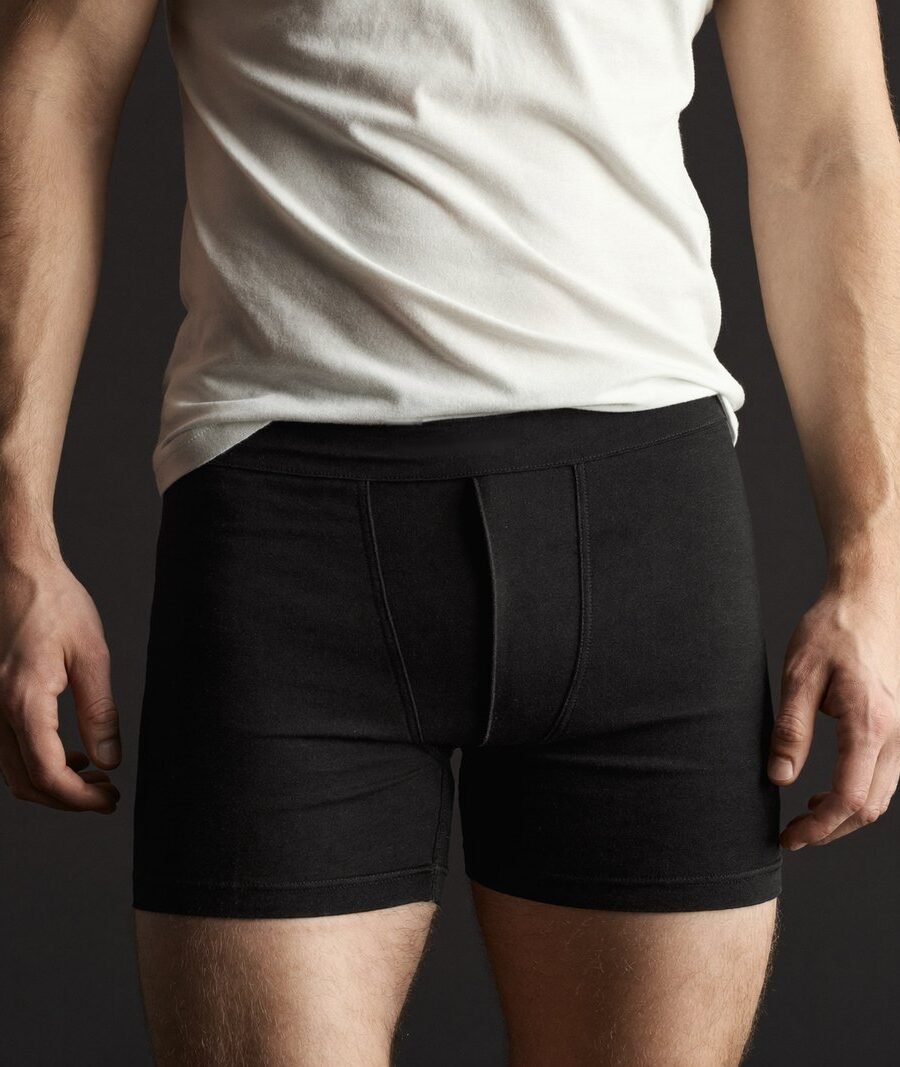
What Is Pouch Underwear? Benefits, Designs and Fit
Pouch underwear gives everything its own shaped space. Here’s how the main designs work, what they can and can’t do, and how a pouch should fit.
How to Prevent Thigh Chafing for Men
Stop thigh chafing before it starts: the layers, fabrics, balms and habits that keep your inner thighs comfortable, plus how to treat a rub that’s already sore.
How to Keep Black Clothes From Fading
Black clothes fade from dye loss, friction, heat and sun. Here’s how to wash, dry and store black so it stays black, and what to do when it’s already gone grey.