
November 23, 2026
Explore: Fit Notes
What Is Pouch Underwear? Benefits, Designs and Fit
Pouch underwear gives everything its own shaped space. Here's how the main designs work, what they can and can't do, and how a pouch should fit.

Most men’s underwear is built around one measurement: the waist. You pick small, medium or large, and the front of the garment is whatever shape that size happens to come with. For a lot of men that works well enough. For plenty of others, the front is either too flat and tight or too loose, and the result is the familiar routine of adjusting yourself through the day.
Pouch underwear is the industry’s answer to that problem. Instead of a flat front panel, it uses a shaped pocket that gives your genitals their own space and holds them in place. Some designs are subtle. Others use an internal sling or extra panels. You’ll see the idea marketed under different names, including contour pouch, ball pouch and ball hammock underwear.
This guide explains what pouch underwear is, the main designs, what it can and can’t realistically do, how it should fit, and who is most likely to notice a difference.
Short answer: Pouch underwear has a shaped front pocket, usually made from extra fabric panels and curved seams, that holds the penis and testicles in place instead of pressing them flat against the body. The main types are a contoured seamed pouch, a separate pouch with side panels that keep the genitals off the thighs, and an internal sling or “hammock.” Many men find pouch designs reduce shifting, readjusting and skin-on-skin contact. A good pouch should hold everything securely without squeezing, the waistband should do the work of keeping it in position, and the leg should still cover your thighs if you’re prone to chafing. Claims beyond comfort and support, especially about fertility, aren’t backed by strong evidence.
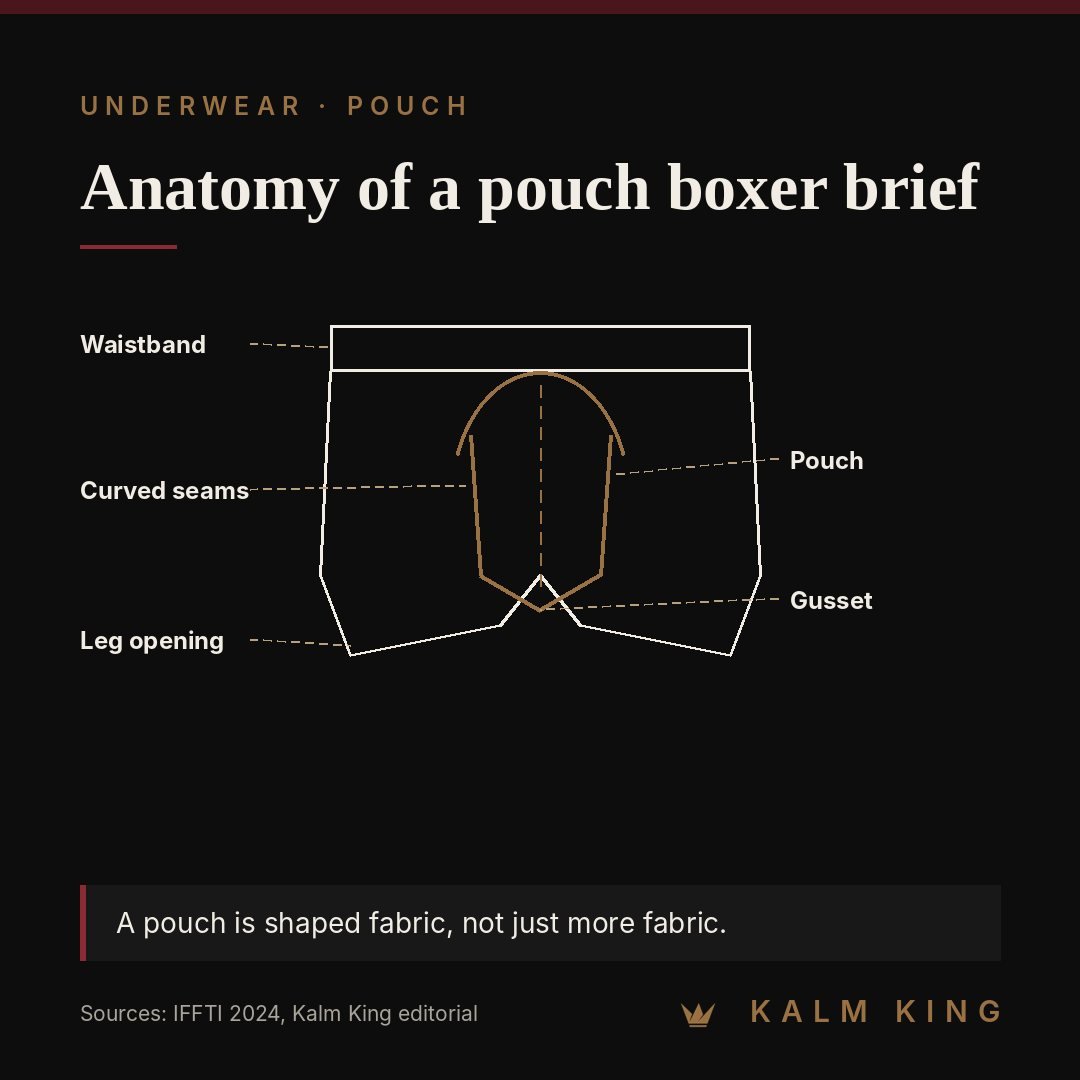
What Is Pouch Underwear?
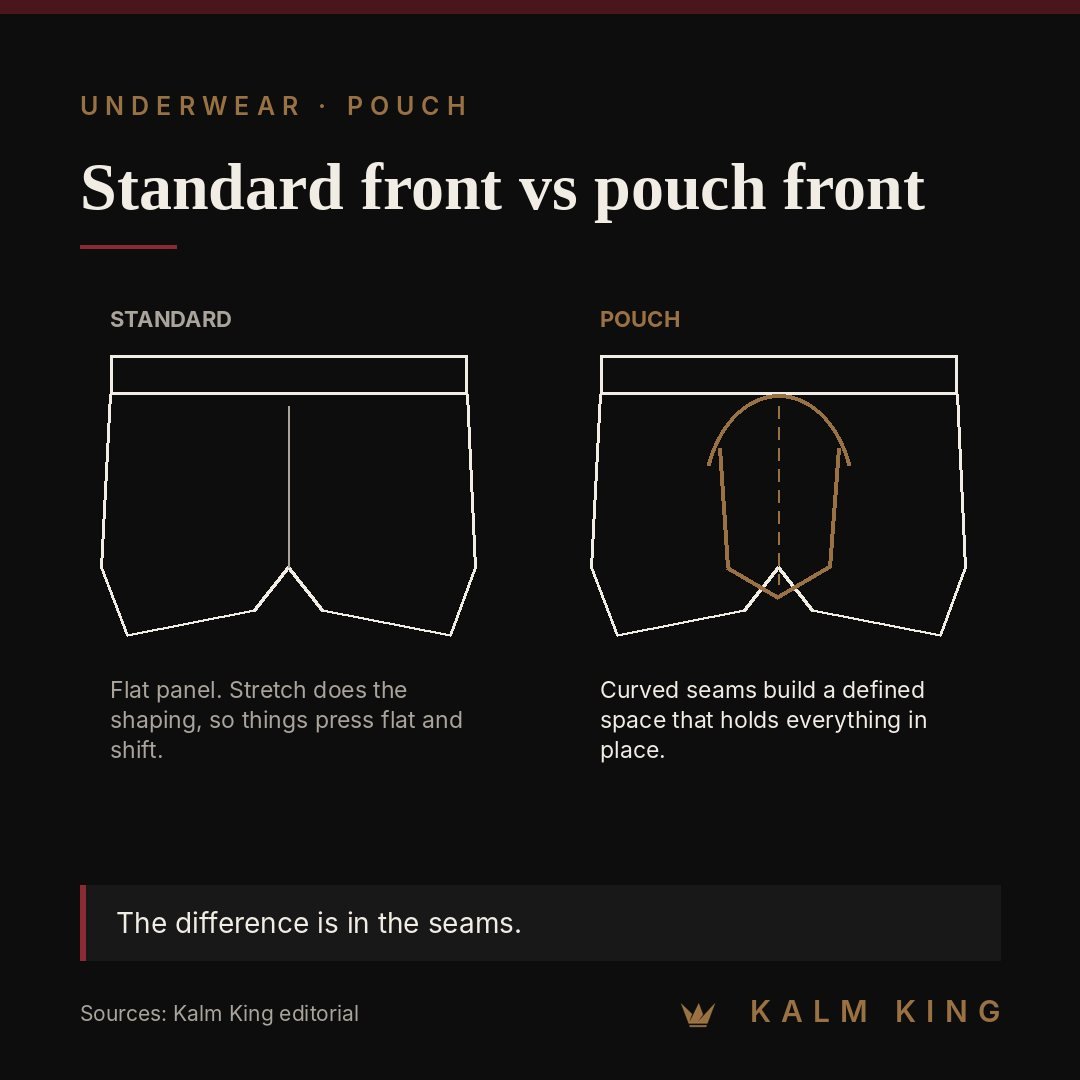
In standard underwear, the front is a mostly flat piece of fabric. Stretch does the shaping. When you put it on, the fabric presses your genitals against your body, and where they sit depends on how the fabric happens to settle.
Pouch underwear builds the shape in. Using two or more panels joined with curved seams, or a separately sewn pocket, it creates a three-dimensional space at the front. The genitals sit inside that space rather than being flattened, and the shape is meant to keep them there as you move.
The idea isn’t new. Athletic supporters and some classic briefs have long used shaped fronts. What has changed is that pouch designs have spread into everyday boxer briefs and trunks, with brands competing on how the pouch is cut.
Why fit at the front matters
There’s a real gap here. A 2024 paper presented at the International Foundation of Fashion Technology Institutes (IFFTI) conference argued that men’s underwear sizing focuses on the waist and doesn’t address varying anatomy, and that fit in the pouch area “has been widely neglected” by the industry. The authors proposed a separate pouch sizing system, similar in principle to cup sizes in bras, with pouch volume chosen independently of waist size.
That proposal hasn’t become an industry standard, but it explains the problem most men recognise. Two men with the same waist measurement can need very different amounts of room at the front, and most underwear only offers one.
The Main Types of Pouch Design
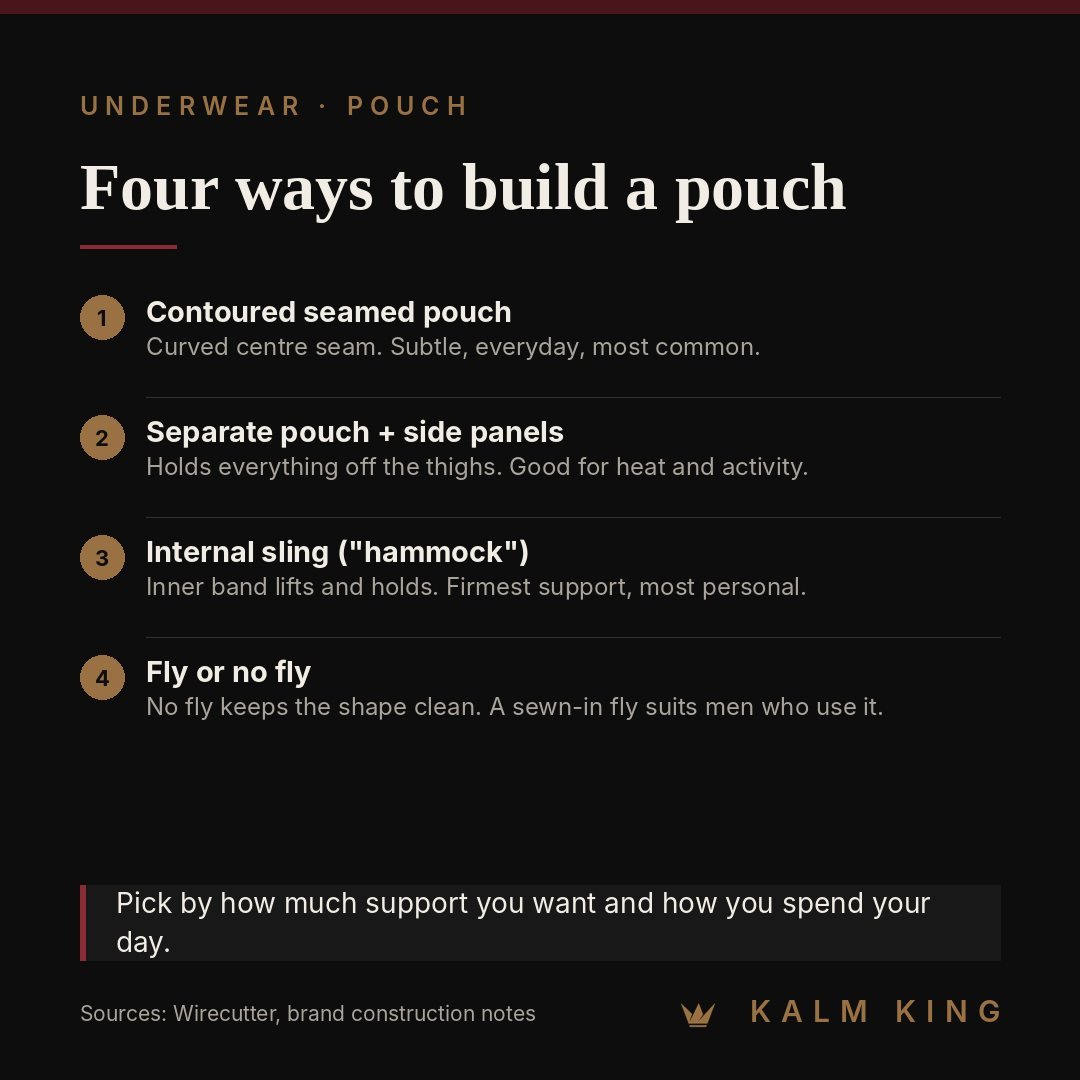
Not every “pouch” is the same. Here are the main designs you’ll come across.
1. Contoured (seamed) pouch
The most common type. The front is cut from two or more panels joined with a curved centre seam, which creates a cup-like shape. It’s subtle and looks much like ordinary underwear from the outside. It gives more room than a flat front without feeling like a separate compartment.
Good for: everyday wear, men who want a little more room without a noticeably different look.
2. Separate pouch with side panels
Here the pouch is a distinct pocket, often with panels or mesh on the sides, that holds the genitals together and away from the inner thighs. Some designs keep the pouch fully enclosed so there’s less skin contact between the scrotum and thighs.
Good for: active days, heat, and men who find their skin sticking to their thighs. Wirecutter’s underwear testing highlights multi-panel designs that wrap the thighs to reduce chafing, and separating panels work on the same principle of cutting down on skin-on-skin contact.
3. Internal sling or “hammock”
An internal band of fabric or mesh sits inside the front and cradles the testicles, lifting them slightly and holding them forward. Brands often call this a “ball hammock” or “ball pouch.”
Good for: men who want firmer support and the least possible movement. Some men love it. Others find the internal band noticeable or restrictive. It’s the most personal of the three.
4. Shaped pouch without a fly
Many pouch designs drop the front fly, because an opening interrupts the shape. Others keep a horizontal or angled fly that’s sewn into the pouch. Neither is better. It depends on whether you use the fly.
Pouch vs Standard Underwear
| Feature | Standard front | Pouch front |
|---|---|---|
| How the front is shaped | Flat fabric, stretch does the shaping | Built-in 3D shape from seams, panels or a sling |
| How the genitals sit | Pressed against the body, position varies | Held in a defined space |
| Movement through the day | Can shift, often needs adjusting | Designed to stay put |
| Skin contact with thighs | Depends on fit and leg length | Reduced in designs with side panels |
| Look under trousers | Flat | Usually similar; some designs look more defined |
| Fit range | One shape per waist size | Varies by brand; still usually sized by waist |
What Pouch Underwear Can Do
It’s worth being clear about what’s realistic, because a lot of pouch marketing goes further than the evidence.
Reduce shifting and readjusting
This is the main reason men switch. A shaped front holds things in one place, so there’s less movement as you walk, sit and stand. If you regularly adjust yourself through the day, a better-shaped front is one of the most direct fixes.
Cut down on skin-on-skin contact
In designs that separate the genitals from the thighs, there’s less skin pressing against skin in the groin. For men who sweat a lot or live somewhere hot, that can feel noticeably fresher. It also matters for chafing, which is driven by friction and made worse by moisture. Our guide on how to prevent thigh chafing covers the rest of the picture, including leg length, fabric and balms.
Give support without squeezing
A good pouch supports by shape rather than by compression. That’s the difference between “held in place” and “pressed flat.” For many men it simply feels more natural.
Improve the look under clothes
A defined front can look tidier than a front that has bunched to one side. This is a matter of taste. Some men prefer the most discreet design they can find.
What Pouch Underwear Can’t Promise
It isn’t a fertility fix
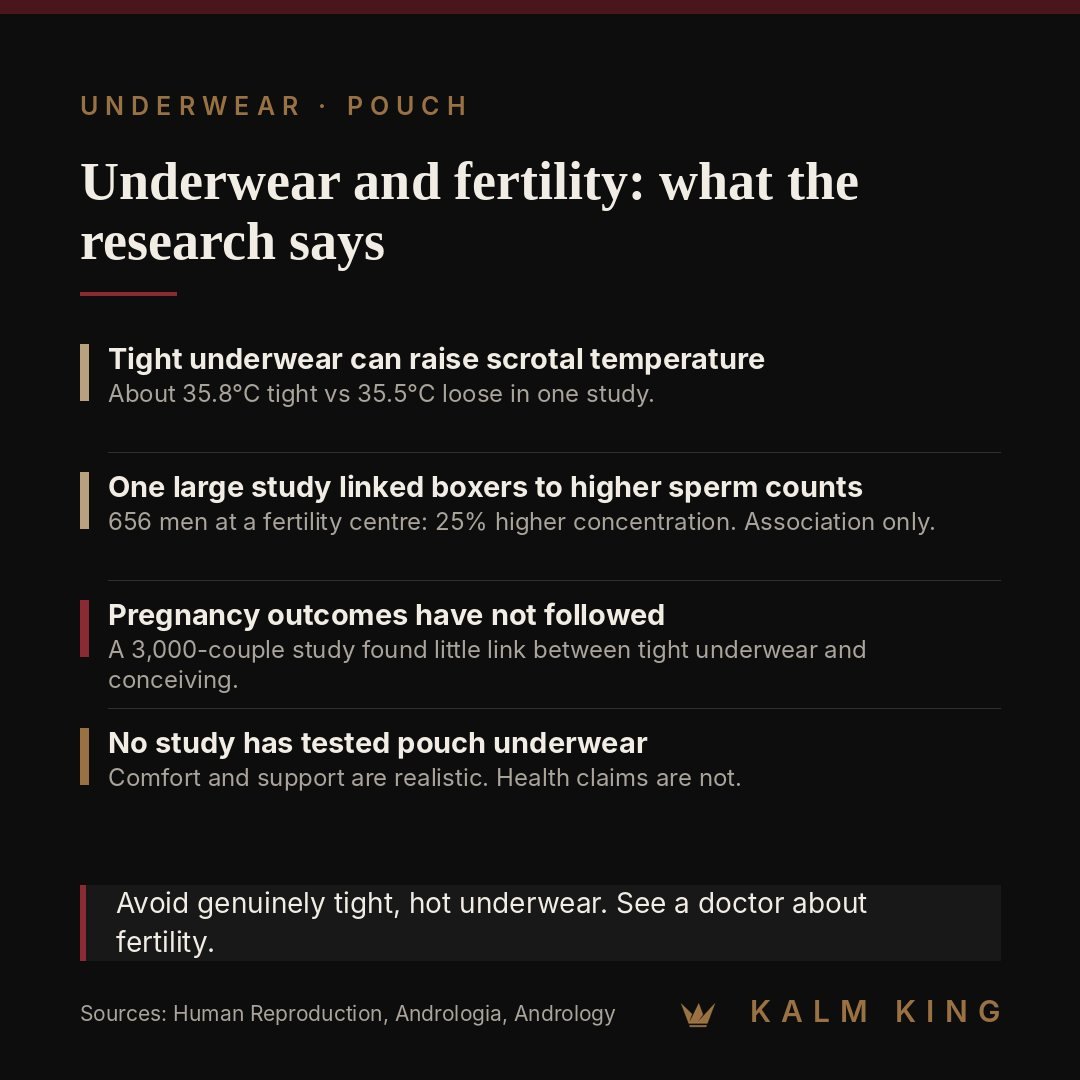
You’ll see pouch and “cooling” underwear linked to sperm health. The underlying science is real but limited, and it’s mostly about tightness, not pouches.
- Tight underwear can raise scrotal temperature. A review in Andrologia by Jung and colleagues reported higher scrotal temperatures with tight-fitting underwear than loose-fitting or no underwear, about 35.8°C versus 35.5°C and 35.2°C in one study. The same review concluded that a negative effect of tight underwear on semen quality was “not convincing” in the available evidence.
- Looser underwear was linked to higher sperm counts in one large study. Research led by the Harvard T.H. Chan School of Public Health, published in Human Reproduction in 2018, found that among 656 men at a fertility centre, those who mostly wore boxers had 25% higher sperm concentration and 17% higher total sperm count than men who didn’t. It was a cross-sectional study, which shows an association, not cause and effect.
- Pregnancy outcomes haven’t followed. A 2026 narrative review in PubMed Central concluded that studies looking at fertility endpoints rather than semen measurements haven’t shown a clear benefit of switching to looser underwear, and that underwear choice alone is unlikely to be a dominant factor in male fertility for men with otherwise normal reproductive function. A preconception study of more than 3,000 couples trying to conceive, published in Andrology, found little association between tight-fitting underwear and the chance of conceiving each cycle.
None of these studies tested pouch underwear specifically. The honest summary: avoid underwear that’s genuinely tight and hot if you’re trying for a baby, and talk to a doctor if fertility is a concern. Don’t buy any underwear expecting it to fix fertility.
It won’t fix a bad fit elsewhere
A great pouch on underwear that’s the wrong size will still ride up, roll down or dig in. The pouch is only one part of the fit.
It’s not one-size-fits-all
Because most brands still size by waist, a pouch that’s roomy for one man may be tight or loose for another with the same waist. You may need to try more than one brand.
How Pouch Underwear Should Fit
The pouch
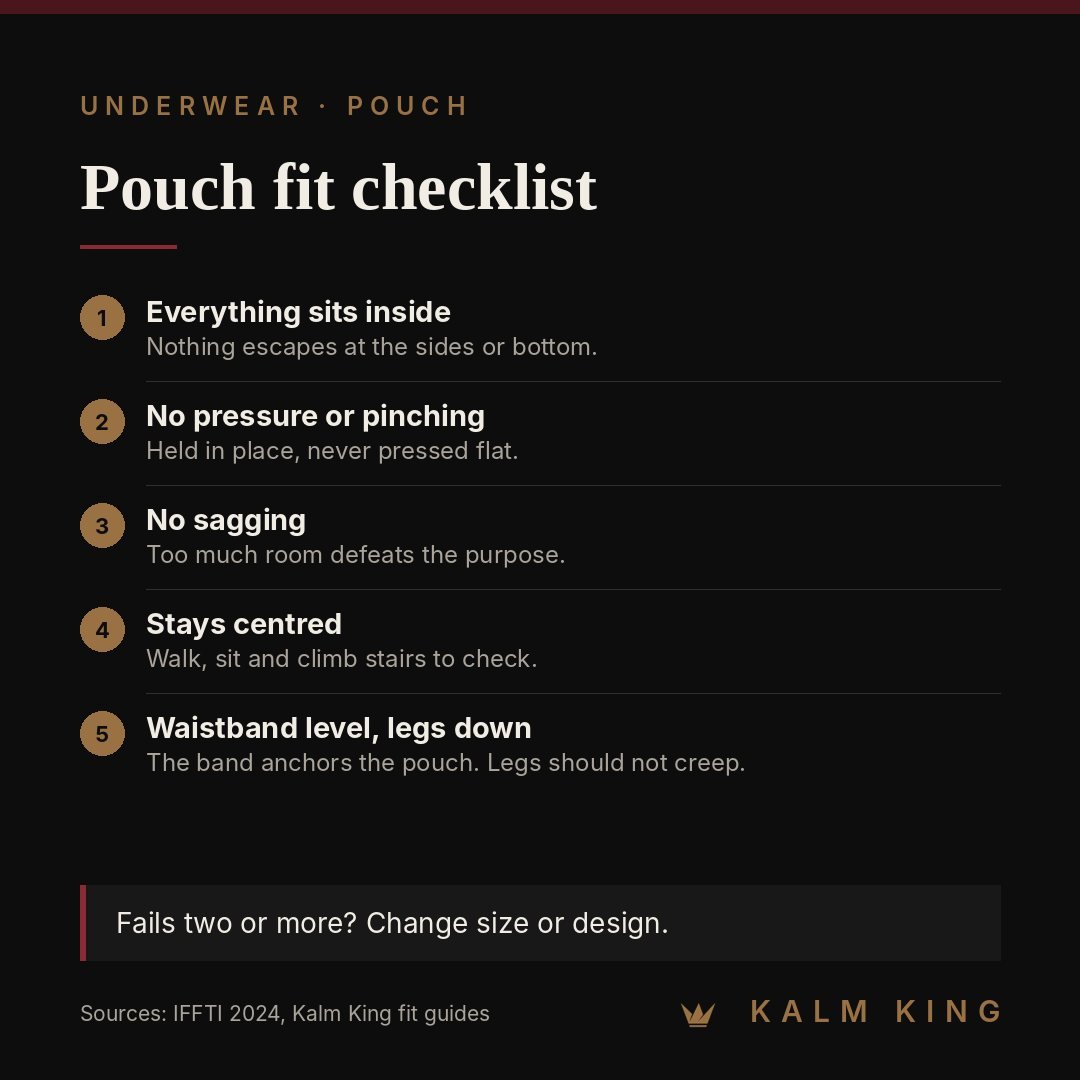
- Everything sits inside the pouch without spilling out of the sides or bottom.
- No pressure points. You shouldn’t feel squeezed, pinched or pressed flat.
- No sagging. A pouch that’s far too big lets things swing and defeats the purpose.
- It stays centred when you walk, sit and climb stairs.
The waistband
The waistband anchors the pouch. If it’s too loose, the whole front drops and the pouch stops supporting. If it’s too tight, it digs in and can roll. It should sit flat and stay level without leaving deep marks. If yours folds over, our guide to why underwear waistbands roll down explains the usual causes.
The legs
In boxer briefs and trunks, the legs should lie flat against your thighs and stay in place. If they creep up, that’s a sizing or cut problem, not a pouch problem. Our guide on how to stop boxer briefs from riding up goes through the fixes.
The size
Start with your waist measurement and the brand’s chart, then judge the pouch on top of that. Our men’s underwear size chart explains how to measure and what to do if you’re between sizes, and our guide to how boxer briefs should fit covers the full fit check.
Fabric Matters as Much as Shape
The fabric decides how the pouch feels against your skin and how it handles sweat.
- Cotton is breathable and soft but holds moisture once it’s wet.
- Modal and other viscose fabrics feel smooth and cool and drape well, which suits a shaped front. Our guide to what modal fabric is explains why it’s popular in underwear.
- Polyester and nylon blends wick sweat and dry quickly, which is why they’re common in sport and travel underwear.
- Elastane (also called spandex) gives the stretch that lets a pouch hold its shape without squeezing. Most pouch underwear includes some.
- Mesh panels add airflow, often on the sides of a pouch or in the gusset.
For a full comparison, see our guide to the best underwear material for men.
Which Styles Come With a Pouch?
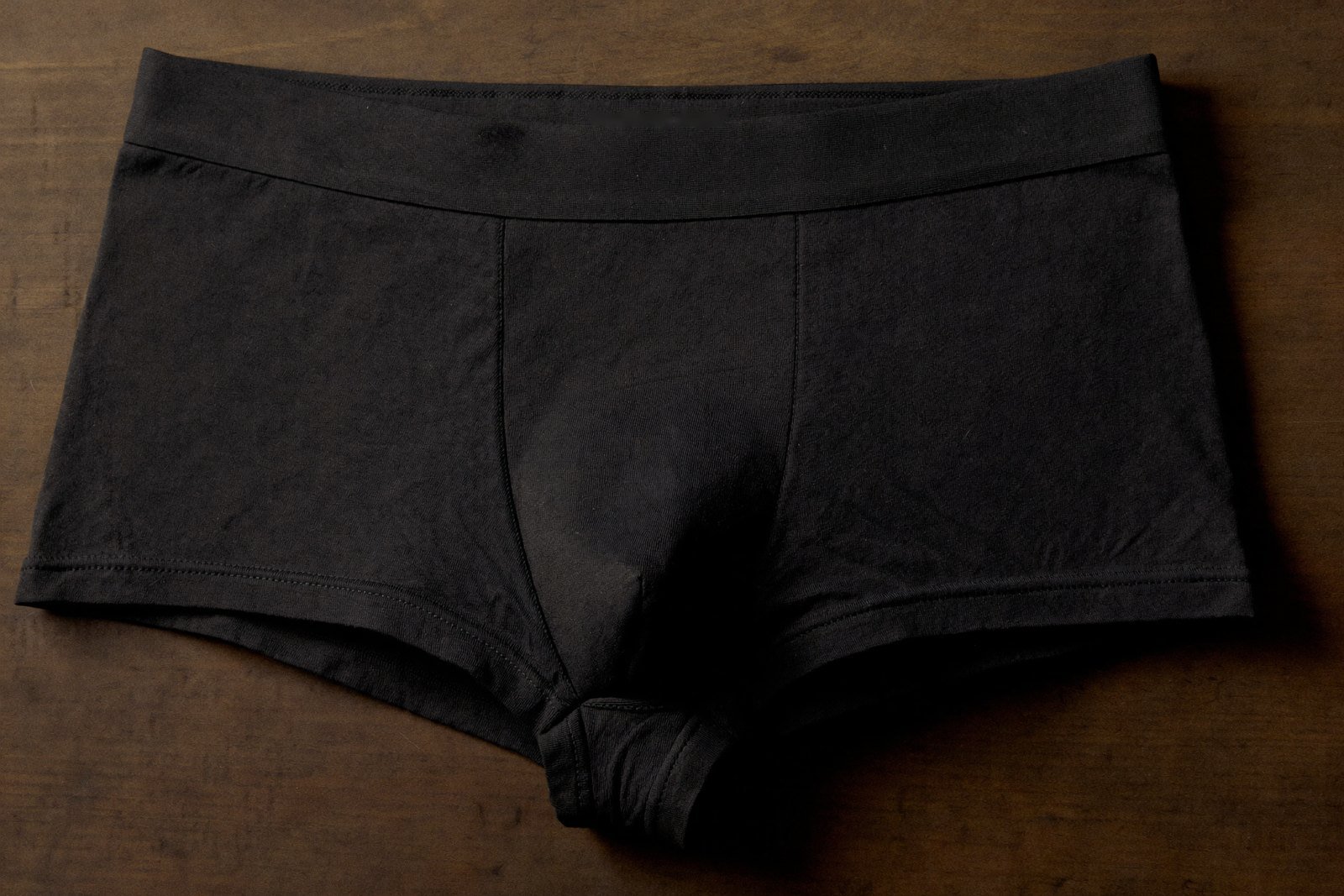
Pouches show up across most cuts:
- Boxer briefs: the most popular home for a pouch, with legs that also help with chafing.
- Trunks: shorter legs and a lower rise, with a contoured pouch for a neater front.
- Briefs: no legs, but a shaped pouch gives more room than a classic flat-front brief.
- Long boxer briefs: longer legs for sport, travel and men who chafe.
- Loose boxers: rarely have a pouch, because there’s nothing to hold it in place.
Not sure which cut suits you? Our guide to briefs vs trunks vs boxer briefs compares them.

Troubleshooting: Signs Your Pouch Doesn’t Fit
If something feels off, the problem usually points to a specific fix.
| What you notice | Likely cause | What to try |
|---|---|---|
| Pressure or pinching at the front | Pouch too small, or waist size too small | Go up a size, or try a brand with a deeper contoured pouch |
| Things slipping out at the sides | Pouch too shallow or too narrow | Try a separate pouch with side panels |
| Swinging or sagging | Pouch too big for you, or waistband too loose | Try a smaller pouch design or check your waist size |
| Pouch slides off-centre | Waistband not holding, or legs riding up | Check the waist fit and choose a cut with grippier leg openings |
| Seam rubs or irritates | Seam placement or thick stitching | Look for flat or bonded seams, or a pouch without a centre seam |
| Skin still sticks to thighs | Pouch doesn’t separate, or fabric stays damp | Try side-panel designs and a wicking fabric |
| Feels too hot | Thick fabric or too much compression | Try lighter modal, mesh panels or a looser pouch |
Choosing a pouch when brands only size by waist
Because almost every brand still sizes by waist, finding the right pouch takes a little detective work:
- Measure your waist where your underwear sits, usually a little below your belly button, and start with the brand’s matching size.
- Read how the pouch is described. Words like “contour,” “enhanced,” “separating” and “sling” usually signal different designs, not just different marketing.
- Check the photos for the seams. A single curved centre seam usually means a subtle contoured pouch. A separate panel or a visible inner band means more structure.
- Buy one pair first. Wear it for a full day before you buy a set.
- Keep notes. Once you find a pouch that works, note the brand, cut and size. Pouch shapes vary far more between brands than waist sizes do.
Pouch Underwear for Different Days
The same design doesn’t suit every situation. Many men end up with a small rotation.
- Office and everyday wear: a contoured pouch in breathable cotton or modal looks neat under trousers and feels unremarkable all day.
- Training and sport: a more structured pouch in a wicking blend, with a longer leg, keeps everything secure while you move.
- Travel and long days on your feet: a quick-drying fabric and a pouch that separates from the thighs make the biggest difference after hours of walking.
- Hot weather: lighter fabrics and mesh side panels help skin stay drier.
- Sleep: many men prefer something looser and less structured at night.
Who Will Notice the Difference Most?
Pouch underwear is worth trying if you:
- Find yourself adjusting through the day
- Sweat a lot, or live or work somewhere hot
- Get thigh chafing or skin sticking in the groin
- Walk, run, cycle or train a lot
- Feel squashed in standard flat-front underwear
- Find standard underwear too loose at the front
If your current underwear is comfortable all day and you never think about it, there’s no need to change.
Common Mistakes When Buying Pouch Underwear
- Sizing down for “more support.” A smaller waist doesn’t make the pouch fit better. It makes the waistband dig and the legs ride up.
- Judging it in the first five minutes. Wear it for a full day, including sitting and walking, before deciding.
- Assuming all pouches are the same. A contoured pouch, a side-panel pouch and an internal sling feel very different.
- Ignoring the fabric. A good shape in a fabric that stays damp will still feel uncomfortable.
- Believing medical claims. Comfort and support are realistic. Health claims need evidence.

How to Care for Pouch Underwear
Shaped fronts and stretch fabrics last longer with gentle care:
- Wash on a cool or warm cycle according to the label.
- Avoid very hot washes and high dryer heat, which wear out elastane.
- Skip fabric softener on wicking fabrics, which can coat the fibres.
- Air dry where you can, or tumble on low.
- Replace pairs once the waistband stretches out or the pouch loses its shape.
Our guide on how to wash men’s underwear covers it in detail.
The Kalm King Take
The front of a pair of underwear is the part men think about most and talk about least. A well-built pouch is simply good design: it gives your body the space it actually needs, holds it there, and lets you forget about it.
What it isn’t is a miracle. Be wary of underwear that promises health outcomes. Look for honest construction instead: a shaped front, a waistband that stays put, a leg that covers your thighs and a fabric that handles sweat. That’s the standard we’re holding ourselves to as we develop our own essentials. If you want to hear about them first, along with practical fit and care notes, join Field Notes.
Frequently asked questions
What is pouch underwear for?
Pouch underwear has a shaped front pocket that holds the penis and testicles in place instead of pressing them flat. Most men wear it to reduce shifting and readjusting, cut down on skin-on-skin contact with the thighs, and get support from shape rather than compression.
Is pouch underwear better than regular underwear?
It depends on your body and your day. Many men find a pouch more comfortable and more secure, especially in heat or during activity. If your current underwear is comfortable all day and doesn’t need adjusting, a pouch may not make much difference.
What is ball hammock underwear?
“Ball hammock” is a marketing name for underwear with an internal sling, a band of fabric or mesh inside the front that cradles the testicles and lifts them slightly forward. It gives firmer support than a simple contoured pouch. Some men like it, while others find the internal band noticeable.
Does pouch underwear help with chafing?
It can help with chafing in the groin, especially designs with side panels that keep the genitals off the thighs. For inner-thigh chafing, leg length and fabric matter more. Choose boxer briefs with a leg long enough to cover the area where your thighs rub, in a fabric that wicks sweat.
Is pouch underwear good for fertility?
There’s no good evidence that pouch underwear improves fertility. Tight underwear can slightly raise scrotal temperature, and one large study linked boxers with higher sperm counts, but studies of pregnancy outcomes haven’t shown a clear benefit from switching. If fertility is a concern, avoid very tight underwear and speak to a doctor.
How should pouch underwear fit?
Everything should sit inside the pouch with no pinching, squeezing or sagging, and the pouch should stay centred when you move. The waistband should sit flat and level, and the legs should stay down. Choose your size by waist measurement first, then judge the pouch.
Can you wear pouch underwear every day?
Yes. Most pouch underwear is designed as everyday wear, not just for sport. Choose a breathable fabric for daily use and a wicking fabric for heat or training.
Sources
- Mínguez-Alarcón et al., Type of underwear worn and markers of testicular function among men attending a fertility center, Human Reproduction (2018) (peer-reviewed study)
- Harvard T.H. Chan School of Public Health: Boxers or briefs? Loose-fitting underwear may benefit sperm production (university press release)
- Jung et al., Influence of genital heat stress on semen quality in humans, Andrologia (2007) (peer-reviewed review)
- Garment fit, scrotal thermoregulation, and male fertility outcomes: a narrative review (PMC13263833) (peer-reviewed review)
- McKinnon et al., Male personal heat exposures and fecundability: a preconception cohort study, Andrology (PMC9588744) (peer-reviewed study)
- IFFTI 2024 Proceedings: Men's Intimates Apparel, Development of a Sizing System to Align With the Needs of Consumers of the Men's Underwear Market (academic conference paper, PDF)
- Wirecutter: The Best Men's Boxer Briefs (independent product testing)
- Cleveland Clinic: Chafing (medical centre)
FIELD NOTES
Get the Overalls Fit Kit, free.
Your measurement card, the six fit checkpoints and a checklist to take shopping. Join Field Notes for new guides and a say in what Kalm King makes.
THE KALM KING JOURNAL
Continue reading
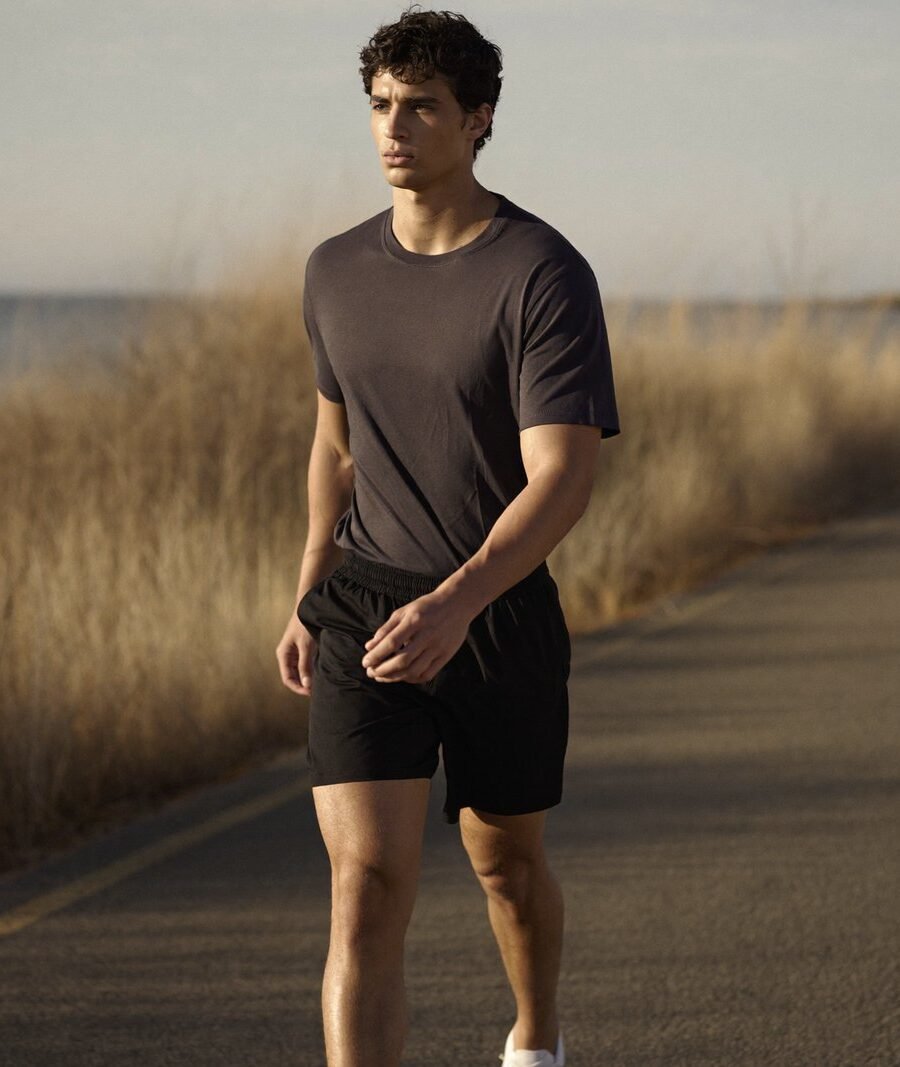
How to Prevent Thigh Chafing for Men
Stop thigh chafing before it starts: the layers, fabrics, balms and habits that keep your inner thighs comfortable, plus how to treat a rub that’s already sore.
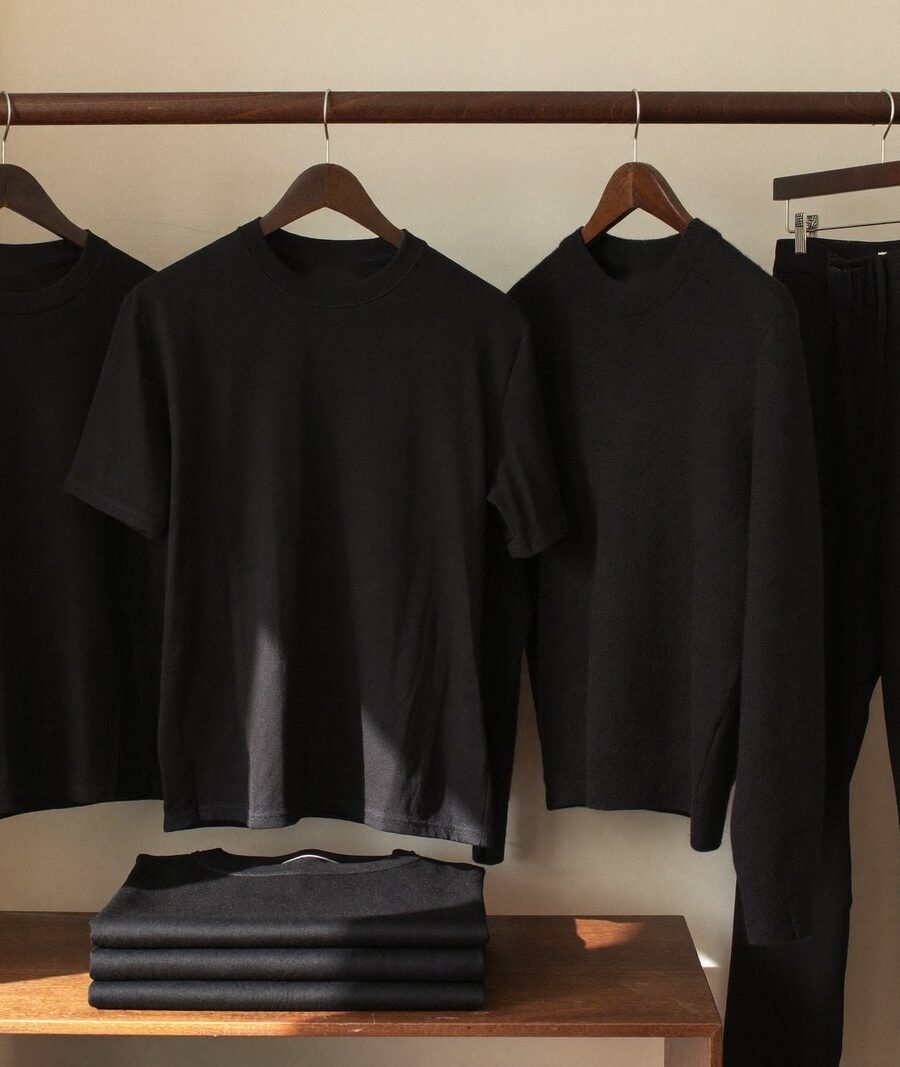
How to Keep Black Clothes From Fading
Black clothes fade from dye loss, friction, heat and sun. Here’s how to wash, dry and store black so it stays black, and what to do when it’s already gone grey.
How to Measure Neck Size for a Dress Shirt
Measure your neck size for a dress shirt in two minutes: where the tape goes, how much room to add, how to read collar sizes, and how a collar should fit.